Embedded Metadata vs Sidecar Files: Which XMP Approach to Use
Embedded metadata lives inside the file itself, while sidecar files store metadata externally in a companion .xmp file. Each approach has real tradeoffs around portability, file integrity, format compatibility, and workflow complexity. This guide compares them head to head and provides a decision framework based on your file formats, sharing needs, and preservation goals.


What Embedded Metadata and Sidecar Files Actually Are
Before choosing between these two approaches, you need to understand what each one does at a technical level.
Embedded metadata is written directly into the file's binary structure. JPEG files store it in APP1 and APP13 segments. TIFF files use IFD (Image File Directory) entries. PDFs carry XMP in a dedicated metadata stream. When you tag a JPEG with copyright info in Adobe Bridge or add keywords in Lightroom, that data gets written into the file itself. Move the file anywhere, email it, upload it to a stock library, and the metadata travels with it.
Sidecar files store metadata in a separate companion file that sits alongside the original. The most common format is XMP, where a file named DSC_0123.NEF gets a companion DSC_0123.xmp. The sidecar contains the same RDF/XML-based XMP data that would otherwise be embedded, but the original file stays completely untouched.
Adobe created XMP (Extensible Metadata Platform) in 2001 and it became ISO standard 16684-1 in 2012 (current revision: ISO 16684-1:2019). XMP uses a subset of W3C RDF/XML, which means any software that reads XML can parse it. The standard supports both storage methods, and most professional tools let you choose between them.
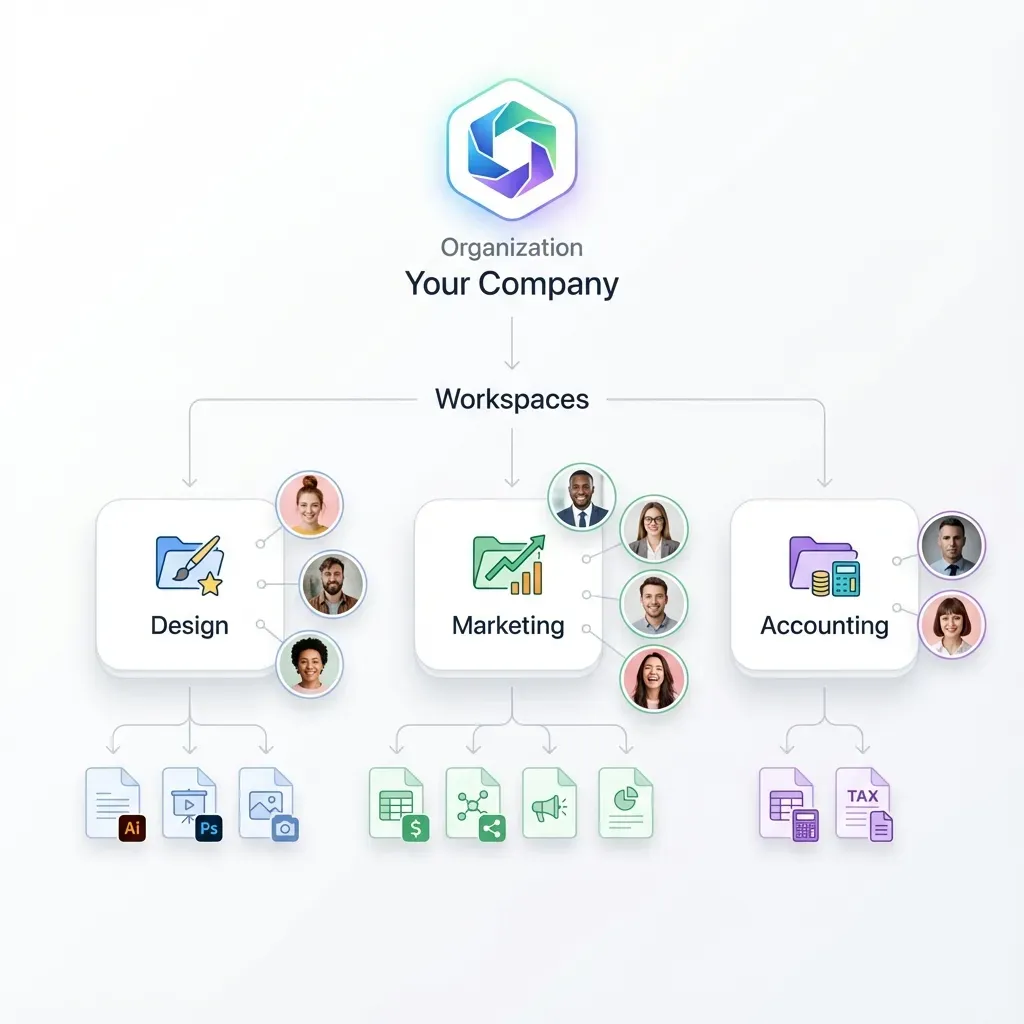
The distinction matters because it affects everything downstream: how you back up files, how metadata survives sharing workflows, whether your original files stay byte-identical over time, and which software can read what you wrote. Whichever approach you pick, Fastio's workspaces keep both originals and sidecars together with team collaboration and AI-driven metadata extraction layered on top.
Related guides
- How to Extract Metadata from RAW Camera Files (CR2, NEF, ARW)RAW camera files like Canon CR2, Nikon NEF, and Sony ARW store far richer metadata than JPEGs, including proprietary...
- How to Extract Metadata from TIFF Image FilesTIFF files carry more metadata than most image formats, from standard EXIF camera data to GeoTIFF spatial coordinates...
- How to Edit and Extract XMP Metadata from Any FileXMP (Extensible Metadata Platform) is the ISO standard for embedding structured metadata in files like PDFs, images,...
- How to Extract Metadata from Font Files (TTF, OTF, WOFF)Font files carry a surprising amount of metadata in their OpenType name tables, from designer attribution and foundry...
- Dublin Core vs XMP vs IPTC: Choosing the Right Metadata StandardDublin Core, XMP, and IPTC each solve a different metadata problem. Dublin Core catalogs resources across libraries and...
- 8 Best Batch Metadata Editing Tools in 2026Batch metadata editing software lets you modify embedded file properties like titles, dates, tags, and copyright across...
More on this subject: Agent File and Document Workflows (325 guides)
How Each Approach Works Under the Hood
Embedded XMP gets inserted into a format-specific container within the file. In a JPEG, the XMP packet sits in an APP1 marker segment (separate from the EXIF APP1 segment). In a PDF, it occupies a metadata stream object. In an MP4, it goes into a uuid atom. The file size increases slightly, typically by a few kilobytes for standard descriptive metadata, though files with extensive edit histories can accumulate larger XMP packets.
When you edit embedded metadata, the tool rewrites part of the file. Well-designed tools like ExifTool use padding bytes within the XMP packet so minor edits don't require rewriting the entire file. But any write operation modifies the original, which changes the file's checksum and last-modified timestamp.
XMP sidecar files are standalone XML documents. Here is what a minimal sidecar looks like:
<?xpacket begin="" id="W5M0MpCehiHzreSzNTczkc9d"?>
<x:xmpmeta xmlns:x="adobe:ns:meta/">
  <rdf:RDF xmlns:rdf="http://www.w3.org/1999/02/22-rdf-syntax-ns#">
    <rdf:Description rdf:about=""
      xmlns:dc="http://purl.org/dc/elements/1.1/"
      xmlns:xmp="http://ns.adobe.com/xap/1.0/">
      <dc:creator><rdf:Seq><rdf:li>Jane Smith</rdf:li></rdf:Seq></dc:creator>
      <dc:rights><rdf:Alt><rdf:li xml:lang="x-default">© 2026 Jane Smith</rdf:li></rdf:Alt></dc:rights>
      <xmp:Rating>4</xmp:Rating>
    </rdf:Description>
  </rdf:RDF>
</x:xmpmeta>
<?xpacket end="w"?>
The sidecar is just text. Edit it with ExifTool, Adobe Bridge, Lightroom, Capture One, darktable, or even a plain text editor. The original file's bytes never change, so its checksum stays identical from the moment of creation.
Naming convention is critical for sidecars. The standard pairing is same base name, different extension: photo.cr3 pairs with photo.xmp. Most software expects this convention. If the names get out of sync (someone renames one file but not the other), the link breaks and the metadata is effectively orphaned.
Head-to-Head Comparison
Here is how embedded metadata and sidecar files stack up across the dimensions that matter most for real workflows.
Portability
Embedded wins. A single file carries everything. Upload it, email it, sync it to cloud storage, and the metadata arrives intact. Sidecar files require you to move two files together. Many file transfer tools, email clients, and cloud sync services don't understand the relationship between a RAW file and its .xmp companion. Zip the pair before sharing, or risk losing the sidecar.
File integrity
Sidecar wins. The original file is never modified. For archival workflows where bit-level preservation matters, this is the deciding factor. Institutions like museums, libraries, and forensic labs often require that original files remain unchanged after ingest. Sidecars make that possible while still allowing metadata to evolve over time.
Format support
Embedded XMP works with JPEG, TIFF, PNG, DNG, PDF, PSD, AI, MP4, MOV, MP3, WAV, and WebP. But many proprietary RAW formats (Canon CR2/CR3, Nikon NEF/NRF, Sony ARW, Fuji RAF) have limited or no support for embedded XMP. Adobe Lightroom Classic creates XMP sidecar files automatically for these RAW formats precisely because embedding is unreliable or impossible.
Editability
Sidecar is easier to edit safely. Since you are working with a plain XML file, there is zero risk of corrupting the image data. Embedded edits carry a small but nonzero risk: a bug in the writing tool, a crash mid-write, or an unexpected format quirk can damage the host file. In practice this is rare with mature tools like ExifTool, but it is a consideration for irreplaceable originals.
Tool compatibility
Both approaches are widely supported, but with different coverage. Adobe Lightroom, Bridge, Capture One, darktable, digiKam, and ExifTool all handle sidecars. For embedded metadata, support is near-universal across image viewers, stock libraries, social media platforms, and DAM systems. The practical difference: embedded metadata is readable by more tools out of the box, while sidecar support is concentrated in professional photo and DAM software.
Batch workflows
Sidecar scales better for bulk operations. If a computer vision model re-analyzes ten thousand images, writing results to sidecar files avoids touching the originals entirely. You can regenerate, replace, or version the sidecar files without any risk to the source assets.
Storage overhead
Negligible for both. A typical XMP sidecar is 2 to 10 KB. Embedded XMP adds a similar amount to the host file. For a library of 50,000 images, the total sidecar overhead is roughly 100 to 500 MB.


Extract and Query File Metadata at Scale
Whether your metadata is embedded or in sidecar files, Fastio's Metadata Views turns documents into a live, queryable database. Describe the fields you want, and the AI handles the rest. Start 14-day trial.
Format-by-Format Recommendations
The right choice depends partly on what file format you are working with. Here is a breakdown by format category.
JPEG, TIFF, and DNG
Embed your metadata. These formats have mature, well-tested support for internal XMP. Every major tool can read and write embedded XMP in these formats. Since JPEGs and TIFFs are typically delivery files (not originals you need to preserve bit-for-bit), the slight modification from embedding is a nonissue. DNG is a special case: Adobe designed it specifically to hold embedded metadata, and it is one of the few RAW formats where embedding works reliably.
Proprietary RAW (CR2, CR3, NEF, ARW, RAF, ORF, RW2)
Use sidecar files. These formats were not designed with standardized metadata containers, and writing into them risks corruption or data loss. This is exactly why Lightroom Classic generates .xmp sidecars for RAW files by default. Capture One, darktable, and RawTherapee follow the same pattern.
Embed. PDF has a dedicated XMP metadata stream defined in the ISO 32000 specification. Tools like ExifTool, Adobe Acrobat, and various PDF libraries can write XMP directly. Since PDFs are typically shared as self-contained documents, embedded metadata makes more sense than sidecars.
Video (MP4, MOV, MXF)
It depends on the workflow. MP4 and MOV support embedded XMP in a uuid atom, and consumer tools handle it reasonably well. But in professional post-production, sidecar approaches are common because video files are large, frequently in transit between editing stations, and modified by multiple tools. The MXF format used in broadcast natively supports extensive embedded metadata through its KLV (Key-Length-Value) structure.
Audio (MP3, WAV, FLAC)
Embed for distribution. Audio files have well-established tag systems (ID3 for MP3, Vorbis comments for FLAC, BWF chunks for WAV) that overlap with XMP capabilities. For archival master recordings, sidecars keep the original waveform untouched.

Choosing the Right Approach for Your Workflow
Most real-world metadata strategies use both approaches. The question is when to use which.
Use embedded metadata when:
- Files will be shared individually (email, cloud upload, stock submission)
- Recipients need to read metadata without specialized tools
- You are working with JPEG, TIFF, DNG, or PDF formats
- Simplicity matters more than bit-level preservation
- Files pass through systems that might strip companion files
Use sidecar files when:
- You are working with proprietary RAW formats
- Original file integrity is a hard requirement (archives, forensics, legal evidence)
- Automated systems generate or update metadata in bulk
- Multiple applications need to write metadata without conflicting
- You want to version or roll back metadata changes independently of the file
The hybrid approach most photographers use: Keep sidecars for RAW originals in your working library. When you export JPEGs or TIFFs for delivery, embed the metadata into those output files. This gives you non-destructive editing on your masters and portable metadata on your deliverables.
For teams managing large file collections, the challenge shifts from storage method to extraction and querying. Knowing that metadata exists inside files (or beside them) is only half the problem. The other half is pulling structured fields out at scale and making them searchable.
This is where tools like Fastio's Metadata Views become relevant. Rather than manually inspecting embedded XMP or parsing sidecar files one at a time, Metadata Views lets you describe the fields you want extracted in plain language. The system designs a typed schema, scans matching files in your workspace, and populates a sortable, filterable spreadsheet. It works across PDFs, images, Word docs, spreadsheets, and scanned pages, regardless of whether the source metadata is embedded or stored externally.
For teams that manage both embedded and sidecar metadata across mixed format libraries, having a unified extraction layer eliminates the need to standardize on a single storage method. You can keep sidecars for your RAW archives and embedded metadata for your delivery files, then query both through the same interface.
Avoiding Common Sidecar Pitfalls
Sidecar files introduce specific failure modes that you need to plan.
Broken file pairing. If someone renames photo.cr3 to client_final.cr3 but leaves photo.xmp unchanged, the link is gone. Enforce naming discipline through folder structure and DAM software rather than relying on manual renaming. Tools like digiKam and Lightroom track the pairing internally, but if you move files outside the application, the sidecar must follow.
Cloud sync gaps. Some cloud storage services filter out small companion files or sync them separately from the parent. Test your sync tool by uploading a RAW file with its .xmp sidecar and verifying both arrive. Google Drive, Dropbox, and OneDrive generally preserve companion files, but automated backup tools with file-type filters might skip .xmp files.
Backup blind spots. Backup scripts that target specific extensions (.jpg, .cr3, .nef) might miss .xmp files entirely. Include *.xmp in your backup inclusion rules. Better yet, back up entire directories rather than filtering by extension.
Conflicting sidecar writes. If two applications write to the same sidecar simultaneously, one will overwrite the other's changes. This is rare in single-user workflows but becomes a real issue in shared environments. When multiple editors work on the same file collection through a shared workspace, file locking helps them coordinate writes to the same metadata.
Migration between systems. When moving from one DAM to another, confirm that the new system reads sidecars in the format your old system wrote. Most tools follow the Adobe XMP specification, but some (like Capture One) store additional proprietary data in their own sidecar format alongside the standard .xmp file. Test with a small batch before migrating your full library.
Sources
References used to verify factual claims in this guide.
-
Adobe created XMP in 2001 and it became ISO standard 16684-1 in 2012
-
Adobe Lightroom Classic creates XMP sidecar files automatically for RAW formats that don't support embedded XMP
-
XMP sidecar files are computer files that store metadata not supported by the format of a source file
Frequently Asked Questions
What is the difference between embedded metadata and sidecar files?
Embedded metadata is stored directly inside the file's binary structure, in format-specific containers like JPEG APP1 segments or PDF metadata streams. Sidecar files store the same metadata externally in a companion file (typically with an .xmp extension) that sits alongside the original. Embedded metadata travels with the file automatically, while sidecar files must be kept paired with their parent file through consistent naming and folder structure.
When should I use XMP sidecar files?
Use XMP sidecar files when working with proprietary RAW camera formats (Canon CR2/CR3, Nikon NEF, Sony ARW) that don't reliably support embedded XMP, when original file integrity is a hard requirement for archival or forensic purposes, or when automated systems need to generate and update metadata in bulk without touching source files. Adobe Lightroom Classic creates sidecar files automatically for RAW formats that lack embedded XMP support.
Do sidecar files get lost when sharing?
They can. Sidecar files are separate from the parent file, so email clients, messaging apps, and some cloud transfer tools may not include them automatically. If you share a RAW file without its .xmp companion, the recipient won't see your ratings, keywords, edits, or other metadata. Zip the file pair before sharing, or embed the metadata into an exported JPEG or TIFF for delivery.
Which metadata storage method is better for archiving?
Sidecar files are generally better for long-term archiving because they never modify the original file. Archives, museums, and forensic labs often require bit-level preservation of original assets, and sidecars satisfy that requirement while still allowing metadata to be added, corrected, or expanded over time. For delivery copies (JPEG, TIFF, PDF), embedding metadata is safer because it ensures the metadata stays with the file regardless of how it is stored or transferred.
Can I use both embedded metadata and sidecar files at the same time?
Yes, and most professional photographers do exactly this. The standard workflow keeps sidecar files for RAW originals in the working library (so masters remain untouched), then embeds metadata into exported JPEG or TIFF deliverables (so recipients get self-contained files). Tools like ExifTool can also copy metadata from a sidecar file into the embedded XMP of a supported format, or extract embedded metadata into a sidecar for archival.
Does Fastio support metadata extraction from files?
Yes. Fastio's Metadata Views feature lets you describe the fields you want extracted in natural language, then automatically extracts structured data from PDFs, images, Word docs, spreadsheets, and scanned pages into a sortable, filterable spreadsheet. This works regardless of whether the source metadata is embedded or stored in sidecar files, giving teams a unified extraction layer across mixed format libraries.
Related Resources

Extract and Query File Metadata at Scale
Whether your metadata is embedded or in sidecar files, Fastio's Metadata Views turns documents into a live, queryable database. Describe the fields you want, and the AI handles the rest. Start 14-day trial.