How to Create a Direct Download Link for Any File
A direct download link (DDL) triggers your browser's download immediately when clicked, skipping preview pages and landing screens. This guide covers manual URL modifications for Google Drive and Dropbox, explains their limitations, and shows how professional file delivery platforms handle direct downloads by default.

What is a Direct Download Link?
A direct download link is a URL that hands the file to your browser's download manager immediately: no preview page, no landing screen, no extra clicks. When you click it, the download starts.
This matters in several situations. If you're sharing a PDF and recipients have to click through a preview page first, some percentage won't bother. If you're downloading files programmatically with curl or wget, preview pages break the script entirely, because automated tools can't click through web interfaces. If you're embedding an image or video on a website, the URL has to point to the actual file, not a landing page. If you're distributing software updates, your installer needs to receive file bytes, not a Dropbox branding page.
Consumer cloud storage services default to preview pages for their own reasons: showing branding, prompting sign-ups, displaying ads. Those goals don't align with professional file delivery, which is why this workaround exists.
Helpful references: Fastio Workspaces, Fastio Collaboration, and Fastio AI.
Related guides
- 5 Best No Signup File Sharing Services (2026 Review)No signup file sharing services let you upload and share files instantly without creating an account, reducing friction...
- How to Bypass the Outlook File Size LimitOutlook's file size limit restricts email attachments to 20-25MB for most accounts, preventing users from sending large...
- How to Send Files Larger Than 25MB in GmailGmail's 25MB attachment limit blocks billions of file transfers every day. Whether you're sending video footage, design...
- 7 Best Send Anywhere Alternatives for Secure File Transfer in 2026Send Anywhere popularized 6-digit key transfers for quick, device-to-device sharing. But its reliance on peer-to-peer...
- How to Set Up an Automated Cloud File Import WorkflowMost teams still copy files between cloud providers by hand, burning hours on repetitive work that breaks silently when...
- How to Implement Cloud File Transfer for EnterprisesGuide to cloud file transfer enterprises: Enterprise file transfer changes once you hit high volumes like several...
More on this subject: File Sharing (155 guides)
How to Create Google Drive Direct Download Links
Google Drive share links open a preview page by default. You can modify the URL structure to create a direct link, but there are important limitations to understand before relying on this method.
Step-by-Step
1. Get the shareable link
Right-click your file in Google Drive and select "Get link." Make sure the sharing permission is set to "Anyone with the link." Your link will look like this:
https://drive.google.com/file/d/1AbCdEfGhIjKlMnOpQrStUvWxYz/view?usp=sharing
2. Extract the File ID
The long string between /d/ and /view is your File ID. In the example above, it is 1AbCdEfGhIjKlMnOpQrStUvWxYz.
3. Construct the direct URL
Replace the entire URL with this format:
https://drive.google.com/uc?export=download&id=YOUR_FILE_ID
Using the example File ID:
https://drive.google.com/uc?export=download&id=1AbCdEfGhIjKlMnOpQrStUvWxYz
This URL will download the file directly when clicked.
Limitations
Virus scan interruption: For files larger than approximately 100MB, Google cannot complete its virus scan. Instead of a direct download, users see a warning page asking them to confirm the download. This breaks automation and adds friction even for legitimate large files. As of early 2026, this 100MB threshold remains in effect.
Bandwidth quotas: Google Drive imposes download limits based on file popularity. If too many people download your file in a short period, Google blocks access with a "you can't view or download this file" error. There is no warning before it happens and no documented limit to avoid.
Google Docs limitation: This method only works for uploaded files. Documents created natively in Google Docs, Sheets, or Slides cannot be converted to direct download links because they do not exist as discrete files on Drive.
Link stability: Google has changed its URL structure in the past without notice, breaking direct links that previously worked.
How to Create Dropbox Direct Download Links
Dropbox direct links are simpler to create than Google Drive links, but they come with their own restrictions.
Method 1: Change the Query Parameter
Dropbox share links end with ?dl=0 by default. Changing this to ?dl=1 triggers a direct download.
Standard share link:
https://www.dropbox.com/s/abc123xyz/document.pdf?dl=0
Direct download link:
https://www.dropbox.com/s/abc123xyz/document.pdf?dl=1
This works immediately with no other changes required.
Method 2: Use the Content Domain
For more reliable direct downloads, replace the domain:
Standard domain:
https://www.dropbox.com/s/abc123xyz/document.pdf?dl=0
Content domain:
https://dl.dropboxusercontent.com/s/abc123xyz/document.pdf
The dl.dropboxusercontent.com domain serves files directly without any preview interface.
Limitations
Bandwidth throttling: Dropbox Basic accounts are limited to 20GB of daily shared link bandwidth with up to 100,000 file downloads per day. Paid plans (Plus, Professional, Business) get 1TB of daily bandwidth, and higher tiers get more. If a file on a Basic account gets popular, Dropbox suspends access until the next calendar day with no warning.
Link expiration: Team account administrators can set link expiration dates, but managing expiration per-link requires manual oversight.
No analytics: Basic Dropbox accounts provide no visibility into who accessed your files or when.
Format inconsistencies: Some file types may trigger browser rendering instead of downloading even with the direct link parameters. This varies by browser and file extension.
Why Manual URL Modifications Fall Short
Creating direct download links through URL modification solves the immediate problem but introduces new ones for anyone sharing files at any volume.
Fragile by design: Consumer cloud storage services are built for personal backup and sync, not file distribution. When you modify their URLs to bypass preview pages, you are working against the product's design. Those workarounds break when the service updates its URL structure, and you have no recourse when they do.
No control after sharing: Once you send a modified Google Drive or Dropbox link, you lose control. You cannot revoke just that link, see who downloaded the file, limit downloads to a time window, or restrict access by geography.
Link appearance: A URL containing dropboxusercontent.com or drive.google.com/uc?export=download looks like a workaround, because it is. Clients and partners notice these things.
No path to scale: URL modification works for occasional one-off sharing. Once you need to share hundreds of files, track engagement, or protect sensitive content, the workaround approach has no answers.
Support burden: When a link breaks (and it will), you're debugging it yourself. Did the service change its URL structure? Did bandwidth limits kick in? Did the file move? Professional platforms handle this; hacked consumer links don't.


Skip the URL Hacks, Fastio Serves Files Directly by Default
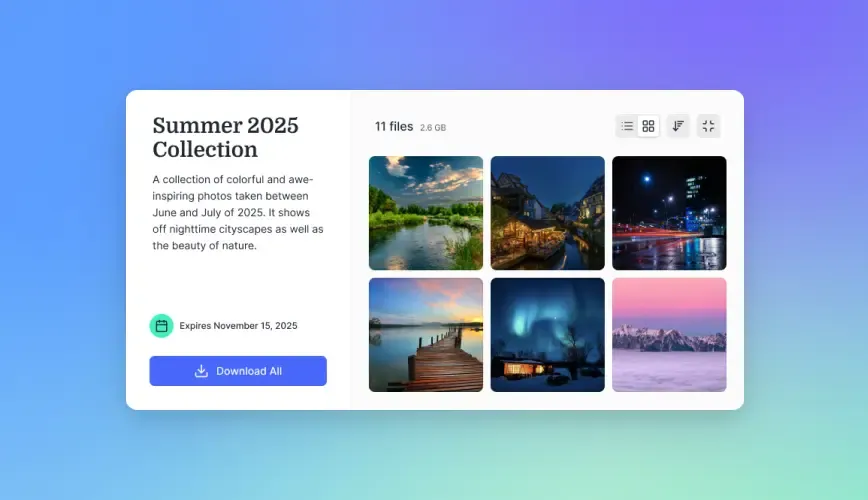
Fastio gives every file a stable share link with password, expiration and download controls. No URL tricks, no broken links.
How Professional File Delivery Works
File delivery platforms like Fastio are built for distributing files, so direct downloads are the default, not a URL hack bolted onto a sync product.
Files are stored in the cloud and download directly from Fastio when someone clicks a link. No sync conflicts and no local storage requirements.
The share dialog gives you actual controls on each link:
- Password protection (recipients authenticate before downloading, no account required)
- Expiration dates for time-sensitive content
- View-only mode when you need recipients to see content but not download it
You also get download analytics: who accessed each file, when, from where. For sales materials and investor decks, that's signal you'd otherwise have to ask for directly.
Setting Up Direct Downloads in Fastio
Configuring Fastio for direct file delivery takes less time than modifying a single Google Drive URL.
Creating Your First Direct Link
1. Upload your file
Drag files directly into any Fastio workspace. Each plan sets a maximum file size, from 25 GB on Starter to 100 GB on Enterprise, and uploads need no special procedure.
2. Generate a share link
Right-click any file and select "Share." Fastio generates a link immediately. Unlike Google Drive, you do not need to change visibility settings or navigate permission dialogs.
3. Configure link behavior
The share dialog presents all available options in one place:
- Toggle password protection on or off
- Set an expiration date or leave the link permanent
- Choose whether recipients can download or only view
4. Copy and distribute
The link works immediately. Recipients open it in the browser and preview or download the file, depending on the settings you chose.
Direct Links for Video and Media
Fastio handles video files using HLS (HTTP Live Streaming), so recipients can watch immediately without downloading the full file first. They can skip to any point in the video, and playback quality adjusts to their connection speed. For files that should download rather than stream, you can configure that behavior per link.
Bulk Link Creation
When you need to share multiple files, Fastio lets you share an entire folder with one link, or use the API to generate links programmatically for integration with existing workflows.
Which Approach to Use for Different Situations
Software distribution
Don't use URL-hacked Google Drive links for software updates. Bandwidth limits and virus scan interruptions are unpredictable, and a broken installer download turns into a support ticket or, worse, a user pulling the binary from an unofficial source. Use a dedicated CDN or a file delivery platform.
Client deliverables
The link is part of the experience. When a client clicks a download link with your domain on it, that reads differently than dropboxusercontent.com. Download analytics also mean you know when the file was actually accessed, so there are no more "did you get it?" emails.
Sales and marketing assets
Friction loses prospects. Someone who has to create an account before downloading a case study will often just not bother. Direct links with engagement tracking tell you who viewed what and for how long without making them jump through hoops.
Internal sharing
For files that stay inside your organization, you usually care more about organization and search than link controls. Workspaces that let teammates browse and access files directly are more practical than creating individual download links for everything.
Media embedding
Images, audio, and video embedded on websites need true direct URLs. Preview page links don't render. Modified Google Drive links break after quota limits.
Sources
References used to verify factual claims in this guide.
-
For files larger than approximately 100MB, Google cannot complete its virus scan, showing a warning page instead of a direct download. This threshold remains in effect as of early 2026.
-
Dropbox Basic accounts are limited to 20GB of daily shared link bandwidth and up to 100,000 file downloads per day.
-
Changing dl=0 to dl=1 in a Dropbox share link triggers a direct download.
Frequently Asked Questions
How do I create a direct download link for a large file?
For files over 100MB, avoid Google Drive because it forces a virus scan warning page that interrupts automated downloads. Dropbox Basic has 20GB of daily bandwidth limits that can block popular files. Fastio accepts single files up to 100 GB on the Enterprise plan.
Can I password protect a direct download link?
Consumer services like Dropbox and Google Drive do not offer password protection on direct download links in free or basic plans. Fastio includes password protection as a standard feature on any link. Recipients enter the password before the download begins.
Why did my direct download link stop working?
Modified Google Drive and Dropbox links fail for several reasons: the file was moved or deleted, the account hit bandwidth limits, Google changed its URL structure, or the file exceeded the virus scan size threshold. Professional file delivery platforms provide stable links that do not depend on URL workarounds.
What is the difference between a direct link and a preview link?
A preview link opens a webpage showing the file with download buttons, branding, and sometimes ads. A direct link sends the file itself to your browser's download manager. Direct links are required for automation, scripting, software updates, and embedding media on websites.
How can I track who downloads my files?
Google Drive and Dropbox provide minimal download tracking on consumer plans. Fastio includes detailed analytics showing who accessed each file, when they downloaded it, and from which location.
Do direct download links work with video files?
Modified Google Drive and Dropbox links force recipients to download entire video files before watching. Fastio uses HLS streaming so viewers can watch immediately. You can configure whether video links stream or download depending on your needs.
Related Resources

Skip the URL Hacks, Fastio Serves Files Directly by Default
Fastio gives every file a stable share link with password, expiration and download controls. No URL tricks, no broken links.