Devin AI vs Perplexity Computer: Sandbox vs. Coworker
A direct comparison of Devin AI's cloud sandboxed Linux development suite and Perplexity Computer's multi-model browser automation engine, highlighting their respective design trade-offs and workspaces.


Comparing execution environments for sandboxed code and browser automation
An AI agent tasked with modifying a production database cannot verify its changes by looking at a browser mockup. When execution and deployment are separated by a local firewall, the agent is forced to suggest code rather than compile it. The structural divide between Devin AI and Perplexity Computer lies in this distinction: one is an isolated sandbox that builds software, while the other is an orchestrator that interacts with existing web interfaces.
Devin AI runs in a cloud environment to compile code, while Perplexity Computer uses multi-model orchestration to execute web and desktop tasks natively. This difference in execution environments determines how each agent interacts with a workspace. Devin AI operates within a cloud sandboxed Linux environment, providing a terminal, a code editor, and a sandbox browser to test applications. In contrast, Perplexity Computer focuses on local or cloud browser automation to perform actions across SaaS platforms, research the web, and execute tasks without compiling a full codebase. Understanding these separate architectures is necessary to select the right tool for engineering or operational workflows.
The mechanics of Devin's code compilation sandbox
To understand Devin AI, you must look at its sandboxed runtime. The agent operates inside a secure virtual machine that isolates the file system and shell operations. For developers running the CLI locally, sandboxing tools like bubblewrap and seccomp on Linux, or seatbelt on macOS, enforce file system restrictions and filter network traffic. This means Devin can install dependencies, run build tools, execute test suites, and compile code safely. If a build fails, the agent reads the compiler logs, modifies the source files, and runs the command again. This internal loop is what makes it an autonomous AI software engineer that can write, run and test code.
If sandbox resolution fails, such as when sandboxing tools are missing on a Linux system, the CLI will refuse to start rather than running unsandboxed. This fail-closed design prevents security policies from being silently bypassed. By containing execution within this strict boundary, Devin can run arbitrary code, test local servers, and handle complex software development tasks without risking the user's primary operating system.
Browser automation and web task orchestration in Perplexity
Perplexity Computer approaches task execution from a different angle. Instead of compiling applications in a virtual machine, it automates interactions with websites and native applications. It uses a Chromium-based browser to click buttons, fill out web forms, download data, and interact with SaaS tools. While Devin focuses on the repository and compiler level, Perplexity Computer is designed to navigate the web, compile research, and coordinate actions across separate platforms. It does not run a compiler loop to fix code syntax, but it can automate the manual tasks of researching market data, updating spreadsheets, or drafting emails.
Related guides
- How to Automate Perplexity Personal Computer with ZapierPerplexity Personal Computer gives you an always-on AI research agent that runs continuously on your behalf. Zapier...
- How to Automate Perplexity Personal Computer Workflows with n8nPerplexity Personal Computer is an always-on AI agent with access to your local files and apps. n8n is an open-source...
- Devin AI Cloud: Sandbox Architecture, Dedicated VPCs, and OutpostsDevin AI Cloud separates agent reasoning from code execution through a split architecture composed of a centralized...
- How to Configure and Manage Devin AI Sandbox File SharingDevin AI runs tasks inside isolated, ephemeral virtual machines that reset at the end of each session. Because files...
- Devin AI vs OpenHands: Comparing Sandbox Security and Model ControlA detailed comparison of Devin AI and OpenHands focuses on the core architectural difference: proprietary convenience...
- How to Manage Files Generated by Devin AIDevin AI generates dozens to hundreds of files per session, but its workspace resets between runs. This guide covers...
More on this subject: Devin (103 guides)
How Perplexity Computer compares to Devin AI
At a functional level, the two tools target different types of work. Devin AI is built specifically for software engineering, whereas Perplexity Computer is designed as a digital coworker for research and task automation.
Perplexity Computer coordinates over 20 frontier models to break down high-level queries. When a user prompts the system to research a market segment or compile a report, the orchestrator breaks the task into subtasks and delegates them to specialized AI sub-agents. For example, it might assign web searching to one model, data processing to another, and text generation to a third. This orchestration allows it to run complex workflows that connect to multiple external applications. It is optimized for operations teams, financial analysts, and business owners who spend their days coordinating information across different web platforms.
Task delegation across a multi-model system
By orchestrating multiple frontier models, Perplexity Computer matches the strengths of specific models to individual task requirements. A reasoning-focused model might plan the execution steps, while a coding-focused model drafts scripts, and a lightweight model summarizes search results. This division of labor allows the system to remain flexible across a wide range of tasks, from competitive research to invoice entry. However, because it relies on web and application automation rather than a compiled environment, it is not designed to debug complex runtime dependencies or compile large-scale applications.
Full development suite tools in Devin
Devin AI, on the other hand, operates a full development suite. When you assign a coding task to Devin, it interacts directly with a repository. Its terminal allows developers to watch commands execute in real time, while the embedded code editor handles file manipulation and debugging. Because it operates within a sandboxed Linux VM, it can run local web servers, execute compilers, and test the resulting applications. Rather than coordinating general business apps, Devin is optimized for the software development lifecycle, including feature development, code migrations, and unit testing.
This difference in design creates a distinct gap in capability. Competitors often overlook how Devin's environment allows full code compilation while Perplexity focuses on browser-centric task automation. An analyst using Perplexity Computer can automate the collection of API data and save it to a sheet, but they cannot run a local build server to verify that a React frontend compiles without errors. Conversely, an engineer using Devin can refactor a TypeScript library and verify the build, but they would not use Devin to automate daily email drafts or monitor CRM updates.
Can Perplexity Computer write code like Devin
A common question is whether a general-purpose worker like Perplexity Computer can replace a dedicated coding agent. While Perplexity Computer can write code, it does so in a different capacity than Devin.
When Perplexity Computer is tasked with a coding prompt, it relies on its multi-model framework to write code snippets, configure files, or draft scripts. It can write a Python script to scrape a website or generate a SQL query to extract database records. However, writing a script is not the same as managing a software project. Perplexity Computer lacks the deep execution loop that defines Devin AI. It does not run a continuous compiler process inside a sandboxed Linux virtual machine to test and debug the code it writes. If the generated script fails due to a missing package or a syntax error, Perplexity Computer must rely on external inputs or restart the prompt, rather than debugging the environment autonomously.
Script generation vs. software engineering
Writing code as a text output is simple for modern LLMs, but integrating that code into a complex codebase requires execution awareness. Devin is aware of the directory structure, the existing imports, and the specific compiler requirements of the project. When Devin edits a file, it reads the surrounding context, makes the changes, and compiles the project. Perplexity Computer is optimized for generating standalone scripts or automation configs that can be executed in external environments, making it a helper for operations rather than a core engineering contributor.
Autonomous testing and feedback loops
Devin's primary advantage lies in its autonomous testing and feedback loops. In a typical session, Devin writes a test file, runs it using a testing framework, captures the output, and uses any stack trace or error message to modify the implementation. This cycle repeats until all tests pass. This level of autonomy is necessary for handling long-running, multi-step engineering tasks, such as migrating a codebase or removing deprecated dependencies across hundreds of files. Perplexity Computer can write code to solve isolated problems, but it does not run the compiler loops required to manage a production codebase.
What is Perplexity Personal Computer
To bring agentic workflows closer to the user, Perplexity introduced Personal Computer. This extension of the core platform runs locally on macOS Sonoma or later, and on Windows.
Perplexity Personal Computer bridges the gap between local hardware and cloud models. By running on a user's local machine, the agent can work directly with system folders, local files, and native applications. This allows it to interact with local files, native apps, and web browsers to perform tasks. For example, a user can prompt the agent to organize local files, update local spreadsheets, or read data from native email clients. These local operations execute directly on the host machine, reducing latency but requiring explicit access permissions for files and folders.
Local file system and application integration
Operating locally allows Personal Computer to access tools and files that are normally gated behind firewalls or authentication walls. It can read local documents, interact with desktop apps, and use local web browsers to complete tasks. This local integration is useful for individual productivity, but it requires careful configuration. Unlike a cloud sandbox, running an agent locally means it operates on your active file system. Users must establish clear folder boundaries and permissions to ensure the agent does not accidentally overwrite important files or run destructive commands.
Continuous operations on dedicated hardware
To maximize the value of this tool, users often run it on a dedicated local machine like a Mac mini. Because the machine is always-on, the agent can run tasks in the background around the clock. It can monitor local directories, process incoming documents, and run long-running workflows without consuming the resources of the user's primary workstation. The agent syncs data with Perplexity's servers, allowing users to check progress or assign new tasks from other devices. However, because it runs on the user's local system, security and permission boundaries are critical. Running an autonomous agent with direct access to local files and system terminals requires strict access controls to prevent accidental data loss or unauthorized modifications.
Bridging the execution gap with shared workspaces for agents and teams
When agents execute tasks, they generate files: code files, research reports, parsed spreadsheets, and build logs. If Devin AI compiles code in an isolated cloud VM, or if Perplexity Personal Computer generates reports on a dedicated Mac mini, those files remain siloed. Teammates cannot access them, and other agents cannot build upon them.
To coordinate these workflows, teams often use standard storage platforms like local file systems, Amazon S3, or Google Drive. However, these tools fail when integrated with autonomous agents. Basic cloud storage lacks the version history needed to track concurrent agent writes, lacks semantic search for quick retrieval, and exposes complex APIs that require constant token management.
Fastio provides the persistent, intelligent workspace layer where humans and agents collaborate. In Fastio, files are stored in shared, organization-owned workspaces with granular permissions at the organization, workspace, folder, and file level. When an agent writes to a workspace, the platform maintains a complete version history for every file, ensuring that concurrent writes by multiple agents do not overwrite work blindly.
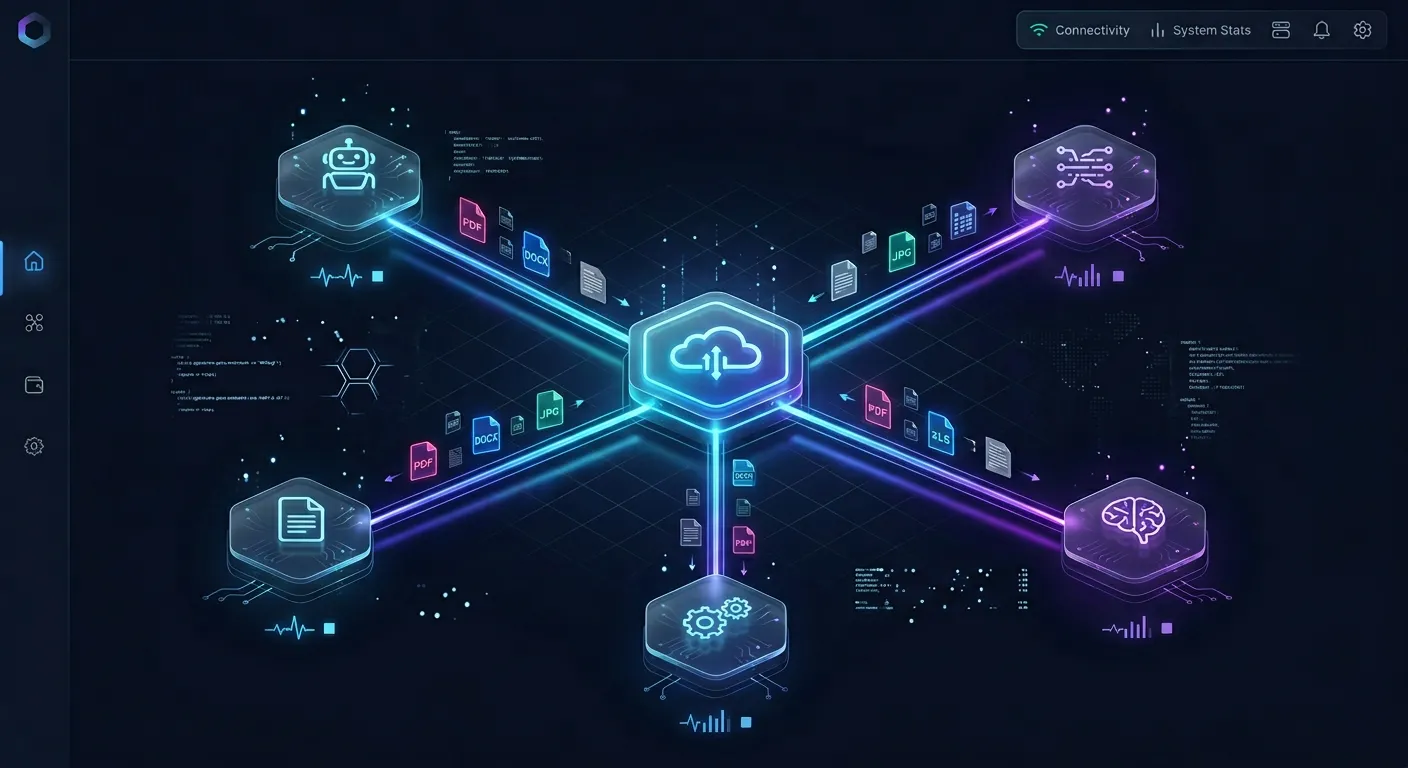
Semantic search and metadata extraction
Instead of treating storage as a passive folder, Fastio includes Intelligence Mode. When enabled, this feature automatically indexes all incoming files for retrieval-augmented generation (RAG). Both humans and agents can query the workspace using semantic search, returning answers backed by document citations.
For structured document processing, Fastio provides Metadata Views, which turn files into a queryable database. Users describe the fields they need extracted in natural language, and the AI constructs a typed schema to populate a filterable spreadsheet. Agents can create Metadata Views, trigger extraction, and query results via the Model Context Protocol (MCP). To explore how this structured extraction works, you can visit the product page for document data extraction.
Connecting agents via the Model Context Protocol
Agents connect to these workspaces using the consolidated Fastio MCP toolset. By exposing Streamable HTTP at https://mcp.fast.io/mcp/code for coding agents and https://mcp.fast.io/mcp/tools for other clients, with Bearer token authentication for headless agents, Fastio allows tools like Devin, Claude Code, or custom scripts to read and write files natively. For more details on configuring these integrations, refer to the Fastio agent storage overview page. Here is an example configuration for an MCP client:
{
  "mcpServers": {
    "fastio": {
      "url": "https://mcp.fast.io/mcp/code",
      "headers": {
        "Authorization": "Bearer your_api_key_here"
      }
    }
  }
}
When an agent completes a task, the platform supports ownership transfer. An agent can set up a workspace, organize files, and transfer ownership to a human colleague while preserving administrative access. Humans can then share these files using branded shares, which can be durable or expiring, with per-recipient access controls. Rather than polling for updates, developers can track file arrivals and workspace changes by listening to the real-time activity feed or using the workspace activity long-poll API.


Connect your autonomous agents to versioned team workspaces
Provide Devin, Perplexity, and custom agents with persistent workspaces. Enable Intelligence Mode for semantic search, extract structured data with Metadata Views, and collaborate securely. Monthly plans start with a trial of up to 14 days.
Determining the right environment for your workflows
Choosing between Devin AI and Perplexity Computer depends on the focus of your daily operations. If your primary need is software engineering, codebase maintenance, and automated testing, Devin's Cloud Sandboxed Linux environment is the appropriate choice. Its terminal and compilation loop allow it to handle complex code refactors and repository-level tasks.
If your workflows focus on market research, web-based task automation, and cross-application data synchronization, Perplexity Computer provides the necessary multi-model orchestration. By routing subtasks to specialized models, it automates manual browser tasks and compiles business data. By separating these workloads, teams can deploy the right agentic system for each task, avoiding the inefficiencies of using a technical compiler for simple web search or using a search assistant for software engineering.
Devin for development, Perplexity for operations
When selecting these tools, consider the boundaries of their execution. Devin is a highly specialized developer sandbox that requires access to source control, build tools, and compilation logs. Perplexity is a general-purpose digital coworker that needs access to web applications, browsers, and local office suites. Using the wrong agent for a task leads to friction. For instance, using Devin for research yields overly technical, script-centric results, while using Perplexity for software engineering leads to unverified snippets that fail during local compilation.
Structuring the workspace layer
Regardless of the agents you deploy, your team needs a shared workspace to collaborate, verify outputs, and manage files. Fastio serves as this coordination layer, combining versioned storage, semantic search, and metadata extraction. For teams configuring multiple agents, setting up secure agent storage provides a persistent layer. Monthly plans start with a trial of up to 14 days (credit card required); annual plans have no trial. Fastio pricing tiers are:
- Starter at $9.99/mo
- Business at $49.99/mo
- Enterprise at $199.99/mo
By connecting your agents to Fastio workspaces via MCP, you ensure that AI-generated artifacts are versioned, searchable, and secure. To review plans and choose the subscription that matches your team scale, see the Fastio pricing page.
Sources
References used to verify factual claims in this guide.
-
Perplexity Computer coordinates over 20 frontier models to break down high-level queries.
-
Devin is an autonomous AI software engineer that can write, run and test code.
Frequently Asked Questions
How does Perplexity Computer compare to Devin AI?
Perplexity Computer is a multi-model coworker agent optimized for browser automation, web research, and cross-application workflows. Devin AI is an autonomous AI software engineer designed specifically for writing, compiling, testing, and deploying code inside a secure cloud sandbox environment.
Can Perplexity Computer write code like Devin?
Perplexity Computer can generate standalone code snippets, scripts, or database queries by routing subtasks to frontier models. However, it lacks the sandboxed compilation VM and autonomous testing loops that enable Devin AI to compile repositories, catch build errors, and run tests independently.
What is Perplexity Personal Computer?
Perplexity Personal Computer is an extension that runs locally on macOS Sonoma or later, and on Windows. It works directly with system folders, local files, and native applications to execute workflows, and is often deployed on dedicated background hardware like a Mac mini.
Related Resources

Connect your autonomous agents to versioned team workspaces
Provide Devin, Perplexity, and custom agents with persistent workspaces. Enable Intelligence Mode for semantic search, extract structured data with Metadata Views, and collaborate securely. Monthly plans start with a trial of up to 14 days.