Devin AI vs. Claude Code: Autonomous Agent vs. Terminal Assistant
Devin AI and Claude Code represent two distinct approaches to AI-assisted software development, separating fully autonomous background execution from interactive, terminal-native assistance. While Devin operates inside an isolated remote sandbox, Claude Code executes commands locally on the developer's machine with permission checkpoints. Choosing between them depends on the need for asynchronous delegation versus real-time steering.

How Remote Containers and Local Terminals Differ Architecturally
In standard agentic benchmarks, Anthropic's Claude 3.7 Sonnet achieves a 70.3% task resolution score on SWE-bench Verified when configured with high-compute test-time sampling, compared to a baseline of 62.3% for standard runs [Anthropic Claude 3.7 Sonnet Launch Announcement]. This leap in reasoning capability has catalyzed the development of autonomous coding assistants, yet the performance of these models is heavily determined by the environment in which they execute. The choice between Devin AI and Claude Code represents a primary divergence in developer tooling: remote cloud sandboxing versus local, terminal-native execution.
Devin AI runs as a remote cloud-hosted agent. When a developer initializes a session, Devin spins up a dedicated virtual machine running in the cloud. This environment includes a full operating system with a web browser, a shell, and a code editor. Developers interact with Devin primarily through a web interface, which displays a real-time feed of the agent's thoughts, shell commands, and browser sessions. For local work, the Devin CLI synchronizes file changes between the local repository and the remote container, making the host system a mirror of the remote workspace rather than the execution engine. This cloud-native architecture means Devin does not use the developer's local CPU, RAM, or disk space, but it does require constant internet connectivity and introduces network latency during file transfers.
Claude Code, by contrast, is a local terminal application. Running natively on macOS, Linux, or Windows Subsystem for Linux, Claude Code interacts directly with the local file system and execution tools. There is no intermediate virtual machine. When a developer inputs a prompt, the assistant reads the local files, runs tests using the local shell, and writes code directly to the local disk. This local native setup minimizes network latency and permits immediate integration with local development servers and compilers. However, it binds the assistant to the computing power and security configuration of the developer's local machine, meaning intensive agent operations will consume local CPU cycles and memory resources.
Related guides
- Cline CLI Guide: Running the Autonomous Coding Agent in Your TerminalCline CLI brings autonomous coding loops out of the graphical editor and directly into shell sessions, scripts, and...
- Cline vs Codeium: Autonomous Coding Agent vs In-Editor AssistantChoosing between Cline and Codeium comes down to execution autonomy versus in-editor code completion. Cline operates as...
- How to Choose Between Devin AI and Claude for Code AutomationDevin AI and Claude represent two distinct methodologies for automated coding, separating remote cloud-hosted...
- Hermes Agent vs Claude Code: Architecture, Strengths, and When to Use EachNous Research Hermes Agent is a persistent autonomous agent that learns across sessions and connects to 20+ messaging...
- Claude Cowork vs Claude Code: Which One Should You Use?Claude Code now accounts for roughly 4% of all public GitHub commits, and Claude Cowork went generally available in...
- How to Connect Claude Code Terminal Agent to Dropbox WorkspacesConnecting Claude Code to Dropbox via MCP enables the terminal AI coding agent to inspect, retrieve, and modify...
More on this subject: Claude and Claude Code (278 guides)
How Sandbox Isolation and Local Permission Security Compare
Because AI agents run terminal commands and modify files, the security boundary of the execution environment is a key point of evaluation. Devin AI and Claude Code manage this risk through two opposing safety architectures.
Devin AI isolates all activity inside its remote container. If the agent executes a command that modifies system configurations, runs a broken loop, or installs deep dependencies, the impact is confined to the remote virtual machine. The developer's physical computer remains protected from accidental filesystem damage or network exposures. When the task completes, the container can be discarded or saved as a clean snapshot, ensuring that experimental executions do not pollute the developer's host machine. This remote setup is particularly useful when testing untrusted packages, cloning repositories with unknown security profiles, or running web scraping scripts that might trigger security alerts on a local network.
Claude Code runs directly on the user's host operating system, which requires a strict, tiered permission model. Instead of relying on a virtual container, Claude Code prompts the developer for explicit permission before executing bash commands or modifying files. File reads and search actions run without prompts, but write operations require manual approval. Developers can customize these safety rules using settings files stored in the .claude/settings.json and .claude/settings.local.json directories, allowing them to permanently trust specific commands or file paths. While this keeps the developer in full control, it places the safety burden on the human operator who must review each execution prompt. A developer who fast-tracks approvals without reading the proposed terminal changes risks running destructive scripts on their host hardware.
How to Manage Agent Compute Quotas and Token-Based Pricing
The billing models of these two systems reflect their underlying deployment structures, separating compute-based subscriptions from token-based consumption.
Devin AI relies on a structured subscription model updated in April 2026 [Cognition AI Release Notes]. The self-serve options include a Free plan with limited features, a Pro plan at twenty dollars per month, and a Max plan at two hundred dollars per month. The Teams plan starts at a minimum of eighty dollars per month. For enterprise tiers, billing is tracked via Agent Compute Units, where one Agent Compute Unit represents approximately fifteen minutes of active compute time. Developers pay for the duration of the container's active processing, which makes the cost independent of the number of model tokens consumed during the execution. A single complex task that runs for two hours will consume eight Agent Compute Units, regardless of whether the model processed ten thousand or one million tokens during that session.
Claude Code uses a token-based pay-as-you-go approach. Access is included with paid Claude subscriptions, such as Claude Pro at twenty dollars per month or Claude Max at one hundred to two hundred dollars per month, subject to standard plan limits. Alternatively, developers can configure the tool using their Anthropic API keys, paying directly for the input and output tokens consumed by the underlying Claude 3.7 Sonnet model. Because agentic workflows involve repetitive loops of reading files and running tests, token usage can accumulate rapidly. To optimize these costs, Claude Code automatically implements prompt caching, which caches the project context and greatly reduces the price of repeated codebase reads. This means a developer working in a large repository will pay full price for the initial codebase read, but subsequent requests within the same session will read from the cache, lowering costs by up to ninety percent for cached input tokens.
These differences in cost structure mean Devin AI provides predictable billing based on compute time, while Claude Code offers flexible pay-as-you-go pricing that rewards codebase compression and prompt caching.
Developer Steering: Asynchronous Autonomy versus Interactive Terminals
The choice of tool also dictates the developer's daily workflow, separating asynchronous delegation from real-time terminal collaboration.
Devin AI is designed as a fire-and-forget autonomous agent. A developer can submit a complex task, such as a full feature request or a complex bug fix, and leave the agent to work in the background. Devin creates a multi-step plan, runs commands, tests the output, and iterates on errors without requiring human attention. The developer can close the web browser and focus on other tasks, returning later to review a completed pull request. Devin only halts execution when it encounters an ambiguous requirement or requires external credentials. This is ideal for tasks that require long processing times, such as updating dependencies across a large codebase or migrating a database from SQLite to PostgreSQL.
Claude Code functions as an interactive terminal coworker. It is built to run inside the developer's active shell session, providing rapid assistance as code is written. A developer might prompt Claude Code to explain a local error log, refactor a specific function, or write a test suite. The assistant executes these tasks in seconds, presenting the diff for immediate human review. This interactive model is designed for active steering, where the developer remains in the loop, guiding the agent's choices step-by-step to match the project's exact styling and design choices. It acts as an extension of the developer's keyboard, resolving small bugs and writing boilerplate code without breaking the flow of local development.
Persistent Workspaces and the Shared Coordination Layer
Whether using background agents or terminal assistants, managing the project resources and outputs of AI workflows requires a stable storage layer. Developers have historically used local disk directories or raw cloud storage like Amazon S3. For team sharing, standard tools like Google Drive or Dropbox are common, but these systems do not connect with agent tools or support automated indexing.
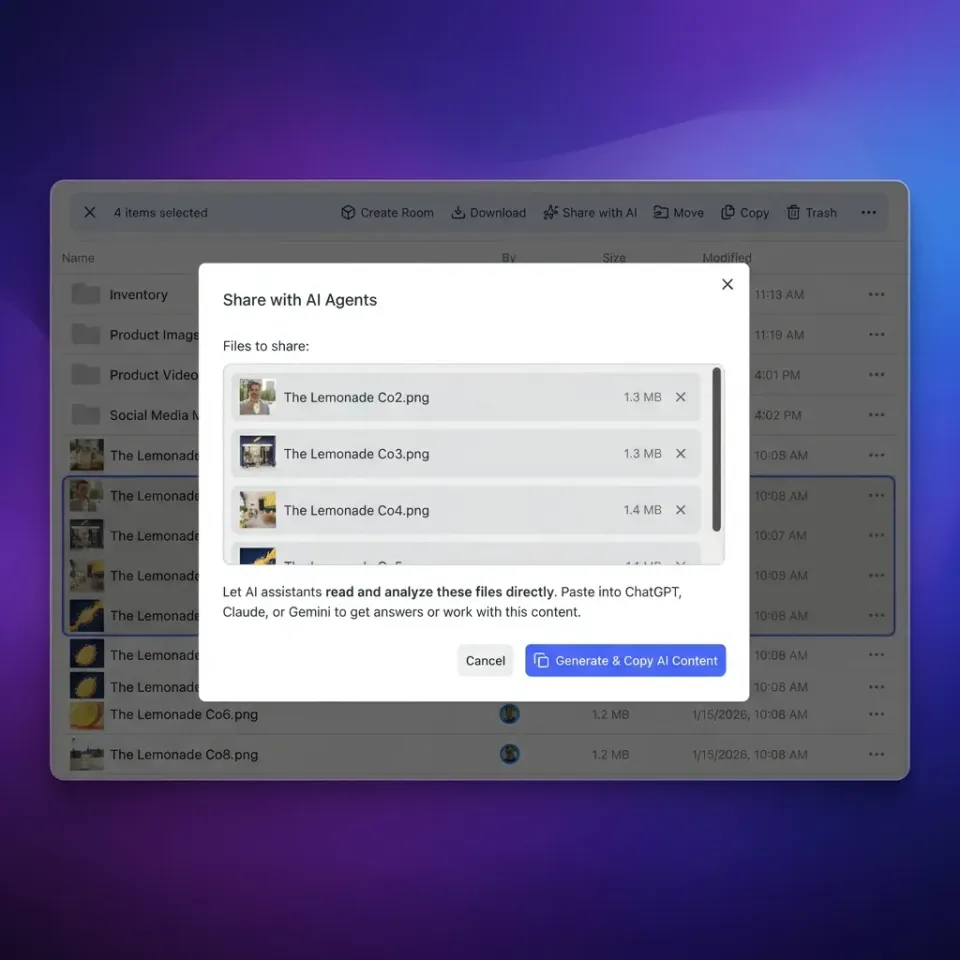
Fastio fills this gap by providing an intelligent cloud workspace platform built for human-agent collaboration. Rather than treating storage as a simple bucket, Fastio serves as the coordination layer where agents and developers share context, track history, and hand off work.
Fastio supports workflows for both local and remote agents through several key capabilities:
Granular Permissions
Developers can set folder and file permissions to control what directories an agent can write to, preventing automated tools from editing production configs.
Per-File Version History
When multiple agents or developers collaborate on the same file, Fastio maintains a complete history of changes, allowing teams to audit modifications and restore prior versions instantly.
Intelligence Mode
This feature auto-indexes uploaded files, providing built-in RAG and semantic search. Agents can query the workspace using natural language to retrieve relevant documentation with precise citations, removing the need to configure a separate vector database.
Metadata Views
For structured data extraction, Metadata Views turn unstructured documents into queryable tables. Users define fields in natural language, and Fastio extracts the data into structured columns (Text, Integer, Decimal, Boolean, URL, JSON, Date & Time), allowing agents to query document attributes directly. This structured layer is detailed at the Metadata Views product page.
Model Context Protocol Access
Fastio exposes its tools natively via Streamable HTTP at /mcp and legacy Server-Sent Events at /sse, allowing Claude Code or Devin to query and write files directly. Developers can read the Model Context Protocol documentation to configure their agents.
Ownership Transfer
An agent can initialize an organization, construct workspaces, and transfer the organization to a human client. The agent retains admin access while the human assumes ownership, simplifying project handoffs.
Creating an account is free, but active organizations require a paid subscription. Monthly plans start with a trial of up to 14 days (credit card required); annual plans have no trial. Paid plans are structured for different team sizes: Starter at $9.99/mo, Business at $49.99/mo, and Enterprise at $199.99/mo.



Organize Agent Inputs and Output Artifacts
Initialize a shared workspace with Model Context Protocol support to let Devin AI or Claude Code access versioned project files, with automatic semantic search indexing. Starts with a 14-day free trial.
How to Evaluate Devin AI vs. Claude Code for Your Team
Choosing between Devin AI and Claude Code depends on the complexity of your tasks and your preferred style of development.
Select Devin AI if you want to delegate large, isolated tasks that can run in the background. It is highly suited for legacy code migrations, broad dependency updates, or running complex test suites that require custom container setups. Devin's cloud isolation ensures that experimental package installations or system alterations do not affect your local development machine.
Select Claude Code if you are an active developer who wants an interactive assistant in your terminal. It is ideal for rapid codebase navigation, inline refactoring, explaining compiler errors, and managing local git commits. Its local native speed and direct access to your local dev servers make it a fast companion for daily coding.
For advanced teams, these tools can work together. You can employ Claude Code for real-time local editing and use Devin AI to handle asynchronous ticket resolution in the cloud. By connecting both systems to a shared, version-controlled workspace like Fastio, you create a persistent registry for all agent inputs and outputs, ensuring that your team's code and documentation remain secure and searchable.
Sources
References used to verify factual claims in this guide.
-
Anthropic's Claude 3.7 Sonnet achieves a 70.3% task resolution score on SWE-bench Verified when configured with high-compute test-time sampling, compared to a baseline of 62.3% for standard runs.
-
Devin's pricing model, updated in April 2026, introduces self-serve tiers including a Pro plan at $20 per month and a Max plan at $200 per month.
Frequently Asked Questions
Should I use Devin or Claude Code?
Choose Devin AI if you want to delegate entire coding tasks to a background agent that runs in an isolated cloud container. Choose Claude Code if you want a fast, terminal-native assistant that works alongside you on your local machine, prompting you for permission for each command and file edit.
Is Claude Code better than Devin AI?
Neither tool is universally superior. Claude Code is faster and cheaper for interactive terminal editing and local refactoring, achieving strong scores on SWE-bench Verified. Devin AI excels at autonomous, long-running tasks that you want to run asynchronously in a remote cloud sandbox without slowing down your computer.
Can Claude Code and Devin access external MCP servers?
Yes, both tools support the Model Context Protocol. You can connect them to external MCP servers, including Fastio, to allow the agents to read files, manage workspaces, and extract structured document metadata directly from your cloud storage.
Related Resources

Organize Agent Inputs and Output Artifacts
Initialize a shared workspace with Model Context Protocol support to let Devin AI or Claude Code access versioned project files, with automatic semantic search indexing. Starts with a 14-day free trial.