Devin AI Open Source Status: Commercial SaaS vs. Open Alternatives
While Devin AI is a proprietary closed-source platform developed by Cognition, several open-source alternatives exist. This guide analyzes the devin ai open source ecosystem, comparing the hosted SaaS model to open-source alternatives like OpenHands and Devika. We cover differences in data privacy, custom tool extensions, and storage costs to help you select the right agent architecture for your team.


Is Devin AI Open Source? A Guide to Developer Scaffolding
When Cognition Labs launched Devin in March 2024, it set an industry benchmark by resolving 13.86% of software engineering issues on SWE-bench [Cognition 2024]. While this milestone proved that agentic software engineers could automate end-to-end tasks, the proprietary nature of the tool has driven the developer community to build open alternatives. Scaffoldings like OpenHands have achieved a 41.7% resolve rate on SWE-bench Lite [OpenHands 2024] when using Claude Sonnet, proving that open architectures can match or exceed closed commercial services. This guide examines the devin ai open source ecosystem, focusing on data privacy, custom extensions, and deployment costs.
To answer the primary question directly: Devin AI is not open source. It is a commercial, closed-source Software-as-a-Service (SaaS) platform managed by Cognition. You cannot inspect the source code, modify the core agentic planning loop, or host the system on your own servers. For teams requiring those capabilities, the developer community has built several open-source alternatives that run locally or in self-hosted environments.
The top two open-source alternatives to Devin are:
OpenHands (formerly OpenDevin): Hosted on GitHub under the permissive MIT License, OpenHands provides a modular, model-agnostic agent framework. It acts as an autonomous developer that executes terminal commands, writes code, and navigates project directories inside isolated Docker containers.
Devika: Created by Mufeed VH under the MIT License, Devika features a chat-centric web interface and focuses on task decomposition, web research, and automated code generation across multiple programming languages.
Both projects offer developers the freedom to build agentic pipelines without vendor lock-in. Understanding the architectural differences between closed SaaS and open-source alternatives is the first step in deciding where your code and agent outputs should live.
Related guides
- Is Claude Code Open Source? Source Code, Licensing, and AlternativesClaude Code is proprietary software governed by Anthropic's Commercial Terms of Service, not an open source project. A...
- Cline and Other Open Source Cursor AlternativesCline markets 8.0M+ installs across platforms as an Apache 2.0 coding agent, which is why "open source cursor...
- Devin vs Devika: Comparing Proprietary and Open-Source AI Software EngineersCognition's Devin and Stition.AI's Devika represent two opposite models of agentic software engineering. Devin uses a...
- Devin AI vs OpenHands: Comparing Sandbox Security and Model ControlA detailed comparison of Devin AI and OpenHands focuses on the core architectural difference: proprietary convenience...
- How to Manage Files Generated by Devin AIDevin AI generates dozens to hundreds of files per session, but its workspace resets between runs. This guide covers...
- How to Connect Devin AI to VS CodeConnecting Devin AI to VSCode (Visual Studio Code) bridges local development environments with autonomous cloud...
More on this subject: Devin (104 guides)
Why Data Privacy Differs Between Devin SaaS and Self-Hosted Docker
Data privacy is one of the most significant differences when comparing Devin to open-source agent frameworks. Because Devin is a managed cloud application, any code, configuration file, or database credential you share with the agent must be processed on Cognition's hosted servers. For teams working on proprietary codebases, financial systems, or databases containing personally identifiable information, sending code to third-party servers creates substantial regulatory risks.
In contrast, open-source alternatives run entirely within your secure boundary. OpenHands and Devika execute all code modifications, terminal commands, and testing operations inside isolated Docker containers on your local machine or private cloud infrastructure. This local execution model guarantees that your source code, environment variables, and proprietary algorithms never leave your firewall.
When deploying these self-hosted agents, developers must choose where to store the files and configurations that the agent reads and writes. Teams typically consider three approaches:
Local Disk Mounts: Binding a local folder directly to the agent's Docker container. This keeps files local but prevents other team members from collaborating on the agent's output in real time.
Amazon S3 Buckets: Writing files to cloud object storage. This enables remote access but lacks a shared visual dashboard, requiring engineers to write custom scripts to view version history or review code modifications.
Fast.io Workspaces: Creating shared, organization-owned workspaces where humans and agents work together. When you connect an open-source agent to a Fast.io workspace, the files are stored securely and indexed. Every file modified by the agent maintains a complete per-file version history, making it easy to restore previous states or compare agent updates. Additionally, Fast.io logs all file modifications in a detailed activity log, ensuring that every command the agent runs is fully auditable.
How Cost Structures and Model Selection Compare
The financial models of proprietary SaaS and open-source alternatives are completely distinct. Devin operates on a commercial subscription model, where pricing is negotiated based on scale and usage, and there is no permanent free trial or free tier. For individual developers, startups, or agencies testing agentic workflows, the entry cost can be a barrier.
With open-source alternatives, the agent scaffolding itself is free under the MIT License. Your only cost is the direct consumption of LLM API tokens. This pay-as-you-go approach provides two distinct advantages:
Granular Cost Control: You only pay for the exact tokens used during a development run. If you run a local model like LLaMA or DeepSeek-Coder on your own hardware, your token cost is zero.
Model Flexibility: Devin is optimized to use Cognition's internal models. Open-source frameworks are model-agnostic. You can pair OpenHands with Claude Sonnet for complex architectural changes, switch to GPT for rapid debugging, or run local open-weights models to ensure absolute data privacy.
This flexibility allows engineering teams to allocate budgets dynamically. A simple task, such as writing unit tests for a utility module, can be handled by a cheaper local model. A complex feature migration, requiring deep reasoning and multi-file updates, can be routed to a larger frontier API.
How to Extend Agent Capabilities with Custom Tool Integrations
In software engineering, agents must interact with external systems, databases, APIs, and documentation. Because Devin is a closed platform, developers are limited to the built-in tools and integrations provided by the vendor. Writing a custom script or exposing a private internal API to Devin requires complex proxy configurations and security overrides.
Open-source agent frameworks are designed for extensibility. Because you own the codebase, you can write custom Python tools, modify the agent's prompt templates, or extend its planning loop to match your specific engineering standards.
The most efficient way to extend open-source agents is through the Model Context Protocol (MCP). Instead of writing ad-hoc integrations for every tool, you can connect your agent to MCP servers. Fast.io is MCP-native, exposing a consolidated MCP toolset. Developers can connect OpenHands or Devika to their Fast.io workspace using streamable HTTP or legacy SSE (for detailed technical integration, see the Fast.io onboarding documentation).
Once connected, the agent uses the Fast.io MCP tools to search the workspace, read files, and write code. This architectural pattern keeps your agent lightweight while offloading the heavy indexing, search, and version control to the Fast.io platform.
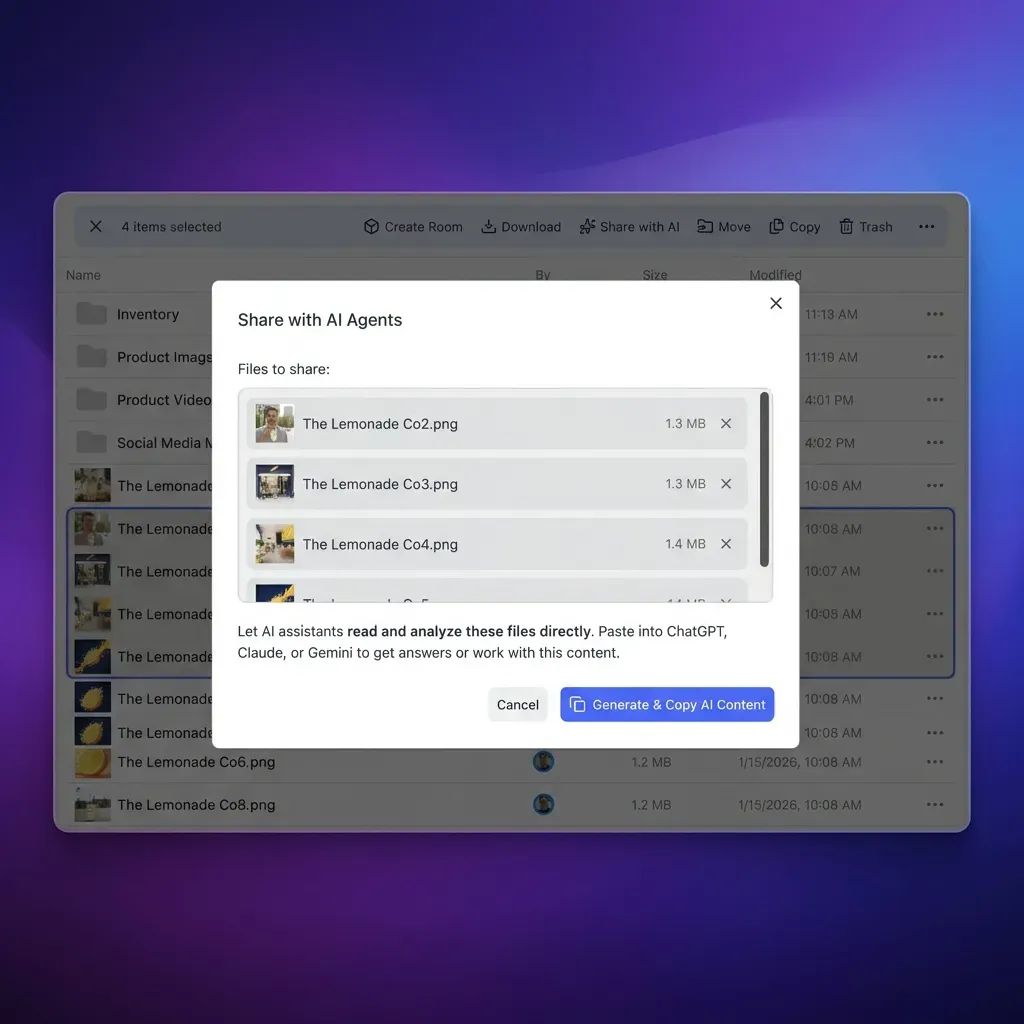


Persist open-source agent files across sessions
Set up a persistent, shared workspace for your AI agents and engineering teams. Connect OpenHands and Devika using our consolidated MCP toolset. Plans start at Starter $9.99/mo, Business $49.99/mo, or Enterprise $199.99/mo, beginning with a 14-day free trial.
Coordinating Handoffs in a Shared Workspace
An AI agent is rarely a solo contributor. In a production pipeline, agents and engineers must collaborate on the same files. A common challenge with open-source agents running in local Docker containers is the handoff gap (the difficulty of sharing the agent's work with the rest of the team for review, testing, and deployment).
In a typical setup, sharing code requires the agent to commit directly to Git, which can pollute the repository with broken builds if the agent makes a mistake. Alternatively, developers must manually copy files from the Docker container to share them via email or chat.
Connecting your agent to a Fast.io workspace resolves this bottleneck by creating a shared environment for humans and agents. The workflow follows a clean, structured path:
Real-Time Visibility: The agent reads and writes directly to the shared workspace. Human team members can monitor progress on their Dashboard, open Collaborative Notes to co-edit documentation with the agent, or view file changes in the activity feed.
Structured Handoffs: When the agent finishes building a prototype or extracting data, it can organize its outputs. For example, it can use Fast.io's Metadata Views to automatically extract key values, such as build versions, test coverage percentages, or error flags, into a queryable spreadsheet view for human review.
Expiring Shared Portals: Once the work is verified, team members can share the build artifacts with external clients using branded shares (Send/Receive/Exchange). These share links can be durable or set to expire automatically, protecting sensitive codebases while maintaining a professional delivery interface.
Ownership Transfer: If an agent builds a workspace or portal for a client, the developer can perform an ownership transfer to hand the workspace over to the human client, while retaining admin or auditor access to continue monitoring the agent's performance.
Compare Devin AI, OpenHands, and Devika: A Summary Matrix
Choosing the right developer agent depends on your team's size, security requirements, and budget. Crucially, while Devin provides a polished SaaS experience out of the box, OpenHands and Devika offer the flexibility and privacy of open-source software.
The table below summarizes the key differences:
For developers who want to experiment with agentic coding using a clean, visual interface, Devika is a lightweight option. For teams building production-grade agentic pipelines that connect to team storage and automated workflows, OpenHands provides the structured scaffolding required. In either case, combining these open-source agents with a persistent workspace like Fast.io ensures your team has the security, auditing, and collaboration tools needed to scale agentic operations.
Sources
References used to verify factual claims in this guide.
-
When Cognition Labs launched Devin in March 2024, it set an industry benchmark by resolving 13.86% of software engineering issues on SWE-bench.
-
Scaffoldings like OpenHands have achieved a 41.7% resolve rate on SWE-bench Lite.
-
Devika was created under the MIT License.
Frequently Asked Questions
Is Devin AI open source?
No, Devin AI is a proprietary, closed-source platform developed and hosted by Cognition. You cannot access its source code, modify its inner reasoning loops, or run it on your own hardware. For self-hosted deployments, you must use open-source alternatives like OpenHands or Devika.
What is the open source version of Devin AI?
While there is no official open-source version of Devin AI, the developer community has built open-source alternatives. The most prominent is OpenHands (formerly OpenDevin), which is hosted on GitHub under the MIT License. Devika, developed by Mufeed VH, is another popular open-source alternative under the MIT License.
Can I host Devin AI on my own server?
No, Devin AI cannot be hosted on your own server. It is hosted entirely on Cognition's proprietary cloud infrastructure as a managed SaaS. If you need an agent that runs on your own servers or within a private cloud, you should deploy open-source alternatives like OpenHands, which runs inside isolated Docker containers.
How do open-source agents connect to external tools and storage?
Open-source agents like OpenHands and Devika connect to external tools and persistent storage using the Model Context Protocol (MCP) and APIs. For example, connecting your agent to a Fast.io workspace via an MCP endpoint allows the agent to search codebases, write files, and run builds within a secure, version-controlled workspace.
Related Resources

Persist open-source agent files across sessions
Set up a persistent, shared workspace for your AI agents and engineering teams. Connect OpenHands and Devika using our consolidated MCP toolset. Plans start at Starter $9.99/mo, Business $49.99/mo, or Enterprise $199.99/mo, beginning with a 14-day free trial.