Claude OneDrive Not Working: Fix Connector Sync and File Stub Errors
Claude OneDrive connection failures occur when Microsoft Graph API throttling limits large folder indexing, tenant admin consent is withheld, or cloud-only files cannot be read by Claude. Local connectors stall on 0-byte Files On-Demand placeholders, while native integrations face strict rate limits. Syncing folders into an indexed Fastio workspace lets Claude query documents through remote Model Context Protocol search without network timeouts.


Why Claude OneDrive Is Not Working Across Local and Cloud Sessions
When an autonomous AI agent attempts to read an enterprise OneDrive folder, it does not browse files the way a human does. It requests directory streams, traverses nested folders, and attempts to pull file bytes across network boundaries, colliding with three distinct architectural barriers: unhydrated file stubs, API throttling limits, and tenant consent blocks.
Claude OneDrive connection failures occur when Microsoft Graph API throttling limits large folder indexing, tenant admin consent is withheld, or OneDrive cloud-only files cannot be read by Claude's connector. Across teams building automated workflows with Claude Desktop, Claude Code, and Claude Cowork, connecting to Microsoft OneDrive storage remains a frequent point of friction. Operational records, vendor contracts, project plans, and financial reports live inside Microsoft 365 environments. When Claude cannot read OneDrive files or reports that a connection failed, automated pipelines grind to a halt.
Users typically attempt two distinct paths to link Claude with OneDrive. The first path is local filesystem integration, where a user points Claude Desktop or Claude Code at a local OneDrive sync folder on Windows or macOS. The second path is remote cloud integration, connecting through Anthropic's native Microsoft 365 connector or third-party gateways. Both paths fail under specific conditions because neither was designed around the access patterns of autonomous AI agents.
Local connections fail because desktop sync clients employ storage optimization techniques that hide behind normal file paths. Files that appear in local folder listings often contain zero bytes on physical storage until explicitly opened by a human user. When an automated agent attempts to parse these placeholders, the operating system either returns an empty byte buffer or pauses the process to download the file over the network, causing tool call timeouts.
Remote cloud connections fail because the underlying Microsoft Graph API imposes strict resource unit controls on directory listings and file downloads. When Claude attempts to index a project folder containing hundreds of documents, it rapidly burns through allowable request rates. Microsoft Entra ID enterprise security policies frequently block external AI connectors from accessing organizational data without tenant administrator approval. Personal OneDrive accounts face an even steeper barrier, as native enterprise connectors refuse consumer logins entirely. Resolving these issues requires understanding the technical mechanisms governing local file stubs, API throttling, and workspace indexing alternatives.

Related guides
- How to Connect Cursor to OneDrive: Integration and Sync GuideA Cursor OneDrive integration links the Cursor AI code editor to Microsoft OneDrive folders, allowing developers and...
- How to Connect Copilot to OneDrive: Fix Hydration & RatesConnecting Copilot to OneDrive links AI coding assistants to Microsoft OneDrive folders, allowing models to search...
- How to Connect Claude to OneDrive: Setup, Sync & File AccessConnecting Claude to OneDrive gives Anthropic AI assistant direct access to personal and business files stored in...
- How to Connect Claude Code to OneDrive with Remote MCPClaude Code OneDrive integration connects Anthropic's terminal coding agent to Microsoft OneDrive folders, enabling CLI...
- Can Claude Access OneDrive? Direct Connectors vs Workspace MCPClaude can access OneDrive files through manual file uploads, local desktop sync directory access in Claude Desktop, or...
- Claude OneDrive MCP: Connect Claude to Microsoft OneDrive via Fast.ioClaude OneDrive MCP connects Anthropic Claude models to Microsoft OneDrive storage for reading, searching, and...
More on this subject: Claude and Claude Code (249 guides)
How to Diagnose 0-Byte Stubs and Hydration Timeouts in Local Sessions
The most common cause of local Claude OneDrive integration errors is Microsoft OneDrive Files On-Demand. Enabled by default across Windows and macOS, Files On-Demand minimizes local disk consumption by retaining files in cloud storage while displaying placeholder representations in Windows File Explorer and macOS Finder.
Reparse Points and Dataless File Architecture
On Windows NTFS file systems, an unhydrated file is structured as a reparse point containing an IO_REPARSE_TAG_FILE_PLACEHOLDER tag and file attributes including FILE_ATTRIBUTE_REPARSE_POINT and FILE_ATTRIBUTE_OFFLINE. When a directory listing utility runs, the file system reports the document's logical size, modified timestamp, and extension. The physical disk allocation, however, is exactly 0 bytes. On macOS APFS systems, the operating system relies on Apple's File Provider framework, designating unhydrated items as dataless files.
When Claude Desktop, Claude Code, or a local filesystem MCP server accesses an unhydrated file path, two failure modes emerge:
- Silent Empty Reads. Many file-reading utilities open a file handle without requesting explicit operating system hydration. The operating system returns an empty byte stream. Claude reads zero bytes, assumes the document is blank, and reports that the file contains no information. In automated data extraction or auditing tasks, this silent failure leads to missing data and inaccurate conclusions.
- Blocking Hydration Timeouts. If the file reading utility requests a full byte stream, the operating system pauses the I/O thread while initiating a background network download via the OneDrive sync engine. If the document is large, if the local network experiences packet loss, or if the OneDrive desktop client is paused or unauthenticated, the I/O operation blocks indefinitely. Claude tool runners enforce execution timeouts, typically terminating after 30 to 60 seconds. The process exits with an unhandled exception, causing Claude to report that the tool call timed out or failed to execute.
Virtualization and Sandboxing Barriers
A related failure mode occurs when running Claude in virtualized or containerized development environments, such as Claude Cowork on Windows. Virtualized runtimes rely on filesystem translation protocols like virtiofs or shared network mounts. These translation layers cannot translate Windows Cloud Files API reparse point tags. When Claude attempts to mount or read a OneDrive directory through a virtualization layer, the translation driver throws an I/O error, preventing the session from starting.
Four-Step Diagnostic Protocol for Local Files
To determine whether unhydrated file stubs are causing your Claude integration errors, run this four-step diagnostic protocol:
- Inspect Physical Allocation on Disk. Verify whether target files contain physical bytes or exist merely as metadata placeholders. In Windows PowerShell, run
Get-Item .\document.pdf | Select-Object Name, Length, Attributes. If the attributes list includesSparseFile,ReparsePoint, orOffline, the file is not hydrated. On macOS, open Terminal and inspect the extended file flags withls -lO document.pdf. The presence of adatalessflag confirms an unhydrated stub. - Force Manual Hydration on Test Files. Right-click the problem folder in Windows File Explorer or macOS Finder and select Always keep on this device. Wait for the sync icon to turn into a solid green checkmark. Alternatively, in PowerShell, force hydration using
attrib -U +P document.pdfor trigger a file stream read withGet-Content -Path .\document.pdf -Raw > $null. Once hydrated, test Claude again. If Claude reads the file successfully, placeholder stubs are the primary failure point. - Check Execution Sandbox Boundaries. If using Claude Cowork or containerized execution tools, confirm that your project workspace resides outside the virtualized OneDrive sync root. Move test files to a standard local path, such as
C:\Projects\on Windows or~/projects/on macOS, and verify whether read errors disappear. - Evaluate Storage and Headless Constraints. While forcing local hydration resolves errors on an individual workstation, it introduces operational limits. Hydrating complete team folders can rapidly exhaust workstation SSD capacity. More critically, local hydration cannot run in cloud virtual machines, continuous integration runners, or headless servers where the OneDrive desktop client does not operate.
Microsoft Graph API Rate Limits and Connector Traversal Delays
When users avoid local filesystem stubs by connecting Claude directly to cloud storage, they encounter API-level bottlenecks. Anthropic provides a native Microsoft 365 connector for enterprise environments, while developer platforms like Composio offer toolkits that expose OneDrive actions through an intermediate gateway. Both approaches route operations through the Microsoft Graph API, where autonomous agents encounter request throttling and directory traversal latency.
The Problem with Directory Walking
Direct cloud connectors treat OneDrive as a raw filesystem tree. When an agent needs to answer a question that spans multiple project files, it cannot perform a centralized semantic search. It must execute recursive folder listings, inspect file names, and download whole files over the network into its context window. A multi-document audit requiring information from twenty documents forces the agent to make dozens of sequential tool calls. Each tool call incurs network latency, token overhead, and API quota consumption.
Microsoft Graph API Throttling and HTTP 429 Errors
Microsoft Graph endpoints protect service availability by imposing strict per-tenant and per-user throttling limits. Folder traversal operations and file download streams consume resource units. When an autonomous agent issues rapid, automated requests to list directories and download files, it quickly triggers rate-limiting protections.
When a throttling threshold is exceeded, Microsoft Graph returns HTTP status code 429 Too Many Requests and requests fail, forcing the calling client to pause operations until the rate limit window resets. Along with the HTTP 429 response, Microsoft Graph provides a Retry-After header indicating how many seconds the application must wait before retrying. Native connectors and agent frameworks that fail to implement exponential backoff loops crash immediately. Connectors that do respect backoff headers pause agent execution for extended intervals, resulting in session timeouts and broken workflows.
Third-Party Gateways and Traversal Latency
Third-party tool routing frameworks like the Composio OneDrive toolkit provide structured tool calls for actions such as downloading specific files, sharing folders, and inspecting file permissions in Claude Cowork. While these toolkits handle OAuth authentication and token refreshes cleanly, the underlying agent execution model remains constrained by raw document retrieval. If an agent must search a deep folder structure to discover which file contains a required clause, each search step requires another round-trip API call. Traversal latency compounds rapidly as folder depth and document volume grow.
Microsoft Entra ID Admin Consent Barriers
Beyond rate limits, enterprise security controls frequently block Claude from establishing a connection. The Microsoft 365 connector requires delegated permissions such as Files.Read.All or Files.ReadWrite.All. In managed corporate tenants, Microsoft Entra ID prevents non-administrative users from granting third-party applications access to corporate data. If a tenant administrator has not pre-approved the Claude application, the authentication flow halts with an admin consent prompt or an AADSTS65001 error. Personal Microsoft accounts face complete exclusion, as native connectors require organizational tenant identities.
How to Bypass Connector Limits with Indexed Workspace Synchronization
Teams managing enterprise files across OneDrive, Box, or Dropbox need an architecture that decouples agent search from raw directory traversal. The practical solution is to retain your files in their existing storage provider while synchronizing target folders into an intelligent Fastio workspace. Fastio acts as an indexed collaboration layer, allowing Claude to query document contents through a remote Model Context Protocol endpoint without pulling whole files across the wire.
Cloud Sync and Workspace Architecture
Fastio Cloud Sync links OneDrive, Box, and Dropbox folders directly to a workspace. SharePoint document libraries are accessible through the OneDrive connector. Folder synchronization runs one-way or two-way, on a schedule or on demand; never continuous, live or real-time. Google Drive imports files today, with sync coming soon. In a one-way sync configuration, your primary cloud storage remains the authoritative source of truth, while Fastio maintains an indexed replica. In a two-way sync configuration, reports and summaries drafted by Claude write back to your OneDrive directory on the configured schedule.
The operational difference between querying an indexed workspace and traversing raw cloud storage is documented in published research. Fastio publishes a head to head comparison of agent file work across Fastio and the major cloud storage providers at Fast.io Benchmarks. Fastio was measured the fastest and the lowest cost of the providers tested.
Hybrid Search and Structured Metadata Extraction
When files arrive in a Fastio workspace with Intelligence Mode enabled, the platform automatically parses and chunks document bodies, generating dense semantic vector embeddings alongside full-text keyword indices. Claude queries this layer using Fastio's consolidated MCP toolset. The agent receives exact text excerpts and page citations, keeping context token consumption minimal and eliminating Microsoft Graph API rate limits entirely.
For structured business records, Fastio provides Metadata Views. Metadata Views turn unstructured documents into a live, queryable database. Users describe the fields they want extracted in natural language, and AI designs a typed schema across seven data types: Text, Integer, Decimal, Boolean, URL, JSON, and Date & Time. Scanned documents, handwritten notes, and image attachments are extracted into structured rows without manual OCR templates. Agents can query these extracted values directly through MCP, filtering files by specific criteria before opening them.
Step-by-Step Setup: Connecting Claude to Synced OneDrive Files
Configuring Claude to search your synced OneDrive documents through Fastio requires four straightforward steps:
- Create an Organization and Workspace. Fastio plans include Starter, Business, and Enterprise tiers, each beginning with a 30-day free trial on monthly billing (credit card required). See the pricing page for plan options. Create a dedicated workspace to serve as the security perimeter for your project files.
- Authenticate OneDrive via Cloud Import OAuth. In your workspace settings, select Cloud Import and authenticate with your Microsoft account. Cloud Import supports personal Microsoft accounts and enterprise OneDrive business accounts without requiring Microsoft Entra Global Administrator consent. Select your target OneDrive folders or SharePoint libraries, choose one-way or two-way synchronization, and set your update schedule.
- Enable Workspace Intelligence Mode. In workspace settings, toggle Intelligence Mode on. Fastio processes incoming PDFs, Word documents, spreadsheets, and presentation files, building hybrid search vectors and indexing document text.
- Connect Claude via Remote MCP. Fastio hosts a remote MCP server accessible over Streamable HTTP at
https://mcp.fast.io/mcp/toolsfor Claude andhttps://mcp.fast.io/mcp/codefor Claude Code. Detailed setup steps are available in the documentation.
To connect Claude Desktop, open Customize, then Connectors; add a custom connector and paste https://mcp.fast.io/mcp/tools; select Connect and sign in to Fastio in the window that opens; in a chat, turn Fastio on from the + menu under Connectors. Sign-in shows a Review Permissions screen where the person picks Read Only or Read & Write and which organizations and workspaces the connection can reach.
To connect Claude Code in your terminal, add the HTTP MCP server using the CLI:
claude mcp add --transport http fastio https://mcp.fast.io/mcp/code
Then run /mcp inside Claude Code to sign in. A project .mcp.json entry needs "type": "http" and "url".
Restart Claude Desktop or reload your terminal session. Claude will display the consolidated Fastio MCP toolset, allowing the model to search and retrieve content across your OneDrive documents immediately.
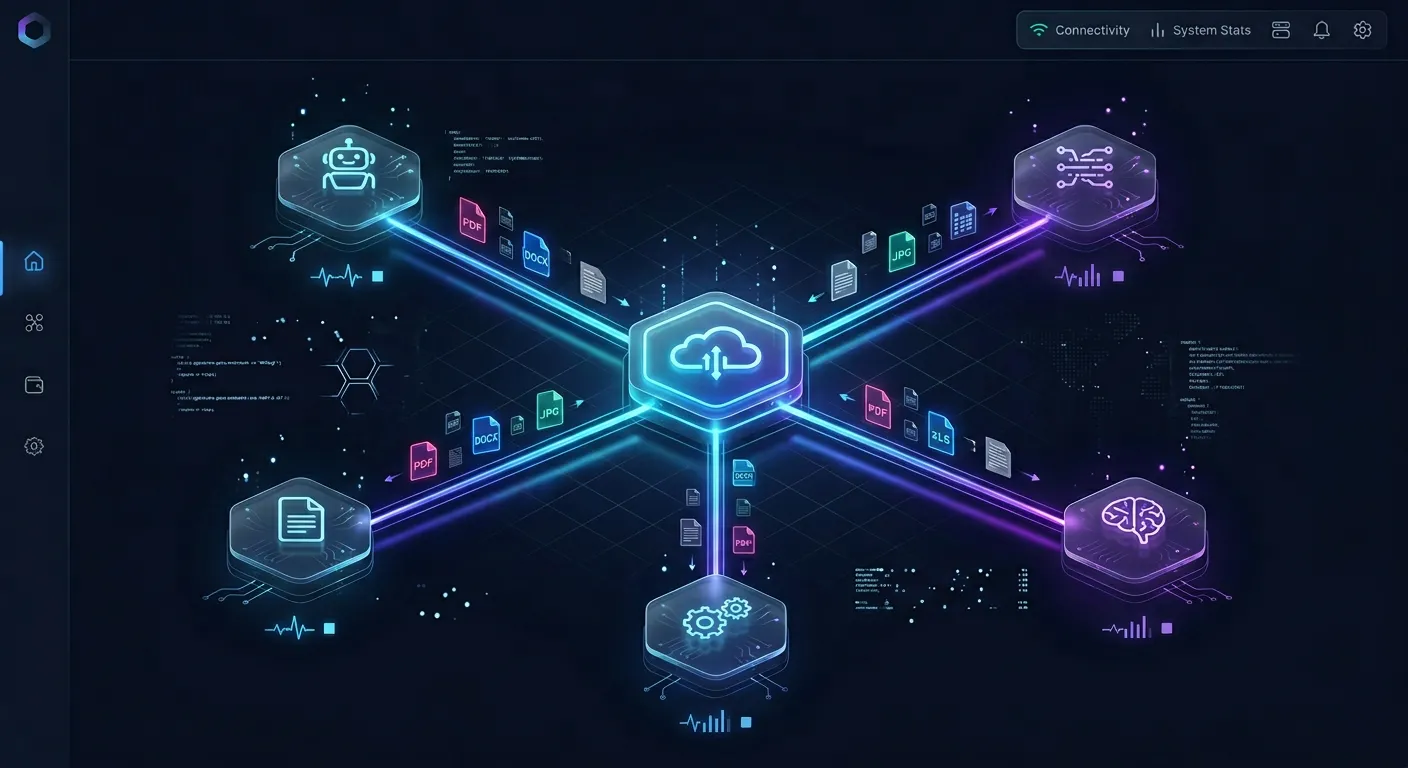


Index OneDrive files for fast Claude search
Connect your OneDrive folders to an intelligent workspace where files are indexed for hybrid search over a remote MCP server. Monthly plans start with a 30-day free trial.
Multi-Agent Coordination and Access Governance for Team Files
Production environments rarely confine AI work to a single chat interface. Engineering, research, and operations teams deploy multiple agents concurrently: Claude Desktop analyzing financial reports, Claude Code refactoring code in the terminal, Cursor building frontend components, and OpenClaw processing inbound data files. When multiple agents and human colleagues interact with files sourced from OneDrive, centralized governance is necessary to avoid overwrite conflicts and track file access.
Per-File Version History and Auditability
Every file in a Fastio workspace retains complete version history. If an agent writes an incorrect summary or overwrites a draft, prior versions remain accessible. Human teammates can inspect changes and restore any previous version with a single click.
Complementing version history, Fastio maintains a detailed activity log tracking every workspace event. Every file upload, sync event, agent query, and download is immutably recorded, providing full visibility into which agent or user accessed specific documents.
Coordinating Multi-Agent Writes with Advisory File Locks
To prevent race conditions during long-running agent tasks, Fastio supports advisory file locks. An agent acquires a lock lease through the MCP storage tool using lock-acquire, maintains it with lock-status, and releases it with lock-release. Because locks are advisory, they notify other agents and users of active work without causing permanent write blocks. Concurrent writes are preserved in version history, allowing team members to resolve differences collaboratively.
Scoped Client Sharing and External Delivery
Workspaces support branded shares (Send, Receive, and Exchange) that can be durable or expiring, configured with per-recipient access controls. External clients, vendors, and contractors can view, search, or upload files through a branded web interface without consuming an organization seat or requiring a Fastio account. A share can also disable file downloads when distributing confidential preview materials, providing granular control over enterprise document distribution.
Sources
References used to verify factual claims in this guide.
-
When a throttling threshold is exceeded, Microsoft Graph returns HTTP status code 429 Too Many Requests and requests fail.
Frequently Asked Questions
Why is Claude failing to connect to OneDrive?
Claude connection failures typically stem from three causes: unsupported personal Microsoft accounts on native enterprise connectors, missing Microsoft Entra tenant administrator consent for Files.Read permissions, or local filesystem connectors encountering 0-byte Files On-Demand placeholder stubs that fail to provide readable data.
How do I fix Claude OneDrive connector permissions in Microsoft 365?
To fix permissions on the native connector, a Microsoft Entra Global Administrator must grant tenant-wide consent for delegated Files.Read.All or Files.ReadWrite.All permissions. If your IT policy restricts third-party enterprise app consent, you can sync your target OneDrive folders into an intelligent Fastio workspace via user OAuth, bypassing tenant administrator approval.
Why does Claude time out when reading large OneDrive folders?
Claude times out because direct connectors execute recursive directory walks, downloading whole files sequentially over the network into the model context window. This sequential traversal consumes extensive time and triggers Microsoft Graph API HTTP 429 throttling limits, which stall execution.
What is the best alternative to Claude's native OneDrive connector?
The most effective alternative is syncing target OneDrive folders into a Fastio workspace. Fastio indexes incoming documents for hybrid semantic and keyword search, allowing Claude to query relevant excerpts through a remote Model Context Protocol server without pulling entire files or hitting API limits.
How do I fix 0-byte Files On-Demand errors in Claude Code?
To fix 0-byte errors locally, right-click the target folder in Windows File Explorer or macOS Finder and select Always keep on this device to force hydration. For cloud virtual machines or headless server environments where the desktop client cannot run, sync your files to a Fastio workspace and connect Claude Code via remote MCP.
Related Resources

Index OneDrive files for fast Claude search
Connect your OneDrive folders to an intelligent workspace where files are indexed for hybrid search over a remote MCP server. Monthly plans start with a 30-day free trial.