How to Connect Claude to Google Drive: Setup, MCP, and Team Workspaces
A Claude Google Drive integration enables Anthropic models to query, read, and cross-reference documents stored across Google Workspace without burning context windows on raw downloads. While Anthropic provides a native connector for web chats and private projects, production agent workflows require structured indexing. This guide covers native setup, Claude Code MCP configuration, and team workspace architecture.

How the Claude Google Drive Connection Operates
Connecting Claude directly to Google Drive sounds like the obvious way to give your AI assistants access to company knowledge, but the native connector breaks down the moment you move past personal document lookup. Individual chat attachments pull entire files into the conversation context window, and project integrations lock Drive access to private workspaces where multi-user teams and autonomous agents cannot collaborate.
A Claude Google Drive integration enables Anthropic models to query, read, and cross-reference documents stored across Google Workspace without burning context windows on raw downloads. Depending on your operational setup, you can connect through Anthropic's native web connector, integrate Claude Code using the Model Context Protocol (MCP), or coordinate multi-agent file retrieval through a dedicated cloud workspace layer. Each approach handles authentication, document parsing, and token consumption differently. Understanding these architectural mechanisms prevents bloated API bills and stalled agent loops.
Native Web Connector Versus Autonomous Agent MCP
Anthropic provides built-in Google Workspace connectors directly within the Claude web interface and desktop application. This native implementation uses OAuth 2.0 delegation to access user files. When an authorized user prompts Claude to inspect a document, the platform contacts the Google Drive API, retrieves the document body, converts it to plain text, and injects that text into the current prompt context.
While this flow works well for interactive conversational queries, it is tied to an individual browser session. Autonomous coding agents like Claude Code operate in headless terminal environments, continuous integration runners, and remote servers. These tools cannot interact with browser popups or interactive OAuth permission screens on every query.
To bridge this gap, developers turn to the Model Context Protocol. MCP defines a standardized JSON-RPC protocol over standard input/output (stdio) or HTTP transports. An MCP client like Claude Code connects to an MCP server, queries available tools, and issues structured requests to read, list, or search files. This decoupling separates the AI reasoning model from the storage authentication mechanics.
The Context Window Bottleneck in Document Ingestion
The most significant technical challenge when connecting Claude to Google Drive is context window consumption. Even with large context windows available in modern Claude models, dumping full document contents into the prompt remains inefficient and expensive.
When the native connector reads a Google Doc, it ingests the entire file text into the prompt. A 40-page technical specification or a 100-page quarterly financial report consumes tens of thousands of tokens before Claude generates a single word. If you attach four related documents to cross-reference customer contracts, the prompt consumes context headroom quickly, driving up per-query costs and increasing inference latency.
Furthermore, naive full-document ingestion introduces the lost-in-the-middle problem, where LLMs struggle to recall specific details buried in massive context blocks. Effective integrations avoid full-document loading by using semantic search and retrieval augmented generation (RAG) to locate precise paragraphs, returning only the relevant excerpts to the model.
Comparing Connection Methods for Anthropic Models
Teams deploying Anthropic models must select an integration method that matches their concurrency requirements, privacy boundaries, and development environments. The following comparison highlights the operational differences across common approaches:
Related guides
- Cursor Google Drive Integration: Connect Specs via MCPConnecting Cursor to Google Drive through the Model Context Protocol gives coding agents direct access to technical...
- How to Connect Copilot to Google Drive via MCPA Copilot Google Drive MCP setup connects GitHub Copilot agent runtime to Google Drive files via the Model Context...
- How to Connect Claude to Google Drive: Native Setup vs Fast.io MCP WorkspacesAnthropic provides a native Claude Google Drive connector for Team and Enterprise tiers, but administrative gates and...
- Claude Code Google Drive MCP: Connecting Terminal Agents to DriveClaude Code Google Drive MCP connects Anthropic's command-line agent to Google Drive files through the Model Context...
- How to Connect Claude to Google Drive: A Complete GuideGetting your Google Drive files into Claude's context is more annoying than it should be. This guide covers the main...
- Can Claude Access Google Drive? Permissions, Limits & Fast.io WorkspacesClaude cannot directly browse entire Google Drive file hierarchies in standard web chat, but users can grant access...
More on this subject: Claude and Claude Code (278 guides)
Steps to Set Up the Native Claude Google Drive Connector
Setting up Anthropic's native Google Drive connector provides quick access to cloud files without writing code or managing terminal configurations. This setup links your personal Google account to Claude's web or desktop application, enabling interactive document analysis, meeting note summaries, and drafting workflows directly inside the conversational chat box.
Before proceeding, confirm that you have an active Claude account and appropriate read permissions for the target Google Drive folders. If you use a Google Workspace account managed by an employer or institution, you may also require domain administrator authorization before third-party connectors can link to your drive storage. Reviewing folder permissions and organizational policies in advance ensures that document lookups proceed smoothly without authorization interruptions.
Enabling the Connector in Claude Settings
To activate the native Google Drive integration in Claude:
- Open Claude in your web browser or desktop app and navigate to your account settings by clicking your profile icon in the bottom left corner.
- Select the "Connectors" menu item from the settings sidebar.
- Locate the Google Workspace entry (which includes Google Drive, Gmail, and Google Calendar) and click "Connect".
- A Google OAuth consent window will appear. Select the Google account hosting your documents.
- Review the requested permissions. Claude requests access to view, search, and manage your Google Drive files, as well as view metadata and export document text.
- Click "Allow" to grant permissions and complete the connection.
Alternatively, you can initiate this flow directly from an open chat conversation by clicking the plus icon next to the message input box, hovering over "Connectors", and choosing Google Drive.
Google Workspace Domain Requirements and Admin Approvals
If you use a corporate Google Workspace account under a Team or Enterprise tier, your organization administrator must approve third-party connectors before individual users can authenticate.
Administrators must navigate to the Google Workspace Admin Console under Apps > Google Workspace Marketplace apps > Access list. The domain policy must allow API access for Anthropic's client ID. If your IT department restricts unvetted OAuth applications, the connection will fail with an authorization error during the OAuth redirect.
Once domain-level approval is in place, Claude respects your existing Google Drive permissions. Claude cannot read files that your authenticated Google account does not have permission to view. If an internal document is restricted to specific department groups, Claude respects those access control lists.
Attaching Documents to Chats Versus Claude Projects
After connecting your account, you can reference Google Drive files in two ways:
- Direct Chat Attachments: In any standard conversation, click the plus icon, select "Add from Google Drive", and browse your recent documents or paste a specific Google Doc URL. Claude fetches the latest revision of the file and includes it in your prompt context.
- Claude Projects Knowledge Base: If you use Claude Pro or Team, you can attach files to a Project. Open your project, navigate to the "Files" tab, click the plus icon, and select Google Drive. This makes the document available as persistent reference material across all conversations inside that project.
There is a critical limitation to note: Anthropic restricts the Google Drive connector to private projects. If you create a shared project to collaborate with teammates, the Google Drive connector option is disabled. Anthropic implements this safeguard to prevent cross-user permission leakage, but it prevents teams from building shared company knowledge bases directly on top of native Drive links.
Native Document Extraction Constraints
The native integration is optimized for standard Google Docs, but real-world business drives contain complex formats. The connector extracts plain body text only. It ignores embedded images, charts, spreadsheet calculations, diagrams, comments, and suggested revisions.
If your team relies on financial spreadsheets in Google Sheets, complex presentations in Google Slides, or scanned PDF contracts stored in Drive, the native text extractor frequently misses essential tabular structures and numerical context. For structured data extraction and non-text formats, teams require an intelligent extraction pipeline rather than a plain text dump.
How to Configure Claude Code for Google Drive with MCP
Claude Code brings Anthropic models directly into your command line and IDE terminal, enabling automated code refactoring, test generation, and architectural analysis. However, Claude Code cannot use the browser-based Google Workspace connector available on the web. It operates in non-interactive developer environments where browser-driven authentication sessions do not exist.
Connecting Claude Code to Google Drive requires the Model Context Protocol. By exposing Google Drive files as an MCP server, you provide Claude Code with tools to search, list, and read documents while executing development tasks. This setup enables terminal agents to inspect architectural blueprints, API documentation, and engineering requirements stored in cloud folders without leaving the shell.
Why Terminal Coding Agents Need MCP Rather than Browser OAuth
Coding agents execute non-interactive commands. They run inside developer terminal sessions, automated scripts, and continuous integration pipelines. A terminal agent cannot stop execution to present a Google login popup or prompt a human to complete two-factor authentication in a web browser.
MCP solves this problem by defining explicit tool contracts. An MCP server runs as a background process or a remote service, manages authentication tokens independently, and presents standard tool functions to Claude Code. When Claude Code needs to inspect a technical design doc or API specification in Google Drive, it invokes the tool through JSON-RPC.
Configuring a Google Drive MCP Server in Claude Code
To connect Claude Code to an MCP server, you define the server configuration in your project's .mcp.json file or in your user configuration file (~/.claude.json).
Community Google Drive MCP servers typically run locally using Node.js or Python. Setting one up requires creating a project in Google Cloud Console, enabling the Google Drive API, configuring OAuth desktop credentials, and downloading a credentials.json secret file.
Here is an example configuration adding a local Google Drive MCP server to Claude Code:
{
  "mcpServers": {
    "google-drive": {
      "command": "node",
      "args": ["/path/to/google-drive-mcp/build/index.js"],
      "env": {
        "GDRIVE_CREDENTIALS_PATH": "/path/to/credentials.json",
        "GDRIVE_TOKEN_PATH": "/path/to/token.json"
      }
    }
  }
}
Once configured, launch Claude Code in your terminal:
claude
Run /mcp inside the interactive session to verify that the Google Drive server is connected and check the list of available tools. You can now prompt Claude Code to inspect project requirements stored in your Drive.
Operational Obstacles with Local MCP Stacks
While running a local stdio MCP server enables basic file reads, developers quickly encounter operational maintenance hurdles:
- Token Expiration Loops: Local OAuth tokens expire regularly. When a token expires during an automated agent run, Claude Code crashes or hangs waiting for credential renewal.
- Google API Rate Limits: The Google Drive API enforces per-user and per-project request quotas. When an agent crawls a nested folder hierarchy or searches through hundreds of files, it triggers HTTP
429 Too Many Requestserrors. - Credential Sprawl: Distributing raw client secrets and OAuth refresh tokens across individual developer machines creates significant security exposure. There is no central audit trail recording which files the agent inspected.
- Local Machine Dependencies: A local stdio server cannot serve remote agents, cloud workers, or teammates without requiring every person to replicate the entire GCP project setup.


Index Google Drive Files for Claude Without Context Bloat
Connect your cloud documents to a persistent workspace with semantic search and a remote MCP endpoint. Monthly plans start with a trial of up to 14 days (credit card required); annual plans have no trial.
Why Persistent Workspaces Solve Agent Context Limits
When teams move from prototype scripts to production agent workflows, raw file connectors become a serious bottleneck. Autonomous agents need fast, indexed document retrieval with granular permissions, without exhausting model context windows or maintaining fragile local credentials across multiple machines.
Fast.io Workspaces provide an intelligent workspace platform designed specifically for agentic teams. Instead of forcing Claude to download raw Google Drive files on every prompt, Fast.io acts as a shared persistence and indexing layer that bridges your existing cloud files to Anthropic models. Teams maintain their existing storage while agents gain targeted search access through a single remote endpoint, eliminating context saturation and improving reasoning accuracy across multi-document tasks.
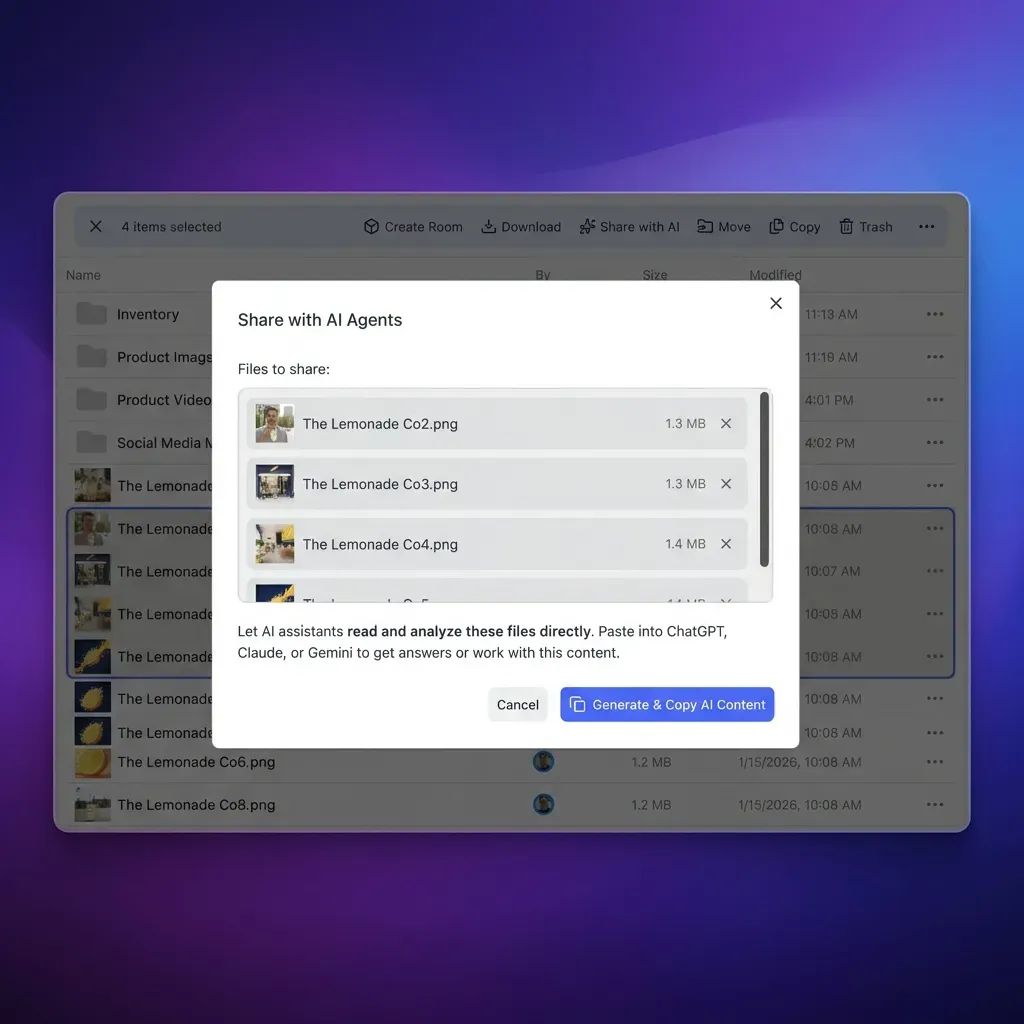
Eliminating Context Bloat with Semantic Search
The fundamental flaw in direct file connectors is that they pull entire documents into prompt memory. If an engineer asks Claude Code to check an architectural guideline stored in a 60-page PDF, downloading the entire file burns context window capacity and slows down response times.
In an intelligent workspace, files are indexed automatically upon arrival. Fast.io's Intelligence Mode parses documents and builds a hybrid index combining full-text keyword search and semantic vector embeddings.
When an Anthropic model queries the workspace, it calls the MCP search function and receives concise, relevant excerpts with page-level citations. The model reads the exact paragraphs required to answer the question, keeping context windows lean and inference speeds fast. Explore how Fast.io AI powers document intelligence for agent workflows.
Keeping Existing Storage Intact with Cloud Import
Adopting an intelligent workspace does not require moving off Google Drive. Teams maintain their existing folders and daily authoring workflows inside Google Docs and Google Drive.
Fast.io provides direct cloud import, allowing you to pull folders and files from Google Drive, Dropbox, Box, and OneDrive via OAuth with folder structures preserved. Fast.io supports automated bidirectional cloud sync for Google Drive, Dropbox, Box, and OneDrive.
Once imported into a Fast.io workspace, documents become immediately available for AI indexing and multi-agent access without drawing down Google Drive API quotas on every LLM prompt. If you are comparing cloud storage options, review our guide to Google Drive alternatives.
Remote MCP Architecture Without Local Server Overhead
Unlike local community MCP servers that require Node.js runtimes, GCP projects, and local credential tokens on every machine, Fast.io operates a hosted, remote MCP server over Streamable HTTP at https://mcp.fast.io/mcp/code.
To connect Claude Code, run claude mcp add --transport http fastio https://mcp.fast.io/mcp/code, then run /mcp inside Claude Code to sign in. A project .mcp.json entry needs "type": "http" and "url":
{
  "mcpServers": {
    "fastio": {
      "type": "http",
      "url": "https://mcp.fast.io/mcp/code"
    }
  }
}
Sign-in shows a Review Permissions screen where you pick Read Only or Read & Write and choose which organizations and workspaces the connection can reach.
The remote MCP server exposes the search tool for querying indexed documentation. When Claude Code needs to reference company documentation, it calls the search tool, passing a natural language query. Fast.io executes the semantic search against the indexed workspace and returns precise results with source references. Configure your environment using the Fast.io setup documentation and review endpoint technical contracts using the https://mcp.fast.io/skill.md reference.
Verified Performance in Multi-Document Retrieval
In benchmark testing published at Fast.io Benchmarks, Fast.io finished the task fastest and at the lowest cost. By offloading parsing, indexing, and vector similarity search to the workspace layer, Claude avoids downloading complete file payloads, resulting in faster turnarounds and predictable token consumption.
How to Manage Permissions, Audit Logs, and Safe Handoffs
Security is the primary reason enterprise IT departments block direct Google Drive integrations for AI models. Personal OAuth tokens grant broad access across a user's entire drive, creating serious risks of accidental data leakage or prompt injection attacks accessing sensitive records.
Intelligent workspaces solve this governance challenge by establishing strict security boundaries around agent activities. By isolating agent access to specific workspaces and recording every file transaction in a detailed activity log, teams can safely deploy autonomous agents without exposing confidential customer or executive data. Granular scoping ensures that models only see what their immediate operational assignments require, while maintaining full accountability across every read and write operation executed during automated workflows.
Scoping Access Below the Google Drive Account Level
A direct Google Drive connection exposes everything the authenticated user can view. If a developer connects their corporate Google account, any agent tool with Drive access could theoretically query compensation documents, executive emails, or legal memos stored in that user's drive.
Fast.io provides granular access controls configured at the organization, workspace, folder, and individual file level. Administrators can create a dedicated workspace for a specific project, import only the relevant documentation, and generate an API key scoped strictly to that single workspace.
Even if an autonomous agent runs uncontrolled prompts or encounters malicious user input, it remains bounded by the workspace perimeter and cannot touch broader company assets. Learn more about secure storage for AI agents.
Tracking File Operations with the Activity Log
When autonomous agents read, write, and manipulate documents, maintaining an accurate chain of custody is mandatory for enterprise compliance. Direct Drive connections offer minimal visibility into what specific sections an AI inspected.
Fast.io maintains a detailed activity log that records every file operation, query event, and permission modification. When Claude Code or another agent queries documentation, the audit trail captures:
- The exact timestamp of the action
- The authenticated API key or agent identity
- The specific workspace and file identifiers accessed
- The search queries executed and documents returned
The activity log records actions by people and agents and is retained according to your plan. In addition, every file retains full version history, allowing teams to review previous revisions and roll back modifications if an agent produces an incorrect edit.
Agent-to-Human Ownership Transfer
In modern development workflows, an AI agent often acts as an automated setup worker. An agent might pull documentation from multiple cloud sources, organize folder structures, index knowledge bases, and generate client-ready project workspaces.
Fast.io supports clean ownership transfer. An agent can set up an organization and populate its workspaces, then generate a secure claim link to transfer primary ownership to a human administrator. Once the human claims the organization and attaches payment details, the agent retains scoped admin access to continue its operational duties without handling billing credentials directly.
How to Troubleshoot Connection and Retrieval Failures
Connecting Claude to cloud document stores involves multiple network layers, authentication handshakes, and file parsing steps. When documents fail to load or search queries return empty answers, teams must systematically isolate whether the problem stems from OAuth token expiry, Google Workspace tenant restrictions, or context window saturation.
The following troubleshooting recommendations cover the most frequent failure modes encountered when connecting Claude and Claude Code to Google Drive, along with proven mitigation patterns for production agent environments. Following these diagnostic procedures allows engineering leads to restore reliable document retrieval without compromising account security or blowing through API usage limits across collaborative projects.
Diagnosing OAuth Token Failures and Re-Authentication Loops
If Claude repeatedly asks you to reconnect your Google account or reports authentication errors when accessing files, check the following points:
- Token Revocation in Google Security: Check your Google Account Security settings under "Third-party apps with account access". If Anthropic or your MCP client is listed multiple times, revoke older authorizations and re-authenticate cleanly.
- Workspace Session Duration: Google Workspace administrators often enforce strict session limits, expiring OAuth refresh tokens after 12 or 24 hours. If your company enforces short session policies, automated agent runs will fail once the session expires.
- Fix with Hosted MCP: Replace local OAuth tokens with long-lived, scoped API keys pointing to a hosted workspace platform like Fast.io. The remote server handles infrastructure persistence, eliminating local token expiration errors.
Handling Complex Formats and Structured Document Extraction
When Claude reads Google Docs directly, it cannot parse complex tables, scanned images, or multi-tab spreadsheets effectively.
If your workflows require extracting structured data from invoices, contracts, financial sheets, or technical schematics, use Metadata Views. Metadata Views turn unstructured PDFs, spreadsheets, and scanned documents into a typed database. You define the fields you need in natural language, and AI populates typed columns (Text, Integer, Decimal, Boolean, Date, URL, JSON) without manual OCR rules.
Agents can then query structured metadata fields directly via MCP rather than attempting to parse messy text dumps.
Production Deployment Checklist for Agentic Document Access
Before rolling out agent-based document access across your team, follow this verification checklist:
- Audit Sensitive Data: Ensure Google Drive folders containing personal identification records, secret credentials, or proprietary source code are excluded from agent access scopes.
- Choose the Right Connection Surface: Use Claude's native web connector for personal, one-off Q&A sessions. Use remote MCP endpoints for Claude Code, CI pipelines, and multi-agent workflows.
- Verify Project Visibility: Remember that native Claude Drive attachments do not work in shared Claude Projects. Use shared Fast.io Workspaces when multiple team members and agents need access to the same document pool.
- Monitor Context Headroom: Avoid pulling full multi-megabyte files into conversations. Use semantic search tools to retrieve targeted excerpts with citations.
- Establish Billing and Access: Fast.io's monthly plans start with a trial of up to 14 days requiring a credit card; annual plans have no trial. Paid subscription plans scale across Starter, Business, and Enterprise tiers based on team storage and credit volume requirements:
Review complete plan options on the Fast.io pricing page.
Sources
References used to verify factual claims in this guide.
-
Google Workspace connectors for Drive are available across Claude and Claude Desktop accounts.
-
The native Claude Google Drive integration extracts body text while ignoring charts, comments, suggestions, and images.
Frequently Asked Questions
How do I connect Claude to Google Drive?
To connect Claude to Google Drive in the web interface, open Account Settings, select Connectors, locate Google Workspace, and click Connect to authorize your Google account. Alternatively, click the plus icon in any chat, hover over Connectors, and toggle Google Drive on. For terminal agents like Claude Code, configure a remote MCP endpoint in your mcp.json file using an API key.
Does Claude have direct access to Google Docs?
Yes, Claude can access Google Docs directly once authenticated through the native Google Workspace connector or an MCP server. In the web interface, Claude retrieves the body text of the document to inform its response. However, native access is limited to plain text and does not interpret embedded images, charts, formulas, comments, or suggested edits.
Can Claude Code read files from Google Drive?
Claude Code cannot use the browser-based Google Workspace connector directly, but it can read files from Google Drive when connected via the Model Context Protocol. You can configure a local stdio MCP server or point Claude Code to a remote MCP endpoint like Fast.io, which imports Google Drive documents and exposes a search tool for semantic search.
Why is Google Drive disabled in shared Claude Projects?
Anthropic restricts the native Google Drive connector to private Claude Projects to prevent cross-user permission leakage and unauthorized access. If you need multiple team members and agents to query the same document collection, use a dedicated shared workspace platform like Fast.io, where permissions are managed at the organization and workspace level.
What file types can Claude read from Google Drive?
Through the native connector, Claude can read text content from Google Docs, Google Sheets, Google Slides, PDFs, Microsoft Office files, and plain text files. Embedded media, charts, and image-based scans are not processed. For structured data extraction from complex tables, forms, or scanned PDFs, use an intelligent extraction layer like Fast.io Metadata Views.
How does using Fast.io MCP differ from connecting Google Drive directly to Claude?
Connecting Google Drive directly pulls full document text into Claude's prompt context, which quickly consumes context window limits and increases token costs. Fast.io indexes imported documents automatically for hybrid semantic search. Through its remote MCP server, Claude queries the workspace and retrieves only relevant excerpts with citations, reducing context consumption while enabling multi-user and multi-agent collaboration.
Related Resources

Index Google Drive Files for Claude Without Context Bloat
Connect your cloud documents to a persistent workspace with semantic search and a remote MCP endpoint. Monthly plans start with a trial of up to 14 days (credit card required); annual plans have no trial.