Box File Request vs Intelligent Agent Rooms: Inbound File Intake Comparison
Inbound file intake requires more than dumping documents into static folders. While Box File Request collects files through simple web links, intelligent agent rooms transform incoming payloads into active workspaces where autonomous agents and human teams index, extract, and query documents immediately upon arrival.


Why Legacy Inbound Dropboxes Fall Short for Autonomous Teams
When an external vendor, client, or contractor uploads a batch of files through an intake link, traditional cloud storage treats the transfer as finished the moment the bytes hit disk. The destination folder stores the payload, fires an email notification, and goes silent. For teams coordinating autonomous AI agents alongside human specialists, file intake is not the conclusion of a transaction. It is the operational trigger. Inbound invoices, legal records, project specifications, and raw datasets require immediate triage, structured extraction, semantic indexing, and collaborative validation before downstream work can proceed. Treating file collection as an isolated deposit creates friction, forcing operators to manually move files across systems, re-index contents, and run disparate validation scripts.
Box File Request enables external parties to securely upload files into a Box folder via an authenticated or public link without gaining access to the rest of the workspace. It provides a clean, controlled method for collecting assets into standard enterprise folder hierarchies. Intelligent agent rooms, by contrast, treat inbound intake as an active operational environment where AI agents and human teammates inspect, analyze, and query files the moment they arrive.
The Operational Mechanics of Box File Request
Box File Request operates as an inbound upload portal attached to a specific folder in a Box account. A user with a Box Business plan or higher selects a target directory, opens the sharing pane, and generates a dedicated URL. The creator can customize the submission interface by adding a title, instructions, and form fields. Submitters do not need a Box account by default, though administrators can enforce Box login or email verification for sensitive enterprise environments.
To capture context alongside raw files, Box allows folder owners to add specific metadata fields to the upload form. These fields map to enterprise metadata templates configured in the Box admin console, letting uploaders input text strings, dates, or dropdown selections before submitting. Files are uploaded directly to the destination folder using short-lived authorization tokens that expire after 24 hours. In terms of batch intake volume, Box File Request allows users to upload up to 500 files at a time through the upload form. Uploaders can submit individual files, but cannot upload nested folder structures, and each folder supports only one active file request form at a time.
Where Traditional Inbound Dropboxes Stop
The primary limitation of traditional file requests is architectural: the system boundary terminates at the storage bucket. Once files land in Box, they sit passively. The uploader receives a confirmation screen, and the recipient receives an email or activity notification. Moving from stored files to action requires external scaffolding.
To process inbound submissions automatically, organizations must configure Box Relay workflows, wire up webhooks to external microservices, or run polling scripts against the Box API. When modern teams introduce autonomous AI models into this flow, the separation becomes painful. A coding agent in Claude Code, an extraction agent in Cursor, or a research agent in OpenClaw cannot inhabit the Box folder. They cannot converse with human reviewers in context, cannot query cross-document relationships without custom indexing pipelines, and cannot leave persistent audit trails within the intake space. Traditional storage acts as a digital mail slot, whereas modern agentic operations require a shared operations room.
Related guides
- Dropbox File Request vs Intelligent Rooms: Modernizing File Intake for AI TeamsTraditional Dropbox file requests collect documents into isolated folders, leaving incoming files dormant until manual...
- Notion File Upload Limits: Size Caps by Plan and Large-File WorkaroundsNotion limits individual file uploads to 5MB on the Free plan and provides unlimited file uploads with a 5GB maximum...
- Box File Size Limit: Upload Caps by Plan and Large-Corpus AI SearchBox documents an individual file upload limit across account plans, ranging from 250 MB on free accounts to 5 GB on...
- NAS File Server vs. Agent Rooms: Modernizing Team StorageComparing a traditional nas file server setup with cloud-based agent rooms highlights a core shift in team storage....
- How to Read Files Line by Line in Python (and Avoid Agent Token Bloat)Reading files line by line in Python prevents system memory exhaustion and AI agent token bloat. Using native iterators...
- Why SMB File Shares Fail for AI Agents (And What to Use Instead)Traditional SMB file share systems were designed for local office local area networks, not distributed autonomous...
More on this subject: Agent File and Document Workflows (325 guides)
How Box File Request Compares to Intelligent Agent Rooms
Comparing Box File Request with intelligent agent rooms highlights two distinct design philosophies for file intake. Box approaches intake from the perspective of centralized enterprise file administration: secure the perimeter, restrict folder visibility, collect files into static directories, and enforce administrative governance across human employees. Intelligent agent rooms approach intake from the perspective of collaborative execution: establish a shared workspace where humans and autonomous software agents possess the tools, memory, and contextual awareness needed to work together on incoming files immediately. In an agent room, intake is not an administrative chore relegated to background folder sync; it is the front door to an automated, intelligent analysis pipeline built on shared storage for agents.
Intake Mechanics and Interface Boundaries
In Box File Request, external contributors see a standalone web form. They upload documents into a blind drop: they cannot inspect what others have submitted, view previous versions, or communicate with the folder owner through the intake interface. Inside Box, team members see the files appear in standard directory lists. If an uploader submits five revised drafts over two weeks, managing duplicates and version history often falls back on manual naming conventions or folder rules.
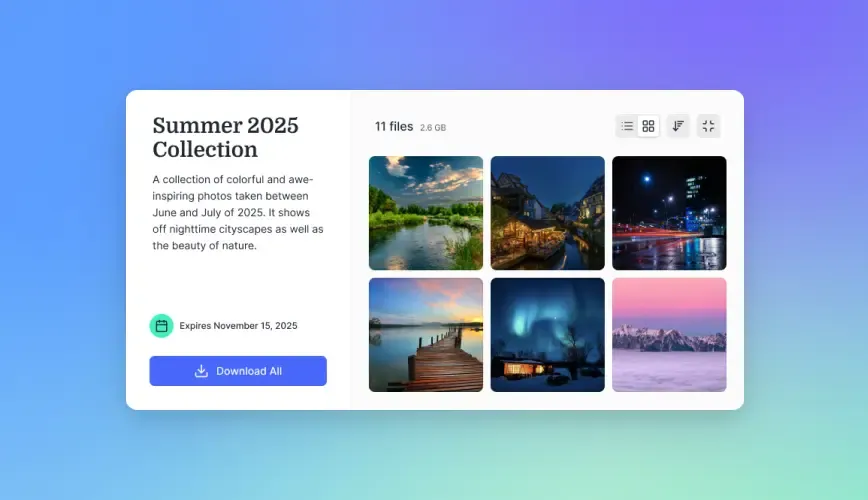
In Fast.io, file collection is built on flexible, org-owned workspaces and branded shares. Teams configure Send, Receive, or Exchange shares depending on the required interaction model. A Receive share creates a branded inbound portal where clients or partners drop files without requiring an account. Unlike static dropboxes, these shares connect directly to intelligent workspaces. Files arriving through a share enter an environment equipped with real-time activity tracking, immutable per-file version history, and instant semantic search.
From Static Form Fields to Automated Extraction
The operational contrast is clearest in how metadata is gathered. Box File Request requires the submitter to do the manual work. If a company wants to capture an invoice number, vendor ID, and due date, an administrator must build a metadata template in advance and mark those fields on the intake form. If an uploader types the date in the wrong format, leaves an optional field blank, or pastes an invalid identifier, the incoming file lands with flawed data.
Intelligent agent rooms decouple document intake from form entry. Submitters upload raw files without filling out tedious attribute questionnaires. The workspace intelligence layer inspects incoming payloads, identifies content patterns, and extracts structured values automatically. This shift removes friction for the submitter while improving data fidelity for the team processing the intake.
How to Connect Inbound File Intake Pipelines to the Model Context Protocol
For software developers, AI engineers, and technical operations leads, the true dividing line between legacy cloud storage and modern agent infrastructure is how easily autonomous software can interact with files. In a Box environment, giving an AI model access to inbound uploads requires registering a custom application in the Box Developer Console, configuring OAuth2 or JWT authentication, obtaining enterprise admin approval, and writing boilerplate integration code to fetch file blobs and stream them into an LLM context. This operational overhead slows development and creates fragile middleware.
Fast.io eliminates this integration friction by providing native Model Context Protocol (MCP) support. MCP has emerged as the open standard for connecting AI models to external tools, databases, and file systems. Instead of writing custom API wrappers for every agent framework, teams connect Claude Code, Cursor, Gemini, OpenClaw, or custom agents directly to Fast.io using standard MCP configuration, while ChatGPT and Codex connect through the Fastio plugin, enabling autonomous agents to participate directly in inbound file intake.
Configuring Agent Access via MCP
Fast.io exposes its consolidated MCP toolset over Streamable HTTP at https://mcp.fast.io/mcp/tools, and at https://mcp.fast.io/mcp/code for coding agents (while Codex connects through the Fastio plugin or its custom MCP server at https://mcp.fast.io/mcp/operations). Connecting an agent requires adding the remote MCP endpoint and an API key, sent as a Bearer header, to the client's configuration file.
In modern development environments and MCP clients, the configuration points directly to the hosted server URL:
{
  "mcpServers": {
    "fastio": {
      "url": "https://mcp.fast.io/mcp/tools",
      "headers": {
        "Authorization": "Bearer YOUR_FASTIO_API_KEY"
      }
    }
  }
}
Once connected, the agent has programmatic access to workspace storage, search, and collaboration tools. When an external partner drops files into a Receive share, an agent can discover the new items, inspect directory trees, search file contents, and retrieve document text directly through standardized tool calls. Developers can consult the official documentation at https://docs.fast.io/, review https://mcp.fast.io/skill.md for tool descriptions, or explore https://fast.io/llms.txt for automated agent onboarding details.
Event-Driven File Processing Without Polling Loops
A persistent issue in programmatic file intake is latency. How does an autonomous agent know a new file has arrived? In traditional cloud drives, developers frequently resort to periodic cron polling, repeatedly hitting list endpoints to check for new timestamps. This consumes API quotas and introduces processing delays.
Fast.io provides real-time event mechanisms designed for agentic workflows. Coordination rooms support webhooks for room messaging and participant updates, including room.message.created and room.participant.status_changed. For workspace-level file activity, agents can maintain an active WebSocket connection or use the activity long-poll endpoint (GET /current/activity/poll/{entity_id}) to wait for file changes without hammering the server.
When an inbound document arrives, the agent wakes up, inspects the file, extracts necessary data, and posts its analysis directly into a shared Collaborative Note or room message feed. Human operators can review the agent's work, ask follow-up questions, and guide next steps in the same shared venue.


Coordinate Inbound File Intake with Agent Rooms
Create shared workspaces where autonomous agents and human teams ingest, extract, and query documents through the Model Context Protocol. Monthly plans start with a trial of up to 14 days (credit card required); annual plans have no trial.
Structuring Inbound Payloads with Automated Metadata Views
A major failure mode in enterprise file collection is the unstructured document bottleneck. Organizations receive hundreds of contracts, purchase orders, medical forms, or technical schematics, but business logic depends on specific data points trapped inside those files. Box attempts to solve this before the upload occurs, relying on manual form fields. Fast.io solves this after the upload occurs, transforming raw documents into structured data using Metadata Views. By separating the mechanical act of file transfer from the analytical work of document parsing, teams eliminate submitter form fatigue while gaining a clean, queryable interface for all inbound assets. This architecture allows organizations to ingest high-volume documentation continuously without waiting for human data entry.
The Friction of Pre-Submission Metadata Forms
When an external supplier or client opens a file intake link and sees a dozen mandatory form fields, submission drop-off spikes. External submitters often do not know internal project codes or cannot be bothered to re-type data that already exists on the first page of the PDF they are uploading. When fields are optional, submitters skip them. When fields are mandatory, submitters enter placeholder text like 'N/A' or 'TBD' to bypass the requirement.
This shifts the burden back to internal staff, who must open every uploaded file, locate the relevant information, and manually type it into internal databases. Box File Request simplifies the initial file transfer, but it leaves the downstream data extraction problem entirely unsolved.
Automated Schema Extraction in Fast.io
Fast.io addresses document structuring through Metadata Views, which turn workspace documents into a live, queryable database. Rather than building rigid templates or training custom OCR coordinate models, users describe the target fields in natural language, such as 'extract the invoice number, counterparty name, total amount, line items, and payment terms.'
The extraction system automatically designs a typed schema across text, integer, decimal, boolean, URL, JSON, and date/time fields. It reads incoming PDFs, high-resolution images, Word documents, spreadsheets, presentations, and scanned pages, populating a sortable, filterable spreadsheet directly within the workspace. If business requirements evolve and the team needs to track a new data point, such as tax identification numbers, they can add a new column to the view at any time without re-uploading or reprocessing the original files.
This extraction layer works harmoniously with autonomous agents. Connected via MCP, agents can query Metadata Views directly, filtering documents by specific extracted attributes or populating external ERP and CRM systems with validated data. Metadata Views handle structured document extraction, complementing Intelligence Mode, which powers semantic full-text search and citation-backed document chat across the entire workspace.
How Agent Rooms Manage Concurrency, Versioning, and Ownership Transfer
Deploying autonomous agents into file intake workflows introduces new operational questions: Who modified this document? What happens if two agents process the same intake folder concurrently? How does a development team hand off an agent-built intake workspace to a client or department head? Effective file intake demands rigorous governance, clear auditability, and clean handoff mechanisms. Without transparent versioning and structured ownership transitions, automated workflows risk silently corrupting data or locking teams out of core administrative controls. Fast.io provides the infrastructure necessary to ensure complete operational integrity, clear provenance, and direct human oversight across the entire lifecycle of an agent room.
Multi-Agent Concurrency and Activity Logging
In a multi-agent environment, race conditions pose a genuine threat to data integrity. If an intake agent is extracting tables from an uploaded contract while a summarization agent writes a digest, pointing both tools at standard file system paths can lead to overwritten files or corrupted outputs. Traditional cloud drives rely on coarse file locking or create conflicted copy duplicates that clutter folders.
Fast.io maintains strict data hygiene through per-file version history and a detailed activity log. Every write operation creates an immutable version of the file rather than overwriting prior states. The activity log records every action, recording which human user or agent touched a file, what time the action occurred, and what changes were made. If an agent produces an inaccurate summary or a teammate needs to inspect the original unmodified upload, previous versions are preserved and can be restored instantly.
Handoff Workflows and Ownership Transfer
A unique advantage of Fast.io agent rooms is the native support for agent-to-human ownership transfer. In modern consulting and software development, technical teams often deploy autonomous agents to configure client workspaces, set up intake shares, and establish document schemas. An agent can programmatically create the organization, organize folder hierarchies, configure branded Receive shares, and connect the workspace to external data sources.
Once the intake architecture is established, the agent can transfer ownership of the organization to the human client or business lead. The human principal assumes administrative control, manages billing on Fast.io pricing plans, and oversees organizational security, while the agent retains scoped administrative or contributor access to continue performing ingestion, indexing, and extraction tasks. This workflow provides a clean bridge between automated setup and ongoing human governance.
Sources
References used to verify factual claims in this guide.
-
Box File Request allows users to upload up to 500 files at a time through the upload form.
Frequently Asked Questions
Do submitters need a Box account to upload files through a Box file request?
No. By default, external uploaders do not need a Box account to submit files through a Box File Request link. However, Box account owners and administrators on Business plans or higher can toggle link settings to require submitters to log in to Box or provide email verification before uploading.
How do you create a file request link in Box?
To create a file request link in Box, select the destination folder in the Box web application, open the Sharing pane on the right side of the screen, and click Create Link under File Request. From there, you can click Edit to customize the form title, add instructions, insert metadata fields, and configure security options before copying the public link or embed code.
How does inbound file intake differ between Box File Request and Fast.io agent rooms?
Box File Request functions as a one-way upload portal that deposits files into a static folder, relying on manual form fields for metadata. Fast.io agent rooms provide a collaborative workspace where files arriving via branded Receive shares are immediately indexed for semantic search, processed by automated Metadata Views, and accessible to autonomous AI agents via the Model Context Protocol.
Can AI agents interact directly with files uploaded through Box File Request?
Interacting with Box files using AI agents requires custom development using the Box REST API, OAuth2 or JWT authentication, and external integration pipelines to fetch files and manage context. Fast.io provides native Model Context Protocol (MCP) endpoints, allowing agents in Claude Code, Cursor, OpenClaw, or custom frameworks to inspect, read, search, and extract document data directly through standardized tools, while ChatGPT and Codex connect through the Fastio plugin.
How does Fast.io extract structured data from uploaded documents without manual forms?
Fast.io uses Metadata Views, which allow users to define desired fields in natural language. When files arrive, the system automatically parses PDFs, images, Word documents, spreadsheets, and scanned pages into a typed tabular spreadsheet with text, integer, decimal, boolean, URL, JSON, and date fields, without requiring manual form entry or rigid OCR templates.
What happens when multiple agents access or modify files in an agent room simultaneously?
Fast.io protects workspace data through per-file version history and a detailed activity log. When agents or human users modify or update documents, every change generates an immutable new version rather than destroying prior data, ensuring complete auditability and straightforward version rollbacks.
Related Resources

Coordinate Inbound File Intake with Agent Rooms
Create shared workspaces where autonomous agents and human teams ingest, extract, and query documents through the Model Context Protocol. Monthly plans start with a trial of up to 14 days (credit card required); annual plans have no trial.