7 Best OpenClaw Tools for Startup Founders
OpenClaw tools for founders act as a force multiplier, handling operations, finance, and product tasks autonomously. This guide covers the 7 best OpenClaw skills for startup founders that help automate investor data rooms, financial analysis, competitor research, and hiring workflows to scale faster with less headcount.

Why Founders Need OpenClaw Agents
In the early stages of a startup, the founder is the bottleneck. You are the VP of Sales, the CFO, the Recruiter, and the Product Manager all at once. OpenClaw tools allow you to offload these operational roles to autonomous agents.
By installing specific skills from ClawHub, you can turn your OpenClaw agent into a specialized employee. It can research competitors, analyze financial CSVs for burn rate, or organize your data room for investors. A good AI agent setup can bridge the gap between "two people in a garage" and "Series A team" without the overhead of premature hires.
This isn't about replacing humans permanently, but about extending your runway and maintaining focus on product-market fit. By using intelligent workspaces where agents and humans collaborate, you create a scalable foundation for growth.
Related guides
- Best n8n Tools for AI Agents: Top 10 Nodes for 2026n8n changed AI automation with its visual workflow builder. We rank the best nodes and integrations for building...
- Best Tools for CrewAI Agents: Top Picks for 2026CrewAI agents need good tools to be useful. The framework handles coordination, but external integrations let agents...
- Top OpenClaw Tools for Graphic DesignersGraphic designers use top OpenClaw tools to handle routine tasks like resizing files and generating palettes. These...
- Best OpenClaw Tools for Indie HackersGuide to openclaw tools indie hackers: OpenClaw tools give solo developers an automated team to handle code and...
- Best OpenClaw Tools for Legal Teams: Top 7 IntegrationsLegal teams use autonomous agents to handle repetitive tasks, and early adopters report significant efficiency gains....
- 7 Best OpenClaw Tools for 3D ArtistsTop OpenClaw tools for 3D artists manage large files, connect to Blender MCP, and support agent collaboration....
More on this subject: OpenClaw Tools (101 guides)
How We Selected These Tools
We evaluated OpenClaw skills based on the specific needs of founders operating across multiple roles simultaneously. We looked for:
- Autonomy: Can the tool run a workflow (e.g., "monitor competitor pricing") without constant hand-holding?
- Integration: Does it work well with the stack founders use (Google Workspace, GitHub, email, cloud storage)?
- Security: Is it safe to trust with sensitive data like pitch decks and cap tables?
- ROI: Does it save actual hours versus just being a cool tech demo?
Here are the 7 skills that passed the test.
1. Fastio - The Founder's Operating System
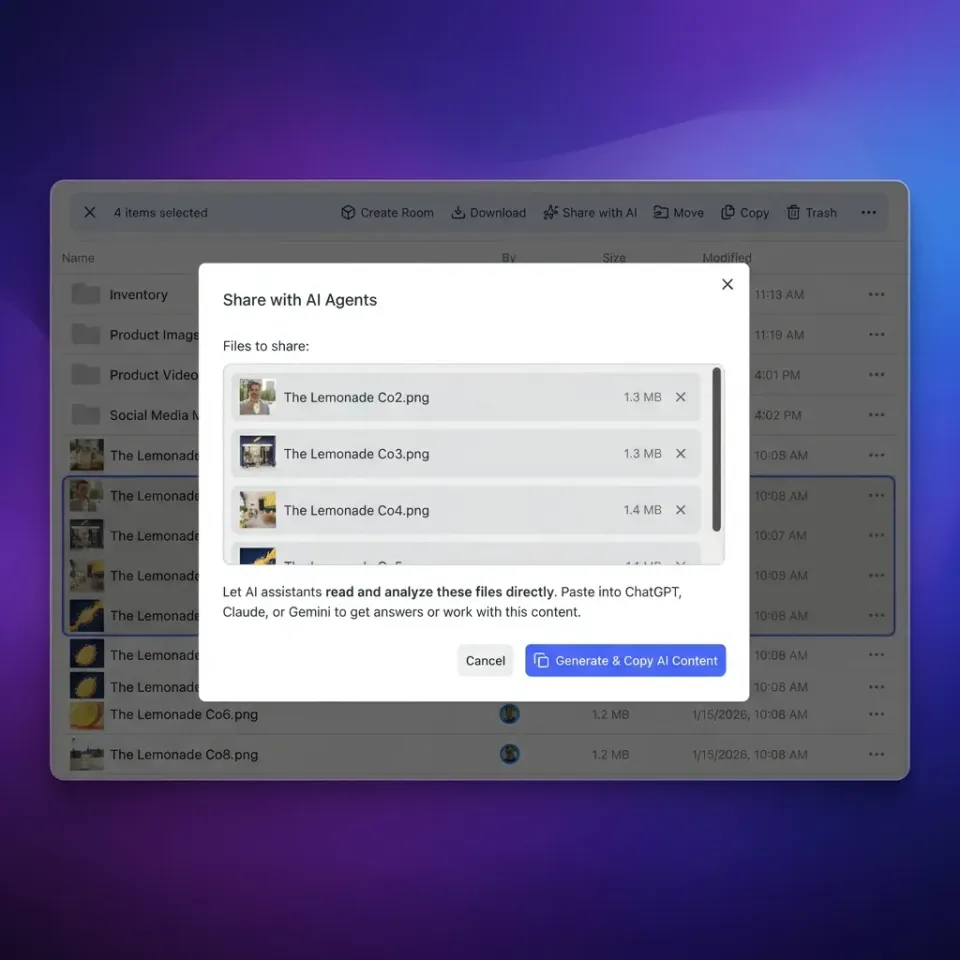
Data rooms and investor updates are essential for fundraising. Fastio's remote MCP server gives your agent the ability to manage this entire process. It is the most important tool because it provides the persistent storage layer for all other agent activities.
MCP Server:
# Connect via remote MCP:
https://mcp.fast.io/mcp/tools
Your agent can create a secure workspace, upload your pitch deck and financials, and generate a branded link to share with VCs. Because Fastio has built-in RAG once Intelligence is enabled for the workspace, investors can ask questions about your documents and get instant, cited answers from your agent. This reduces the back-and-forth email volume.
Best for: Due diligence, data rooms, and investor relations.
Founder Win: Transfer ownership of the entire data room to your lead investor or legal counsel with one command when the deal closes. This feature alone saves hours of manual file migration and helps with compliance during handovers.
MCP Server: mcp.fast.io/docs


Build Your Automated Startup with Fastio
Give your OpenClaw agents a secure place to work. Persistent cloud storage, data rooms for investors, and built-in RAG.
2. SQL Toolkit - Financial Analysis & Metrics
You don't need a CFO yet, but you do need to know your numbers. The SQL Toolkit skill lets your agent query, analyze, and report on your data - whether that's a SQLite database of user signups, a PostgreSQL analytics database, or exported CSVs from Stripe and your bank.
Use Case: "Query the payments database and calculate monthly recurring revenue, churn rate, and projected runway based on last month's burn."
Why it matters: Keeps your finances on track without spending hours in spreadsheets every week. You can ask your agent "What is our month-over-month growth rate?" or "List the top 5 expense categories" and get immediate answers from your actual data. The toolkit supports complex queries with window functions and CTEs, so your agent can produce the investor metrics tables you'd otherwise pay a consultant to build.
Pro Tip: Automate a weekly financial health check. Schedule your agent to run a variance analysis against your budget every Friday and save the report to your Fastio workspace before the weekend.
ClawHub Page: clawhub.ai/gitgoodordietrying/sql-toolkit
3. Playwright - Research, Competitive Intelligence & App Testing
Founders deal with two browser-heavy problems: keeping up with competitors and testing their own product. Playwright handles both. As a browser automation skill, it can navigate real websites, extract data from JavaScript-rendered pages, capture screenshots, and generate PDFs - and it doubles as a test automation tool for your own app.
Use Case (Research): "Capture the current pricing page of Competitor A and save it to Fastio with a timestamp. Alert me if it changes next week."
Use Case (Testing): "Run the sign-up flow on staging, take a screenshot at each step, and flag any errors."
Why it matters: Gives you a competitive intelligence analyst and a QA engineer without the salary. Playwright's codegen feature generates test scripts from your own manual interactions, cutting the time to build E2E test coverage dramatically.
Pro Tip: Chain Playwright with Fastio to build a competitive intelligence archive - every captured pricing page is stored and timestamped, so you can track how competitors evolve their offer over time.
ClawHub Page: clawhub.ai/ivangdavila/playwright
4. Agent Browser - Market Research & Monitoring
Where Playwright excels at structured automation and testing, Agent Browser is optimized for rapid, lightweight web tasks. Built in Rust with a Node.js fallback, it keeps resource consumption low - important when you're running multiple background agents on a budget VPS.
Use Case: "Monitor the job boards of Competitor A and B for new engineering hires. If they post more than 3 engineering roles in a week, summarize the titles and save the report."
Why it matters: Monitoring competitor hiring velocity is one of the best signals of where a company is investing. Agent Browser handles this as a background task, giving you intelligence that would otherwise require a manual weekly review.
Pro Tip: Use Agent Browser for quick data grabs from public sources, and Playwright when you need structured extraction, full-page archives, or test coverage.
ClawHub Page: clawhub.ai/TheSethRose/agent-browser
5. AgentMail - Investor Outreach & Customer Communication
Fundraising is a sales funnel. AgentMail is an API-first email platform built for AI agents - it lets your agent manage dedicated email addresses programmatically, run high-volume outreach without rate limits, and receive replies via real-time webhooks so follow-up actions happen instantly.
Use Case: "Draft personalized follow-ups to the investors I met this week referencing our conversation notes. Send from the investor-relations@ address and notify me when anyone replies."
Why it matters: Helps you never drop the ball on a warm lead during a busy fundraising round. Unlike plugging an agent into your personal Gmail, AgentMail keeps automated outreach separate from your main inbox and provides webhook-based reply handling so your agent can act on responses immediately.
Pro Tip: Set up reply-detection nudges. If an investor hasn't replied in 3 days, have your agent draft a polite bump with a new piece of traction - without ever touching your personal inbox.
ClawHub Page: clawhub.ai/adboio/agentmail
6. Gog - Google Workspace Automation
Most founders live in Google Workspace - Gmail, Sheets, Drive, Calendar, Docs. Gog is a Google Workspace CLI skill that gives OpenClaw agents native access to all of it. For a founder, this means your agent can update your investor pipeline spreadsheet after each call, schedule follow-up meetings without email tag, and retrieve documents from Drive on demand.
Use Case: "After each investor call, update the 'Investor Pipeline' sheet with the meeting date, outcome, and next step. Then create a calendar event for the follow-up in two weeks."
Why it matters: Eliminates the manual CRM update work that founders consistently skip when they're busy. Confirmation prompts before sending mail or creating events prevent your agent from firing off messages without your approval.
Pro Tip: Use Gog to automate your monthly investor update - have your agent pull metrics from a Sheet, draft the update in a Doc, and email it from Gmail, all from a single instruction.
ClawHub Page: clawhub.ai/steipete/gog
7. GitHub - Technical Audits & Release Management
Even non-technical founders need to stay in the loop on product development. The GitHub skill gives OpenClaw agents access to your repositories via the gh CLI - monitoring CI runs, summarizing merged pull requests for release notes, and flagging failed workflows before they become incidents.
Use Case: "Summarize the PRs merged this week into a changelog for the release notes. Flag any that touched authentication or payment code."
Why it matters: Keeps you informed on product development without disturbing engineers. You can generate changelogs, track which features shipped in the last sprint, and prepare the engineering section of your investor update - all without running a git command yourself.
Pro Tip: Use this before a due diligence process. Have your agent audit open issues and recent CI failure rates to identify patterns you should address before technical reviewers see the codebase.
ClawHub Page: clawhub.ai/steipete/github
Putting It Together: Your Automated Startup Stack
By combining these skills, you create an operational architecture where AI agents handle the repetitive tasks of finance, research, hiring, and investor relations. Start with Fastio as your data layer - it gives you the persistent memory and file management that all other skills rely on. Then add skills as your operational needs grow.
A practical sequence:
- Fastio first - everything else stores outputs here.
- SQL Toolkit and Gog to handle data analysis and Google Workspace.
- Playwright and Agent Browser for competitive intelligence and product testing.
- AgentMail and GitHub when fundraising and product development ramp up.
This modular approach lets you build a custom operating system for your startup that scales with you, without the overhead of premature hiring.
Sources
References used to verify factual claims in this guide.
-
Fastio provides built-in RAG (Intelligence Mode) for investor questions
Frequently Asked Questions
Is OpenClaw good for startups?
Yes, OpenClaw is great for startups because it cuts operational overhead. By using agents for tasks like investor outreach, financial analysis, and competitor monitoring, founders can work like a larger team without the burn rate.
How can founders use AI agents?
Founders use AI agents to automate slow tasks such as scheduling investor meetings, managing data rooms, analyzing financial data, tracking competitor changes, and generating weekly reports.
What is the best AI tool for pitch decks?
While tools like Beautiful.ai generate slides, an OpenClaw agent with Fastio is best for secure sharing. It ensures investors see the right version, supports RAG once Intelligence is enabled so investors can ask questions about your documents directly, and lets you transfer data room ownership to your lead investor with one command.
Related Resources

Build Your Automated Startup with Fastio
Give your OpenClaw agents a secure place to work. Persistent cloud storage, data rooms for investors, and built-in RAG.