Best OpenClaw Skills for AI Plagiarism and Originality Detection
Non-disclosed AI-assisted content in academic submissions jumped from 4.7% to 17.8% between 2023 and early 2026, pushing the anti-plagiarism software market past $836 million. OpenClaw agents that generate text at scale need plagiarism and originality checks baked into their workflows. This guide evaluates seven skills and API integrations that let your OpenClaw agent verify content is original before it ships.


Why Plagiarism Checking Belongs in Your Agent Pipeline
Non-disclosed AI-assisted content in academic submissions climbed from 4.7% in 2023 to 17.8% by early 2026, according to market research tracking AI content in higher education. The problem extends beyond academia. Any OpenClaw agent that writes blog posts, product descriptions, or client reports can inadvertently reproduce phrases from its training data or paraphrase existing sources too closely.
The root keyword "ai plagiarism checker" draws 14,800 monthly searches, yet no existing OpenClaw-focused resource covers how to wire plagiarism detection into an agent workflow. Most plagiarism tools assume a human pasting text into a web form. OpenClaw agents need something different: API-accessible checks that run automatically between content generation and publication.
Three properties matter when selecting a plagiarism skill for OpenClaw:
- API availability, because OpenClaw skills wrap HTTP endpoints or CLI tools
- Speed per document, since agent pipelines process batches
- Detection scope, meaning how many sources the tool compares against
The seven options below range from full ClawHub skills you can install today to external APIs you wrap in a custom SKILL.md. Each entry covers what it does, where it fits, and what it costs.
Related guides
- How to Use Claude Code Skills in ClineAccording to GitHub's Octoverse 2024 report, the number of developers building with generative AI on the platform...
- How to Install and Manage Cline Agent SkillsAI coding agents boost code volume by 180%, but shipped code rises by only 30%, showing a critical gap in development...
- Best OpenClaw Skills for Web ResearchWeb research skills let OpenClaw agents find and read information on the live web. Without them, your AI is stuck with...
- Top 7 OpenClaw Skills for Growth HackersThese top OpenClaw skills help growth hackers automate experimentation and analytics. They scale campaigns faster. Real...
- How to Automate Infrastructure: Top OpenClaw Skills for Network EngineersNetwork automation used to require writing complex Python scripts or wrestling with Ansible playbooks. Today, OpenClaw...
- Top OpenClaw Skills for Video ProductionOpenClaw skills automate video production tasks like editing, asset management, and reviews with MCP tools. Video teams...
More on this subject: OpenClaw Skills (109 guides)
How We Evaluated These Skills
Every tool on this list meets at least three criteria:
- Has a documented API or exists as an installable ClawHub skill
- Can process text programmatically without requiring a browser session
- Returns structured results (scores, matched sources, or pass/fail signals) that an OpenClaw agent can act on
We weighted API response time, source database breadth, pricing at agent-scale volumes (thousands of documents per month), and how cleanly each tool fits the OpenClaw SKILL.md format. Tools that only offer browser-based interfaces or lack batch endpoints did not make the list.
A note on existing ClawHub coverage: ClawHub hosts over 5,400 curated skills across dozens of categories, but dedicated plagiarism-detection skills are not yet common. Most options below involve wrapping an external API in a custom skill. The two native ClawHub entries on this list handle adjacent verification workflows rather than direct plagiarism scanning.

1. Copyleaks API
Copyleaks is an enterprise-grade plagiarism and AI content detection platform built API-first. It compares text against billions of web pages, academic journals, and internal databases.
Key strengths:
- Claims 99.1% accuracy on GPT-4 generated English content with false positive rates as low as 0.03% in controlled benchmarks
- Returns results in 2-4 seconds for documents under 2,000 words
- Supports multi-language detection and source code plagiarism checking
- Provides both plagiarism percentage and matched source URLs in the response
Limitations:
- Enterprise pricing is opaque for small-scale usage
- Independent testing shows accuracy drops on rewritten or humanized text
Best for: Teams running OpenClaw agents that produce high volumes of content across multiple languages and need a single API for both plagiarism and AI detection.
Pricing: Credit-based. Roughly $0.01 per credit at volume, where one credit covers one scan. Enterprise plans available.
OpenClaw integration: Wrap the Copyleaks REST API in a custom SKILL.md. The API uses OAuth2 authentication and returns JSON with similarity scores and matched sources. Store your API key in an environment variable and declare it in the skill's metadata block.
2. Originality.ai
Originality.ai combines plagiarism detection, AI content detection, and fact-checking in a single API. Its distinguishing feature is paraphrased plagiarism detection, catching content that has been reworded rather than copied verbatim.
Key strengths:
- Detects paraphrased plagiarism, not just exact matches
- Bundles AI detection and fact-checking alongside plagiarism scanning
- One credit covers 100 words across all detection types
- Readability scoring included in the response payload
Limitations:
- Originality.ai has no free tier for API access
- Smaller source database than Copyleaks or Turnitin for academic content
Best for: Content agencies using OpenClaw to generate marketing copy where paraphrased plagiarism is a greater risk than verbatim copying.
Pricing: Base plan at $14.95/month for 2,000 credits. Pro plan at $179/month with extended API access. Pay-as-you-go at $30 for 3,000 credits.
OpenClaw integration: The REST API accepts plain text or URLs and returns JSON scores. Build a skill that posts generated content to their endpoint, parses the plagiarism percentage, and blocks publication if the score exceeds your threshold.


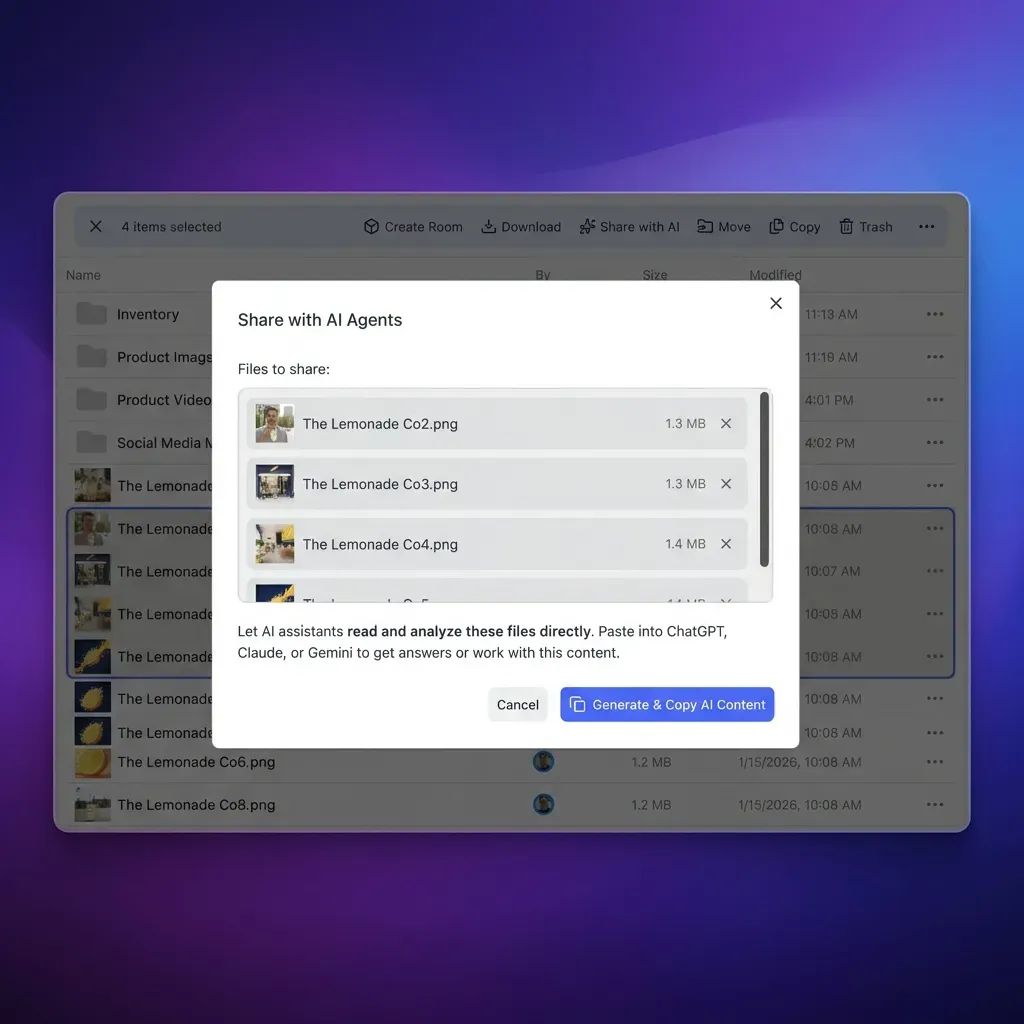
Store verified content with a full audit trail
Generous storage workspace with file versioning, activity logs, and MCP access for your OpenClaw agent.
3. GPTZero
GPTZero started as an AI detection tool and expanded into plagiarism checking and authorship verification. Its developer API supports batch processing and works alongside Zapier for no-code workflow connections.
Key strengths:
- Claims 99.3% accuracy on unmodified AI-generated text with a 0.24% false positive rate
- Combined plagiarism and AI detection in a single scan
- Authorship verification feature for comparing writing styles across documents
- Chrome extension and Google Docs integration for manual spot-checks alongside automated workflows
Limitations:
- The 99.3% accuracy claim comes from controlled benchmarks using unmodified GPT-4 output, not real-world mixed content
- False positives remain a known issue for non-native English speakers and polished human writing
Best for: Developer teams that want a single API covering AI detection, plagiarism, and authorship verification without managing multiple vendor relationships.
Pricing: Individual tier at $14.99/month. Premium at $23.99/month with plagiarism checking and 300,000 words. Developer API from $45/month for up to 300,000 words.
OpenClaw integration: The API returns structured JSON with sentence-level detection scores. A custom skill can parse these scores, flag specific paragraphs, and trigger rewriting workflows for flagged sections.
4. clarity-gate (ClawHub Skill)
Unlike the API wrappers above, clarity-gate is an existing ClawHub skill you can install directly. It performs pre-ingestion verification for epistemic quality in RAG systems, checking whether content meets quality thresholds before it enters a knowledge base or gets published.
Key strengths:
- Installable directly from ClawHub without additional configuration
- Designed specifically for agent pipelines, no external API key required
- Evaluates content quality signals that overlap with originality (source attribution, claim specificity, factual grounding)
- Lightweight enough to run on every document without adding latency to your pipeline
Limitations:
- Not a plagiarism scanner in the traditional sense; does not compare against a web-scale database of existing content
- Better suited as a quality gate than a standalone plagiarism check
Best for: OpenClaw agents building RAG systems or knowledge bases where content quality and epistemic integrity matter as much as avoiding copied text.
Pricing: Free. Open-source ClawHub skill.
How it fits: Use clarity-gate as a first-pass filter. Content that fails its quality checks gets flagged before reaching a more expensive API-based plagiarism scan. This layered approach reduces API costs by filtering obvious low-quality content early.
5. Grammarly Plagiarism Detection API
Grammarly offers a Plagiarism Detection API in beta that compares uploaded documents against billions of web pages and academic papers. The API returns an originality score indicating how much of the text matches existing sources.
Key strengths:
- Massive comparison database (billions of web pages plus academic papers in private databases)
- Returns results accessible for 30 days per scan
- OAuth-based authentication fits the OpenClaw skill security model
- Rate limits are reasonable for batch processing: 10 POST requests per second
Limitations:
- Currently in beta, features may change
- 4 MB file size limit per document
- No AI detection bundled, only plagiarism matching
- Requires Grammarly enterprise agreement for API access
Best for: Organizations already using Grammarly for writing assistance that want to add plagiarism checking to their OpenClaw agent pipeline without onboarding a new vendor.
Pricing: Part of Grammarly enterprise plans. No standalone API pricing published.
OpenClaw integration: The API uses standard REST with OAuth tokens. A custom skill would authenticate via the OAuth flow, submit content as a POST request, then poll the GET endpoint for results. Declare the OAuth scope in your SKILL.md metadata.
6. web-search-pro (ClawHub Skill)
web-search-pro is an agent-first web search and retrieval skill available on ClawHub. While not a plagiarism checker by design, it enables a manual verification workflow: your agent searches for phrases from its generated content and checks whether those phrases already exist elsewhere on the web.
Key strengths:
- Installable from ClawHub, no external API keys beyond your search provider
- Designed for agent consumption, returns structured search results
- Enables a "spot-check" workflow where the agent verifies key sentences against web results
- Combines with other skills for a complete verification pipeline
Limitations:
- Not a substitute for a proper plagiarism database scan
- Only catches exact or near-exact phrase matches found by the search engine
- Slower than dedicated plagiarism APIs for full-document scanning
- Results depend on your search provider's index coverage
Best for: Budget-conscious setups where you want basic originality spot-checks without paying for a dedicated plagiarism API. Works best as a supplement to other tools rather than a standalone solution.
Pricing: Free skill. You pay only for your underlying search API usage.
Workflow pattern: After your writing agent generates content, a verification step extracts 5-10 distinctive phrases, searches each via web-search-pro, and flags any that return exact matches. This catches obvious duplication without the cost of a full plagiarism scan on every document.
Building a Complete Plagiarism Workflow in OpenClaw
None of these tools works best in isolation. A production-grade plagiarism workflow layers them:
Stage 1: Quality gate. Run clarity-gate on generated content. Documents that fail basic quality checks get sent back for rewriting without consuming plagiarism API credits.
Stage 2: Spot-check. Use web-search-pro to search for 5-10 distinctive phrases from the document. If any return exact web matches, flag the document for full scanning.
Stage 3: Full scan. Send flagged documents (or all documents, depending on your budget) to Copyleaks, Originality.ai, or GPTZero for a comprehensive plagiarism check.
Stage 4: Store results. Save the original content, plagiarism scores, and matched sources alongside the document. This creates an audit trail proving you checked originality before publication.
For the storage and audit trail layer, Fastio's workspace provides file versioning and activity logs that track every version of a document through your pipeline. Enable Intelligence Mode on a workspace to make all content searchable by meaning, which also lets you catch internal duplication across your own previously published work. The MCP server exposes a consolidated toolset that OpenClaw can call directly, covering file operations, workspace management, and AI queries against your indexed content.
This layered approach keeps costs low. If your agent generates 1,000 documents per month and only 15% fail the quality gate or spot-check, you run full plagiarism scans on 150 documents instead of 1,000.
Which Tool Should You Choose?
Your choice depends on three factors: budget, content volume, and how much risk you tolerate.
For high-volume content teams producing thousands of documents monthly across multiple languages, Copyleaks offers the strongest combination of speed, accuracy, and language coverage. Its API-first design means your custom OpenClaw skill stays simple.
For content agencies where paraphrased plagiarism is the primary concern, Originality.ai's paraphrase detection catches rewording that simpler tools miss. The bundled fact-checking is a bonus for accuracy-sensitive content.
For developer teams that want a single vendor for plagiarism, AI detection, and authorship verification, GPTZero's combined API reduces integration complexity.
For budget-limited setups, start with clarity-gate and web-search-pro from ClawHub (both free), then add a paid API only for content that fails the initial checks.
For teams already on Grammarly, the Plagiarism Detection API avoids a new vendor relationship, though its beta status means you should have a fallback.
Regardless of which scanner you pick, store your verification results alongside the content. File versioning and audit logs prove you ran checks before publication, which matters when clients or legal teams ask questions months later. Fastio workspaces handle this out of the box with the 14-day Business Trial: scalable storage, usage-based credits, and MCP access for your OpenClaw agent to read and write files directly.
Sources
References used to verify factual claims in this guide.
-
Non-disclosed AI-assisted content in academic submissions climbed from 4.7% in 2023 to 17.8% by early 2026
-
Anti-plagiarism software market valued at USD 836.47M in 2026, projected to reach USD 1210M by 2032
-
Copyleaks claims 99.1% accuracy for GPT-4 generated content with false positive rates as low as 0.03%
-
GPTZero claims 99.3% accuracy with a 0.24% false positive rate
-
5,400+ skills filtered and categorized from the official OpenClaw Skills Registry
-
Originality.ai Base plan at $14.95/mo for 2,000 credits
Frequently Asked Questions
What is the best AI plagiarism checker for OpenClaw?
Copyleaks offers the strongest standalone API for OpenClaw integration, with claims of 99.1% accuracy and 2-4 second response times. For teams that also need AI content detection, GPTZero and Originality.ai bundle both features. The best choice depends on your volume and whether you need paraphrase detection or multi-language support.
Can OpenClaw detect plagiarism in documents?
OpenClaw does not include a built-in plagiarism scanner, but it can run plagiarism checks through custom skills that wrap external APIs like Copyleaks or Originality.ai. You write a SKILL.md that calls the API, parses the response, and acts on the results. The ClawHub skill clarity-gate provides quality verification but not full plagiarism database scanning.
How do you set up plagiarism checking in an OpenClaw workflow?
Create a custom SKILL.md that authenticates with your chosen plagiarism API, submits text via POST request, and parses the JSON response for similarity scores. Declare your API key as an environment variable in the skill metadata. Then add the skill to your agent pipeline between the content generation step and the publication step.
Are there free OpenClaw skills for plagiarism detection?
clarity-gate and web-search-pro are free ClawHub skills that handle adjacent verification workflows. clarity-gate checks content quality before ingestion, and web-search-pro lets your agent spot-check phrases against web results. Neither is a full plagiarism scanner, but together they catch obvious duplication without API costs.
How much does plagiarism checking cost at agent scale?
Costs vary by provider and volume. Originality.ai charges roughly $0.01 per 100 words. GPTZero's developer API starts at $45/month for 300,000 words. Copyleaks uses per-scan credits with volume discounts. For an agent generating 1,000 documents monthly at 1,500 words each, expect $150-450/month depending on your provider.
Related Resources

Store verified content with a full audit trail
Generous storage workspace with file versioning, activity logs, and MCP access for your OpenClaw agent.