How to Deploy OpenClaw on Coolify for Self-Hosted Agent Infrastructure
Coolify gives you a managed deployment experience for OpenClaw without surrendering control to a cloud vendor. This guide walks through the full setup: connecting your server, deploying OpenClaw from a public repo, configuring AI providers and chat integrations, and hardening the deployment for daily use. You will also learn how to add Fastio as a persistent storage layer so your agent's files survive container restarts and stay accessible to your team.

Why Coolify Sits Between Bare Docker and Full PaaS
Most OpenClaw self-hosting guides assume you are comfortable writing Docker Compose files by hand or that you want a fully managed platform like Railway. Coolify occupies the middle ground. It is an open-source, self-hostable PaaS alternative that gives you a web dashboard for deploying containers on your own servers, with automatic Let's Encrypt SSL, Git-based deploys, and one-click service management. You keep root access and full data ownership.
For OpenClaw specifically, this matters because the agent requires HTTPS to function correctly, uses HTTP Basic Auth for its dashboard, and benefits from Docker isolation to contain crashes. Coolify handles all three out of the box. You point it at a Git repo containing a Docker Compose file, configure your environment variables, and Coolify provisions the container with a valid TLS certificate, reverse proxy routing through Traefik, and persistent volumes for workspace data.
The practical difference compared to raw Docker: you skip writing Nginx or Traefik configs, managing Certbot renewals, and debugging port-binding issues. Compared to Railway or Render, you keep your data on hardware you control and avoid per-seat pricing that scales poorly for always-on agents.
Related guides
- How to Deploy Hermes Agent on KubernetesHermes Agent's official docs cover six terminal backends, but Kubernetes is not one of them. A community-maintained...
- How to Deploy CrewAI to ProductionDeploying CrewAI crews to production moves notebook experiments to reliable systems. Notebooks suit tests, but lack...
- How to Deploy OpenClaw on AWS Lambda for Serverless AI AgentsRunning OpenClaw on AWS Lambda eliminates the fixed monthly cost of a dedicated server while keeping your AI agent...
- How to Deploy OpenClaw with Ansible82% of server configuration errors originate from manual setup, and AI agent deployments are no exception. The official...
- How to Deploy OpenClaw on DigitalOcean App PlatformDigitalOcean gives you three ways to run OpenClaw: a 1-Click marketplace Droplet, the managed App Platform for...
- OpenClaw Hosting: Best Options for Self-Hosted and Managed DeploymentOpenClaw runs on your own infrastructure, which means you need to pick a server. Self-hosted VPS plans start around...
More on this subject: OpenClaw Setup and Guides (199 guides)
Prerequisites and Server Setup
Before deploying OpenClaw, you need a server running Coolify and an API key for at least one LLM provider.
Server requirements:
- A VPS, dedicated server, or home machine with SSH access and at least 2 CPU cores, 4GB RAM, and 13GB free disk space (Docker build cache is large)
- Coolify installed on the server, either via the self-hosted install script or Coolify Cloud (starts at $5/month for managed infrastructure)
- A domain or subdomain pointed at your server's IP address for HTTPS
LLM provider keys (pick at least one):
- Anthropic (
ANTHROPIC_API_KEY) - OpenAI (
OPENAI_API_KEY) - Google Gemini (
GEMINI_API_KEY) - OpenRouter (
OPENROUTER_API_KEY) - Groq, Mistral, xAI, or Cerebras
- AWS Bedrock (requires
AWS_ACCESS_KEY_ID,AWS_SECRET_ACCESS_KEY, andAWS_REGION) - Ollama for local models (
OLLAMA_BASE_URL)
Coolify's official documentation at coolify.io/docs covers server installation if you need to set it up first.

How to Deploy OpenClaw from a Public Repository
Coolify deploys services from Git repositories containing Docker Compose configurations. Several community-maintained repos on GitHub package OpenClaw for Coolify, including repos from essamamdani, wiselancer, and the Coolify team itself (coollabsio/openclaw). Each bundles a slightly different set of companion services, so review their README files to pick the one that fits your use case.
General deployment flow:
- In the Coolify dashboard, create a new service pointing at a public Git repository containing an OpenClaw Docker Compose file
- Coolify detects the compose configuration and lists the available services
- Set your environment variables (covered in the next section)
- Deploy and watch the service logs for the startup confirmation
- Open the Coolify-generated HTTPS URL to access the OpenClaw dashboard
Coolify's Traefik reverse proxy maps the container's internal port to your domain with automatic HTTPS. Make sure the container listens on 0.0.0.0 rather than 127.0.0.1 so the proxy can reach it.


Give your OpenClaw agent persistent, searchable storage
generous storage workspace with automatic indexing and MCP server access, with a 14-day trial on monthly plans (credit card required). Your agent writes files, your team finds them.
Configuring Environment Variables and Authentication
Coolify auto-generates AUTH_USERNAME and AUTH_PASSWORD for HTTP Basic Auth during deployment. These protect the OpenClaw web dashboard from unauthorized access. You will also want to set OPENCLAW_GATEWAY_TOKEN for API access.
Required variables:
- At least one LLM provider API key (e.g.,
ANTHROPIC_API_KEY) OPENCLAW_PRIMARY_MODELto set the default model. For proxy services like OpenRouter, use theprovider/model-nameformat
Optional but recommended:
BROWSER_DEFAULT_PROFILE(defaults toopenclaw) for persistent browser sessionsBROWSER_SNAPSHOT_MODE(defaults toefficient) controls how browser state is savedBROWSER_EVALUATE_ENABLED(defaults totrue) allows JavaScript execution in the built-in browser
Set all variables through the Coolify dashboard under your service's Environment tab. Coolify encrypts secrets at rest and injects them at container startup, so you never need to commit credentials to a repository.
Chat Channel Integration
OpenClaw supports messaging platforms as its primary interface. Setup complexity varies by channel:
- Telegram is the fast to configure. Create a bot via BotFather, paste the token into your environment variables, and redeploy
- WhatsApp requires scanning a QR code from the OpenClaw dashboard's Channels tab
- Discord and Slack use CLI-managed setup through the dashboard or channel management commands
After connecting a channel, you message your agent directly from the chat app. It can run commands, manage files, browse the web, and handle multi-step tasks through natural conversation.
How Gateway Validation and Production Hardening Work
OpenClaw 2026.5.x introduced a significant safety change: gateway config validation now fails closed. If openclaw.json contains invalid configuration, the gateway refuses to start rather than silently falling back to defaults. This prevents a situation where a bad config edit strips security settings and leaves the agent exposed.
How it works in practice:
- Direct file edits are treated as untrusted. The config watcher waits for editor write churn to settle, reads the final file, and rejects invalid changes without overwriting your config
- OpenClaw-owned config writes go through the same schema gate. Destructive changes like dropping
gateway.modeor shrinking the file by more than half are rejected and saved as.rejected.*for inspection - Hot reload skips invalid external edits and keeps the current running config active
If you do end up with a broken config, run openclaw doctor --fix from the Coolify terminal. It can remove non-JSON prefixes, restore the last known good copy, and preserve the rejected payload as .clobbered.* for review.
Additional hardening for Coolify deployments:
- The Docker Socket Proxy sidecar (in the
essamamdanirepo) restricts container API access, blocking Swarm, Secrets, and System functions while permitting only Container, Image, and Network operations - Sub-agents run in disposable containers with restricted Docker API access, so a misbehaving agent cannot affect the host or other services
- SearXNG runs as a local sidecar for private web search, keeping research queries off third-party search providers
- Coolify's built-in backup system can snapshot your volumes to S3-compatible storage for disaster recovery
Adding Persistent Storage with Fastio
Docker volumes keep your agent's workspace data across container restarts, but they are tied to a single server. If you need to share files between agents and humans, access agent output from a browser, or survive a server migration, you need external persistent storage.
Local storage options like mounting a host directory or using NFS shares work but require manual backup configuration and offer no built-in search or collaboration features. S3-compatible storage (MinIO, Backblaze B2, AWS S3) handles durability well but treats files as opaque blobs with no semantic understanding.
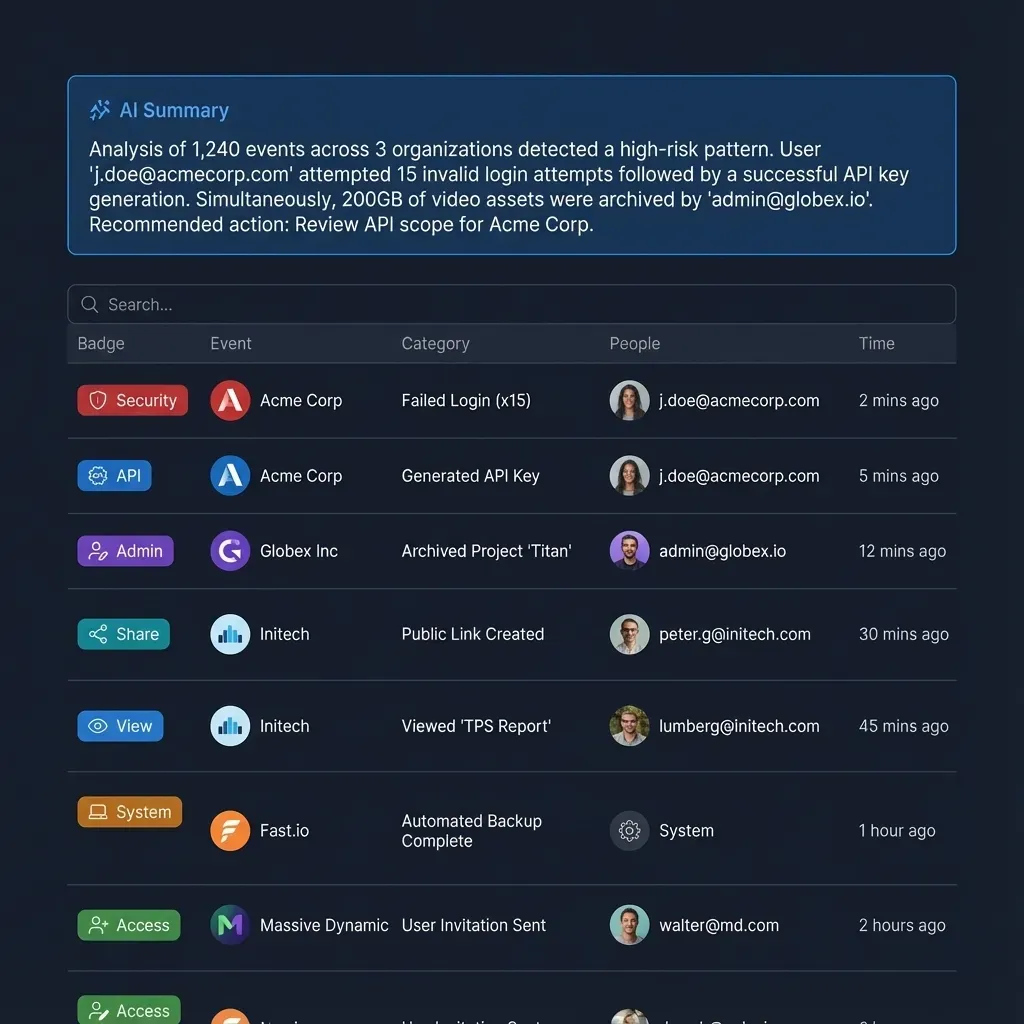
Fastio provides intelligent workspaces where files are automatically indexed for semantic search once Intelligence Mode is enabled. Your OpenClaw agent can read, write, and organize files through the Fastio MCP server using Streamable HTTP at /mcp, while your team accesses the same files through the web UI. When the agent finishes a project, you can transfer workspace ownership to a human recipient who gets full access without needing to touch the command line.
Fastio offers a 14-day Business Trial (card required; see /pricing/) to run a production OpenClaw deployment with persistent file storage, audit trails, and granular permissions at the workspace and folder level.
To connect your OpenClaw instance to Fastio, configure the MCP server endpoint in your agent's tool configuration. Files your agent creates, research it downloads, and browser snapshots it captures all persist in a shared workspace that survives container rebuilds, server migrations, and team changes.
Sources
References used to verify factual claims in this guide.
-
Coolify supports 280+ one-click services for self-hosted deployment
-
OpenClaw deployment requires approximately 13GB free disk space during Docker build
-
Gateway config validation fails closed in OpenClaw 2026.5.x
Frequently Asked Questions
How do I self-host OpenClaw with Coolify?
Install Coolify on your server, create a new service from one of the community OpenClaw-Coolify repositories (such as essamamdani/openclaw-coolify), configure your LLM provider API key and any chat integrations in the environment variables tab, then deploy. Coolify handles Docker orchestration, HTTPS provisioning via Let's Encrypt, and reverse proxy routing through Traefik automatically.
What is the easiest way to self-host OpenClaw?
Coolify provides the lowest-friction self-hosted path. It gives you a web dashboard for deployment, automatic SSL certificates, and built-in monitoring without requiring you to write Docker Compose, Nginx, or Certbot configurations by hand. The alternative is a bare Docker setup, which offers more control but requires manual reverse proxy and certificate management.
Is Coolify good for running AI agents?
Coolify works well for single-server agent deployments. It provides Docker isolation so agent crashes do not affect other services, automatic HTTPS which OpenClaw requires, persistent volumes for workspace data, and a web terminal for debugging. For multi-server or Kubernetes-scale deployments, you would outgrow Coolify and need container orchestration tooling directly.
How do I deploy OpenClaw without a cloud provider?
Run Coolify on any machine with SSH access, including a home server, a Raspberry Pi with sufficient RAM, or a refurbished desktop. Point a domain at your IP address (or use Cloudflare Tunnel for dynamic IPs), deploy OpenClaw through the Coolify dashboard, and your agent runs entirely on hardware you own. The only external dependency is the LLM API key, unless you run a local model through Ollama.
What happens if my OpenClaw config breaks after a Coolify update?
OpenClaw 2026.5.x validates gateway configuration on startup and fails closed rather than falling back to insecure defaults. If your config is invalid, the gateway will not start, and the last known good config stays active during hot reload. You can diagnose and repair the issue by running openclaw doctor --fix from the Coolify terminal, which restores the last valid config and preserves the rejected version for inspection.
Can I access OpenClaw from my phone after deploying on Coolify?
Yes. Connect a Telegram bot to your deployment for the fast mobile experience, or install the OpenClaw web dashboard as a Progressive Web App through Safari or Chrome. Voice message support is available through Telegram, allowing hands-free interaction with your agent from anywhere.
Related Resources

Give your OpenClaw agent persistent, searchable storage
generous storage workspace with automatic indexing and MCP server access, with a 14-day trial on monthly plans (credit card required). Your agent writes files, your team finds them.