How to Set Up Free AI Code Detector Tools with Hermes Agent
Eighty-four percent of developers use or plan to use AI tools, yet only 33% trust the accuracy of AI output. A free AI code detector workflow uses no-cost checkers to flag likely AI-generated source before review, and Hermes Agent can orchestrate those checks into PR-ready reports.


Why free AI code detectors belong in the review path
The 2025 Stack Overflow Developer Survey found that 84% of respondents use or plan to use AI tools in development, while only 33% trust the accuracy of AI tool output. More developers actively distrust that accuracy (46%) than trust it. That gap is the practical reason teams look for an ai code detector free path that can run before a human reviewer opens the pull request.
A free AI code detector workflow uses no-cost or open-source checkers to flag likely AI-generated source files before review or merge. It does not prove authorship in a courtroom sense. It ranks likelihood from style patterns, naming, comments, structure, or code-origin signals, then hands a structured report to a person who still owns the decision.
Search demand shows the same tension. Queries such as "ai code detector free," "code ai detector," and "ai code checker" all cluster around commercial intent: people want something they can try today without buying an enterprise scanner first. Paid AI code scanners fill that market with sales pages and seat pricing. Fewer guides show an agent-driven free stack that stores reports, versions findings, and produces PR-ready notes humans can actually use.
Nous Research Hermes Agent is a strong fit for that stack. It is open source under MIT, runs under your control (local machine, Docker, SSH, Modal, Singularity, or similar backends), and extends through terminal execution, file tools, skills compatible with the agentskills.io standard, and MCP servers for external tools. Hermes does not ship a built-in "AI code detector" product. What it does ship is the orchestration layer: run a free checker, normalize the score, write a report, and keep the artifact somewhere a teammate can reopen next week.
Related guides
- 8 Best Free OpenClaw Tools for AI Content Creation and EditingThe cheapest-image ClawHub skill generates visuals at $0.0036 each, roughly 30x less than premium alternatives in the...
- Best n8n Tools for AI Agents: Top 10 Nodes for 2026n8n changed AI automation with its visual workflow builder. We rank the best nodes and integrations for building...
- How to Set Up Automated Code Review with Hermes AgentSeventeen percent of pull requests contain high-severity defects that pass manual review under time pressure, and PR...
- Nous Research Hermes Agent AI Code Detector Setup: Automating Code AuditsNous Research Hermes Agent AI code detector setup involves configuring the agent to automatically fetch source files...
- How to Run a ChatGPT Code Detector Workflow with Hermes AgentEighty-four percent of developers use or plan to use AI tools in their work, yet 46% say they do not trust the accuracy...
- Hermes Agent vs. AI Detector Tools: How to Build Self-Verifying WorkflowsThis guide examines how to integrate the open-source Nous Research Hermes Agent with passive AI detector tools like...
More on this subject: Hermes Agent (100 guides)
Free AI code detector shortlist you can wire today
Featured-snippet version: if you need a free path to detect AI generated code, start with this shortlist, then connect the winner to Hermes.
- AICodeDetector.org: browser paste checker for Python, JavaScript, PHP, Java, C, and C++. Free analysis without registration, multi-layer style heuristics (naming, comments, structure, language-specific tells), and a human-likelihood score. The vendor states 90%+ accuracy and treats results as likelihood indicators, not definitive proof. Paid upgrades add repo upload, SBOM export, PDF/JSON reports, and API access when you outgrow paste-only use.
- Codespy free scan: free instant paste scan for JavaScript/TypeScript, Python, Java, PHP, C/C++, and C#, with a limited monthly free quota (vendor lists 10 AI scans per month on Free). Useful when you want a visual AI-likelihood report before account upgrades. Higher paid options unlock unlimited scans and exports; verify current limits on the pricing page before you script bulk runs.
- AboutCode AI-Generated Code Search: open-source utilities aimed at finding code that may have been generated with LLMs and linking fragments back toward FOSS origins via approximate similarity search. This is closer to supply-chain provenance than a single "AI vs human" probability. Best when license inheritance and training-data origin matter as much as authorship style.
- Local heuristic scripts (DIY free): a small Python or Node scorer you control, run entirely offline with Hermes
terminal/execute_code. Score comment density, identifier verbosity, docstring formality, and formatting uniformity. Accuracy is lower than trained detectors, but you keep source private and avoid third-party upload policies.
How these free options differ from linters
Linters and static analyzers (ESLint, Ruff, SonarQube Community, Semgrep rules) answer "is this code correct, secure, or style-compliant?" Free AI code detectors answer a different question: "does this file look machine-authored?" You still need both. A Copilot-generated function can be perfectly lint-clean and still need extra review for security assumptions, license risk, or business logic.
Practical selection rules
Paste-only web tools fit single-file spot checks and education. They are awkward for private monorepos unless the vendor's privacy model and terms are acceptable.
- Free SaaS quotas fit intermittent PR sampling. Script them carefully so you do not burn the monthly scan budget on noise.
- Open-source origin search fits compliance and FOSS reuse questions, not classroom "did a student write this alone" cases.
- Local heuristics fit air-gapped environments and first prototypes.
Treat every free vendor accuracy claim as marketing until you benchmark it on your languages and coding style. AICodeDetector.org publishes a 90%+ figure and still recommends broader evaluation for academic or professional decisions. Codespy advertises high accuracy on its landing page. Both should be re-tested on held-out samples before you fail CI on a score alone.



Keep free detector reports next to the code under review
Use a shared Fast.io workspace with MCP access so Hermes Agent can upload scan JSON, version re-runs, and hand flagged files to humans for merge decisions. Monthly plans start with a trial of up to 14 days (credit card required); annual plans have no trial.
Wire free detectors into Hermes Agent tools and skills
Hermes Agent tools are grouped into toolsets you enable per session or platform. For a free code AI detector workflow, the useful built-ins from the official tools guide are:
- Terminal and files:
terminal,process,read_file,patchfor cloning repos, running scripts, and writing reports - Web and browser:
web_search,web_extract, plus browser automation tools when a free web detector only offers a paste UI - Agent orchestration:
todo,execute_code,delegate_taskfor multi-file scans and subagent isolation - Automation:
cronjobwhen you want scheduled baseline scans of a branch - Integrations: MCP server tools for Fast.io, GitHub, or internal APIs
Enable a focused toolset when chatting:
hermes chat --toolsets "terminal,file,web,skills"
Or open the interactive tool configurator:
hermes tools
Terminal backends for safer scanning
The Hermes tools docs list terminal backends: local, docker, ssh, singularity, modal, and daytona. For untrusted third-party detector CLIs or large model downloads, prefer an isolated backend so packages and temp files do not sit on the agent host by default.
Example Docker-oriented pattern from the official docs (values under terminal in ~/.hermes/config.yaml):
terminal:
  backend: docker
  docker_image: python:3.11-slim
  cwd: "."
  timeout: 180
  container_cpu: 2
  container_memory: 4096
  container_disk: 51200
  container_persistent: true
Hermes keeps one long-lived Docker container for the process and routes terminal, file, and execute_code calls into it. Packages and files under /workspace persist for the session, which is ideal when you install a detector dependency once and reuse it across PRs.
Skills: encode the detector procedure once
Skills are on-demand knowledge documents under ~/.hermes/skills/, compatible with the agentskills.io standard. They load through progressive disclosure so the agent only pulls full instructions when needed. A detector skill should describe when to run, which free tool to call, the JSON report schema, and the human handoff rule.
Minimal SKILL.md skeleton (format from Hermes skills docs):
---
name: free-ai-code-detector
description: Scan changed source files with free AI code detectors and write a PR report
version: 1.0.0
metadata:
  hermes:
    tags: [code-review, ai-detection]
    category: devops
    requires_toolsets: [terminal]
---

# Free AI Code Detector

## When to Use

Run on pull request file lists or when a reviewer asks to detect AI generated code.

## Procedure
1. Collect changed paths (git diff against base branch).
2. Skip vendor, lockfile, and generated asset paths.
3. For each eligible source file, run the configured free detector path.
4. Normalize scores into the report schema.
5. Write reports/ai-code-detect/<pr-or-sha>.json and a short markdown summary.
6. Never fail merge on score alone without human confirmation.

## Verification
Confirm the report lists path, score, tool id, timestamp, and sample excerpt hash.
Install path pattern: place that directory under ~/.hermes/skills/devops/free-ai-code-detector/. Invoke it as a slash command once Hermes indexes the skill, or ask in natural language: "Use the free AI code detector skill on the last commit."
You can also bootstrap a skill from a procedure you already walked through:
/learn how we scan PR diffs with free AI code detectors and write JSON reports
Hermes gathers the material with the tools it already has and authors a skill that follows house authoring standards. Keep secrets out of the skill body. If a free SaaS tool needs an API key later, declare it through the skill's required environment variable pattern and store values in ~/.hermes/.env.
MCP: attach external systems without writing native tools first
Hermes MCP support is part of the standard install. Add servers under mcp_servers in ~/.hermes/config.yaml. Stdio servers use command / args / env. HTTP servers use url and optional headers or OAuth.
Filesystem MCP example from the official MCP guide:
mcp_servers:
  filesystem:
    command: "npx"
    args: ["-y", "@modelcontextprotocol/server-filesystem", "/home/user/projects"]
GitHub MCP pattern for PR context (token via env):
mcp_servers:
  github:
    command: "npx"
    args: ["-y", "@modelcontextprotocol/server-github"]
    env:
      GITHUB_PERSONAL_ACCESS_TOKEN: "***"
For a remote workspace layer, use an HTTP MCP entry pointing at the host that stores scan reports. Fast.io exposes Streamable HTTP at https://mcp.fast.io/mcp/tools (see the Fast.io MCP guide). A Hermes-side HTTP shape looks like:
mcp_servers:
  fastio:
    url: "https://mcp.fast.io/mcp/tools"
    headers:
      Authorization: "Bearer YOUR_API_KEY"
After config changes, start a session and ask Hermes to list MCP tools or run a smoke upload. Prefer the server's own auth tools when the remote MCP expects session-based sign-in rather than a static header. Catalog installs (hermes mcp, hermes mcp catalog, hermes mcp install <name>) are useful for Nous-reviewed entries; custom HTTP servers are fine for Fast.io and internal tooling.
Run a repo scan and produce PR-ready reports
Once tools and skills are wired, the daily loop is simple: select files, score them, write a report a human can paste into a PR.
1. Scope the scan
Full-repo scans waste free quotas and create noise. Prefer:
- Files touched in the PR (
git diff --name-only origin/main...HEAD) - Language filters (
.py,.js,.ts,.java,.php,.c,.cpp,.cs) - Exclusions for
node_modules/,vendor/, lockfiles, minified bundles, and generated protobufs
Ask Hermes in plain language:
List source files changed vs origin/main, skip vendor and generated paths,
then run the free-ai-code-detector skill. Write JSON + markdown under reports/ai-code-detect/.
2. Choose a free detector path per file
Path A, local script (fully free, private): Hermes runs your scorer via terminal or execute_code inside Docker. Output a float score and short rationale per file.
Path B, free web checker (human-in-the-loop): For paste tools like AICodeDetector.org or Codespy's free scan, Hermes can open the page with browser tools, paste a sample, and capture the score. This is slower and UI-fragile, but it works when you have no API key and only need sample-based checks. Do not paste proprietary code into a third-party site unless policy allows it.
Path C, open-source origin tooling: For AboutCode-style utilities, install the project in the container backend and run its documented CLI or library entry points against the changed files. Treat matches as "possible AI-derived FOSS fragment" signals, not pure authorship scores.
3. Normalize to one report schema
Free tools return different shapes. Normalize before storage:
{
  "schema_version": "1.0",
  "run_id": "2026-07-17T14-02-00Z",
  "git_sha": "abc123",
  "base_ref": "origin/main",
  "tool": {
    "name": "aicodedetector.org",
    "mode": "paste-free",
    "version_note": "web UI 2026-07-17"
  },
  "files": [
    {
      "path": "src/billing/invoice.py",
      "language": "python",
      "ai_likelihood": 0.78,
      "human_likelihood": 0.22,
      "excerpt_sha256": "…",
      "notes": "Verbose names; formal docstrings; consistent formatting"
    }
  ],
  "summary": {
    "files_scored": 12,
    "flagged_over_0_7": 3,
    "policy": "human_review_required"
  }
}
Pair the JSON with a short markdown summary Hermes can post as a PR comment draft:
## Free AI code detector report

- Tool: AICodeDetector.org (paste free checker)
- Base: origin/main @ abc123
- Files scored: 12
- Flagged (>= 0.70 AI likelihood): 3

### Needs human review
1. `src/billing/invoice.py` (0.78)
2. `src/api/client.ts` (0.74)
3. `scripts/migrate_users.py` (0.71)

Scores are likelihood signals, not authorship proof. Review flagged files for security assumptions and license risk before merge.
4. Policy defaults that keep free stacks honest
- Warn, do not hard-fail on free detectors until you measure false positives on your codebase.
- Dual-run critical paths: free web score plus local heuristic, flag only when both agree above threshold.
- Log tool identity and date because free UIs change without notice.
- Hash excerpts instead of storing full proprietary file bodies in shared report folders when possible.
- Separate AI-likelihood from security findings. A free AI detector is not a SAST tool.
5. Optional schedule
Hermes documents cronjob automation for scheduled tasks. A weekly baseline scan of main can catch silent growth of machine-authored surface area even when PRs skip the check. Keep schedules light if you depend on free SaaS quotas.
Where reports live: local disk, object storage, or a shared workspace
Detector output dies if it only exists in terminal scrollback. Pick a persistence layer that matches how your team reviews code.
Local folders under the repo (reports/ai-code-detect/) work for solo developers. They version with git if you commit them, but they clutter PRs and leak scores into the product history unless you gitignore and upload elsewhere.
Object storage (S3, GCS, MinIO) works for CI artifacts. You get cheap bulk storage and lifecycle rules. You do not get human-friendly review, semantic search over findings, or an agent-native tool surface unless you build that glue yourself.
Consumer drive folders (Google Drive, Dropbox) are fine for casual sharing. They are weak for concurrent agent writes, granular workspace permissions, and audit-friendly review loops.
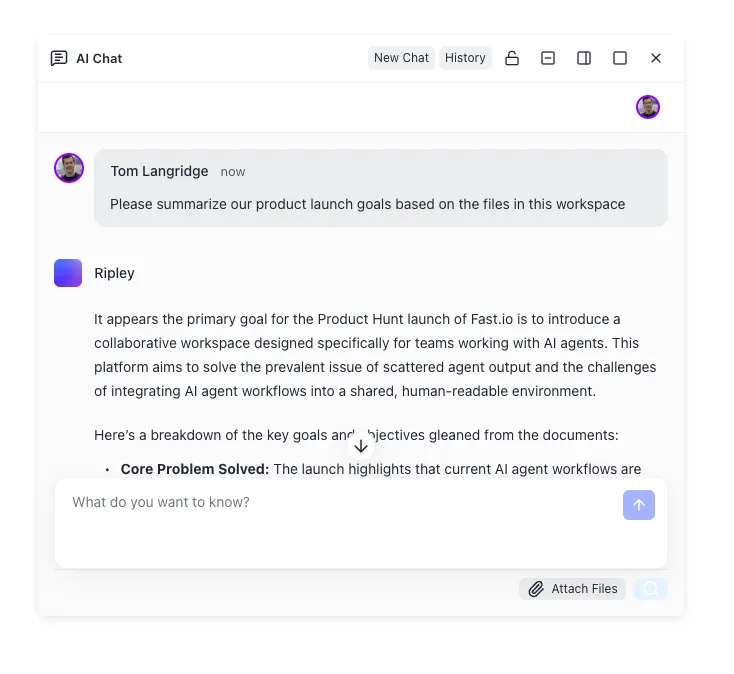
Shared intelligent workspaces fit agent-plus-human review better. With Fast.io workspaces, Hermes can upload JSON and markdown reports through the Fast.io MCP server, keep per-file version history when scores are re-run, and let a human open the same files in the UI. Enable Intelligence Mode on the workspace so reviewers can ask citation-backed questions such as "which flagged files touched billing last week?" without re-opening every JSON blob by hand.
For structured follow-up, Metadata Views can extract fields like path, score, language, and review status from the report set into a sortable grid agents and people both query. That is different from Intelligence Mode: Intelligence indexes for search and chat; Metadata Views builds a typed spreadsheet of extracted columns.
Fast.io plans start at Starter $9.99/mo, Business $49.99/mo, and Enterprise $199.99/mo; monthly plans include a trial of up to 14 days (credit card required), and annual plans have none. Real work runs on a paid organization subscription after the trial. Agent accounts can build the workspace, then transfer ownership to a human when the handoff is ready. See storage for agents and pricing for the current packaging.
Human review loop
- Hermes writes the report files and a short PR summary.
- A reviewer opens flagged paths and confirms or rejects each flag.
- Decisions go into a sibling
review-decisions.jsonor workspace comments so the next scan can learn exclusions. - High-risk flags (auth, payments, cryptography) always get a senior pass regardless of score.
That loop is the product, not the free detector itself. Free tools only buy you triage. Humans still own merge quality.
Accuracy limits, privacy, and when free is not enough
Free AI code detectors fail in predictable ways. Plan for those failures before you put them in CI.
Style collapse. As more humans adopt AI-like formatting and more models mimic human shortcuts, pure style classifiers drift. A 90% claim on a vendor landing page may not hold on your TypeScript monorepo six months later.
Language skew. Tools that shine on Python and JavaScript often weaken on domain-specific languages, templates, or heavily idiomatic codebases.
Obfuscation and partial authorship. Mixed files (human design, AI implementation) confuse binary labels. Prefer per-file and per-hunk notes over whole-repo guilt.
Privacy. Paste-based free tools may process code on third-party infrastructure. For regulated or proprietary code, default to local heuristics or open-source origin tooling inside a Docker/SSH backend, and only send synthetic samples to public UIs for calibration.
Quota cliffs. Free SaaS tiers (for example, limited monthly scans) break agent loops that re-scan on every push. Cache scores by content hash so unchanged files skip re-analysis.
Not a linter, not a license engine, not a security scanner. Keep Semgrep/Sonar/OSV (or your preferred SAST/SCA stack) in parallel. AI-likelihood is one signal in a review packet.
Graduate from free tools when you need SLAs, private-cloud deployment, org-wide dashboards, legal-grade provenance, or API rate limits that survive full-fleet PR volume. Until then, a Hermes-driven free stack is enough to stop "we never even looked" from being the default for machine-authored diffs.
Sources
References used to verify factual claims in this guide.
-
84% of Stack Overflow survey respondents use or plan to use AI tools in their development process, up from 76% the prior year. Only 33% of respondents trust the accuracy of AI tool output, while 46% actively distrust it (3.1% highly trust + 29.6% somewhat trust vs 26.1% somewhat distrust + 19.6% highly distrust).
-
AICodeDetector.org claims over 90% accuracy distinguishing AI-generated and human-written code and provides free analysis without registration for supported languages.
-
Hermes Agent documents terminal backends (local, docker, ssh, singularity, modal, daytona), terminal/file tools, skills, and MCP server configuration for external tools.
-
Hermes Agent is open source on GitHub under the NousResearch/hermes-agent repository.
-
AboutCode AI-Generated Code Search provides open source tools to find code that may have been generated using LLMs and GPT tools and explore FOSS origin via approximate similarity search.
-
Codespy offers a free instant code scan path and a free monthly scan quota for supported languages.
-
Fast.io MCP is available over Streamable HTTP at https://mcp.fast.io/mcp/tools and https://mcp.fast.io/mcp/code.
Frequently Asked Questions
Is there a free AI code detector?
Yes. Free options include browser paste tools such as AICodeDetector.org (no registration for basic analysis) and Codespy's free scan tier, plus open-source projects like AboutCode AI-Generated Code Search for origin-oriented detection. Free always means limits: quotas, language coverage, accuracy drift, and privacy tradeoffs. Verify current vendor limits before you automate bulk scans.
How accurate are free AI code detectors?
Vendor claims vary. AICodeDetector.org states over 90% accuracy and still frames scores as likelihood indicators, not definitive proof. Independent of any vendor, free detectors are probabilistic style or origin classifiers. Accuracy shifts by language, coding style, model family, and time. Benchmark on your own samples and keep a human in the loop for merge decisions.
Can Hermes Agent scan a repo with free detectors?
Yes, as an orchestration pattern. Hermes Agent provides terminal execution, file tools, skills, browser/web tools, and MCP integrations. You install free detectors or call free web checkers through those tools, then write structured reports. Hermes does not ship a built-in commercial AI code detector product; you wire free tools into a skill and report path.
What is the difference between AI code detectors and linters?
Linters and static analyzers check correctness, style rules, and often security patterns against known specifications. AI code detectors estimate whether source looks machine-generated. A file can pass every lint rule and still warrant extra review for authorship risk, license inheritance, or shallow business logic. Run both: linters for quality gates, detectors for triage signals.
Should free AI code detectors fail CI automatically?
Not until you measure false positives on your codebase. Start in warn mode: post a PR comment with flagged paths and scores, require human confirmation on high-risk areas, and only then consider non-blocking checks. Hard-failing merges on free tool scores alone creates alert fatigue and unjustified authorship claims.
Where should Hermes Agent store detector reports?
Local report folders work for solo use. Object storage works for CI artifacts. Shared workspaces work better when agents and humans both need version history, search, and handoff. Fast.io workspaces plus MCP give agents an upload and review surface with Intelligence Mode for citation-backed questions over report history. Monthly plans include a trial of up to 14 days if you want to try that path.
Related Resources

Keep free detector reports next to the code under review
Use a shared Fast.io workspace with MCP access so Hermes Agent can upload scan JSON, version re-runs, and hand flagged files to humans for merge decisions. Monthly plans start with a trial of up to 14 days (credit card required); annual plans have no trial.