Elicit AI Review for 2026: Pricing, Accuracy, and Honest Verdict
Elicit searches more than 125 million academic papers and automates screening, extraction, and synthesis for literature reviews. This review tests those accuracy claims against independent Cochrane benchmarks, breaks down what each pricing tier gets you from the free plan through enterprise, and identifies where the tool falls short for formal systematic reviews.


What Elicit Does and What It Promises
Elicit validated its abstract screening against 994 Cochrane systematic reviews and reported 96.9% sensitivity, beating single-reviewer human performance. An independent 2025 study published in Cochrane Evidence Synthesis and Methods found sensitivity dropped to 37.9% when queries followed real systematic review search strategies (Lau et al., 2025). That 59-point gap between controlled benchmarks and field conditions is what this review investigates.
Elicit is an AI-powered research assistant that searches academic literature, extracts structured data from papers, and synthesizes findings across studies. Built by a public benefit corporation that spun out of Ought (a nonprofit ML research lab) in 2023, the company has raised $31 million in venture funding. A $22 million Series A in early 2025 was co-led by Spark Capital and Footwork, with backers including Jeff Dean, Google's chief scientist.
The tool indexes more than 125 million academic papers through Semantic Scholar and 545,000 clinical trials from ClinicalTrials.gov. Unlike general-purpose chatbots, Elicit focuses on structured research workflows: you ask a question, it finds relevant papers, and it extracts data points into sortable tables rather than generating a prose summary.
Core capabilities include:
- Semantic search across the full paper corpus using natural language, not Boolean strings
- Structured data extraction into customizable table columns for study design, sample size, outcomes, and effect sizes
- Automated research reports that synthesize findings across dozens of sources
- PRISMA-compliant systematic review workflows with screening, extraction, and synthesis stages
- Paper alerts that monitor for new publications on topics you define
- Full-text chat with individual papers
More than 2 million researchers in academia, pharmaceuticals, policy, and technology use Elicit as of 2026.
Related guides
- DeepSearch AI: Features, Use Cases, and Best Alternatives in 2026ChatGPT holds roughly 60% of AI search traffic, yet its Deep Research mode caps free users at five queries per month....
- Clever AI Review 2026: Features, Pricing, and Honest VerdictClever AI Hub bundles 15+ AI models into one interface with a free tier and custom agent builder, but output quality...
- Smith.ai Review 2026: Pricing Breakdown, Features, and Honest VerdictSmall businesses miss 62% of incoming phone calls, costing an average of $126,000 per year in lost revenue. Smith.ai's...
- Fireflies AI Review 2026: Features, Pricing, and Honest VerdictFireflies.ai hit a $1 billion valuation in mid-2025 on the strength of 500,000+ organizations and over 2 billion...
- Perplexity Personal Computer vs Google NotebookLM for ResearchPerplexity Personal Computer is an always-on AI agent that merges local files with cloud search. Google NotebookLM is a...
- Perplexity vs ChatGPT: Which AI Search Tool Is Better in 2026?Perplexity indexes over 50 billion web pages and cites every claim inline. ChatGPT has 900 million weekly users and a...
More on this subject: AI Tool Directories and Comparisons (231 guides)
Pricing: What Each Tier Gets You
Elicit runs on four tiers. The free plan is more generous than most competitors, but the gap between free and paid is steep.
Basic (Free)
Unlimited search across 138 million papers, unlimited summaries, and unlimited chat with full-text access. You get 2 automated reports per month and can add 2 columns to extraction tables at a time. Zotero import is included.
The unlimited search and summaries make the free tier genuinely useful for staying current on a topic or doing exploratory reading. But 2 reports and 2 columns per table is restrictive for any structured work. Most researchers doing systematic extraction hit the ceiling within a few days.
Pro ($49/month, $588/year)
Designed for systematic reviews. You get 144 reports or systematic reviews per year (12 per month), a dedicated systematic review workflow that screens up to 5,000 papers, and 20 table columns at a time. Reports pull from up to 135 data sources. You also get 10 personalized research alerts, custom extractions from uploaded papers, explanations for AI-generated answers, and API access.
At roughly $32/month with the annual discount, Pro is where Elicit becomes a serious research tool. The systematic review workflow alone justifies the cost for anyone running structured evidence synthesis.
Scale ($169/month, $2,028/year)
Everything in Pro, plus figure extraction from research papers, real-time collaboration with live editing, 240 reports per year, 30 table columns, reports drawing from up to 200 sources, and an admin panel with usage tracking and seat management.
Scale makes sense for research teams that need collaborative features. Solo researchers will find Pro sufficient unless they need figure extraction or higher report volume.
Enterprise (custom pricing)
Screens up to 40,000 papers with 40 extraction columns. Includes SSO, SAML, 2FA, domain verification, single-tenancy deployments, unlimited API access, a dedicated customer success team, and a default policy of not training on your data.
For comparison, Consensus Pro runs $9.99/month for basic evidence summaries, and SciSpace Premium starts at $12/month for paper reading assistance. Neither offers Elicit's extraction table depth or systematic review workflows, which makes the pricing gap feel smaller than the sticker price suggests.
Accuracy Under the Microscope
Accuracy is what separates Elicit from a chatbot with a search bar. The data here comes from two sources: Elicit's own validation study and an independent academic comparison.
Elicit's Internal Benchmarks
Elicit tested its pipeline against 994 Cochrane reviews covering 38,493 study records. The validation methodology and full results are published on their engineering blog:
- Search recall: 95.0% of included studies found using only the review title as the query
- Abstract screening: 96.9% sensitivity with 92.5% specificity
- Full-text screening: 99.5% paper-level recall with 94.8% per-criterion accuracy
- Data extraction: 95.6% accuracy on methods, participants, and interventions fields
In a case study for a German education policy review, Elicit correctly extracted 1,502 of 1,511 data points, a 99.4% accuracy rate.
The abstract screening sensitivity is particularly notable. At 96.9%, Elicit outperformed single human reviewers (86.6% in comparable studies from Gartlehner et al. 2020) and approached dual-reviewer screening standards (97.5%).
Independent Testing Results
A 2025 study by Lau et al., published in Cochrane Evidence Synthesis and Methods, compared Elicit to traditional database searching across four systematic reviews. The findings diverged sharply from the internal benchmarks:
- Elicit's average precision was 39.6%, higher than the 7.55% average of original searches
- Sensitivity averaged only 37.9%, compared to 93.5% for traditional methods
In practical terms, Elicit returned a higher proportion of relevant results in each result set (better precision) but missed most of the relevant studies that traditional multi-database searching would find (poor sensitivity). For a systematic review where missing a relevant study can invalidate the conclusions, this is a serious gap.
A separate study in BMC Medical Research Methodology confirmed that Elicit's accuracy varies with how you phrase your research question. Different wordings yielded different cited articles even when the conclusions were similar. The study also found Elicit incorrectly cited a protocol paper, underscoring the need for human verification at every stage.
Why the Numbers Diverge
Elicit's validation uses review titles as queries and measures against known included studies. This tests how well Elicit retrieves papers already identified as relevant. Traditional systematic reviews use comprehensive search strategies across PubMed, Embase, Cochrane Library, and other databases with controlled vocabulary, Boolean operators, and hand-searching. Elicit's semantic approach trades that exhaustiveness for speed and ease of use.
The takeaway: Elicit's extraction accuracy is genuinely strong at 95% or above when papers are in its corpus. Its search and screening work well for rapid evidence scanning, scoping reviews, and identifying key papers. For formal systematic reviews where comprehensive retrieval is required, Elicit should supplement traditional database searching, not replace it.



Give your research files a queryable home
Intelligent workspaces with AI indexing, version history, and MCP access for research agents. Start a 14-day Business Trial (card required; see /pricing/).
Where Elicit Falls Short
No tool covers every use case. These are the limitations that matter most for working researchers.
Search reproducibility. Elicit searches cannot be exported as structured, reproducible search strategies. You cannot save a Boolean search string or controlled vocabulary terms because Elicit does not use them. For PRISMA 2020 reporting, which requires transparent documentation of search methods, this creates real friction. Some systematic review journals may not accept "we used Elicit" as sufficient search documentation.
Limited to empirical research. Elicit works best with structured empirical studies: randomized controlled trials, cohort studies, and meta-analyses. It struggles with theory-heavy fields like philosophy, critical theory, and qualitative social science where the literature does not map cleanly to extraction tables with discrete data points.
No quality appraisal. Elicit cannot assess risk of bias or methodological rigor. A poorly designed observational study looks the same as a well-powered RCT in the extraction table. The tool provides heuristics like citation count and journal name, but these are proxies, not substitutes for critical appraisal tools like Cochrane's RoB 2 or the Newcastle-Ottawa Scale.
Hallucination risk, reduced but present. Elicit links every claim to source text, which drastically reduces hallucination compared to general-purpose chatbots. But its own documentation acknowledges the tool "can miss the nuance of a paper or misunderstand what a number refers to." Complex tables, ambiguous statistics, and papers with multiple study arms are particularly prone to extraction errors.
Integration gaps. Beyond Zotero import, Elicit lacks direct integrations with reference managers, cloud storage, or project management tools. Team members cannot simultaneously edit an Elicit project in real time on the free or Pro tiers, since real-time collaboration requires Scale. Exports are manual CSV or report downloads that you need to organize separately.
Corpus boundaries. Elicit relies on Semantic Scholar's index. Preprints not yet indexed, conference proceedings from smaller venues, government technical reports, and grey literature may be absent. If your review requires sources beyond standard academic databases, you will still need manual searching.
Elicit vs. Consensus, Scite, and Semantic Scholar
Elicit occupies a specific niche in the AI research tool landscape. Understanding where alternatives fit helps you pick the right combination.
Consensus answers specific research questions with evidence-based summaries drawn from peer-reviewed papers. Its Consensus Meter visualizes the degree of scientific agreement on a topic. At $9.99/month for Pro, Consensus is cheaper and faster for directional answers. But it lacks extraction tables, systematic review workflows, and the ability to process uploaded papers. Use Consensus for quick evidence checks on specific claims. Use Elicit when you need to systematically extract data across dozens of studies.
Scite classifies citations as supporting, contrasting, or mentioning by analyzing the sentences around each citation. This reveals how the field has received a particular paper over time. Scite complements Elicit rather than competing with it: use Elicit to find and extract from papers, then use Scite to assess how those findings have been challenged or confirmed by subsequent research.
Semantic Scholar is a free discovery platform from the Allen Institute for AI, indexing over 200 million papers. Elicit builds on Semantic Scholar's index and adds extraction and synthesis layers on top. If you only need to find papers without structured extraction, Semantic Scholar covers a larger corpus at no cost.
SciSpace (formerly Typeset) focuses on reading and understanding individual papers. Upload a PDF and ask the AI to explain equations, complex tables, or dense methodology in plain language. At $12/month, SciSpace is the strongest single-paper reading tool, but it does not handle multi-paper extraction workflows.
ChatGPT Deep Research and Perplexity search broader sources including web pages, news, and non-academic content. They work well for interdisciplinary research but lack Elicit's structured tables and systematic review workflows. Neither provides the source-level citations that Elicit attaches to every extracted data point.
For most researchers, the practical toolkit is: Elicit for structured multi-paper analysis, Consensus for quick evidence summaries, Semantic Scholar as a free discovery layer, and SciSpace for reading dense individual papers.
Organizing Research Output Beyond Elicit
Elicit handles search and extraction, but it does not manage the full lifecycle of a research project. Exported CSVs, downloaded reports, annotated PDFs, and draft manuscripts need a home that supports version history, team access, and ideally some way to query across your collected documents.
Most researchers default to Google Drive or Dropbox for file storage, and these tools work fine as simple containers. The limitation shows up when your collection grows: you cannot search your stored PDFs by meaning rather than filename, and sharing permissions are typically all-or-nothing at the folder level.
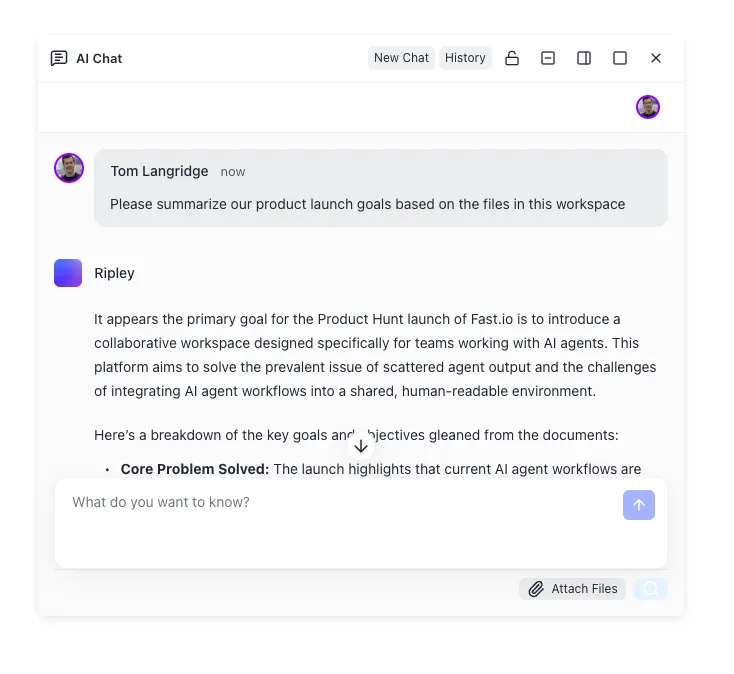
Fast.io takes a different approach with workspaces designed for research and agent-driven workflows. Once Intelligence is enabled for the workspace, files are indexed and searchable for semantic search and Ripley AI chat. Upload your Elicit exports, literature notes, and draft manuscripts, then ask questions across the entire collection without switching tools. Fastio offers a 14-day Business Trial (card required; see /pricing/).
For teams running AI research agents like Hermes Agent alongside tools like Elicit, Fast.io serves as the persistent storage layer that agents and humans share. Agents read, write, and organize files through the Fast.io MCP server, while researchers access the same workspace through the web UI. Ownership transfer lets an agent build and populate a research workspace, then hand it off to a human collaborator who reviews, refines, and publishes the findings.
Granular permissions at the workspace, folder, and file level solve a common team research problem: sharing extraction tables with co-authors without exposing raw interview transcripts or pre-publication drafts. Audit trails track every change, which matters for research integrity documentation.
The gap that tools like Fast.io fill is between extraction (what Elicit does well) and synthesis (what researchers do with the extracted data). A workspace that indexes and versions your research files as queryable knowledge, rather than treating them as static downloads, closes that gap.
Sources
References used to verify factual claims in this guide.
-
96.9% abstract screening sensitivity across 994 Cochrane reviews covering 38,493 study records 99.4% extraction accuracy on 1,502 of 1,511 data points
-
37.9% average sensitivity in independent comparison of Elicit to traditional database searching
-
Over 2 million researchers use Elicit in academia and industry
-
Elicit pricing: Free Basic, Pro at $49/month, Scale at $169/month
-
Accuracy varies with question phrasing; protocol paper incorrectly cited in testing
Frequently Asked Questions
Is Elicit AI free?
Yes. Elicit's Basic plan is free and includes unlimited search across 138 million papers, unlimited summaries, and unlimited chat with full-text access. The free tier also provides 2 automated reports per month and Zotero import. Paid plans start at $49/month (Pro) for systematic review workflows, higher report limits, and API access.
How accurate is Elicit AI for research?
Elicit's own validation against 994 Cochrane reviews shows 96.9% abstract screening sensitivity and 95.6% data extraction accuracy. An independent study in Cochrane Evidence Synthesis and Methods found lower sensitivity (37.9%) when comparing Elicit to traditional multi-database search strategies. Extraction accuracy is consistently high at 95% or above, but search comprehensiveness depends on your query and how well your topic is covered in Semantic Scholar's index.
What is the best AI for literature review?
It depends on the task. Elicit is strongest for structured data extraction across multiple papers and systematic review workflows. Consensus excels at quick evidence-based answers to specific research questions. Scite provides citation context analysis showing whether papers support or contradict a finding. Semantic Scholar offers free discovery across 200 million papers. SciSpace is the best option for reading and understanding individual dense papers.
Can Elicit replace manual literature review?
Not entirely. Elicit accelerates screening and extraction significantly, and its internal testing shows abstract screening sensitivity near 97%. But independent testing shows it can miss relevant studies that traditional database searching would find. For formal systematic reviews, Elicit works best as a complement to traditional methods, handling high-volume screening and extraction while researchers maintain comprehensive search strategies and critical appraisal.
Does Elicit work for non-medical research?
Yes. Elicit indexes papers from all academic disciplines through Semantic Scholar, not just medicine. It performs well with empirical studies in social sciences, economics, environmental science, and engineering. It is less effective for theory-heavy humanities, philosophy, and qualitative research where findings do not map cleanly to structured extraction tables.
Related Resources

Give your research files a queryable home
Intelligent workspaces with AI indexing, version history, and MCP access for research agents. Start a 14-day Business Trial (card required; see /pricing/).