Devin AI Figma Integration: Design-to-Code with MCP and Visual Verification
Autonomous software engineering agents require direct access to vector frames, layout constraints, and design tokens to convert Figma files into production code without guesswork. By connecting Devin AI to Figma through the Model Context Protocol, development teams enable Devin to inspect live canvas specs and verify implementations using built-in browser screenshots. Fastio shared workspaces keep design assets and generated code persistent, versioned, and auditable.


How Devin AI Connects to Figma via the Model Context Protocol
Prompting an AI coding assistant with static UI screenshots forces the model to guess hex values, layout constraints, and spacing tokens from compressed pixels. The model reliably misjudges flex wrapping, drops edge-case padding, and invents component props that do not exist in the design system. The fix is connecting an autonomous software engineering agent directly to the vector tree and design tokens of the original Figma canvas through the Model Context Protocol, letting the agent inspect the exact frame hierarchy before writing a single line of frontend code.
The Devin AI Figma integration enables Devin to read design tokens, frame layouts, and component specs from Figma via MCP to generate pixel-accurate frontend implementations.
Unlike basic prompt-to-UI builders that generate isolated HTML and CSS snippets, Devin AI operates as an autonomous software engineer inside a full Linux sandbox. Prompt-to-UI tools output single-file demonstrations disconnected from your repository architecture, component libraries, or testing suites. Devin approaches design implementation by cloning your repository, inspecting established coding standards, querying the Figma canvas for structural metadata, and editing your actual source tree.
The Model Context Protocol acts as the bridge for this workflow. By supporting standard client-to-server MCP communication, Devin connects to the official remote Figma MCP server. Instead of guessing styles from rendered images, Devin calls MCP tools to retrieve structured node data, auto-layout parameters, typography styles, and color variables directly from the Figma document object model.
When working with Figma files, designers organize complex hierarchies with nested frames, vector masks, and component variants. Through MCP, Devin reads these properties as structured JSON objects. It extracts exact margin values, flex directions, padding constraints, and responsive fill rules. This structural awareness prevents the visual regressions and layout drift common in screenshot-based AI code generation.
Devin also handles asset extraction alongside code generation. When a component requires vector iconography or background illustrations, Devin calls Figma MCP tools to export those vector assets directly into your repository's public asset directory. Rather than relying on broken external placeholder links, Devin commits real SVG files that match the designer's canvas specifications.
Related guides
- Claude Code vs Cline: MCP Integration ComparisonThis guide provides a detailed Claude Code vs Cline MCP integration comparison for developers. We break down...
- How to Integrate MCP Servers with OpenClaw AgentsMCP integration lets OpenClaw agents connect to external tools like file storage servers. Access Fastio's consolidated...
- How to Configure MCP Servers in Devin AIConfiguring Model Context Protocol servers in Devin AI requires editing the devin mcp config files. This guide details...
- How to Use MCP with Devin AIDevin AI supports three MCP surfaces, not one: the in-product marketplace, the free DeepWiki MCP server for public...
- What Is Devin AI? An Overview of Cognition's Autonomous CoderDevin AI, developed by Cognition, is an autonomous AI software engineer that operates inside a secure remote sandbox....
- Devin AI Context Window: Architecture, Memory Management, and Large CodebasesThe Devin AI context window pairs a frontier model token buffer with episodic memory and dynamic tool-based retrieval...
More on this subject: Devin (104 guides)
Comparing Figma Access Scopes: Personal vs. Organization
Connecting Devin AI to your Figma workspace takes place through Devin's integration settings. Organization administrators navigate to Settings, select Connections, and open the MCP servers tab in the Devin web application. Within the marketplace catalog, locating Figma and clicking Enable initiates the setup flow.
Authentication relies on standard OAuth protocols. When enabling the server, Devin prompts you to complete an authorization flow that routes through Devin's OAuth callback handler. How this connection functions across your team depends on the access scope you choose.
The Figma MCP integration supports both Personal and Organization-scoped access tokens:
For engineering teams, setting the access scope to Organization is standard practice. The Devin MCP documentation recommends connecting a dedicated Figma service account rather than a personal user profile. A service account ensures that team members run Devin sessions against design files without exposing personal tokens. It also prevents session failures if an individual employee leaves the organization or changes their Figma account settings.
Once the MCP server is enabled, you point Devin to your design files by including the direct Figma URL in your initial prompt. To prevent Devin from parsing massive canvas files that consume excessive context tokens, link directly to the specific frame or component using Figma's node-id parameter:
Implement the responsive user profile card from our Figma design system:
Figma URL: https://www.figma.com/design/AbCdEf12345/App-Design-System?node-id=402-1892
Target repository: frontend/components/profile/ProfileCard.tsx
Framework: React with Tailwind CSS
Providing the exact node-id directs Devin's MCP queries to the relevant subtree, ignoring unrelated screens and keeping context windows focused on the component implementation.
When scoping instructions for Devin, specify whether the agent should extract vector icons locally or import them from an established iconography package. Specifying your component path and target framework ensures that Devin places generated files in the correct directories without restructuring your project layout.
Steps to Convert Live Figma Vector Trees into Production Code
Once Devin resolves the target Figma node via MCP, it starts translating design parameters into production-grade source code. This process follows four systematic phases: inspecting tokens, matching repository components, writing frontend code, and verifying compilation.
First, Devin inspects the design tokens associated with the frame. It extracts CSS variables, color hex codes, spacing units, and typography scales. If the Figma file uses Figma Variables or a connected design system library, Devin queries those definitions directly.
Here is an example of the structured layout and style payload Devin receives from the Figma MCP server when inspecting a card component:
{
  "id": "402:1892",
  "name": "UserProfileCard",
  "type": "FRAME",
  "layoutMode": "VERTICAL",
  "primaryAxisAlignItems": "MIN",
  "counterAxisAlignItems": "CENTER",
  "paddingLeft": 24,
  "paddingRight": 24,
  "paddingTop": 32,
  "paddingBottom": 32,
  "itemSpacing": 16,
  "cornerRadius": 12,
  "fills": [
    {
      "type": "SOLID",
      "color": { "r": 0.98, "g": 0.98, "b": 0.99, "a": 1.0 }
    }
  ],
  "strokes": [
    {
      "type": "SOLID",
      "color": { "r": 0.88, "g": 0.90, "b": 0.92, "a": 1.0 }
    }
  ],
  "strokeWeight": 1
}
Second, Devin inspects your repository to identify existing components and styling patterns. Rather than creating generic div containers with hardcoded styles, Devin maps the Figma tokens to your project's Tailwind configuration, CSS variables, or component libraries such as Shadcn UI or Radix primitives.
Third, Devin writes the component implementation directly into your repository. Below is the production TypeScript React component Devin generates from the extracted frame metadata:
import React from 'react';

export interface UserProfileCardProps {
  name: string;
  role: string;
  avatarUrl: string;
  bio: string;
  isOnline?: boolean;
}

export const UserProfileCard: React.FC<UserProfileCardProps> = ({
  name,
  role,
  avatarUrl,
  bio,
  isOnline = false,
}) => {
  return (
    <article className="flex flex-col items-center rounded-xl border border-slate-200 bg-slate-50 p-6 pt-8 text-center shadow-sm">
      <div className="relative mb-4">
        <img
          src={avatarUrl}
          alt={name}
          className="h-20 w-20 rounded-full object-cover ring-2 ring-white"
        />
        {isOnline && (
          <span
            className="absolute bottom-0 right-0 h-4 w-4 rounded-full bg-emerald-500 ring-2 ring-white"
            aria-label="Online status indicator"
          />
        )}
      </div>
      <h3 className="text-lg font-semibold text-slate-900">{name}</h3>
      <p className="text-sm font-medium text-slate-500">{role}</p>
      <p className="mt-4 text-sm leading-relaxed text-slate-600">{bio}</p>
    </article>
  );
};
Fourth, Devin tests the implementation in its built-in terminal. It executes build commands such as npm run build and runs project linters to confirm that TypeScript types resolve cleanly and no styling syntax errors exist.
If the component relies on dynamic states such as loading skeletons, error banners, or interactive dropdown menus, Devin inspects the corresponding Figma variant states. It incorporates conditional rendering logic to ensure that interactive behaviors match the designer's intent.


Persist Devin AI Design Tokens and Frontend Assets
Give your autonomous engineering agents a versioned cloud workspace. Connect Devin to Fastio via MCP to store component assets, review visual diffs, and collaborate with human developers. Monthly plans start with a trial of up to 14 days (credit card required); annual plans have no trial.
Why Autonomous Visual Verification Prevents Layout Regressions
Writing clean code is only half the battle in design-to-code pipelines. The code must match the visual intent across different screen dimensions. Autonomous agents without visual feedback frequently introduce subtle layout defects: text that wraps awkwardly, buttons that overlap containers, or flex elements that collapse unexpectedly.
Devin solves this problem through its built-in browser environment. After generating or updating the component code, Devin starts your local development server or Storybook workshop inside its sandbox. It navigates to the rendered component and captures visual proof of the output.
Devin takes automated screenshots across desktop (1440px) and mobile (375px) breakpoints to verify design match.
By capturing screenshots at both 1440px desktop widths and 375px mobile viewports, Devin evaluates how the component behaves under responsive constraints. It inspects media query breakpoints, flexbox wrapping, and fluid typography.
During visual verification, Devin executes an automated review cycle:
- Render component: Devin loads the component in its browser using Storybook or a local Vite or Next.js preview server.
- Capture viewport captures: Devin resizes the browser viewport to 1440px desktop width and takes a full-resolution screenshot, then resizes to 375px mobile width for a second capture.
- Compare against Figma: Devin compares the captured screenshots with the original Figma frame specs fetched via MCP.
- Autonomous visual debugging: If Devin detects discrepancies, such as clipped text, incorrect padding, or misaligned badges, it modifies the styling rules and re-evaluates the rendered page.
- Provide visual evidence: Devin posts the final rendered screenshots directly into the session conversation, allowing human developers to review visual fidelity before merging.
Developers reviewing the session can step backward through Devin's browser history to inspect what the agent saw at each iteration, as detailed in the Devin frontend components guide. This transparency eliminates guesswork and ensures that pull requests arrive with verified visual evidence.
For teams running component workshops, Devin can also add stories to Storybook automatically. Devin configures Storybook stories with mock props representing default, loading, and edge-case states, verifying that each permutation renders without console errors.
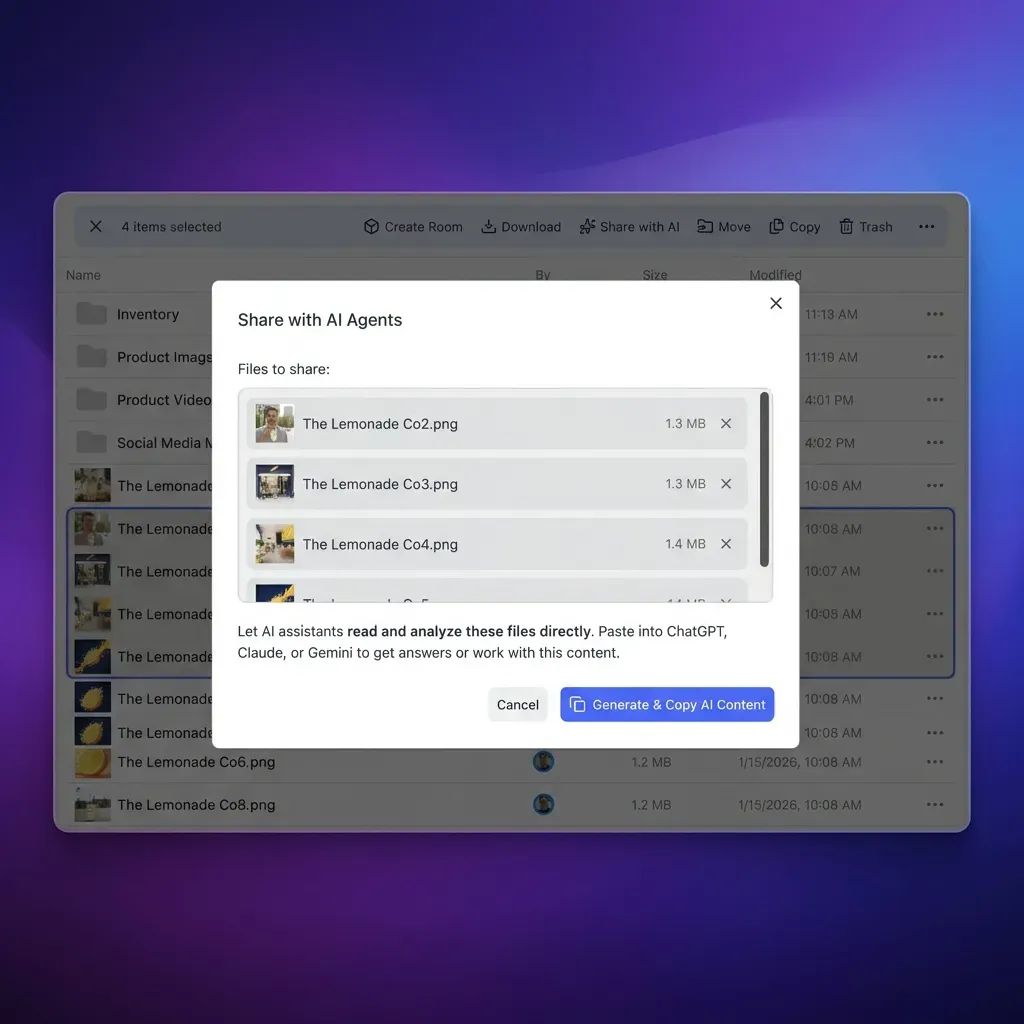
Managing Design Assets and Team Handoff with Fastio Workspaces
Autonomous engineering sessions produce numerous digital assets, including exported SVG icons, raster imagery, design token JSON schemas, and visual verification screenshots. Relying solely on Devin's ephemeral VM disk creates operational bottlenecks: once a session concludes, intermediate assets and review logs are difficult for design teams to access.
Storing design deliverables across unorganized channels introduces friction. Local developer machines hide assets from remote teammates, raw cloud storage buckets lack human-friendly preview interfaces, and standard personal drives fail to provide clean programmatic APIs for autonomous agents.
Fastio intelligent workspaces provide the shared persistence substrate for agentic design-to-code workflows. In Fastio shared workspaces, human designers, developers, and autonomous agents collaborate within shared environments where files remain indexed, versioned, and auditable.
Agents connect to Fastio through the Fastio MCP server using Streamable HTTP at endpoint https://mcp.fast.io/mcp/code, the address for coding agents. Devin can call Fastio MCP tools to persist component assets, write Storybook build outputs, and upload visual verification screenshots directly to project folders.
Fastio enhances the Devin AI Figma pipeline across several key operational areas:
- Per-file version history: Every file uploaded to a Fastio workspace retains a complete version history. When Figma designs change and Devin regenerates assets, previous iterations remain preserved. Teams can review changes or restore earlier versions at any point.
- Collaborative Notes: Fastio Collaborative Notes provide real-time co-editing where human team members and AI agents interact on the same document. Teams use Notes to document component prop requirements, design token mappings, and edge-case behaviors that guide Devin during development.
- Granular permissions: Organization administrators configure access permissions at the organization, workspace, folder, and file level. Devin can be granted write access to specific asset directories while sensitive production configurations remain restricted.
- Detailed activity log: Fastio maintains a detailed activity log recording every upload, edit, and access event, retained according to your plan. This record provides visibility into which assets were created by Devin and when they were modified.
- Structured document extraction: Teams managing design token specifications in PDFs or spreadsheets can use Fastio Metadata Views to extract typed design parameters automatically.
- Ownership transfer: When an external agency or contractor uses Devin to build a design system library, they can create the organization and workspaces, populate the assets, and transfer organization ownership to the client while retaining administrative access.
Subscription options are structured to support team scalability:
Monthly plans start with a trial of up to 14 days (credit card required); annual plans have no trial. Teams can explore Fastio pricing and plans to select the tier that matches their deployment requirements.
Sources
References used to verify factual claims in this guide.
-
Devin integrates with the official remote Figma MCP server via OAuth to access design files.
-
Devin uses a built-in browser to capture project screenshots and visually verify UI implementations.
Frequently Asked Questions
Can Devin AI convert Figma designs into code?
Yes. Devin AI connects directly to Figma using the Model Context Protocol. By querying the official Figma remote MCP server, Devin inspects vector layers, layout constraints, color variables, and typography tokens from Figma frames and implements production frontend code directly into your repository.
How do I connect Figma to Devin AI?
Navigate to Settings, select Connections, and open the MCP servers tab in your Devin account. Find Figma in the MCP marketplace, click Enable, and complete the OAuth authorization flow. You can configure the connection with Personal scope for individual use or Organization scope using a dedicated Figma service account for team environments.
Does Devin use the Figma MCP server?
Yes. Devin uses the official remote Figma MCP server hosted at https://mcp.figma.com/mcp. This server provides structured endpoints that allow Devin to read frame trees, inspect design variables, and extract component styles directly over HTTP.
How does Devin verify that generated code matches the Figma design?
Devin runs the frontend project locally using Storybook or a development server, opens the page in its built-in browser, and captures screenshots at 1440px desktop and 375px mobile breakpoints. It compares these captures with the Figma canvas specs and iterates on the code to resolve visual discrepancies.
What access scope should I use when connecting Figma to Devin in an organization?
For teams, Organization scope is strongly recommended. Devin documentation advises connecting a dedicated Figma service account rather than a personal user profile. This ensures consistent file access across all team sessions and protects individual developer credentials.
How do teams store and collaborate on assets generated by Devin?
Teams use Fastio shared workspaces to persist assets, icons, and visual diffs created by Devin. Devin uploads files via the Fastio MCP server, where assets benefit from per-file version history, granular access controls, real-time Collaborative Notes, and a detailed activity log.
Related Resources

Persist Devin AI Design Tokens and Frontend Assets
Give your autonomous engineering agents a versioned cloud workspace. Connect Devin to Fastio via MCP to store component assets, review visual diffs, and collaborate with human developers. Monthly plans start with a trial of up to 14 days (credit card required); annual plans have no trial.