What Is Cognition AI? The Company Behind Devin
Cognition AI raised over $1B at a $26B valuation in May 2026 while reporting $492M run-rate revenue, and says 89% of its own code is committed by Devin. That scale matters because Cognition is not just a product name. It is the company behind Devin Cloud, Devin CLI, Devin Desktop, DeepWiki, and Devin Review, and buyers need a clear map of which surface does what.


What Cognition AI is
Cognition AI raised over $1 billion at a $26 billion valuation in May 2026, reported $492 million in run-rate revenue, and said 89% of code committed by its own engineers is committed by Devin [Cognition Series D 2026]. That is not a side project. It is a company-scale bet that autonomous software engineers will become a normal part of how large teams ship code.
Cognition AI is the company behind Devin, an autonomous AI software engineer designed to plan, write, test, and ship code inside existing engineering workflows. Official company materials position Cognition as an applied AI lab building tools for software creation, with Devin as the product line that plans, writes, tests, and ships production code inside customer codebases and tools [Cognition 2026].
Search demand reflects that buyer confusion. DataForSEO shows roughly 9,900 monthly US searches for "cognition ai" and about 1,000 for "cognition labs," with elevated CPC on brand variants. People are not only looking up a product. They are trying to sort company, product names, and brand aliases before they talk to procurement.
Products under the Cognition umbrella:
- Devin Cloud: the long-running autonomous agent that works on its own machine in the cloud
- Devin CLI: Devin intelligence from the terminal, with handoff to cloud Devin for longer work
- Devin Desktop: the desktop agent command center and IDE path (formerly Windsurf)
- DeepWiki: AI documentation you can talk to, generated and updated from repositories
- Devin Review: automated code review across diffs
Cognition AI, Inc. is also known as Cognition Labs and does business as Cognition. Wikipedia and press use those names interchangeably. The legal and brand surface has shifted as the company grew, but the core identity is consistent: San Francisco-based AI company founded by competitive programmers, best known for Devin AI.
Cognition is not a foundation model lab in the OpenAI or Anthropic sense. In its Series D note it describes itself as an independent agent lab that works with foundation model providers, evaluates models across many software engineering task categories, and routes work for price and performance [Cognition Series D 2026]. Buyers evaluating "cognition software" should treat Cognition as an agent platform company, not as a raw model vendor.

Related guides
- How to Use Devin DeepWiki for Codebase DocsDevin DeepWiki is Cognition's AI documentation layer for Devin AI. It indexes repositories into architecture diagrams,...
- How to Use MCP with Devin AIDevin AI supports three MCP surfaces, not one: the in-product marketplace, the free DeepWiki MCP server for public...
- Inside Devin AI: The Architecture and Engine Behind Cognition's Autonomous EngineerCognition Devin AI combines a cloud-based reasoning model with a secure, containerized Devbox environment equipped with...
- Devin AI vs. Windsurf: Understanding the Cognition EcosystemCognition AI's acquisition of the Windsurf IDE in July 2025 led to its rebranding as Devin Desktop in June 2026. This...
- How to Manage Files Generated by Devin AIDevin AI generates dozens to hundreds of files per session, but its workspace resets between runs. This guide covers...
- How to Connect Devin AI to VS CodeConnecting Devin AI to VSCode (Visual Studio Code) bridges local development environments with autonomous cloud...
More on this subject: Devin (104 guides)
Cognition, Devin, and DeepWiki: who owns what
Most SERP pages either paste a company blurb or sell Devin as a single product. The buying decision is cleaner when you separate company, agent, documentation, and desktop surfaces.
Cognition (the company)
Cognition is the parent company and commercial entity. Enterprise contracts, government offerings, and brand-level announcements come from Cognition. Customer logos and case studies on Cognition and Devin sites include large banks, manufacturers, systems integrators, and public sector teams. Cognition also runs hiring, research posts, and corporate financing.
When someone asks "what is Cognition AI," the accurate short answer is: the company that builds and operates Devin and related software creation tools. When someone asks "who built Devin AI," the answer is Cognition (founders Scott Wu, Steven Hao, and Walden Yan, with a broader engineering org around them).
Devin AI (the agent product line)
Devin is Cognition's AI software engineer. Official docs describe Devin as an autonomous agent that can write, run, and test code, tackle tickets, implement features, reproduce bugs, and build internal tools. A practical rule of thumb in the docs: if a competent engineer can finish a task in about three hours, Devin can often handle it [Devin Docs 2026].
Devin is not only a chat box. The product surface includes:
- a conversational web UI with session tools (shell, embedded IDE, browser)
- cloud sessions for longer autonomous runs
- CLI access for local interactive work and handoff to cloud
- integrations with issue trackers, chat tools, GitHub-style PR flows, and observability systems
- API and automation hooks for programmatic task creation
Strength areas Cognition and Devin materials emphasize include parallel backlog work, migrations and refactors, repetitive chores (PR review, unit tests, documentation maintenance), bug triage, and customer engineering prototypes. Weak fit areas still exist: extremely hard novel research tasks, poorly specified work, and anything that lacks a clear completion check.
DeepWiki (documentation surface)
DeepWiki is Cognition's AI documentation product for repositories. The public site frames it as up-to-date documentation you can talk to for repos, closer to "Deep Research for GitHub" than to a static wiki [DeepWiki 2026]. On Devin's product pages, documentation use cases point to auto-generated docs and system diagrams for legacy or unfamiliar codebases, with DeepWiki as the dedicated surface.
For buyers, DeepWiki solves a different problem than Devin. Devin changes code. DeepWiki helps humans and agents understand code. Teams often need both: DeepWiki (or similar repo Q&A) for orientation, Devin for execution.
Devin Desktop and the Windsurf line
In July 2025 Cognition signed a definitive agreement to acquire Windsurf, the agentic IDE, including product, IP, brand, and team [Cognition Windsurf 2025]. In June 2026 Cognition announced that Windsurf is now Devin Desktop: an agent command center with a full IDE, multi-agent management, Spaces for shared context, and support for ACP-compatible third-party agents such as Codex, Claude Agent, and OpenCode [Devin Desktop 2026].
Devin Desktop is not "Devin but local only." Official messaging positions one Devin identity across surfaces:
- Devin Desktop: manage local and cloud agents in one place, with IDE when you need it
- Devin Cloud: autonomous long-running work on a remote machine
- Devin CLI: terminal-first interaction and handoff
- Devin Review: review on every diff
That map is the content gap most thin overviews skip. Cognition is the company. Devin is the agent product family. DeepWiki is the documentation product. Devin Desktop is the desktop/IDE and multi-agent control surface after the Windsurf acquisition and rebrand.



Park Cognition AI and Devin outputs in one place
When Devin finishes a session, keep migration notes, review packs, and handoff files in a shared Fast.io workspace with version history, Intelligence Mode, and MCP access. Monthly plans start with a 14-day trial (credit card required).
Founders, funding, and how Cognition got here
Cognition was founded in 2023 by Scott Wu (CEO), Steven Hao (CTO), and Walden Yan (CPO). Public profiles emphasize competitive programming pedigrees, including International Olympiad in Informatics gold medals among founders and early hires. The early team pitch was that teaching an agent to program well is an algorithmic systems problem, not only a chat UX problem [Wikipedia Cognition AI 2026].
Timeline that matters for buyers:
- 2023: company founded in San Francisco; early focus later consolidated around AI software engineers
- March 2024: public Devin demo as an AI software engineer
- Early/mid 2024: Founders Fund-led financing; company reaches unicorn status after a large 2024 round
- 2025: product expansion (including Devin 2.x era features), valuation steps higher, Windsurf acquisition in July, further growth financing through the year
- May 2026: Series D scale financing over $1B at a $26B valuation; company reports $492M run-rate revenue and more than 10x enterprise usage growth year-to-date [Cognition Series D 2026]
- June 2026: Windsurf rebranded to Devin Desktop; Devin Local introduced as the rewritten local agent path
The Series D post is the cleanest primary source for current scale claims. Cognition says enterprise usage grew more than 10x since the start of 2026, run-rate revenue reached $492M, and customers include institutions such as Citi, Mercedes-Benz, Goldman Sachs, Dell, Santander, and U.S. military organizations, plus growth-stage tech teams [Cognition Series D 2026]. Treat customer lists as company-reported. For evaluation, request reference calls in your industry and measure on your repos.
Cognition also publishes product and research work under its own model program (for example SWE-series models discussed in company blogs) while remaining model-agnostic as a platform. That independence story is part of the commercial pitch: pick models per task class rather than locking every workflow to one lab.
For searchers comparing "cognition labs" vs "cognition ai company," there is no separate public product company called Cognition Labs today. Cognition Labs is an alternate name for the same firm. Devin is the product brand. Cognition is the corporate brand.
What the funding means operationally
Large valuations do not prove product-market fit for your stack. They do signal that Cognition can fund long sales cycles, enterprise security reviews, multi-year product integration after Windsurf, and model evaluation work. If you are buying for a regulated org, ask for the current enterprise packaging, data handling docs, and deployment options rather than inferring them from press headlines.
How engineering teams actually use Devin AI
Devin AI is the product most people mean when they say "Cognition." Official customer stories and product pages cluster around a few workflow patterns that map cleanly to real backlogs.
Migrations and refactors at scale
Nubank's published case study describes a multi-million-line ETL modernization. Engineers taught Devin the migration pattern, then delegated high-volume sub-tasks with human review. Cognition reports 8x to 12x engineering time efficiency gains on the delegated work and over 20x cost savings on the Devin-handled scope, with business units completing migrations in weeks instead of months or years [Devin Nubank case study]. Numbers like these are customer-specific. Your gain depends on task regularity, test coverage, and review quality.
Parallel ticket and chore work
Devin docs highlight parallel backlog execution: Linear or Jira tickets, feature slices, bug reports, and app testing. The highest success rates come from clear prompts, explicit completion criteria, and easy verification such as green CI or a deployable preview [Devin Docs 2026].
Review, triage, and maintenance
Product materials emphasize PR review, visual QA, incident investigation, CI failure fixes, scheduled release notes, and documentation upkeep. These are the tasks that drain senior time without needing full product inventiveness.
Multi-surface day-to-day
A practical pattern from official guidance:
- Start exploratory or short fixes in Devin CLI or Devin Desktop.
- Handoff longer work to Devin Cloud.
- Keep humans on architecture, prioritization, and merge decisions.
- Use DeepWiki or generated docs when onboarding agents or people to unfamiliar systems.
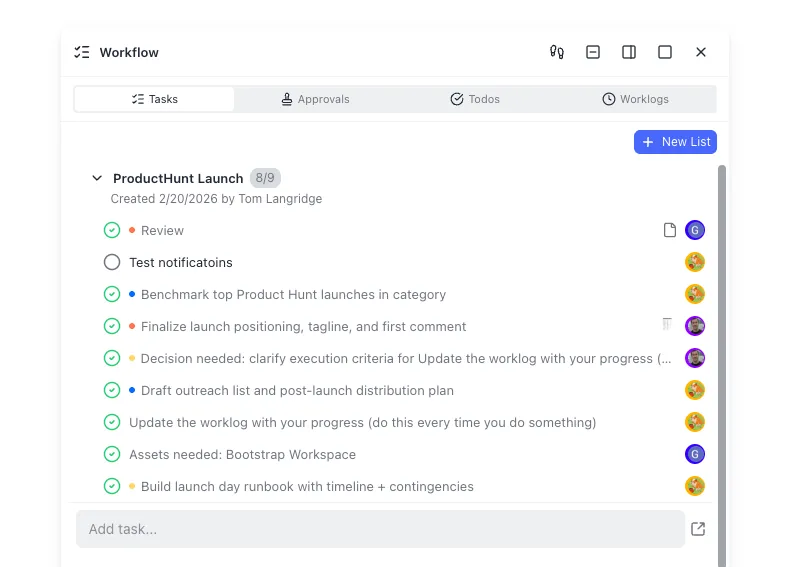
Devin is most effective when it is embedded in the team's existing tools rather than used as a one-off demo sandbox. That is also where operational risk appears: agents create files, patches, logs, screenshots, migration notes, and review artifacts faster than email or chat can organize them.
Where agent output needs a durable workspace
Cognition's stack is built for writing and reviewing software. It is not a general file system of record for every artifact a multi-agent program produces. Teams still choose where playbooks, design PDFs, customer export packs, migration reports, and signed handoff packages live.
Common options first:
- Local disks and developer laptops: fast, fragile, invisible to the rest of the team
- Git hosting alone: excellent for code, weak for large binaries, client packages, and cross-functional review
- Object storage (S3 and peers): durable and cheap, but raw buckets need custom glue for permissions, search, and human review
- Consumer drives (Google Drive, Dropbox, Box, OneDrive): familiar for people, awkward as an agent API surface and weak for concurrent agent version history
Fast.io sits in the coordination layer around tools like Devin AI rather than replacing them. Agents and humans share org-owned workspaces. Files keep per-file version history. Permissions can be set at org, workspace, folder, and file levels. A detailed activity log records actions by people and agents. Branded Send, Receive, and Exchange shares support durable or expiring access with per-recipient grants. Intelligence Mode indexes content for citation-backed RAG chat. Hybrid Search combines full-text, semantic, and metadata-value queries. Metadata Views turn documents into typed, filterable grids when you need structured extraction rather than freeform Q&A.
For agent workflows, Fast.io also exposes a consolidated MCP toolset over Streamable HTTP at /mcp and legacy SSE at /sse. See the agent storage guide at /storage-for-agents/ for setup. Ownership transfer lets an agent bootstrap an org and hand it to a human while keeping admin access. The activity feed, available over WebSocket or long-poll, supports reactive automation when files change. Cloud import can pull from Google Drive, OneDrive, Box, Dropbox, or URLs without local shuttle scripts.
A concrete Devin-adjacent pattern:
- Keep repo work in git and Devin sessions as usual.
- Drop migration runbooks, DeepWiki exports, QA recordings, and customer-facing packs into a Fast.io workspace.
- Enable Intelligence so reviewers can ask citation-backed questions across those artifacts.
- Have reviewers comment on the files and check their version history when human sign-off is required before release.
- Share a branded Receive or Exchange room when external vendors must drop evidence without joining your git org.
Creating a Fast.io user account does not require payment, but real work requires an organization on a paid subscription. Monthly plans start with a trial of up to 14 days (credit card required); annual plans have no trial. Plans are Starter at $9.99/mo, Business at $49.99/mo, and Enterprise at $199.99/mo. Details live on /pricing/ and the agent-oriented overview at /storage-for-agents/.
Cognition and Devin AI remain the coding-agent decision. Fast.io is the persistent workspace decision for everything those agents and humans must keep, search, share, and audit after the session ends.
Buyer checklist for Cognition software
If you are evaluating Cognition AI as a vendor, run a short pilot with success metrics before a broad rollout.
Scope the right product surface
- Need autonomous multi-hour coding on tickets and migrations: start with Devin Cloud.
- Need terminal-native interaction and fast local loops: add Devin CLI.
- Need an IDE plus multi-agent command center: evaluate Devin Desktop.
- Need living documentation over large repos: evaluate DeepWiki.
- Need automated review on every diff: evaluate Devin Review.
Define measurable tasks
Pick 10 to 20 real backlog items with clear done conditions: CI green, migration checklist complete, vulnerability class reduced, docs regenerated for a module. Avoid open-ended "improve the app" pilots.
Instrument human review cost
Track time to write the prompt, time to review the PR, rework rate, and merge rate. Cognition's own productivity writing argues that agents should earn their keep. Your finance team will ask the same question with your wage rates.
Separate code system of record from artifact system of record
Keep source of truth for code in your git host. Decide explicitly where non-code artifacts live. If agents and humans will co-own those files, prefer a workspace with version history, permissions, audit trail, and agent APIs over ad hoc chat attachments.
Plan for multi-agent reality
Devin Desktop's ACP support and Spaces model assume engineers will run more than one agent. Your storage and review process should assume concurrent writers, not a single personal sandbox.
Security and compliance review
Ask Cognition for current enterprise controls, data residency options, and government packaging if you need them. Do not copy marketing claims into your risk register without vendor docs. For Fast.io specifically, do not invent compliance certifications that are not published.
Cognition AI is the company. Devin AI is the autonomous engineer product line. DeepWiki and Devin Desktop complete the surface area buyers actually evaluate. Treat press valuations as context, not proof. Prove value on your repos, with your review process, and with a clear place for the files agents leave behind.
Sources
References used to verify factual claims in this guide.
-
Cognition raised over $1B at a $26B valuation in May 2026, reported $492M run-rate revenue, more than 10x enterprise usage growth year-to-date, and said 89% of code committed by its engineers is committed by Devin.
-
Cognition operates Devin, the autonomous software engineer, and positions the company as building tools for software creation. DataForSEO monthly US search volume is about 9,900 for 'cognition ai' and about 1,000 for 'cognition labs' (topic research snapshot).
-
Devin is an autonomous AI software engineer that can write, run, and test code; docs give a roughly three-hour task rule of thumb for good fit.
-
Cognition AI, Inc. (also known as Cognition Labs) developed Devin AI; founded 2023 by Scott Wu, Steven Hao, and Walden Yan; acquired Windsurf in 2025; rebranded Windsurf to Devin Desktop in June 2026.
-
Cognition signed a definitive agreement to acquire Windsurf, including product, IP, brand, and team.
-
Windsurf is now Devin Desktop, with Devin Cloud, CLI, and Review as related surfaces; Devin Desktop supports ACP-compatible agents.
-
DeepWiki provides up-to-date documentation you can talk to for repositories.
-
Nubank case study reports 8x to 12x engineering time efficiency gains and over 20x cost savings on Devin-delegated ETL migration scope.
Frequently Asked Questions
What is Cognition AI?
Cognition AI (also known as Cognition Labs, doing business as Cognition) is a San Francisco AI company that builds tools for software creation. Its flagship product line is Devin, an autonomous AI software engineer that plans, writes, tests, and ships code. Related products include DeepWiki for conversational repo documentation, Devin Desktop for IDE and multi-agent management, Devin CLI, and Devin Review.
Is Cognition Labs the same as Cognition AI?
Yes. Cognition Labs and Cognition AI refer to the same company. Press and filings have used both names. The company does business as Cognition, and Devin is the product brand for the AI software engineer line.
What products does Cognition AI make?
Cognition's public product surface centers on Devin Cloud (autonomous cloud agent), Devin CLI (terminal interface with handoff to cloud), Devin Desktop (desktop agent command center and IDE, formerly Windsurf), DeepWiki (AI documentation for repositories), and Devin Review (automated code review). Enterprise packaging and government offerings are sold under the Cognition brand.
Who built Devin AI?
Devin AI was built by Cognition AI. The company was founded in 2023 by Scott Wu (CEO), Steven Hao (CTO), and Walden Yan (CPO). A broader team of engineers and competitive programmers expanded Devin from a 2024 public demo into a multi-surface product line used by enterprise customers.
How is Devin different from DeepWiki?
Devin is an autonomous coding agent that changes and ships software. DeepWiki is a documentation product that indexes repositories so people and agents can ask questions and explore up-to-date docs. Teams often use DeepWiki to understand a codebase and Devin to implement work against that understanding.
What happened to Windsurf after Cognition acquired it?
Cognition signed a definitive agreement to acquire Windsurf in July 2025. In June 2026, Cognition rebranded Windsurf as Devin Desktop, positioning it as the agent command center and IDE surface for Devin and other ACP-compatible agents, alongside Devin Cloud, CLI, and Review.
How should teams store files produced by Devin workflows?
Keep source code in git. Store migration notes, exports, review packs, and cross-functional deliverables in a shared workspace with version history, permissions, and search. Options include object storage with custom tooling, existing drives, or an agent-ready workspace such as Fast.io with MCP access, Intelligence Mode, and ownership transfer for agent-to-human handoff.
Related Resources

Park Cognition AI and Devin outputs in one place
When Devin finishes a session, keep migration notes, review packs, and handoff files in a shared Fast.io workspace with version history, Intelligence Mode, and MCP access. Monthly plans start with a 14-day trial (credit card required).