Best Tools for Multi-Modal AI Agents in 2026
Multi-modal AI agents need more than a capable model. They need infrastructure to store, index, retrieve, and deliver assets across text, images, video, and audio. This guide evaluates eight tools that solve different parts of that stack, from orchestration frameworks to vector databases and asset delivery platforms.


Why Multi-Modal Agents Need Specialized Tooling
Text-only AI agents call APIs, write code, and answer questions. Multi-modal agents do all of that while also processing screenshots, analyzing video feeds, interpreting audio, and generating images. The model handles reasoning across modalities, but everything around the model (storage, retrieval, delivery, and orchestration) needs to support heterogeneous data types.
Most discussions about multi-modal AI focus on model capabilities: what GPT-4o can see, what Gemini can hear. But the harder engineering problem sits one layer down. How do you store a mix of PDFs, images, and video clips so an agent can retrieve the right asset at the right time? How do you embed and index visual content alongside text? How do you deliver large media files without blocking the agent's reasoning loop?
Multi-modal RAG retrieval improves answer accuracy substantially on document-heavy tasks compared to text-only approaches, according to benchmarks from ICLR 2025 and the UniDoc-Bench evaluation framework. The gains come not from better models but from better infrastructure feeding those models.
The tools below address different layers of this stack. Some handle orchestration (connecting models to tools), others handle ingestion (turning raw files into embeddings), and others handle storage and delivery (making assets available to agents at runtime).
Related guides
- Top 5 Tools Every LangGraph Developer NeedsLangGraph lets you build stateful, cyclic AI agents, but the framework alone isn't enough. You need tools for...
- 5 Best Semantic Search Tools for AI AgentsSemantic search helps agents retrieve information based on meaning, not just keywords. It uses vector embeddings to...
- Best ETL Tools for AI Agents: Parsing Unstructured DataExtracting clean data from unstructured files is the biggest bottleneck in building effective RAG pipelines. We...
- Best Tools for AI Agent Prompt Versioning in 2026Prompt versioning tools track changes to agent prompts over time, enabling teams to roll back regressions, A/B test...
- Top 7 Tools for AutoGen Agents in 2026Guide to tools autogen agents: AutoGen tools enable multi-agent conversations to execute code, browse the web, and...
- Best AI Tools for Developers in 2026Most "best AI tools" lists stop at coding assistants. This guide covers 14 tools across every phase of the software...
More on this subject: AI Tool Directories and Comparisons (231 guides)
How We Evaluated These Tools
We assessed each tool against five criteria relevant to multi-modal agent workflows:
- Modality coverage - which data types (text, image, video, audio, documents) does the tool natively handle?
- Agent integration - can the tool be called as a tool/function by an LLM agent, or does it require manual pipeline orchestration?
- Production readiness - is there enterprise adoption, observability, and stable APIs?
- Composability - does the tool work alongside other tools in the stack, or does it demand a monolithic setup?
- Cost at scale - how does pricing work for high-volume multi-modal workloads?
The list is ordered by category rather than rank, because these tools solve different problems. An orchestration framework is not competing with a vector database.

Orchestration Frameworks
1. LangGraph (LangChain)
LangGraph extends LangChain with stateful, graph-based orchestration for multi-step agent workflows. For multi-modal agents, it provides the routing layer that decides when to call a vision model, when to query a vector store, and when to fetch a file from storage.
Modalities supported: Text, images, audio, and video through integrations with GPT-4o, Gemini 1.5, and Claude. Recent releases extend multi-modal support to PDFs and other file types using a unified read_file tool interface.
Agent integration: Native. LangGraph agents use tool-calling natively, with per-node token streaming, checkpointing, and time-travel debugging for complex multi-modal pipelines.
Best for: Teams building production agents that need observability (via LangSmith), human-in-the-loop approval, and graph-based state machines. Deployed at Klarna, Cisco, and Vizient.
Pricing: Open source core. LangSmith (observability) starts at $39/month for teams.
2. Google Agent Development Kit (ADK)
Google's ADK is an open-source, code-first Python framework for building multi-agent systems with first-class multi-modal support. It stands out for bidirectional audio and video streaming capabilities, enabling agents that can see and hear in real time.
Modalities supported: Text, images, video, and audio natively. Agents receive structured Content objects consisting of multiple Parts, so a single message can contain text, an image, and audio simultaneously.
Agent integration: Built-in tool calling with Gemini models. Supports workflow agents (Sequential, Parallel, Loop) for predictable pipelines and LLM-driven dynamic routing for adaptive behavior.
Best for: Teams building on Google Cloud who need real-time multi-modal interaction, built-in agent evaluation, and easy deployment to Cloud Run or Vertex AI.
Pricing: Open source. Compute costs on Google Cloud.
3. Haystack (deepset)
Haystack is an open-source AI orchestration framework that handles multi-modal workflows natively. Agents can process text documents, extract image metadata, transcribe audio, and synthesize outputs that combine multiple data types.
Modalities supported: Text, images, and audio through modular pipeline components. The framework's Tool class lets agents call any pipeline as a tool, including multi-modal RAG pipelines.
Agent integration: The native Haystack agent uses Chat Generators for tool calls, a Tool class for actions, and a ToolInvoker for execution. Components can declare a State parameter to receive live agent state at invocation time.
Best for: Teams that want explicit control over retrieval, routing, memory, and generation without framework magic. Strong for document analysis where text and visual elements carry equal weight.
Pricing: Open source. deepset Cloud (managed) has enterprise pricing.


Give Your Multi-Modal Agents Persistent Storage
Fastio provides shared workspaces with built-in RAG and a consolidated MCP toolset. Upload files, enable Intelligence Mode, and your agents can search semantically across documents, images, and video.
Multi-Modal Retrieval and Embedding
4. Weaviate
Weaviate is an open-source vector database with native multi-modal embedding support. Any modality can serve as a query to retrieve objects of any other modality: a text query fetches relevant images, an image query fetches related text passages.
Modalities supported: Text, images, video, and audio through multi-modal embedding models (CLIP, ImageBind, and custom models). Supports any-to-any retrieval in multi-modal embedding space.
Agent integration: REST and GraphQL APIs that agents can call as tools. Native multi-tenancy for isolating agent workspaces. Built-in language models for automatic embedding generation and classification.
Best for: Multi-modal RAG systems where agents need to retrieve across modalities. Strong for cross-modal search (find images from text descriptions, find text from image queries).
Pricing: Open source self-hosted. Weaviate Cloud starts at $25/month.
5. Twelve Labs
Twelve Labs provides video understanding APIs built on multimodal foundation models. Their Marengo model generates contextual vector representations that capture visual expressions, body language, spoken words, and scene context simultaneously.
Modalities supported: Video (primary), with native understanding of visual, audio, and text modalities within video content. The Embed API generates multi-modal embeddings for semantic video search and video RAG systems.
Agent integration: REST APIs with Python and Node.js SDKs. Agents can search across petabyte-scale video libraries using natural language queries or image inputs. Indexes one hour of video in approximately 15 minutes.
Best for: Agents that need to search, analyze, or reason over video content. Integrated with Databricks and Snowflake for enterprise data pipelines.
Pricing: Free tier available. Usage-based pricing for indexing and search operations.
Ingestion and Processing
6. Unstructured.io
Unstructured is the standard ETL layer for turning raw documents into structured data that agents can consume. It processes 64+ file types (PDFs, images, Word docs, spreadsheets, presentations, scanned pages) using OCR, layout analysis, and intelligent chunking.
Modalities supported: Text documents, images, scanned pages, presentations, and spreadsheets. Combines OCR with layout analysis to preserve the relationship between text and visual elements in documents.
Agent integration: Python library for direct integration, plus a Platform API for production pipelines. The processing lifecycle includes format normalization, data cleansing, chunking, embedding generation, and connector management for downstream vector stores.
Best for: Agents that work with enterprise documents where text and visual layout both carry meaning (contracts, invoices, technical drawings, presentations). Used by 87% of Fortune 1000 companies according to Unstructured's published metrics.
Pricing: Open source library. Platform pricing is usage-based.
7. Fastio
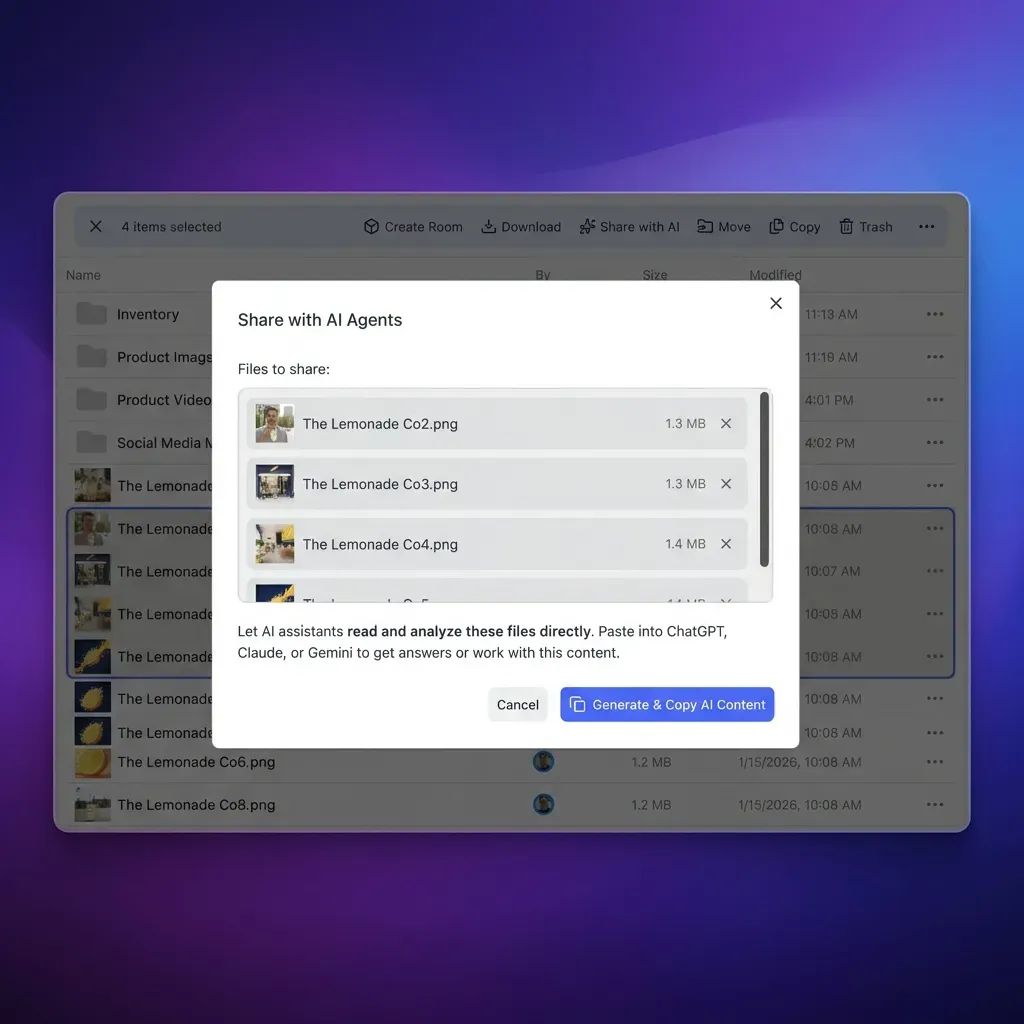
Fastio is an intelligent workspace platform that handles storage, indexing, and delivery for multi-modal assets. When an agent uploads files to a workspace with Intelligence Mode enabled, those files are automatically indexed for semantic search and RAG, covering documents, images, and video.
Modalities supported: Text documents, images, video (with HLS streaming), audio, and any file type for storage. Intelligence Mode auto-indexes uploaded content for semantic retrieval with citations. Metadata Views extract structured data from documents, images, and scanned pages using AI-designed schemas.
Agent integration: Exposes a remote MCP server with a consolidated toolset via Streamable HTTP at /mcp and legacy SSE at /sse. Agents can upload, search, share, and query files through tool calls. Works with Claude, GPT-4, Gemini, LLaMA, and local models. Supports advisory file locks and version history for multi-agent coordination, and a realtime activity feed or WebSocket events feed for reactive workflows.
Best for: Multi-agent systems that need persistent storage with built-in intelligence. The ownership transfer model lets agents build workspaces and hand them to humans. Includes a 14-day Business Trial (card required).
Pricing: Starter ($9.99/mo, 250 GB), Business ($49.99/mo, 5 TB), Enterprise ($199.99/mo, 25 TB); 14-day Business Trial at fast.io/pricing.
Comparison Table and Recommendations
Which tool should you choose?
The answer depends on which layer of the multi-modal stack you are building:
If you need orchestration and your agents already have access to models, LangGraph gives you the most production-tested routing and observability. Google ADK is the stronger choice for real-time audio/video streaming with Gemini.
If you need retrieval across modalities, Weaviate handles cross-modal search natively. Pair it with Twelve Labs if your use case involves video content at scale.
If you need document ingestion, Unstructured.io is the default choice for turning raw files into agent-consumable chunks.
If you need persistent storage with built-in RAG, Fastio eliminates the need to wire up a separate vector database for file-based content. Upload files, enable Intelligence Mode, and agents can search semantically through the same MCP server they use for file operations. The Business Trial removes cost barriers for experimentation.
Most production multi-modal agent systems combine tools from multiple categories. A typical stack might use LangGraph for orchestration, Unstructured for document processing, Weaviate for embeddings, and Fastio for persistent file storage and delivery to downstream humans.
Sources
References used to verify factual claims in this guide.
-
Multi-modal RAG retrieval substantially outperforms text-only approaches on document-heavy tasks
-
Unstructured is used by 87% of Fortune 1000 companies
-
Twelve Labs indexes one hour of video in approximately 15 minutes
-
LangGraph deployed at Klarna, Cisco, and Vizient
-
Google ADK supports bidirectional audio and video streaming
Frequently Asked Questions
What tools do multi-modal AI agents need?
Multi-modal AI agents need tools across four layers: orchestration (routing between models and tools), ingestion (converting raw files into embeddings), retrieval (searching across text, images, video, and audio), and storage/delivery (persisting and serving multi-modal assets). No single tool covers all layers, so production systems typically combine a framework like LangGraph with a vector database like Weaviate and a storage platform like Fastio.
How do AI agents process images and video?
AI agents process images and video by passing them to multi-modal models (GPT-4o, Gemini, Claude) that accept visual input alongside text. For retrieval, multi-modal embedding models like CLIP or Twelve Labs' Marengo convert visual content into vector representations that can be searched semantically. The infrastructure layer handles indexing, chunking video into searchable segments, and delivering the right frames or clips back to the agent at query time.
What is multi-modal RAG?
Multi-modal RAG (Retrieval-Augmented Generation) extends traditional text-based RAG to retrieve across images, video, audio, and documents. Instead of only matching text queries to text passages, multi-modal RAG uses cross-modal embeddings so a text query can retrieve relevant images, or an image query can find related text. Research from ICLR 2025 shows this approach substantially outperforms text-only retrieval for document-heavy tasks where visual elements like tables, charts, and diagrams carry critical information.
Can multi-modal agents work with any LLM?
The orchestration layer (LangGraph, Haystack, Google ADK) supports multiple LLM providers, but multi-modal capabilities depend on the underlying model. GPT-4o, Claude, and Gemini all support native image and text input for agent tool calls. For video and audio, you typically need specialized models (Twelve Labs for video, Whisper for audio) called as tools within the agent workflow rather than handled by the primary reasoning model.
How do you store multi-modal assets for AI agents?
Multi-modal assets need storage that handles heterogeneous file types, supports semantic retrieval, and delivers content efficiently. Options include object storage (S3, GCS) for raw files paired with a vector database for embeddings, or an intelligent workspace like Fastio that indexes uploaded files for semantic search once Intelligence Mode is enabled. The key requirement is that agents can both write assets (upload results) and read them (retrieve for context) through tool calls.
Related Resources

Give Your Multi-Modal Agents Persistent Storage
Fastio provides shared workspaces with built-in RAG and a consolidated MCP toolset. Upload files, enable Intelligence Mode, and your agents can search semantically across documents, images, and video.