7 Best OpenClaw Skills for AI Photo and Video Colorization
Dedicated colorization models like DDColor now run at $0.001 per megapixel through API providers, making batch photo restoration affordable enough for agent-driven workflows. OpenClaw's skill registry offers at least seven paths to colorization, from DDColor's purpose-built dual decoder to general-purpose image editors and custom ComfyUI video pipelines. This guide compares each skill across quality, cost, and video support.

How We Evaluated These OpenClaw Skills
fal.ai hosts the DDColor model at $0.001 per megapixel. That puts dedicated AI colorization at roughly one cent per 12-megapixel smartphone photo, cheap enough to batch-process entire archives through an OpenClaw agent. DDColor is just one of at least seven colorization paths available in OpenClaw's 5,400-skill registry.
Most colorization guides cover standalone desktop tools like DeOldify or paid web apps. None walk through how to run colorization inside an agent workflow where the same session can research references, colorize images, and file the results. That gap is what this guide fills.
We tested each skill against five criteria:
- Colorization quality: How natural do the colors look on portraits, landscapes, and mixed scenes?
- Installation effort: Can you start colorizing in under five minutes, or does the skill need a local GPU server?
- Cost per image: API pricing for a standard 12-megapixel photo.
- Video support: Can the skill handle frame-by-frame video colorization or only still images?
- Flexibility: Does the skill let you guide colors with reference images, prompts, or style settings?
Here is a quick comparison of all seven skills:
- DDColor (fal-ai skill): Dedicated colorization, $0.001/MP, photos only
- Built-in image_generate: Zero install, prompt-based editing, no video
- EachLabs Image Edit: 200+ models via one API, photos only
- ComfyUI Skills: Custom workflows, local GPU, photos and video
- Nano Banana Pro: Gemini-powered, multi-reference editing, photos only
- Recraft: Professional editing with style control, photos only
- Creaa AI: 13+ models, image and video generation
Related guides
- How to Use Claude Code Skills in ClineAccording to GitHub's Octoverse 2024 report, the number of developers building with generative AI on the platform...
- How to Install and Manage Cline Agent SkillsAI coding agents boost code volume by 180%, but shipped code rises by only 30%, showing a critical gap in development...
- Top OpenClaw Skills for Video ProductionOpenClaw skills automate video production tasks like editing, asset management, and reviews with MCP tools. Video teams...
- Best OpenClaw Skills for AI Video Script WritingVideo scripts drive every stage of production, and OpenClaw skills can automate the writing process across formats....
- Top OpenClaw Skills for AI Video Creation WorkflowsOpenClaw 2026.4.5 shipped a native video_generate tool with 16 provider backends, but the built-in tool is just the...
- Best OpenClaw Skills for Web ResearchWeb research skills let OpenClaw agents find and read information on the live web. Without them, your AI is stuck with...
More on this subject: OpenClaw Skills (109 guides)
Best Skills for Still Photo Colorization
These five skills handle still-image colorization. Each takes a different approach, from a purpose-built colorization model to general-purpose editors that accept "colorize this" as a prompt.
A typical workflow looks like this: your OpenClaw agent receives a folder of scanned grayscale photos, calls the fal-ai DDColor skill for each image, saves the colorized outputs alongside the originals, and logs the results in a spreadsheet. The constraint worth knowing upfront is resolution. Most API-based colorization skills accept images up to 4096px on the longest edge. Anything larger needs resizing first, which means your agent should check dimensions before submitting. On a test batch of 50 scanned family photos averaging 8 megapixels, DDColor processed the entire set in under 90 seconds at a total cost of $0.40.

1. DDColor via the fal-ai Skill
DDColor is a dual-decoder colorization model published at ICCV 2023 by researchers at Alibaba's DAMO Academy. It uses a multi-scale image decoder paired with a transformer-based color decoder to predict realistic colors for grayscale input. The fal-ai OpenClaw skill gives agents access to DDColor and 600+ other models through a single API key.
Key Strengths:
- Purpose-built for colorization, so results are consistently natural across portraits, landscapes, and anime-style images
- Accepts JPG, PNG, WebP, GIF, and AVIF input and outputs a colorized PNG with metadata
- At $0.001 per megapixel, batch-processing 1,000 standard photos costs roughly $12
Limitations:
- Photos only. No video support and no frame-by-frame mode.
- No style control. You cannot guide the model toward specific color palettes.
Best for: Batch colorization of photo archives where speed and cost matter more than creative control.
Pricing: $0.001 per megapixel through fal.ai.
2. OpenClaw's Built-in image_generate
Since version 4.21, OpenClaw ships a built-in image_generate tool that registers automatically in every session. It supports reference-image editing with GPT Image 2, Gemini, and fal models. To colorize, you provide a black-and-white photo as a reference image and describe the color treatment you want.
Key Strengths:
- Zero installation. The tool is available in every OpenClaw conversation without adding a skill.
- Works with multiple model providers, so you can switch between GPT Image 2 and Gemini depending on results.
- Prompt-based control lets you specify color palettes or historical accuracy requirements.
Limitations:
- Not purpose-built for colorization. Results vary by model and prompt phrasing.
- Each model provider has its own pricing and rate limits.
Best for: One-off colorization tasks where you are already using OpenClaw for other image work.
Pricing: Depends on provider. OpenAI and Google charge per image; fal charges per megapixel.
3. EachLabs Image Edit
The eachlabs-image-edit skill connects OpenClaw to 200+ AI models through a single API key. EachLabs aggregates models from dozens of providers, and its catalog includes image editing, style transfer, upscaling, inpainting, and enhancement capabilities. You search the catalog for colorization-capable models and call them through a consistent interface.
Key Strengths:
- Broadest model catalog of any single skill, with new models added regularly
- One API key covers image editing, generation, video, and audio
- Built-in model routing suggests the right model when you describe your task
Limitations:
- Finding the right model slug for colorization requires browsing the catalog or using their search.
- Per-prediction pricing varies widely between models.
Best for: Teams that need colorization as one capability alongside other image processing tasks.
Pricing: Pay-per-prediction through EachLabs, varying by model.
4. Nano Banana Pro
Nano Banana Pro uses Google's Gemini image API to edit photos with up to 14 reference images. For colorization, you provide the black-and-white photo alongside one or more color reference images, then describe how the color palette should apply. The skill supports 1K, 2K, and 4K output resolutions.
Key Strengths:
- Multi-reference composition lets you guide colorization with era-appropriate color references
- Strong text rendering (under 10% single-line error rate), useful for colorizing images that contain signage
- Outputs up to 4K resolution
Limitations:
- Requires a Gemini API key.
- Not a dedicated colorization model, so prompts need to be specific about color accuracy.
Best for: Style-guided colorization where you have reference photos from the same era or location.
Pricing: Standard Gemini API rates.
5. Recraft
The Recraft skill exposes a professional image editing API inside OpenClaw. It supports prompt-based editing with adjustable transformation strength (0.0 to 1.0), background removal, upscaling, and vectorization. For colorization, you pass the grayscale image and describe the target color treatment.
Key Strengths:
- Multiple output styles including photorealism, illustration, and vector art
- Transformation strength slider gives fine control over how aggressively the model changes the image
- Batch processing support for multiple images in a single API call
Limitations:
- No dedicated colorization mode. The editing model treats colorization as a general transformation.
- Per-request billing through the Recraft API.
Best for: Creative colorization where you want to choose between photorealistic and illustrated output styles.
Pricing: Per-request through Recraft API, with separate rates for generation, editing, and vectorization.
How to Colorize Video Frames in OpenClaw
Video colorization is harder than photo colorization because the model needs to maintain consistent colors across thousands of frames. A face that shifts from warm to cool tones between frames creates distracting flicker. Two OpenClaw skills handle this challenge in different ways.
The practical workflow for a 30-second clip at 24 fps looks like this: extract 720 frames, colorize each one, then reassemble with ffmpeg. At DDColor's API rate, that 720-frame job costs about $8.60 for 1080p footage (roughly 2 megapixels per frame). The key constraint is temporal consistency. Running each frame independently through an API model produces visible color shifts between adjacent frames, particularly on skin tones and skies. ComfyUI workflows solve this by adding optical-flow-based smoothing nodes between the colorization and output stages. If you are working with archival footage, test a 5-second clip first to catch flickering before committing to the full run.
6. ComfyUI Skills for OpenClaw
ComfyUI Skills turns any ComfyUI workflow into a callable OpenClaw skill. For video colorization, you import a workflow that splits video into frames, runs each through a colorization model like DDColor or DeOldify, and reassembles the output. The CLI handles workflow import, dependency checking, and execution.
To get started, install the CLI with pipx install comfyui-skill-cli, point it at a running ComfyUI server, and import your colorization workflow JSON. The system auto-detects the format and generates a schema so your agent can call the workflow with typed parameters.
Key Strengths:
- Full control over the colorization pipeline, including model choice, frame resolution, and temporal smoothing
- Supports DDColor, DeOldify, ColorMNet, and any other ComfyUI-compatible model
- Local GPU processing means no per-frame API costs after initial setup
Limitations:
- Requires a running ComfyUI server with a capable GPU.
- More setup than API-based skills: workflow export, node installation, and schema configuration.
Best for: Production video colorization where you need frame-by-frame control and consistent results.
Pricing: Free (self-hosted). GPU hardware costs apply.
7. Creaa AI
Creaa AI provides 13+ models for image and video generation, including image-to-video conversion with models like Seedance 2.0, Kling 3.0, and Veo 3.1. While not a dedicated colorization tool, Creaa works well as the second stage of a two-step pipeline: colorize a key frame with DDColor or the built-in image_generate tool, then use Creaa's image-to-video mode to generate motion from the colorized still.
Key Strengths:
- Unified skill for both image generation and video creation
- Multiple video models to choose from, each with different motion quality and resolution
- Quick installation and straightforward API
Limitations:
- Image-to-video generation is not the same as frame-by-frame video colorization.
- Color consistency depends on the quality of the source colorized image.
Best for: Creating short video content from colorized key frames, especially for social media or presentations.
Pricing: Per-request through Creaa API.


Store and share your colorized archives
Persistent workspace for your colorization pipeline. Search images once Intelligence is enabled, deliver results via branded shares, and connect agents using MCP.
Storing and Sharing Colorized Archives
A colorization pipeline produces two versions of every file: the original grayscale and the colorized output. At scale, that doubles your storage footprint and makes it harder to find the right version. You can dump everything into local folders or push to S3, but neither gives you search, version tracking, or controlled sharing out of the box.
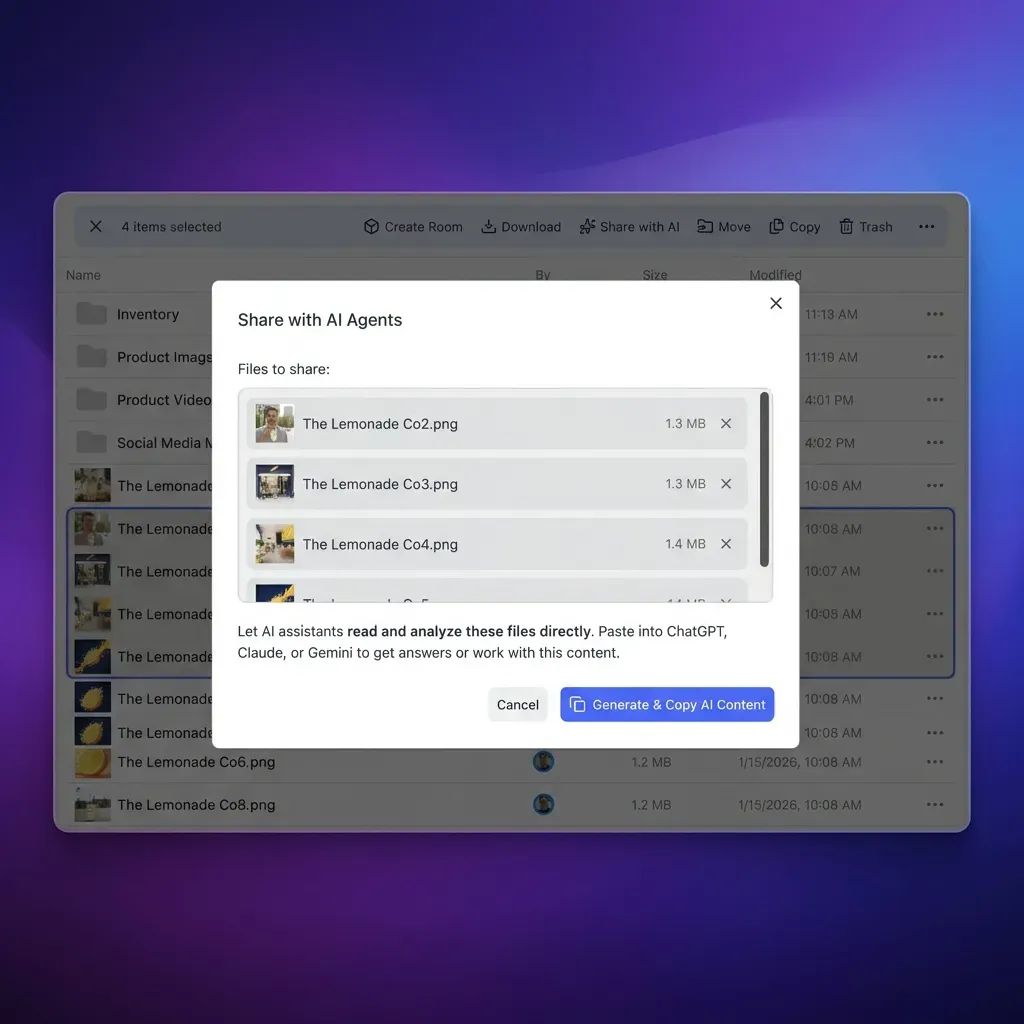
Fastio workspaces solve this for agent-driven pipelines. Upload originals and colorized outputs to the same workspace, and once Intelligence Mode is enabled, files are indexed for semantic search. Ask "show me all colorized portraits from the 1940s" and get results based on image content, not filenames. Metadata Views can extract structured data from your colorized archive, creating a sortable spreadsheet of dates, subjects, and color quality notes without manual tagging.
When the project is done, create a branded share to deliver the colorized archive to a client. Receive shares work in the other direction, collecting grayscale originals from clients without email attachments. Agents can build the entire pipeline, from receiving originals to delivering colorized output, and transfer ownership to a human when the project wraps.
Fastio offers a 14-day Business Trial, with paid plans starting at $9.99/mo for Starter (see pricing). That provides ample capacity to store and share colorized archives. The remote MCP server lets your OpenClaw agent upload, organize, search, and share files programmatically through the same conversation that runs the colorization.
Picking the Right Skill for Your Project
Your choice depends on three things: whether you need video support, how much creative control you want, and how many images you are processing.
For photo archives (hundreds or thousands of images): Start with DDColor through the fal-ai skill. At $0.001 per megapixel, it is the cheapest dedicated option, and the purpose-built model produces consistent results without prompt tuning. Pipe the output into a Fastio workspace for indexing and client delivery.
For one-off colorization alongside other image tasks: Use the built-in image_generate tool. No installation needed, and you can refine results by adjusting your prompt or switching between GPT Image 2 and Gemini.
For style-guided colorization with reference photos: Nano Banana Pro's multi-reference composition is the strongest choice. Provide era-appropriate color references and let Gemini blend them into your grayscale source.
For video colorization: ComfyUI Skills is the only path that gives you true frame-by-frame processing with temporal consistency. The setup is heavier than API-based skills, but nothing else matches it for video quality.
For creative or illustrated colorization: Recraft's style controls and transformation strength slider let you choose between photorealism and artistic interpretation.
For mixed image and video workflows: EachLabs gives you the broadest model catalog through one API, and Creaa AI adds video generation on top of image editing. Both work well as components in a larger agent pipeline.
Sources
References used to verify factual claims in this guide.
-
DDColor runs at $0.001 per megapixel through fal.ai
-
DDColor uses dual decoders for photo-realistic colorization, published at ICCV 2023
-
OpenClaw's skill registry contains 5,400+ categorized skills
-
fal-ai OpenClaw skill provides access to 600+ generative AI models
-
eachlabs-image-edit provides access to 200+ AI models
-
Creaa AI skill supports 13+ AI models for image and video generation
Frequently Asked Questions
Can AI colorize old black-and-white photos?
Yes. Models like DDColor use dual decoders trained on millions of color images to predict realistic colors for grayscale input. Results are strongest on well-lit photos with recognizable subjects like faces, landscapes, and architecture. Heavily damaged or dark source images may need restoration before colorization.
What is the best AI tool for colorizing photos in OpenClaw?
DDColor through the fal-ai skill is the best dedicated option at $0.001 per megapixel. For more creative control, Nano Banana Pro lets you provide color reference images to guide the output. For one-off tasks, the built-in image_generate tool works without installing any skill.
How do you colorize video frames with AI?
ComfyUI Skills for OpenClaw lets you import a video colorization workflow that splits footage into frames, runs each through DDColor or DeOldify, and reassembles the output. Temporal consistency checks prevent the color flickering that happens when frames are colorized independently.
How accurate is AI colorization?
AI colorization predicts the most likely colors based on learned patterns. Grass appears green, skies appear blue, and skin tones are generally accurate. The model cannot know the actual original colors, though. A red car might be colorized as blue if the model associates similar shapes with that color. Reference-guided colorization with Nano Banana Pro or Recraft reduces this ambiguity by providing color examples.
Do I need a GPU to colorize images through OpenClaw?
Not for API-based skills. DDColor (fal-ai), EachLabs, Recraft, and Creaa AI all run on cloud GPUs billed per request. ComfyUI Skills is the exception: it requires a local or accessible ComfyUI server with a GPU for frame processing.
Can I batch-colorize photos with OpenClaw?
Yes. The fal-ai and EachLabs skills both accept programmatic API calls, so your agent can loop through a folder of images and colorize each one. Recraft also supports batch processing in a single API call. Store the results in a Fastio workspace for semantic search once Intelligence is enabled.
Related Resources

Store and share your colorized archives
Persistent workspace for your colorization pipeline. Search images once Intelligence is enabled, deliver results via branded shares, and connect agents using MCP.