Best AI Tools for Researchers in 2026: 10 Tools Worth Your Time
AI research tools have moved well past the "ask ChatGPT to summarize a paper" stage. Specialized platforms now handle literature discovery, citation analysis, data extraction, and manuscript editing as distinct workflow steps. This guide covers 10 tools that solve specific research problems, with honest assessments of what each one does well and where it falls short.


How We Evaluated These Tools
Researchers spend roughly half their working time on literature review and data management, according to a 2024 Nature survey. That makes tool selection consequential: the right tool saves weeks per project, while the wrong one adds friction without reducing the actual work.
We tested each tool in this list against five criteria:
- Accuracy of results. Does it return relevant papers and correct summaries, or does it hallucinate citations?
- Workflow integration. Does it export to Zotero, Mendeley, BibTeX, and other reference managers researchers actually use?
- Transparency. Can you trace how the tool reached its conclusions? Can you verify the underlying sources?
- Pricing accessibility. Is there a usable free tier, or does the paywall lock out independent researchers and students?
- Specialization depth. Does it solve one problem well, or does it try to do everything and do nothing particularly well?
The tools below are organized by research workflow stage: discovery, analysis, writing, and data management.
Related guides
- Best Free AI Tools in 2026: What's Actually Free and Worth UsingMost free AI tool lists include 14-day trials that quietly start charging you. This guide covers 11 tools that are free...
- Best AI Tools for Excel in 2026Microsoft, OpenAI, and Anthropic all shipped native Excel add-ins in early 2026, joining established third-party tools...
- Best AI Summarizers in 2026: 10 Tools Tested and ComparedKnowledge workers spend 1.8 hours every day just searching for information, according to McKinsey. AI summarizers cut...
- Best AI Tools for Writing Research Papers in 2026Over half of researchers now use AI during peer review, yet only 5% consider undisclosed usage appropriate. That gap...
- Best AI Tools for Work in 2026, Sorted by What You Actually DoSeventy-eight percent of knowledge workers who use AI at work bring their own tools, creating fragmented workflows and...
- Best AI Note Taking Apps in 2026: 10 Tools We Actually TestedAI note taking apps now go far beyond basic transcription. The best ones identify speakers, extract action items, and...
More on this subject: AI Tool Directories and Comparisons (231 guides)
Best Tools for Literature Discovery and Search
Finding relevant papers is the first bottleneck in any research project. These tools approach the problem differently: some prioritize search breadth, others focus on mapping citation relationships, and one uses AI to answer research questions directly from the literature.
1. Semantic Scholar
Semantic Scholar is a free, AI-powered search engine from the Allen Institute for AI that indexes over 200 million academic papers. Its strength is contextual understanding: rather than matching keywords, it identifies papers based on meaning, relationships, and citation patterns.
What it does well:
- TLDR summaries give you one-sentence AI abstracts so you can assess relevance in seconds
- Research Feeds learn your interests and surface new papers as they publish
- Citation graphs show how papers connect, helping you trace idea lineage across decades of work
- The Semantic Reader adds inline context and definitions while you read papers
- Completely free, including the API
Limitations:
- Coverage skews toward computer science, biomedicine, and STEM. Social sciences and humanities have thinner representation
- No built-in full-text access. You still need institutional subscriptions or open-access sources for the actual papers
Pricing: Free
Best for: Researchers who need fast, broad literature searches with AI-powered relevance ranking, especially in STEM fields.
2. Consensus
Consensus is an AI search engine built specifically for research questions. Ask it "Does creatine improve cognitive performance?" and it returns a summary synthesized from peer-reviewed studies, along with a Consensus Meter showing how much the literature agrees or disagrees.
What it does well:
- The Yes/No/Possibly breakdown is unique. No other tool gives you an at-a-glance view of where the scientific community stands on a question
- Scholar Agent (built on GPT-5) automates multi-step research workflows: it plans sub-questions, searches, reads papers, and synthesizes results with charts
- Direct citation export to Zotero, Mendeley, EndNote, and RefWorks
- Indexes 220+ million papers from Semantic Scholar and OpenAlex
Limitations:
- The Consensus Meter can oversimplify nuanced debates. A "67% Yes" verdict might mask important methodological disagreements between studies
- Full features require a paid plan. The Trial limits the number of AI-powered searches per day
Pricing: Free tier available; paid plans start around $9/month
Best for: Researchers who need quick, evidence-based answers to specific research questions rather than browsing for papers.
3. Connected Papers
Connected Papers takes a single seed paper and builds a visual graph of related research based on co-citation and bibliographic coupling. Papers that share more references cluster closer together on the graph, giving you an instant map of a research area.
What it does well:
- Visual citation mapping reveals relationships that keyword searches miss entirely
- "Prior works" and "derivative works" views let you trace the intellectual lineage forward and backward from any paper
- Useful for building comprehensive bibliographies for theses and review papers
- Connected to Semantic Scholar's database of 200 million papers
Limitations:
- Trial limits you to 5 graphs per month, which can feel restrictive during an active literature review
- The tool maps relationships but does not summarize or analyze the papers themselves
Pricing: Free tier with 5 graphs/month; Academic plan around $6/month; Business plan around $20/month
Best for: Graduate students and researchers building comprehensive bibliographies or exploring a new research area for the first time.



Give your research files a searchable memory
Fastio indexes documents for semantic search once Intelligence is enabled for the workspace. Remote MCP server included for automated workflows.
Citation Analysis and Literature Review
Once you have a set of candidate papers, you need to evaluate which ones actually matter. These tools go beyond counting citations to analyze how papers cite each other and whether those citations are supportive, contrasting, or merely passing mentions.
4. scite
scite has indexed over 1.6 billion citations from 280 million sources and classifies each one as Supporting, Contrasting, or Mentioning. This turns citation counts (a blunt instrument) into citation context (a sharp one). A paper with 500 citations sounds impressive until you learn that 200 of them contradict its findings.
What it does well:
- Smart Citations show exactly how a paper is cited, with the citing passage in context. You can see whether a study's findings held up or got challenged
- Reference Verification lets you upload a manuscript and check whether your cited papers have retractions, corrections, or heavy contradictions in the literature
- Browser extension works alongside Google Scholar, PubMed, and other research platforms
- Partners with 30+ academic publishers for broad content coverage
Limitations:
- The most useful features (unlimited Smart Citations, Reference Verification) require a paid plan
- Coverage is strongest in biomedical and natural sciences. Humanities and some social science fields have sparser data
Pricing: Free tier available; Basic at $7.99/month; Premium at $100/year; institutional licenses available
Best for: Biomedical and natural science researchers who need to evaluate whether cited findings held up under subsequent scrutiny.
5. Elicit
Elicit started as a literature search tool but has grown into a full systematic review platform. You can search across 138 million papers, extract structured data into tables (sample sizes, methodologies, key findings), and generate research briefs inspired by systematic review protocols.
What it does well:
- Systematic review workflows now support PRISMA 2020 guidelines, making the process reproducible and auditable
- Data extraction with unlimited custom columns pulls specific data points from papers automatically
- Can analyze up to 20,000 data points at once, which matters for meta-analyses and large-scale reviews
- API access lets you integrate Elicit into your own research pipelines
- Export to CSV and BibTeX for reference management
Limitations:
- Advanced extraction and systematic review features require the Pro plan
- Results depend heavily on how you frame your search query. Poorly worded questions return noisy results
Pricing: Free tier with basic search and summaries; Plus at $10-12/month; Pro at $49/month; Team at $79/month
Best for: Researchers conducting systematic reviews or meta-analyses who need structured data extraction at scale.
6. Litmaps
Litmaps builds interactive citation maps and monitors your research landscape for new publications. After acquiring ResearchRabbit in May 2025, Litmaps now combines citation network visualization with AI-powered paper recommendations.
What it does well:
- Daily monitoring alerts you when new papers match your saved searches, so you never miss relevant work in an active area
- Access to over 270 million articles across disciplines
- Zotero sync imports your existing library and maps citation relationships within it
- Search by keyword, author, DOI, PubMed ID, or arXiv ID
Limitations:
- The citation map can get cluttered with highly-cited seed papers that connect to thousands of related works
- The ResearchRabbit integration is still evolving. Some users report the combined interface feels less streamlined than either tool did independently
Pricing: Free tier available; paid plans for advanced features
Best for: Researchers who need ongoing monitoring of a research area and want visual maps of how the literature connects.
AI Writing and Manuscript Preparation
Writing a paper is where many researchers hit their second bottleneck. These tools handle different parts of the writing process: one focuses on reading comprehension and explanation, another on grammar and journal formatting, and a third on turning your sources into a structured knowledge base.
7. SciSpace
SciSpace positions itself as a research super agent with 150+ integrated tools and access to 280 million papers. Its standout feature is the AI Copilot, which lets you highlight any passage in a paper and get a plain-language explanation, related concepts, or follow-up questions.
What it does well:
- The Copilot works inside the reading interface. Highlight a methods section you do not understand, and it explains the technique in context
- Deep Review runs high-end literature searches and synthesizes findings across multiple papers
- Over 40,000 journal formatting templates for submission-ready manuscripts
- Paraphraser adjusts tone (more academic, more concise, more accessible) while preserving meaning
Limitations:
- The Trial limits AI Copilot queries, which can run out quickly during intensive reading sessions
- Trying to do everything (reading, writing, searching, formatting) means some features feel less polished than dedicated alternatives
Pricing: Free tier available; Premium at $12/month; Lab plan at $100/month for 5 users
Best for: Researchers who want a single platform for reading, understanding, and writing, especially non-native English speakers working on journal submissions.
8. Paperpal
Paperpal is built by Editage, which has decades of experience in academic editing. It goes beyond generic grammar checking to catch problems specific to academic writing: inconsistent terminology, unclear methodology descriptions, and citation formatting errors.
What it does well:
- 30+ journal readiness checks flag problems reviewers would catch, before you submit
- AI Review acts as a virtual research coach, giving feedback on clarity, structure, and argumentation at any draft stage
- Access to 250 million verified articles for finding and citing references
- Works across platforms: web app, Microsoft Word add-in, Google Docs, and Overleaf for LaTeX users
- Plagiarism detection and AI content detection are built in
Limitations:
- Most useful features (unlimited checks, submission preparation) require a paid plan
- The AI suggestions occasionally overcorrect informal but acceptable academic prose into overly formal language
Pricing: Free tier with basic checks; paid plans for full features
Best for: Researchers preparing manuscripts for journal submission who want systematic pre-submission quality checks.
9. Gemini Notebook (formerly NotebookLM)
Gemini Notebook (formerly NotebookLM) is Google's AI research tool that turns your uploaded sources into a queryable knowledge base. Upload PDFs, Google Docs, websites, YouTube videos, or slide decks, and Gemini Notebook reads everything and answers questions with inline citations pointing back to your original materials.
What it does well:
- Source-grounded responses with inline citations. Every answer points to the specific passage in your uploaded documents, so you can verify claims instantly
- Audio Overviews generate podcast-style discussions about your research, useful for absorbing complex material during commutes or exercise
- Video Overviews (added 2025) create visual slide-style summaries of your documents in 80+ languages
- Notebooks now sync across Gemini and Gemini Notebook, creating persistent knowledge bases for long-running projects
- The free tier is generous enough for most individual researchers
Limitations:
- Only works with sources you upload. It does not search the broader literature on its own
- Quality of responses depends entirely on the quality and breadth of your uploaded sources
Pricing: Free; Gemini Notebook Plus available through Google One AI Premium
Best for: Researchers who want to build a private, queryable knowledge base from their collected papers and notes, with verified citations.
Research Data Management and Collaboration
Research generates files: datasets, drafts, figures, supplementary materials, reviewer comments, and version after version of each. Managing these files across collaborators, institutions, and projects is where a lot of work falls through the cracks.
10. Fastio
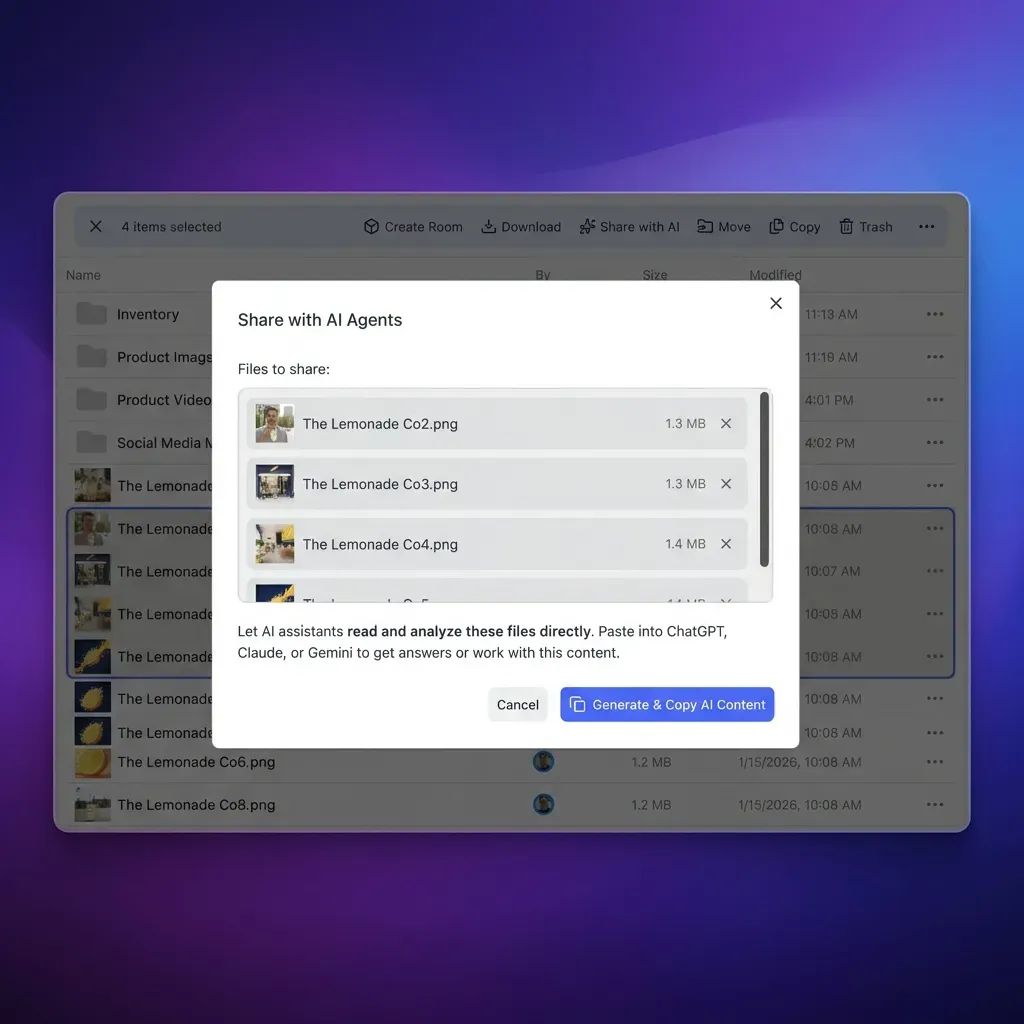
Fastio is a cloud workspace platform that handles research file management differently from generic cloud storage. Instead of dumping files into folders and hoping collaborators can find them, Fastio auto-indexes uploaded files for semantic search and AI-powered Q&A once Intelligence Mode is enabled.
What it does well:
- Once Intelligence Mode is enabled, it indexes uploaded documents automatically. Ask questions about your research files and get answers with citations pointing to specific documents. This works across PDFs, Word docs, spreadsheets, and presentations without manual tagging
- Metadata Views let you describe fields in natural language and extract structured data from uploaded papers, contracts, or datasets into a sortable spreadsheet. Useful for pulling sample sizes, publication dates, or methodological details from a stack of PDFs
- Granular permissions at the org, workspace, folder, and file level. Share raw data with one collaborator and final drafts with another, without managing separate storage locations
- Branded shares let you create polished Send, Receive, or Exchange links for sharing research outputs with external reviewers or funding agencies
- Full audit trails track who accessed, modified, or downloaded each file
- The MCP server lets AI agents read, write, and query your research workspace programmatically, so you can build automated research pipelines
Limitations:
- Not a literature search tool. It manages the files you already have rather than helping you discover new papers
- Intelligence Mode works best with text-heavy documents. Image-heavy or data-heavy files may need additional processing
Pricing: Starter $9.99/mo (3 seats, 250 GB, 100,000 credits/mo), Business $49.99/mo (10 seats, 5 TB), Enterprise $199.99/mo (30 seats, 25 TB); 14-day Business Trial requiring a credit card.
Best for: Research teams that need intelligent file management with built-in AI search, structured data extraction, and fine-grained access controls.
For researchers working with AI agents or building automated research workflows, Fastio offers remote MCP server access at https://mcp.fast.io/mcp/tools and workspaces for agent collaboration.
How to Build Your Research Tool Stack
The right answer depends on where your research workflow breaks down. Most researchers will end up using 2-3 tools from this list, not all 10.
If you are drowning in literature search, start with Semantic Scholar (free, broad coverage) or Consensus (question-driven, synthesized answers). Add Connected Papers or Litmaps when you need to map citation networks visually.
If you need systematic review support, Elicit is the strongest option. Its PRISMA-compliant workflows and structured data extraction handle the tedious parts of large-scale reviews. scite complements it by showing whether cited findings held up or got contradicted.
If writing is the bottleneck, Paperpal handles academic-specific editing and journal readiness checks better than general-purpose grammar tools. SciSpace is worth trying if you want reading comprehension and writing tools in one place.
If you need a research knowledge base, Gemini Notebook turns your collected sources into a queryable, citable reference system.
If file management and collaboration are the problem, Fastio gives you semantic search across your document collection once Intelligence is enabled, plus structured extraction and team-level access controls.
A practical stack for a typical research project: Semantic Scholar or Consensus for discovery, Elicit for systematic analysis, Paperpal for manuscript preparation, and Fastio for managing the resulting files across your team. Each tool handles one stage well, and they integrate through standard exports (BibTeX, CSV, PDF).
Sources
References used to verify factual claims in this guide.
-
Researchers spend an average of 52% of their time on literature review and data management
-
Semantic Scholar indexes over 200 million academic papers
-
scite has indexed over 1.6 billion citations from 280 million sources
-
Elicit searches across 138 million papers
-
Consensus indexes 220+ million papers
-
SciSpace provides access to 280 million papers
-
Litmaps acquired ResearchRabbit in May 2025
Frequently Asked Questions
What AI tools do researchers actually use?
The most widely adopted tools fall into three categories. For literature discovery, Semantic Scholar (200M+ papers, free) and Consensus (AI-synthesized answers from peer-reviewed studies) lead the field. For citation analysis and systematic reviews, Elicit and scite offer structured data extraction and smart citation classification. For writing and manuscript prep, Paperpal and SciSpace handle academic-specific editing and journal formatting. Most researchers combine 2-3 specialized tools rather than relying on a single general-purpose AI.
What is the best AI for literature review?
Elicit is the strongest option for structured literature reviews, especially systematic reviews. It supports PRISMA 2020 workflows, extracts data into structured tables with custom columns, and can process up to 20,000 data points. For broader discovery, Semantic Scholar covers 200M+ papers with AI-ranked relevance. For visual citation mapping, Connected Papers and Litmaps show how papers relate to each other. The best choice depends on whether you need depth (Elicit), breadth (Semantic Scholar), or visual exploration (Connected Papers).
Can AI help with data analysis in research?
Yes, but the tools vary by research type. Elicit extracts quantitative data from papers into structured tables, making it useful for meta-analyses. SciSpace's Copilot explains statistical methods and results in context. For your own datasets, general-purpose AI assistants like Claude and GPT-4 can write analysis scripts, explain statistical output, and help with data visualization. Fastio's Metadata Views can extract structured data from document collections automatically. The key distinction: research-specific AI tools analyze published literature, while general AI assistants help with your own data.
Are AI tools allowed in academic research?
Most universities and journals now permit AI tools for specific research tasks, with disclosure requirements. The consensus across major publishers (Nature, Science, Elsevier, Springer) is that AI can be used for literature search, data analysis, editing, and coding, but cannot be listed as an author. Researchers must disclose AI tool usage in their methods section. Policies vary by institution, so check your university's AI policy and the target journal's author guidelines before submission. Using AI to fabricate data or citations remains universally prohibited.
Are these AI research tools accurate?
Accuracy varies by tool and task. Citation-based tools like Semantic Scholar and scite are highly reliable because they work with indexed metadata rather than generating text. AI synthesis tools like Consensus and Elicit can occasionally mischaracterize a study's findings, though both provide source links for verification. Writing tools like Paperpal can overcorrect stylistic choices. The general rule: always verify AI-generated summaries against the original papers, use tools that provide citations and source links, and treat AI output as a starting point rather than a final answer.
Related Resources

Give your research files a searchable memory
Fastio indexes documents for semantic search once Intelligence is enabled for the workspace. Remote MCP server included for automated workflows.