Best AI Summarizers in 2026: 10 Tools Tested and Compared
Knowledge workers spend 1.8 hours every day just searching for information, according to McKinsey. AI summarizers cut through that by condensing documents, videos, and meetings into key points you can act on. This guide tests 10 tools across text, PDF, video, and audio summarization, with honest pros, cons, and pricing for each.


Why AI Summarizers Matter More Than Ever
Information overload costs the global economy roughly $1 trillion per year, according to a Rensselaer Polytechnic Institute study published in Nature Human Behaviour. The problem is not that we lack information. It is that we drown in it.
McKinsey's research puts a finer point on it: knowledge workers spend 1.8 hours daily just searching for information, and another 2.6 hours on email. That is more than half the workday gone before anyone does skilled work. A 2023 BCG study of 758 consultants found that those using GPT-4 completed 12% more tasks, worked 25% faster, and delivered 40% higher quality output. The gains were not marginal.
AI summarizers sit at the intersection of these two realities. They turn the firehose into a filtered stream. But the category has fragmented: some tools handle text only, others focus on PDFs or academic papers, and a growing number tackle video transcripts and meeting recordings. Few reviews compare all these formats in one place. That is what this guide does.
Related guides
- Best AI Note Taking Apps in 2026: 10 Tools We Actually TestedAI note taking apps now go far beyond basic transcription. The best ones identify speakers, extract action items, and...
- Best Free AI Tools in 2026: What's Actually Free and Worth UsingMost free AI tool lists include 14-day trials that quietly start charging you. This guide covers 11 tools that are free...
- 8 Best AI Search Engines in 2026, Ranked and ComparedAI search engines use large language models to understand queries contextually and synthesize answers from multiple...
- Best AI Tools for Excel in 2026Microsoft, OpenAI, and Anthropic all shipped native Excel add-ins in early 2026, joining established third-party tools...
- Best AI Browsers in 2026: 8 Options Ranked by Use CaseAI-driven search now accounts for 30% of all query interactions, up from under 10% in 2023, and the browsers carrying...
- Clever AI Review 2026: Features, Pricing, and Honest VerdictClever AI Hub bundles 15+ AI models into one interface with a free tier and custom agent builder, but output quality...
More on this subject: AI Tool Directories and Comparisons (231 guides)
How We Evaluated These Tools
We tested each summarizer against the same set of inputs: a 15-page PDF report, a 3,000-word blog post, a 45-minute YouTube video transcript, and a dense academic paper. We scored on five criteria:
- Accuracy: Did the summary capture the core argument, or just surface-level keywords?
- Format coverage: Text, PDFs, video, audio, or some combination?
- Output quality: Readable prose vs. disjointed bullet fragments?
- Pricing transparency: Clear tiers, or buried costs?
- Integration depth: Does it connect to your existing workflow tools?
The list below covers standalone summarizers, research tools, and knowledge platforms. General-purpose LLMs like ChatGPT and Claude can also summarize, but this guide focuses on tools purpose-built for the job.

The 10 Best AI Summarizers in 2026
1. Gemini Notebook (formerly NotebookLM)
Best for: free, deep exploration of your own documents
Gemini Notebook is the standout free option in 2026. Upload up to 50 sources (PDFs, Google Docs, web URLs, YouTube videos, audio files), and it generates summaries grounded entirely in your material. The 1-million-token context window means it can handle book-length documents without chunking.
What sets it apart is output variety. Beyond text summaries, it generates Audio Overviews (podcast-style two-host discussions of your material), Video Overviews, slide decks, and infographics. Inline citations trace every claim back to your uploaded sources, which keeps hallucination low.
Limitations: Summaries draw only from your uploaded material, not the broader web. The free tier caps daily queries at 50.
Pricing: Free. Gemini Notebook Plus is available for heavier use.
2. Scholarcy
Best for: academic literature reviews
Scholarcy converts research papers into structured "flashcards" with the abstract, key findings, methodology, and references extracted automatically. The Robo-Highlighter identifies the most important sentences, and you can export to Notion, Zotero, or Obsidian.
It handles PDFs, Word documents, and YouTube lecture transcripts. For graduate students screening hundreds of papers during a literature review, Scholarcy turns a week of reading into a day of targeted scanning.
Limitations: The interface can feel data-heavy for casual users. Poorly scanned documents sometimes need manual correction.
Pricing: Free trial available. Paid plans from $9.99/month.
3. QuillBot
Best for: students who need summarization and rewriting in one tool
QuillBot bundles a summarizer with a paraphraser, grammar checker, and plagiarism detector. The summarizer lets you adjust output length with a slider and toggle between bullet-point and paragraph formats. Browser extensions and Word integration keep it accessible without context-switching.
Limitations: The free tier caps summaries at 1,200 words of input and paraphrasing at 125 words. Complex technical content can get oversimplified.
Pricing: Free (limited). Premium from $8.33/month (annual billing). Student plan at $6.25/month with .edu email.


Give your AI summaries a searchable, permanent home
Fastio indexes your documents for semantic search and AI chat once Intelligence is enabled for the workspace. Remote MCP server included with a 14-day Business Trial.
More Top Picks: Research, Video, and Workflow Tools
4. Wordtune
Best for: professionals who want readable digests, not just bullet points
Wordtune (by AI21 Labs) produces narrative-style summaries that read like something a human wrote. The interactive side-by-side view lets you compare the summary against the original, and integrated rewriting tools adjust tone and verify facts. It handles long-form text, PDFs, URLs, and YouTube videos.
Limitations: The free tier allows only 3 summaries per month. Technical STEM papers can lose nuance.
Pricing: Free (3 summaries/month). Advanced from $6.99/month.
5. Recall
Best for: building a personal knowledge base from everything you read
Recall summarizes articles, YouTube videos, podcasts, and PDFs, then stores everything in a searchable knowledge base. It automatically discovers connections between your saved materials. You can choose ChatGPT, Claude, or Gemini as the underlying AI model.
Think of it as a "second brain" that gets smarter the more you use it. The value compounds over months of consistent use.
Limitations: Requires ecosystem commitment to get full value. The interface has a learning curve.
Pricing: Lite (free, 10 summaries/month). Plus $10/month (annual). Max $38/month (annual).
6. TLDR This Best for: fast key-point extraction from web articles
TLDR This is the simplest tool on this list. Install the browser extension, click a button, and get a clean summary of any webpage with ads and clutter stripped away. It also supports file uploads (PDF, DOC, DOCX up to 25 MB).
Limitations: Struggles with articles over 6,000 words. PDF performance is weaker than web content.
Pricing: Free (5 file uploads, 20 chat messages/day). Pro $9.99/month.
7. SciSpace
Best for: STEM researchers working with formulas and data tables
SciSpace (formerly Typeset) goes deeper than most summarizers for scientific content. Its AI Copilot explains mathematical formulas, reads charts in context, and cross-references against a database of 280 million papers. It supports 75+ languages.
Limitations: The Copilot gives generic answers for highly niche topics. The interface is busy for first-time users.
Pricing: Free plan (limited). Paid from approximately $20/month.
8. Notta Best for: multilingual meeting transcription and summaries
Notta transcribes meetings and audio recordings in real time with 98.86% accuracy and automatic speaker identification. It supports 58 transcription languages and 40 real-time translation languages. Summaries include extracted action items that integrate with Slack, Jira, and Asana.
Limitations: Audio clarity directly affects accuracy. The Trial limits you to 120 minutes per month.
Pricing: Free (120 min/month). Pro from $13.49/month.
9. Glasp
Best for: social readers who highlight and curate across platforms
Glasp generates summaries from your highlights and notes across the web, Kindle, and YouTube. It includes social features for sharing and discovering other people's highlights. Export to Notion, Obsidian, and Roam Research keeps your workflow connected.
Limitations: Browser-extension dependent with no standalone desktop app. Trial limits YouTube summaries to 100 per month.
Pricing: Free. Pro $10/month (annual). Unlimited $25/month (annual).
10. Lindy
Best for: teams that need summaries to trigger actions
Lindy is not a traditional summarizer. It summarizes emails, documents, and meetings, then converts those summaries into automated workflow actions: creating tasks, sending replies, updating CRMs. It connects to 100+ tools and uses plain-language prompting instead of code.
Limitations: Not ideal for one-off text summarization. The price point reflects its workflow automation scope.
Pricing: Free trial. Paid from $49.99/month.
Quick Comparison Table
Here is how the 10 tools stack up across key criteria:
- Gemini Notebook (formerly NotebookLM): Formats: PDF, Docs, video, audio. Free. Best for deep document exploration.
- Scholarcy: Formats: academic PDFs, Word, YouTube lectures. From $9.99/mo. Best for literature reviews.
- QuillBot: Formats: text, PDFs, articles. Free tier + $8.33/mo. Best for students.
- Wordtune: Formats: text, PDFs, URLs, YouTube. Free tier + $6.99/mo. Best for readable digests.
- Recall: Formats: articles, video, podcasts, PDFs. Free tier + $10/mo. Best for knowledge management.
- TLDR This: Formats: web articles, PDFs. Free tier + $9.99/mo. Best for quick web summaries.
- SciSpace: Formats: scientific papers, formulas, charts. Free tier + ~$20/mo. Best for STEM research.
- Notta: Formats: meetings, audio, video. Free tier + $13.49/mo. Best for multilingual teams.
- Glasp: Formats: web, Kindle, YouTube, podcasts. Free tier + $10/mo. Best for social learning.
- Lindy: Formats: email, docs, meetings. Free trial + $49.99/mo. Best for workflow automation.
Worth noting: General-purpose LLMs like Claude (200K context window, $20/month Pro) and ChatGPT (128K context window, $20/month Plus) are strong summarizers too. They lack the specialized features above but handle ad hoc summarization well.
Where AI Summarization Fits Into a Broader Workflow
A summarizer solves one problem: reading time. But most teams hit a second bottleneck right after: the summaries live in personal tabs and chat threads where nobody else can find them.
This is where persistent, shared storage changes the equation. When summaries, source documents, and extracted insights live in a workspace that everyone (including AI agents) can access, the knowledge compounds instead of evaporating.
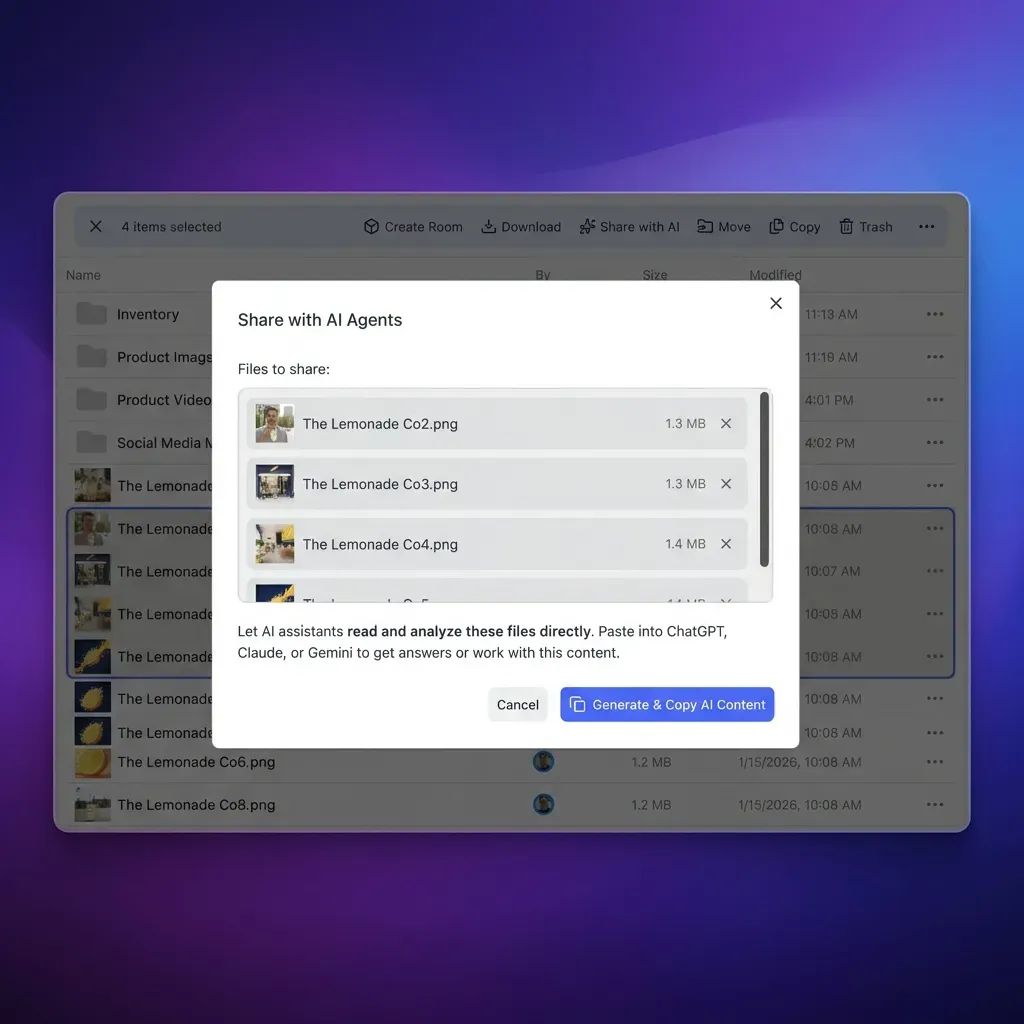
Fastio approaches this differently than commodity cloud storage. Workspaces index uploaded documents for semantic search and AI chat once Intelligence is enabled for the workspace. You can ask questions about your files and get answers with citations, without setting up a separate vector database or RAG pipeline.
For teams using AI agents, Fastio exposes a remote MCP server so agents can read, write, search, and summarize files in the same workspaces humans use. An agent can process a batch of documents, generate summaries, store them in a shared workspace, and hand the whole thing off to a human reviewer.
Fastio offers plans starting at $9.99/month, and a 14-day Business Trial requiring a credit card lets you evaluate workspaces firsthand. If you are already generating summaries with the tools above, Fastio gives those summaries a permanent, searchable home.
Other options for storing and organizing summaries include Notion (good for personal wikis), Google Drive (familiar but no built-in AI search), and S3 (cheap bulk storage, no intelligence layer). The right choice depends on whether you need your stored documents to be queryable by AI or just filed away.
Sources
References used to verify factual claims in this guide.
-
Knowledge workers spend 1.8 hours daily searching for information Information overload costs the global economy approximately $1 trillion per year
-
BCG study: GPT-4 users completed 12% more tasks, worked 25% faster, delivered 40% higher quality
-
Notta transcription accuracy of 98.86%
-
SciSpace database of 280 million papers
Frequently Asked Questions
What is the best free AI summarizer?
Gemini Notebook (formerly NotebookLM) is the strongest free option in 2026. It handles PDFs, Google Docs, YouTube videos, and audio files with a 1-million-token context window. It also generates Audio Overviews, video summaries, and slide decks at no cost. For simpler web article summarization, TLDR This offers a free browser extension that works without an account.
Can AI summarize a PDF?
Yes. Most tools on this list handle PDFs directly. Scholarcy and SciSpace are strongest for academic PDFs with complex formatting. QuillBot and TLDR This handle general PDFs. Gemini Notebook can ingest PDFs up to its 50-source limit and cross-reference them. For large PDF collections, Fastio auto-indexes uploaded PDFs for semantic search and AI-powered Q&A once Intelligence is enabled for the workspace.
Is AI summarization accurate?
Accuracy varies by tool and content type. Tools grounded in your uploaded sources (like Gemini Notebook) hallucinate less because they cannot invent information from outside your documents. General-purpose summarizers can miss nuance in technical or highly specialized content. Best practice: use summarizers to identify what to read closely, not as a replacement for reading critical documents.
What is the best AI tool to summarize long documents?
For documents over 50 pages, Gemini Notebook (1M token context) and Claude (200K context window) handle the most text in a single pass. Scholarcy and SciSpace are better for academic papers where you need structured extraction of methodology, findings, and citations. For teams processing many long documents, Fastio indexes entire workspaces for search and Q&A once Intelligence is enabled.
Can AI summarize video and audio content?
Several tools now handle video and audio. Notta transcribes meetings and recordings in 58 languages with speaker identification. Gemini Notebook generates Audio Overviews from uploaded content. Glasp and Wordtune both summarize YouTube videos. For meeting recordings specifically, Notta and Otter.ai offer real-time transcription with action item extraction.
Related Resources

Give your AI summaries a searchable, permanent home
Fastio indexes your documents for semantic search and AI chat once Intelligence is enabled for the workspace. Remote MCP server included with a 14-day Business Trial.