Best AI Agents for Project Management in 2026
AI project management agents go beyond suggesting next steps. They monitor deadlines, flag risks, reassign work, and compile reports without waiting for a human prompt. This guide evaluates 10 agents that handle real coordination work in 2026, with honest assessments of strengths, limitations, and pricing.


What separates an AI agent from a PM tool with AI features
Most project management platforms added AI in 2024 and 2025 as an autocomplete layer. Summarize this document, draft a status update, suggest a due date. Useful, but reactive. You ask, they answer.
AI agents work differently. An agent monitors your project data continuously, decides when something needs attention, and acts on its own. When a deadline slips, the agent identifies downstream dependencies, notifies the right people, and proposes a revised schedule. When a new request arrives, the agent triages it, routes it to the right person, and fills in missing context from past conversations.
Gartner predicts that 80% of project management tasks will be handled by AI by 2030. That timeline is looking conservative. In early 2026, platforms like ClickUp, Wrike, and Notion shipped agents that operate as autonomous teammates with their own workspace identities, task assignments, and approval workflows.
The shift matters because project managers typically spend more than half their working hours on administrative tasks: updating status fields, chasing approvals, compiling reports, routing requests. Agents absorb that load. The real question is which agent architecture fits your team's stack and workflow.
Related guides
- Top Prompt Management Tools for Developers in 2026Guide to prompt management tools developers: Managing prompts in production requires more than a spreadsheet. Explore...
- Best Headless Browsers for AI Agents: Top Tools (2026)Finding the best headless browsers for AI agents matters for reliable automation. Old scrapers break on dynamic sites....
- Best Web Browsing Tools for AI Agents (2026)Web browsing tools let AI agents navigate the live web, fill forms, and extract real-time data. Traditional scrapers...
- Best Inference Providers for AI Agents: Low-Latency API SolutionsInference providers deliver managed APIs for accessing Large Language Models with high throughput and low latency. The...
- Best Free AI Agent Tools 2026: Top 12 Platforms ComparedBuilding autonomous agents doesn't have to be expensive. The free AI agent ecosystem now offers professional frameworks...
- Best Pydantic AI Tools for Building Reliable Agents (2026)Building reliable AI agents requires more than just prompts; it demands structured, type-safe data. Pydantic AI tools...
More on this subject: AI Tool Directories and Comparisons (231 guides)
How we evaluated these tools
We tested each tool against four criteria that separate genuine agents from AI-assisted features:
Task automation depth: Can the agent execute multi-step workflows independently, or does it only suggest actions for you to approve?
Risk prediction: Does the agent proactively flag schedule slips, resource conflicts, or scope creep before they become problems?
Resource optimization: Can it reassign work, balance workloads, or recommend staffing changes based on capacity data?
Cross-tool orchestration: Does the agent pull context from Slack, GitHub, Figma, or other tools your team uses daily?
We also considered pricing transparency, setup complexity, data governance controls, and whether each agent explains its reasoning when it takes action. The 10 tools below range from full PM platforms with embedded agents to standalone infrastructure that pairs with whatever PM tool you already use.

Agents built into PM platforms
These five tools started as project management platforms and layered agentic AI on top of their existing workflow engines. The advantage is immediate: your agent already knows your projects, tasks, and team structure from day one.
1. ClickUp Super Agents
ClickUp launched Super Agents in December 2025 as AI teammates you can @mention in comments, assign tasks to, and put on recurring schedules. They come with 500+ configurable skills and operate within your existing workspace like any other team member.
Key strengths:
- Multi-step autonomous execution across tasks, docs, and chat
- Autopilot mode runs standups, triage, and status updates without prompting
- Reasoning logs and human approval gates for high-stakes decisions
Limitations:
- Brain add-on is a separate cost on top of existing plans
- Complex agent configurations take time to dial in
Best for: Teams already on ClickUp who want autonomous agents in their existing workspace.
Pricing: Free plan available. Brain add-on required for agent features on paid plans.
2. Wrike AI Agents
Wrike shipped three prebuilt agents in early 2026: a risk agent that monitors schedule and dependency risks, a triage agent that routes incoming requests, and an intake agent that checks new requests for completeness. A no-code builder lets you create custom agents on top of those. Wrike reports that early adopters save up to 520 hours per employee per year with these agents.
Key strengths:
- Three production-ready agents cover the most common PM automation needs out of the box
- No-code builder where you describe a problem and Wrike builds an agent to solve it
- Full reasoning transparency shows exactly why the agent made each decision
Limitations:
- Agent features are gated behind higher-tier plans
- Custom agents need clear scope definitions to perform well
Best for: PMOs and enterprise teams running structured, repeatable workflows.
Pricing: Free plan available. Agents require Business plan or above.
3. Notion AI
Notion's AI agents execute autonomous work across hundreds of pages at once, with scheduled triggers and MCP integrations for tools like Slack, Linear, and Figma. Custom agents run on autopilot based on schedules or events, handling daily standups, feedback compilation, and request triage automatically.
Key strengths:
- Up to 20 minutes of autonomous execution across your entire workspace per run
- Custom agents trigger on schedules or events without manual initiation
- Deep integration with Notion's wiki, database, and doc layers
Limitations:
- Stronger for knowledge-driven PM than timeline-heavy scheduling
- Agent credits add cost beyond the base subscription
Best for: Teams managing projects through docs and databases rather than Gantt charts.
Pricing: Free plan available. AI features on Plus ($10/seat/month) and above. Custom agents on Business and Enterprise plans.
4. Asana AI Studio
Asana's AI Studio lets you create custom agents with plain-language instructions, connect them to your project data, and have them execute tasks across your workspace. The builder is designed so non-technical users can create and configure agents without writing code.
Key strengths:
- Accessible agent creation without any coding
- Agents update your workspace directly by creating tasks, reassigning work, and posting updates
- Enterprise-grade access controls and audit logging
Limitations:
- Still in beta with evolving capabilities
- Fewer third-party integrations than ClickUp or Wrike agents
Best for: Enterprise Asana teams wanting custom automation without developer involvement.
Pricing: Premium from $10.99/user/month. AI Studio available on Business tier and above.
5. Monday.com
Monday.com's Risk Analyzer agent monitors schedule, dependency, and workload risks across projects and alerts stakeholders when something drifts. The platform also supports natural language queries for generating dashboard charts and pulling status reports without digging through boards manually.
Key strengths:
- Proactive risk monitoring across your entire project portfolio
- Natural language queries generate live charts and status summaries
- Visual workload management helps balance team capacity
Limitations:
- Agent capabilities lean toward monitoring rather than autonomous execution
- AI features locked behind Standard tier and above
Best for: Teams wanting automated risk visibility without building custom agents.
Pricing: Free plan for up to 2 seats. AI features on Standard ($12/seat/month) and above.
Specialized and standalone agent tools
These five tools take different approaches. Some are agent-first platforms built around AI from the start. Others provide infrastructure that connects with whatever PM tool you already use.
6. Taskade
Taskade is an agent-first workspace where you build multi-agent teams, each with its own personality, skills, and persistent memory. Agents collaborate on tasks in real time alongside human teammates, and you can choose which AI model powers each one.
Key strengths:
- Multi-agent teams with custom tools and persistent memory across sessions
- Choose from GPT, Claude, or Gemini per agent
- Lightweight setup with project, task, and doc management built in
Limitations:
- PM features are less mature than ClickUp or Asana
- Smaller integration ecosystem than established platforms
Best for: Small teams and solo operators who want AI-first project management.
Pricing: Free plan available. Pro at $8/user/month with expanded agent access.
7. Plane
Plane is open-source and AI-native. Its agents read across every project, cycle, doc, and thread in your workspace, then handle triage, deduplication, blocker detection, and status reporting. The full source code is on GitHub, so you can self-host and customize.
Key strengths:
- Self-hostable with the complete source code available
- AI summarizes progress, catches duplicates, and triages incoming work
- Developer-friendly: REST API with OAuth 2.0, HMAC-signed webhooks, and typed SDKs
Limitations:
- Newer platform with a smaller community than established tools
- Fewer integrations than Monday.com or ClickUp
Best for: Engineering teams wanting open-source PM with built-in agent capabilities.
Pricing: Free and open source. Cloud hosting plans available.
8. Dust
Dust is a custom agent orchestration platform, not a PM tool. You build agents that pull data from Notion, Jira, Slack, GitHub, and 50+ other integrations, then compile reports, triage requests, or track deadlines across all of them simultaneously.
Key strengths:
- 50+ integrations for true cross-tool project orchestration
- Agent memory persists across conversations for continuity on long-running projects
- Scheduled agents run daily reports and weekly summaries without human initiation
Limitations:
- Not a PM tool itself, so you still need Jira, Notion, Linear, or another platform for task tracking
- Steeper setup for non-technical users
Best for: Teams building custom cross-tool agents who need more flexibility than embedded PM AI offers.
Pricing: Starts around $29/user/month for team plans.
9. Fastio
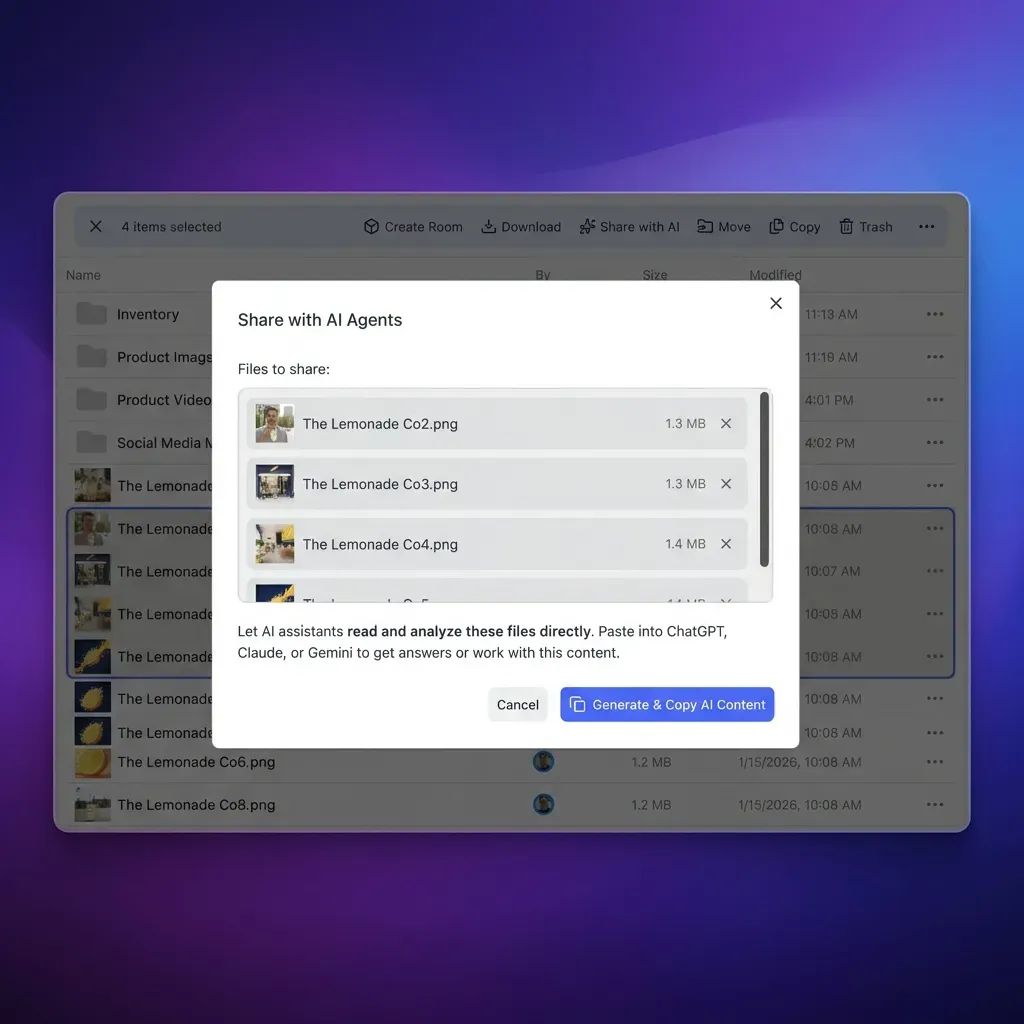
Fastio is an intelligent workspace platform, not a project management tool. It provides the persistent storage, file intelligence, and human-agent handoff layer that PM agents need but most PM platforms don't offer natively.
When your AI agent generates project deliverables, documentation, or reports, those files need somewhere to live where both agents and humans can access them. Fastio's MCP server exposes a consolidated MCP toolset for reading, writing, searching, and sharing files. Once Intelligence Mode is enabled for the workspace, it indexes uploaded files for semantic search and RAG with citations, so agents can query project context through natural language.
Key strengths:
- 14-day Business Trial requiring a credit card
- MCP-native access at mcp.fast.io for any LLM (Claude, GPT-4, Gemini, or local models)
- Intelligence Mode indexes files for semantic search and question-answering with citations once enabled
- Ownership transfer lets agents build workspaces, then hand control to humans
Limitations:
- Not a PM tool. Needs to pair with ClickUp, Asana, Notion, or another PM platform.
- Best suited as an infrastructure layer rather than a standalone solution
Best for: Teams running AI agents that need persistent file storage, semantic search, and structured handoff between agents and humans.
Pricing: Starter $9.99/mo (3 seats, 250 GB), Business $49.99/mo (10 seats, 5 TB), Enterprise $199.99/mo (30 seats, 25 TB), with a 14-day Business Trial requiring a credit card. Details at fast.io/pricing.
10. PMI Infinity
PMI Infinity is the Project Management Institute's AI advisor, grounded in over 14,000 vetted resources covering PMI standards, methodologies, and best practices. It gives project professionals on-demand guidance and document generation rather than workflow execution.
Key strengths:
- Backed by PMI's global standards and body of knowledge
- Dedicated agents for creating planning documentation with minimal prompting
- Available on web and mobile through the PMI app
Limitations:
- Advisory only. It answers questions and generates documents but doesn't execute tasks in your PM tool.
- Requires PMI membership, which limits access for casual users
Best for: Certified project managers who want AI coaching grounded in PMI methodology.
Pricing: Included with PMI membership (individual membership starts around $149/year).


Give your PM agents persistent storage and search
Fastio provides a 14-day Business Trial with a remote MCP server for agent reads and writes. Intelligence Mode indexes files for semantic search once enabled.
Choosing the right agent for your team
The best pick depends on where your team already works and what kind of agent capability you need most.
If your team is on ClickUp, Wrike, Asana, Monday.com, or Notion, start with their built-in agents. You skip the integration step entirely, and the agent already has context on your projects, tasks, and team members. ClickUp and Wrike currently offer the deepest autonomous execution. Notion is strongest for knowledge-heavy, doc-driven project management.
If you want maximum control over agent behavior, Dust and Taskade let you build custom agents from scratch. Dust excels at cross-tool orchestration across platforms you're already using. Taskade offers a lighter-weight, agent-first workspace for teams starting fresh.
If open source matters, Plane gives you a self-hostable PM platform with AI built in from the ground up.
If your agents produce files, reports, or deliverables that need to persist across sessions and be accessible to both AI and human teammates, add Fastio as your storage and intelligence layer. It pairs with whatever PM tool you choose.
Start with the agents already in your current stack. Add specialized tools when you hit a gap they can't cover.
Sources
References used to verify factual claims in this guide.
-
Gartner predicts that 80% of project management tasks will be handled by AI by 2030
-
Early adopters save up to 520 hours per employee per year with Wrike AI agents
Frequently Asked Questions
What is the best AI agent for project management?
It depends on your existing stack. ClickUp Super Agents and Wrike AI Agents currently offer the most autonomous execution within established PM platforms. For teams managing projects through docs and databases, Notion AI is a strong fit. If you need custom cross-tool agents, Dust gives you the most flexibility. Start with whatever is built into the PM tool your team already uses.
Can AI replace project managers?
Not in any meaningful way. AI agents handle administrative and repetitive PM tasks well, including status tracking, risk monitoring, report compilation, and request triage. But project management also requires stakeholder negotiation, strategic prioritization, and contextual judgment that comes from understanding team dynamics. AI agents free project managers to focus on that higher-value work instead of spending time on data entry and status chasing.
What project management tools use AI agents in 2026?
ClickUp, Wrike, Notion, Asana, Monday.com, Taskade, and Plane all have AI agent capabilities built into their platforms as of 2026. ClickUp and Wrike offer the most advanced autonomous agents with prebuilt workflows and custom builders. Notion and Asana provide agent builders for custom automations. Standalone platforms like Dust let you build custom agents that orchestrate across multiple PM tools.
How do AI agents handle project scheduling?
Most AI agents approach scheduling by monitoring dependencies and workload data, then flagging conflicts before they cascade. Wrike's risk agent tracks schedule risks and alerts stakeholders automatically. ClickUp's Super Agents can identify blocking tasks, notify owners, and suggest timeline adjustments to dependent work. These agents watch the schedule continuously and intervene when something drifts, rather than replacing your scheduling tool.
Are there free AI project management agents?
Yes. ClickUp, Wrike, Monday.com, Notion, Taskade, and Plane all offer free plans, though agent features are sometimes limited to paid tiers. Plane is fully open source. Fastio offers a 14-day Business Trial with persistent file storage and a remote MCP server that works alongside any PM agent. PMI Infinity is included with PMI membership.
Related Resources

Give your PM agents persistent storage and search
Fastio provides a 14-day Business Trial with a remote MCP server for agent reads and writes. Intelligence Mode indexes files for semantic search once enabled.