Manus AI File Storage: Persistent Workspace Best Practices
Manus AI runs tasks inside secure cloud sandboxes with isolated, temporary filesystems that automatically recycle after inactivity. Without a persistence plan, sandbox resets cause permanent data loss. This guide details Manus storage limits, compares sandbox environments with persistent cloud drive integrations, and outlines best practices for connecting Manus to Fastio workspaces to secure task artifacts for collaboration.


What Is Manus File Storage and Its Ephemeral Risk?
Manus enforces a strict 48-hour deletion policy for all API-uploaded files, capping individual files at 512 MB and total account storage at 10 GB [Manus Documentation]. This brief window is the critical constraint of the platform's standard sandbox model. Developers deploying autonomous agents to compile research reports, run code tests, or build code artifacts must design around the temporary lifecycle of these execution containers. When a task completes, the container is destroyed, and the sandbox filesystem is securely wiped.
Manus file storage refers to the sandboxed file system where the agent reads and writes task artifacts, which can be externalized to persistent cloud drives. If you do not construct an export loop, the data generated during the run is lost forever.
To solve this problem, developers often evaluate a few standard alternatives:
Local Disk Storage via Desktop App: The Manus desktop application allows local directory access, running terminal commands directly on a user's machine. While this resolves file survival, it locks the execution to a single physical device, exposes the local system to shell script errors, and prevents team members from accessing outputs concurrently.
Amazon S3 Buckets: Storing files in S3 provides durable storage but requires writing IAM access policies and handling credential keys within the agent scripts. S3 lacks a simple preview interface for non-technical team members and does not support automatic document versioning.
Google Drive: Standard shared folders provide easy web access but fail when agents execute high-frequency API writes. Google Drive frequently triggers rate limits during automated script loops and lacks structured document metadata extraction capabilities.
Fastio addresses these limitations directly. By connecting Manus to a version-controlled Fastio workspace, developers create a secure, shared space where agent output is preserved, auto-indexed for semantic search, and made available to human teammates.
The inactivity reset policy of Manus is a major risk factor. Free users face an automatic sandbox reset after 7 days of non-use, while paid Pro users face a reset after 21 days of non-use [Manus Documentation]. When a reset triggers, all files currently stored within that sandbox environment are lost. Although Manus attempts to restore some critical assets like uploaded attachments and Slides or WebDev files, it does not guarantee the recovery of intermediate code, compiled binaries, or temporary data outputs. For developers who run multi-stage research and generation tasks over several days, relying on the internal sandbox for file storage is a critical vulnerability.
Related guides
- How to Add Persistent File Storage to Replit AgentReplit Agent can build full apps from a prompt, but its file storage resets when containers sleep.
- How to Build a Hermes Agent Telegram Bot With Persistent File StorageHermes Agent's messaging gateway connects to Telegram as a persistent background process, handling file attachments,...
- Manus AI Script Execution: Automation Setup GuideManus AI script execution and automation allows the agent to run Python, Node.js, and shell scripts in isolated cloud...
- How to Build a Homework Helper Workspace with Manus AIA homework helper workspace combines collaborative cloud folders with autonomous AI agents to solve problems, analyze...
- How to Ask Questions with Manus AI RAG SetupConnecting your files to a persistent workspace allows you to run Retrieval-Augmented Generation (RAG) queries...
- Configuring Manus AI as a Playwright Test RunnerWhile 89% of quality engineering teams pilot generative AI in their workflows, only 15% have scaled these systems...
More on this subject: Manus (52 guides)
Standard Sandbox vs. Cloud Computer: How They Differ
Understanding the difference between the standard sandbox and the Cloud Computer is essential for designing persistent workflows. Manus employs distinct storage lifecycles depending on the agent environment you select. The standard sandbox is an ephemeral virtual machine allocated for a single task, while the Cloud Computer is a persistent VM that remains active continuously.
The following comparison table highlights the operational trade-offs between sandboxed storage, persistent cloud computers, and a version-controlled workspace like Fastio:
Where does Manus AI store files? By default, Manus stores all temporary task files in the Standard Sandbox. The sandbox environment is initialized with an independent, temporary filesystem that contains the uploaded files, package dependencies, and generated outputs. If you use the Cloud Computer, files persist between task executions. However, the Cloud Computer remains restricted to a single virtual environment. For team collaboration and automated file distribution, developers must export files to an external workspace. The temporary sandbox filesystem enforces the 48-hour deletion policy for these files, making externalization a necessity rather than an option.
How to Export Files and Artifacts from Manus AI
How do I export files from Manus AI? The export method depends on whether you are using the manual user interface or designing an automated execution loop. For manual workflows, you can view and download files directly from the browser window. In the top-right corner of the task interface, clicking the file overview list allows you to download individual artifacts to your computer.
For headless integrations and automated agent loops, connect Manus to the Fastio MCP server. Use Streamable HTTP at https://mcp.fast.io/mcp/tools and send the API key in an Authorization: Bearer header. Generate an API key in Settings > Devices & Agents > API Keys, keep the 19-digit workspace profile id in the environment, and have the agent persist artifacts with a tools/call.
Here is a Python pattern that imports a generated report from a URL into a Fastio workspace:
def persist_to_fastio(source_url):
    import os
    import requests
    fastio_api_key = os.getenv("FASTIO_API_KEY")
    workspace_id = os.getenv("FASTIO_WORKSPACE_ID")
    payload = {
        "jsonrpc": "2.0",
        "id": 1,
        "method": "tools/call",
        "params": {
            "name": "upload_manage",
            "arguments": {
                "action": "web-import",
                "url": source_url,
                "profile_type": "workspace",
                "profile_id": workspace_id,
            },
        },
    }
    response = requests.post(
        "https://mcp.fast.io/mcp/tools",
        headers={"Authorization": f"Bearer {fastio_api_key}"},
        json=payload,
    )
    if response.ok:
        print("Artifact persisted to the Fastio workspace.")
    else:
        print(f"Export failed: {response.text}")
This upload call with the web-import action writes the file into the workspace before the virtual container is destroyed. Add this step to your agent prompts so Manus moves artifacts from temporary container storage into a version-controlled workspace. For a large local binary, stage the bytes at the MCP POST /blob sidecar (100 MB cap, five-minute expiry, single use), then pass the returned blob_id to upload.
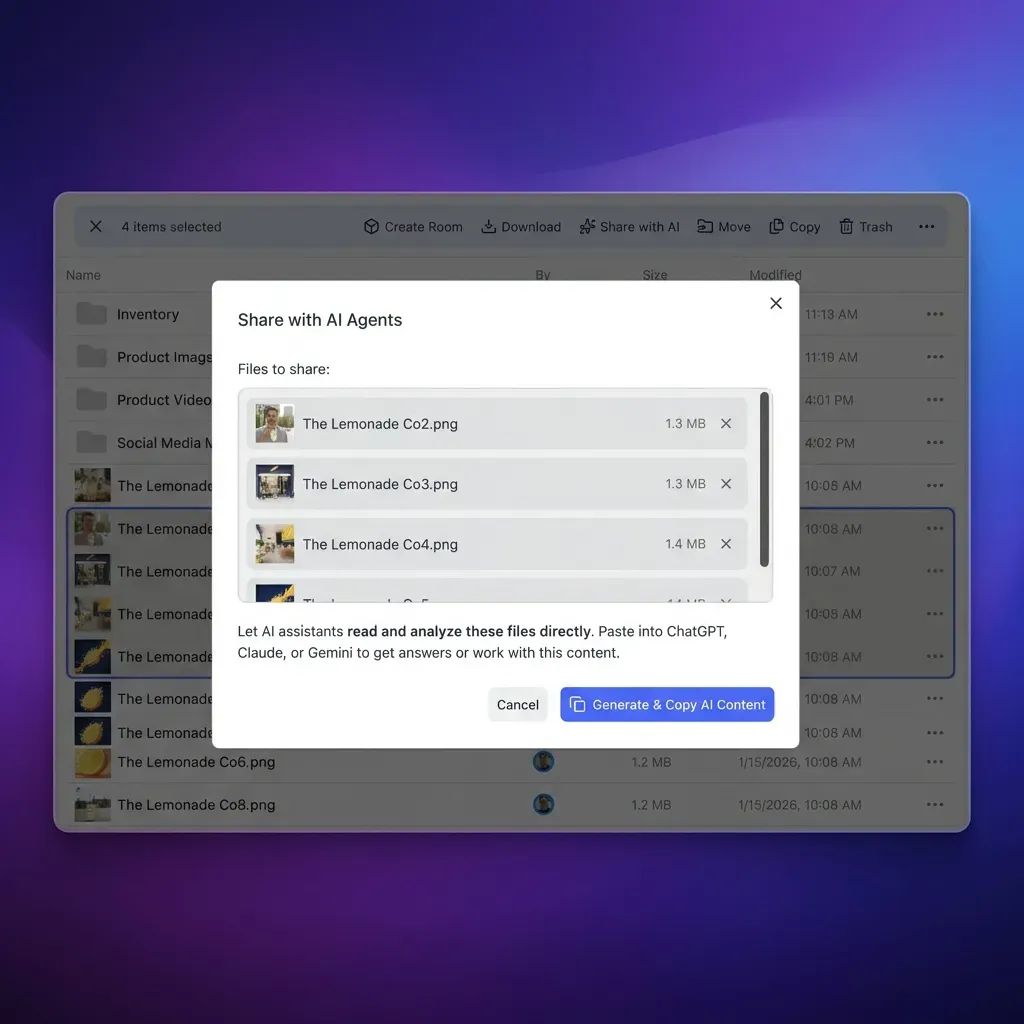


Persist Manus agent files in version-controlled folders
Provide your autonomous agents with a secure, permanent workspace. Connect the Fastio MCP server, persist task files, and organize data with a 14-day free trial.
Why Fastio Is the Ideal Persistence Layer for AI Agents
Integrating a persistent storage workspace like Fastio changes the role of your AI agents from solo script-runners to collaborative team members. Instead of running tasks in isolated cloud VMs and leaving files trapped in temporary download links, agents and humans share the same file directories, search capabilities, and version history.
Fastio provides several key capabilities that solve the sandbox persistence challenge:
Shared Workspaces: Shared workspaces allow teams to structure files in a single, org-owned directory tree. Both human team members and AI agents access the same folders, making files immediately visible to the entire team.
Per-File Version History: When agents execute automated loops, they frequently overwrite data sheets or source files. Fastio maintains a detailed version history for every file, letting you view differences, restore previous versions, and track what changes are made.
Intelligence Mode: When you enable Intelligence Mode on a workspace, Fastio automatically indexes all incoming files. This enables semantic search and RAG chat. You can ask questions about the files and receive answers with precise citations.
Unlimited Guest Seats: Sharing agent output folders with clients or external teams is easy. Fastio provides unlimited user seats for sharing agent output folders, meaning you do not have to purchase extra subscriptions just to let clients access their reports.
Developers can connect agents to Fastio using the Model Context Protocol. Fastio exposes Streamable HTTP at https://mcp.fast.io/mcp/tools, and agents send a Bearer API key in the Authorization header. The complete tool specifications are available in the Fastio MCP Guide and the developer documents. Using the MCP server, Manus can search folders, upload files, and ask Ripley about document contents directly.

Setting Up Structured Extraction and Handoff Workflows
Once files are safely transferred to your persistent workspace, you can automate how you analyze and structure the data. Instead of writing custom python code to extract information from every invoice, legal contract, or insurance policy, developers can use Fastio's metadata extraction tool.
Use Metadata Views to turn documents into a live, queryable database. When the Manus agent writes PDF reports, Excel models, or scanned images to your workspace, Metadata Views parses them automatically. You describe the columns you want in natural language (such as contract date, counterparty name, or total cost), and the platform builds a structured database layout. The schema supports Text, Integer, Decimal, Boolean, URL, JSON, and Date & Time formats. New columns can be added dynamically without reprocessing existing documents. The structured extraction layer is detailed at the Metadata Views product page: /product/document-data-extraction/.
Transferring ownership to a client is the final step in the process. The agent can set up the folder structure, configure the Metadata Views, and then hand off the workspace. Fastio supports ownership transfer, allowing an agent to hand over billing and admin rights to a human client.
To begin building, monthly plans start with a trial of up to 14 days that requires a credit card to activate [Fastio Pricing]. After the trial ends, the account transitions to a paid plan. Fastio offers three subscription plans: Starter is priced at $9.99/mo, Business is priced at $49.99/mo, and Enterprise is priced at $199.99/mo [Fastio Pricing]. By combining Manus's agent execution with Fastio's intelligent workspace, your team ensures that all task artifacts remain secure, searchable, and fully persistent.
Sources
References used to verify factual claims in this guide.
-
Manus enforces a strict 48-hour deletion policy for all API-uploaded files, capping individual files at 512 MB and total account storage at 10 GB. Free users face an automatic sandbox reset after 7 days of non-use, while paid Pro users face a reset after 21 days of non-use.
-
Fastio offers three subscription plans: Starter is priced at $9.99/mo, Business is priced at $49.99/mo, and Enterprise is priced at $199.99/mo. Monthly plans start with a trial of up to 14 days (credit card required); annual plans have no trial.
-
Agents persist files through the Fastio MCP upload_manage tool using a tools/call with the web-import action.
Frequently Asked Questions
Where does Manus AI store files?
By default, Manus AI stores files in the Standard Sandbox, which is an ephemeral virtual machine filesystem allocated for each task. The temporary sandbox filesystem enforces the 48-hour deletion policy for these files. For persistent workflows, you must write files to the Cloud Computer or export them to a persistent workspace like Fastio.
How do I export files from Manus AI?
You can export files manually by clicking the file overview list in the top-right corner of the task interface. For automated pipelines, include an export step in your agent prompts that calls the Fastio MCP upload tool and imports the artifact into a version-controlled workspace.
How does Fastio prevent data loss from Manus sandboxes?
Fastio provides a persistent cloud workspace that acts as an external storage layer for Manus. By calling the Fastio MCP upload tool (for example the web-import action) from the agent, files land in version-controlled directories that remain available after the temporary Manus sandbox container is wiped.
Can Manus use Fastio's Model Context Protocol server?
Yes. Fastio exposes Streamable HTTP at https://mcp.fast.io/mcp/tools. By configuring the Fastio MCP server, Manus can read, write, search, and manage files in your workspace using standard tools/call requests.
Related Resources

Persist Manus agent files in version-controlled folders
Provide your autonomous agents with a secure, permanent workspace. Connect the Fastio MCP server, persist task files, and organize data with a 14-day free trial.