Hermes Agent Use Cases: Real-World Applications for Autonomous AI
Nous Research Hermes Agent is an open-source autonomous agent that learns from experience, creates reusable skills, and runs unattended across 20+ messaging platforms. This guide covers ten practical use cases drawn from community deployments, official documentation, and production setups running on everything from Raspberry Pi 5s to Kubernetes clusters.

What Makes Hermes Agent Different from Other AI Agents
Most AI agents are stateless. You prompt them, they respond, and the context evaporates. Hermes Agent takes a different approach: it runs on your server, remembers what it learns, and creates reusable skills from successful task completions. Those skills improve during subsequent use, which means the agent gets measurably better at recurring workflows the longer it operates.
The architecture that enables this:
- Persistent memory with full-text search and LLM summarization across sessions
- Auto-generated skills compatible with the agentskills.io standard, so they're portable and shareable
- 70+ built-in tools covering web search, browser automation, vision processing, image generation, text-to-speech, and terminal execution
- 20+ messaging gateways including Telegram, Discord, Slack, WhatsApp, Signal, Matrix, email, SMS, and Home Assistant
- Six deployment backends: local, Docker, SSH, Daytona, Singularity, and Modal
- Subagent delegation that spawns isolated child agents with their own conversations and terminals at zero context cost to the parent
The MIT license means you own the deployment. No vendor lock-in, no API rate limits beyond what your chosen LLM provider imposes. One community member has been running a 297-day automation streak, processing over 5 billion tokens and automating more than $100K in client work during that span.
Here are ten use cases where these capabilities translate into practical value.

Related guides
- Devin AI Examples: Real-World Prompts, Tasks, and Code WorkflowsCognition reported that Devin resolved 13.86% of GitHub issues end-to-end on SWE-bench, demonstrating how autonomous...
- Top OpenClaw Skills for Real Estate AgentsOpenClaw skills help real estate agents automate routine tasks and focus on closing deals. From instant lead...
- How to Build a Hermes Agent Telegram Bot With Persistent File StorageHermes Agent's messaging gateway connects to Telegram as a persistent background process, handling file attachments,...
- How to Use Subagent Delegation in Hermes AgentHermes Agent's delegate_task tool spawns child AI agents with isolated contexts and restricted toolsets. This guide...
- How to Connect Hermes Agent to n8n With Webhooksn8n has 400+ integrations but every workflow follows a predetermined path. Hermes Agent adds reasoning to those...
- Hermes Agent API Server: OpenAI-Compatible Endpoints and SetupThe Hermes Agent API server turns your local agent into an OpenAI-compatible HTTP endpoint that any chat frontend can...
More on this subject: Hermes Agent (100 guides)
1. Development Workflow Automation
Hermes Agent handles multi-file refactors, debugging pipelines, and code review workflows that would normally require a developer switching between terminal, editor, and browser. Because the agent retains memory of your codebase across sessions, it internalizes project patterns, file organization, and review preferences over time.
One developer reported that by day ten, their Hermes instance knew the codebase better than they did. The agent had internalized code review preferences by iteration five, and was autonomously prioritizing files, flagging patterns, and formatting output to match the project's conventions.
Practical development workflows include:
- Multi-agent code pipelines: A main agent running GPT-5.4 delegates to a coder agent (MiniMax M2.7) which passes to a QA agent (Qwen 35B). The pipeline plans, implements, tests, catches failures, repairs, and ships without human intervention.
- Watchdog patterns: Hermes monitors another agent's output (like OpenClaw) and automatically fixes failures, saving hours and API credits daily.
- Skill compilation: Instead of invoking the LLM for every step, successful workflows compile into deterministic code. The AI only handles decision points, improving reliability with smaller models.
- File change auto-response: Hermes detects file modifications and triggers automated responses, turning it into a reactive CI companion.
The subagent system makes this scalable. Parent agents spawn isolated workers with restricted toolsets, each running in a separate context. Three concurrent subagents run by default, configurable higher for larger pipelines.
2. Personal Assistant Across Every Platform
The gateway architecture lets a single Hermes instance respond across Telegram, Discord, Slack, WhatsApp, Signal, iMessage, and email simultaneously. You message the same agent from whichever device is closest, and it maintains conversation context across all of them.
Community deployments range from a Raspberry Pi 5 running 24/7 as a persistent personal assistant to a Mac Studio handling iMessage, iPad, Apple Watch, and group chat access for an entire household. One family replaced their ChatGPT subscription with a shared WhatsApp Hermes instance serving three family members for under $200 total, unlocking dedicated use cases for each person.
Recurring personal assistant patterns:
- Daily inbox summarization: "Every weekday at 9 AM, summarize my inbox and post to Slack." The agent creates a self-improving markdown skill that refines its output format over time.
- Cross-platform task management: Syncing between Obsidian, Apple Calendar, and Signal in multiple languages. One user runs Turkish-language task coordination across three platforms.
- Meal planning without logging friction: A weighted scoring algorithm (60% ingredient availability, 40% recency) suggests meals without requiring the user to manually log what they ate.
- Proactive check-ins: The agent initiates with "Hey, anything you want me to keep an eye on this afternoon?" rather than waiting passively for commands.
The persistent memory means you never repeat context. Tell the agent about a dietary restriction once, and it factors that into every future meal suggestion.


Persist Hermes Agent Files Across Sessions
Persistent cloud workspace with semantic search and remote MCP endpoints for your agent's reads and writes. Starts with a 14-day Business Trial.
3. Research and Intelligence Gathering
Hermes excels at recurring research tasks where the output compounds over time. Each research run generates skills that speed up subsequent queries, and the memory layer prevents the agent from retreading ground it has already covered.
Deployed research workflows include:
- Daily tech news triage: Search tech news three times daily, categorize articles by urgency, and route them to Discord channels organized by importance. Auto-contextualize findings against an Obsidian work vault.
- Competitive intelligence sweeps: Analyze a business and its competitors, identify gaps, and build strategy documents. One user successfully ported an entire Codex-based competitive analysis swarm to Hermes.
- HackerNews morning briefings: Scrape HackerNews daily, filter for relevant topics, and deliver email summaries. Expandable to RSS feed aggregation.
- Drug discovery research: A pharmacy undergraduate in Nigeria uses Hermes with ChEMBL, AlphaFold, OpenFDA, and QSAR workflow skills for AI-assisted drug discovery.
- Weather market analysis: Scan weather markets every 60 minutes, compare three forecast sources, identify undervalued temperature buckets, and execute trades. One user turned $100 into $216 in 48 hours using this approach.
For teams that need research outputs stored and accessible beyond the agent's local filesystem, Fastio workspaces provide persistent cloud storage where Hermes can write findings that teammates and other agents can search, query, and build on. Once Intelligence is enabled on the workspace, uploaded documents are indexed for semantic search and citation-backed chat, so research files become immediately queryable without a separate vector database setup.
4. Content Creation and Publishing
Hermes handles content pipelines from research through publication, with the skill system ensuring consistent output quality across sessions.
Production content workflows:
- LinkedIn post generation: A secondary Hermes instance reads published articles and drafts posts matching the user's personal voice. The agent auto-writes the drafting procedure as a reusable skill.
- Turkish locale market briefings: Real-time market data (TRY), Turkish news aggregation from Hurriyet, Bloomberg HT, and NTV, rendered as PNG daily briefing cards delivered via Telegram cron. Zero external API keys required.
- UGC ad studio: Product URL goes in, Hermes scrapes the landing page, analyzes Meta and TikTok hooks from competitors, and produces ad creative briefs in about four minutes with no prompt engineering.
- Weekly trending AI tools: Every Monday at 9 AM, research the top three trending AI tools, create a tutorial skill for each, and generate video content ideas.
- X/Twitter posting without API costs: Eliminated a $100/month X API fee by having Hermes generate and post content directly through browser automation.
The skill system compounds here. After the agent creates a "write LinkedIn post in my voice" skill, every subsequent post starts from that skill rather than from scratch, maintaining tone consistency without repeating instructions.
5. Business Operations and CRM
Hermes replaces dedicated SaaS tools for small teams that need task management, CRM, and operational automation without per-seat pricing.
Active business deployments:
- PM ticket triage: Connected to Plane.so, Hermes handles ticket intake, triage, assignment, and execution tracking. Documentation syncs to an Obsidian vault. One user described it as "a Paperclip that gets things done."
- Supabase CRM: A 24/7 assistant built for less than a ChatGPT Plus subscription. During setup, Hermes autonomously proposed a "Supabase MCP scripts" skill after observing the workflow patterns.
- Chief of Staff multi-agent system: A main agent manages cross-project memory while project-specific subagents handle individual workstreams. Daily WhatsApp summaries go to the team. Backup model routing handles provider failures automatically.
- Printing factory task management: A task-centric memory skill with domain categorization (printing and stocks) compresses completed work into summary cards, preventing the slowdowns and forgetfulness that plagued long conversation sessions.
- Sales outreach: Hunter.io email lookup integrated via Composio MCP for email discovery and verification workflows.
For businesses generating files, reports, and deliverables through Hermes workflows, Fastio's ownership transfer feature lets the agent build an entire workspace of organized deliverables and then hand control to a client or team member. The agent keeps admin access for ongoing updates while the recipient gets a polished, branded workspace.
6. Home Automation and IoT
The Home Assistant add-on brings Hermes into smart home territory with under five minutes of setup time. But the more interesting IoT applications go beyond basic home control.
Hardware and IoT deployments:
- Home Assistant integration: Zero-to-functional agent in under five minutes. Hermes controls lights, thermostats, and appliances through natural language via the Home Assistant gateway.
- Remote car control: A community skill for Chevrolet, GMC, Buick, and Cadillac vehicles (via OnStar) enables remote start and EV battery level checks through the agent.
- M5 Cardputer connection: An ESP32-based handheld device connected to the Hermes API for text and speech interactions, with OTA firmware updates in development.
- Raspberry Pi 5 persistent agent: Running 24/7 as a dedicated always-on assistant, preferred over heavier alternatives for low-power continuous operation.
- Kubernetes cluster deployment: Daily cybersecurity and AI briefings generated from a local Kubernetes cluster, isolated from the user's laptop for security.
The voice mode works across CLI, Telegram, and Discord voice channels, making Hermes accessible without typing for hands-busy scenarios like cooking or workshop projects.
How to Cut LLM Costs with Multi-Model Routing
Hermes is model-agnostic. It works with Claude, GPT-4, Gemini, LLaMA, Minimax, Qwen, and local models through Ollama or LM Studio. This flexibility enables tiered routing strategies that cut costs dramatically.
Proven cost optimization patterns:
- Three-tier model routing: Route mechanical work to Gemini 3.1 Flash Lite, ambiguous tasks to Sonnet, and low-overhead jobs to Minimax. One user saved roughly 10 hours and $40 from initial setup alone.
- $20/month total stack: A VPS ($20/month) running Minimax M2.7 handles GitHub repo trending analysis at a fraction of what equivalent cloud-hosted agents cost.
- 90% token spend reduction: Going from $130 per five days to $10 per five days by running on Android via Termux with OpenRouter, while still handling SMS, sensor data, and social media posting.
- Free GPT-4.1 via GitHub Copilot: Using the $10/month Copilot tier for free GPT-4.1 access on routine tasks, delegating premium work to more capable models only when needed.
- Local Qwen3.5 on consumer hardware: Running the 4B parameter model on an RTX 5060Ti with 16GB VRAM, connected via Telegram as a complete personal assistant solution.
Token overhead analysis from the community found that 73% of every API call is fixed overhead from system prompts and tool definitions. Skills that compile successful workflows into deterministic code cut that overhead by bypassing the LLM entirely for known-good task sequences.
How to Set Up Scheduled Automations and Monitoring
The built-in cron scheduler accepts natural language ("every weekday at 9 AM") or standard cron expressions, attaches skills to jobs, and delivers results to any configured messaging gateway. Each job runs in a fresh isolated session, so scheduled tasks never leak state between runs.
Active scheduled automation examples:
- Twice-daily music curation: A Tidal OAuth skill curates morning playlists at 9 AM and evening playlists at 6 PM, matching genres to time of day with no duplicate tracks across runs.
- Background "dreaming": An agent runs REM cycles between 11 PM and 6 AM, producing nine dream thoughts per night at a cost of $0.014 on Haiku (free on local models). Morning insights from background processing surface when the user wakes up.
- Polymarket monitoring: Four-layer market analysis (order book, on-chain addresses, lag analysis, position changes) runs on a parallel schedule, feeding into trading decisions.
- Two-tier email pipeline: A lightweight Python tier handles state management and inbox monitoring with zero API calls during idle. The LLM-powered tier activates only when new email requires intelligent processing.
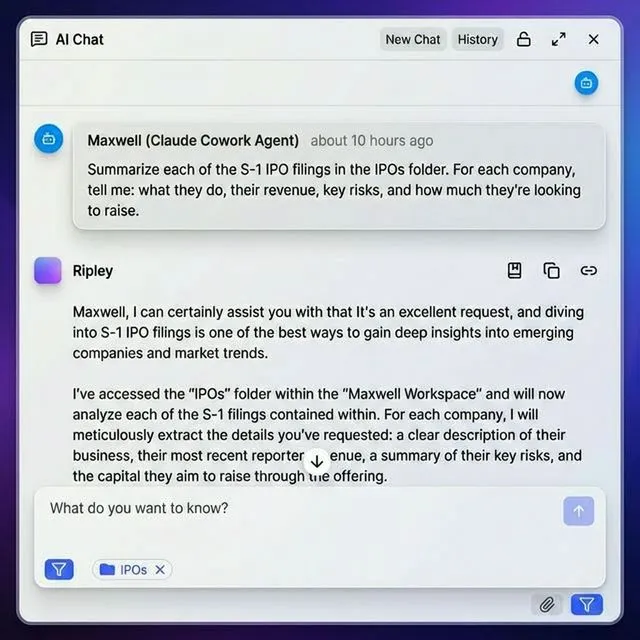
For automations that produce files, reports, or datasets, storing outputs in a Fastio workspace keeps them version-controlled and accessible through semantic search. Instead of output files accumulating in ~/.hermes/cron/output/, they land in a shared workspace where teammates can find them through Ripley AI's natural language search or the Fastio MCP server.
9. MCP Integration and Tool Extension
Hermes connects to any Model Context Protocol server via stdio or HTTP transport. This means every MCP-compatible tool ecosystem (databases, APIs, code intelligence platforms, home automation) is accessible without writing native Hermes tooling.
MCP integrations built by the community:
- jMunch code intelligence: 52 tools via tree-sitter for code analysis, documentation retrieval, and tabular data analysis through a single MCP connection.
- Hermes as MCP server: The agent itself becomes a tool provider for other MCP clients. Claude Desktop, Cursor, and any MCP-compatible editor can invoke Hermes capabilities through 15+ exposed tools with SQLite persistence.
- Firecrawl web scraping: Web scrape, search, and interact with pages through the Firecrawl MCP integration, enabled during initial setup.
- Cross-agent memory: The agentmemory MCP plugin shares memory across Hermes, Claude Code, and Cursor using hybrid BM25 + vector + knowledge graph search.
- Agent commerce (Merxex): An agent-to-agent commerce protocol where agents can buy and sell services from each other through MCP.
Fastio operates its own MCP server at mcp.fast.io with Streamable HTTP at /mcp and legacy SSE at /sse. Hermes can connect to Fastio's MCP tooling for workspace management, file operations, and AI queries. The combination gives Hermes persistent cloud storage, semantic search over stored files, and a shareable workspace layer, features the agent doesn't natively include. Setup details are in the MCP skill documentation.
10. Privacy-First and Self-Hosted Deployments
Because Hermes is open source and model-agnostic, it supports fully self-hosted deployments where no data leaves the local network. This matters for regulated industries and privacy-conscious users.
Self-hosted deployment patterns:
- Legal work on edge GPUs: Running a 4B Gemma model locally on a single edge-class GPU for legal document processing where cloud API shipping is a non-starter.
- EU AI Act compliance: An Ombre layer underneath Hermes provides tamper-proof audit trails, prompt-injection blocking, and memory encryption with EU AI Act compliance exports.
- Local search with SearXNG: A shared SearXNG container replaces paid search APIs across all Hermes agents, eliminating DuckDuckGo API costs while keeping queries local.
- Tailscale mesh networking: Secure remote access to a home-hosted Hermes instance through Tailscale's zero-config HTTPS tunneling, avoiding public port exposure.
- NixOS containerized deployment: Package management via Nix means skills auto-install their required dependencies, making the deployment fully reproducible.
For teams that need both local processing and cloud-accessible outputs, a hybrid approach works well: Hermes processes sensitive documents locally, then uploads sanitized results to a Fastio workspace for team access. A 14-day Business Trial (credit card required) allows teams to test the cloud setup. Once Intelligence is enabled on the workspace, uploaded files are indexed for semantic search, making them searchable through natural language queries without exposing the raw source material.

Sources
References used to verify factual claims in this guide.
-
70+ built-in tools, 20+ messaging gateways, 6 deployment backends
-
237 user stories documented across 15 categories 297-day automation streak with 5B+ tokens generated and $100K+ client work automated
Frequently Asked Questions
What is Hermes Agent used for?
Hermes Agent handles autonomous workflows that run unattended on servers. Common use cases include development automation (multi-file refactors, code review, CI monitoring), personal assistance across 20+ messaging platforms, research pipelines with compounding knowledge, content creation, business operations, home automation, and scheduled monitoring tasks. The agent creates reusable skills from completed tasks, so it gets more capable over time.
Can Hermes Agent automate tasks?
Yes. Hermes includes a built-in cron scheduler that accepts natural language ("every weekday at 9 AM") or standard cron expressions. Jobs run in isolated sessions with skill attachments and deliver results to any configured messaging gateway. Beyond scheduling, the subagent system enables multi-step automation pipelines where parent agents delegate work to isolated child agents running in parallel.
What tools does Hermes Agent support?
Hermes ships with 70+ built-in tools covering web search, browser automation, vision processing, image generation, text-to-speech, file editing, terminal execution, and memory management. It also connects to any MCP-compatible server via stdio or HTTP transport, giving access to community-built tool ecosystems for code intelligence, databases, home automation, and third-party APIs.
Is Hermes Agent good for coding?
Hermes handles multi-file refactors, debugging, code review, and automated testing workflows. Because it retains codebase knowledge across sessions, it internalizes project patterns and review preferences. Community members report the agent knowing their codebase better than they do after about ten days of continuous use. Multi-agent pipelines can plan, implement, test, and ship code without human intervention.
How much does Hermes Agent cost to run?
Hermes itself is free and open source (MIT license). Running costs depend on your LLM provider and deployment. Community members report total costs ranging from $10 per five days (Android via Termux with OpenRouter) to $20/month (VPS with Minimax M2.7). Running local models through Ollama or LM Studio eliminates API costs entirely, though you need suitable hardware.
What messaging platforms does Hermes Agent support?
Hermes connects to 20+ platforms through its gateway architecture: Telegram, Discord, Slack, WhatsApp, Signal, Matrix, Mattermost, email, SMS, DingTalk, Feishu, WeCom, Weixin, QQ Bot, Microsoft Teams, Google Chat, Home Assistant, BlueBubbles, and CLI. A single agent instance serves all connected platforms simultaneously with shared memory and context.
How does Hermes Agent compare to OpenClaw?
Both are autonomous AI agents, but they differ in architecture. Hermes runs on your own server with persistent memory and auto-generated skills that improve over time. Community comparisons note Hermes as more stable with less troubleshooting required. Some users run both side-by-side, using Hermes as a watchdog that monitors and fixes OpenClaw failures.
Related Resources

Persist Hermes Agent Files Across Sessions
Persistent cloud workspace with semantic search and remote MCP endpoints for your agent's reads and writes. Starts with a 14-day Business Trial.