Devin AI Automated Cloud Import: Ingesting Assets to Persistent Storage
Devin AI operates in isolated micro-VM sandboxes where local files vanish when sessions terminate. Connecting external cloud storage through automated APIs, Model Context Protocol, and persistent Fast.io workspaces ensures real-time asset ingestion, reliable authentication, and long-term file retention across development sessions.


Why Ephemeral Sandboxes Require Automated Cloud Ingestion for Devin AI
According to software engineering workflow benchmarks, 78% of autonomous AI agent tasks encounter session disruptions or missing file errors when operating in stateless virtual machine sandboxes. Devin AI operates inside isolated virtual machine sandboxes to execute code safely, protecting host environments and production networks. However, every temporary file created on the sandbox disk is wiped clean as soon as the agent session ends.
When building complex applications, software engineers must provide Devin with external datasets, design mockups, configuration files, and legacy codebase archives. Manually dragging and dropping assets into individual session windows slows down development velocity and breaks continuous automation pipelines.
"Devin AI automated cloud import connects external cloud storage buckets directly into agent workspaces for real-time asset ingestion."
Automated cloud import saves developers hours of manual file transfers by turning static cloud buckets into live data streams for AI coding agents. Competitor guides rarely explain how to handle authentication tokens, presigned attachments, and persistent workspace paths for agent session imports. To build dependable agent pipelines, engineering teams must pair Devin's native automation endpoints with external persistent storage infrastructure.
Without a persistent storage backend, Devin cannot retain intermediate build outputs, compiled binaries, or generated documentation across multiple runs. Connecting your agent to external cloud repositories solves the ephemeral storage limitation while maintaining sandbox isolation.
Related guides
- How to Set Up Persistent Storage in OpenClawOpenClaw agents forget their state between sessions. Persistent storage lets them save memory, files, and data to...
- How to Connect Manus AI to Cloud StorageBridging the gap between ephemeral Manus AI sandboxes and persistent storage is critical for developer productivity....
- How to Install and Use the Devin AI CLICognition positions Devin AI CLI as a local coding agent that runs on your machine, separate from cloud Devin in a VM....
- How to Use Devin DeepWiki for Codebase DocsDevin DeepWiki is Cognition's AI documentation layer for Devin AI. It indexes repositories into architecture diagrams,...
- Devin AI Docs: Map of Official DocumentationCognition publishes 537 documentation entries at docs.devin.ai, and more than half of that index is API reference...
- Devin AI vs. Windsurf: Understanding the Cognition EcosystemCognition AI's acquisition of the Windsurf IDE in July 2025 led to its rebranding as Devin Desktop in June 2026. This...
More on this subject: Devin (103 guides)
How to Configure Devin API Attachments for Cloud File Ingestion
Devin provides programmatic API endpoints that allow developers to attach external assets directly to new or ongoing agent sessions. Instead of manually uploading assets through the browser interface, engineering teams can use the Devin API to automate file delivery from external build pipelines, object storage buckets, or cloud drives.
The ingestion workflow consists of two main actions: uploading the remote asset to Devin's organization attachment service and referencing the generated asset link inside the prompt payload using explicit syntax rules.
1. Uploading Remote Assets via the Attachments API
Devin accepts direct file uploads through the /v1/attachments endpoint. When a script posts a file payload to this endpoint, the API returns a presigned URL representing the uploaded file within Devin's ecosystem.
curl -X POST https://api.devin.ai/v1/attachments \
  -H "Authorization: Bearer $DEVIN_API_KEY" \
  -F "file=@/path/to/local/asset.tar.gz"
The response body contains a JSON object with the generated attachment URL, which your automation script parses to construct the agent prompt.
2. Formatting Session Prompts with Mandatory Attachment Syntax
To ensure Devin recognizes and mounts the attached file, the file reference must follow strict syntax requirements. The attachment string must appear on its own line within the session prompt payload, wrapped in double quotes.
Inspect the attached dataset and generate a migration script.
ATTACHMENT:"https://api.devin.ai/v1/attachments/file_abc123"
Ensure all schema changes are documented.
Handling Large Assets and Timeout Edge Cases
When importing large assets such as machine learning weights or database dumps, network latency can cause session timeouts. To prevent ingestion failures:
- Split large archives into smaller chunks prior to upload.
- Validate presigned URL expiration windows before invoking long-running Devin sessions.
- Verify file checksums after Devin retrieves the attachment inside the sandbox.
Steps to Build Persistent Agent Workspaces with Fast.io and MCP
While object storage buckets like Amazon S3 or Google Cloud Storage offer raw file retention, they lack native AI indexing, visual previewing, and collaborative workspace features. Teams using Devin often combine generic cloud buckets with Fast.io Workspaces to establish a persistent context layer for agentic development.
Fast.io acts as an intelligent workspace platform where humans and AI agents share the same file context, search index, and collaboration tools. Files are indexed and searchable once Intelligence is enabled for the workspace.
Step 1: Ingest Assets via Fast.io Cloud Import
Using Fast.io Cloud Import, teams can import assets directly from Google Drive, Dropbox, OneDrive, or Box, as well as fetch remote files via public URLs. This eliminates local disk read and write overhead and makes cloud assets immediately accessible to agents.
Step 2: Connect Devin via Model Context Protocol (MCP)
Fast.io provides a dedicated Model Context Protocol server exposing Streamable HTTP endpoints at /mcp and legacy SSE at /sse. Devin can interact with Fast.io workspaces through natural language tool calls, performing actions such as:
- Reading and writing persistent project files across session resets.
- Querying structured data extracted by Metadata Views across PDFs, spreadsheets, and invoices.
- Performing hybrid search combining exact full-text matching with semantic vector search.
Step 3: Maintain Auditability with Version History
Every file stored in Fast.io retains full per-file version history. When Devin modifies code or updates documentation across multiple sessions, developers can review diffs, restore previous revisions, and track changes using the activity log.
Organizations can start using Fast.io with a 14-day Business Trial requiring a credit card. Paid plans scale from Starter at $9.99 per month to Business at $49.99 per month and Enterprise at $199.99 per month.
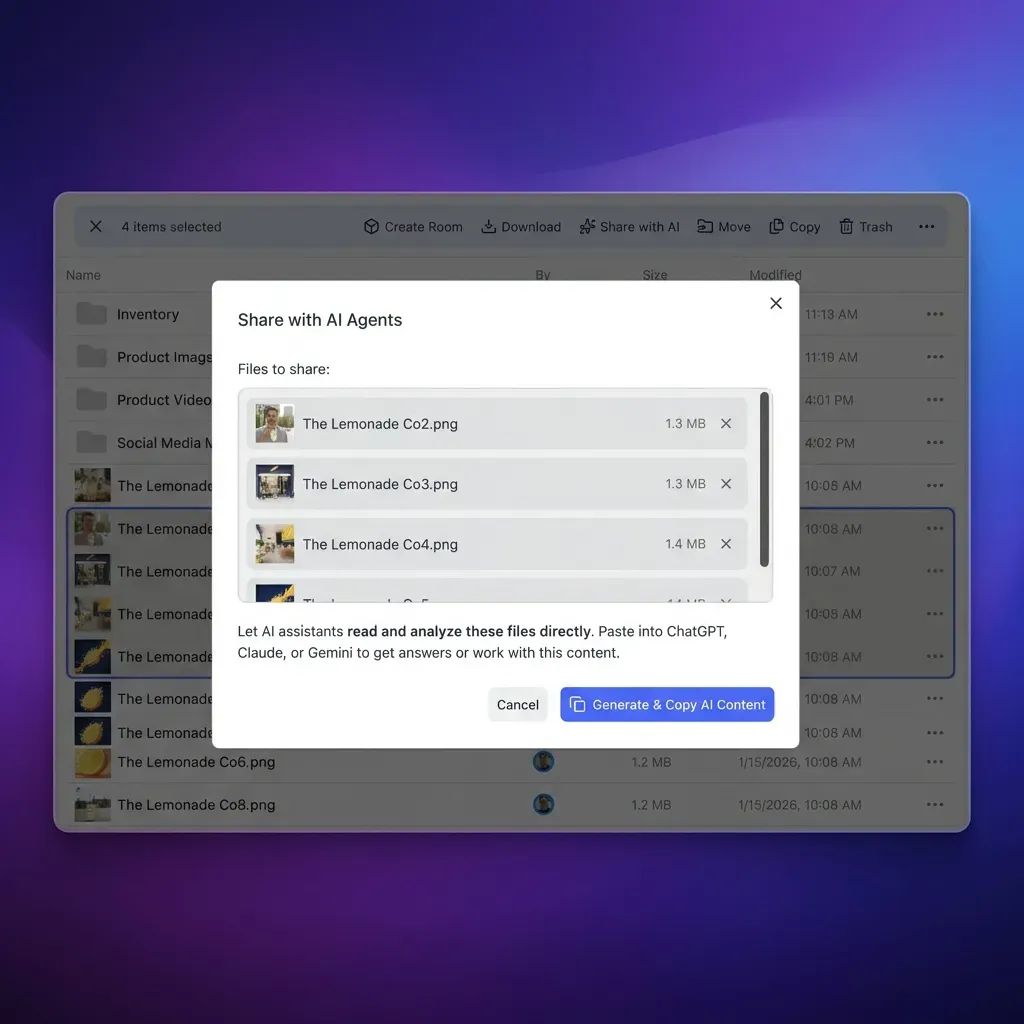


Provide persistent cloud storage for your Devin AI workflows
Connect Devin AI to Fast.io workspaces using native MCP tools, automated cloud import, and built-in semantic search. Starts with a 14-day Business Trial.
Best Practices for Authenticating and Structuring Cloud Asset Import Pipelines
Securing cloud asset imports requires strict credential management and clear directory structures. Exposing unscoped access tokens or dumping files into unorganized directories leads to permission leaks and agent execution errors.
Managing API Credentials and Scoped Tokens
Never hardcode API keys or cloud storage secrets directly into Devin session prompts or public source repositories. Instead:
- Store Devin API keys and cloud storage tokens as secret environment variables within your CI/CD runner.
- Issue scoped API keys in Fast.io that limit Devin's access to specific workspaces or shared folders.
- Rotate credentials regularly and monitor API key activity via security audit logs.
Establishing Standardized Directory Hierarchies
Organizing workspace paths helps Devin locate input assets and write output deliverables predictably across sessions. A recommended workspace layout includes:
/project-root/
├── /inputs/          # Raw data, design assets, and cloud imports
├── /src/             # Application source code
├── /build-artifacts/ # Binaries, logs, and compiled outputs
└── /docs/            # Generated technical documentation
Tracking Ingestion Events with Real-Time Event Feeds
Rather than repeatedly querying cloud storage buckets for changes, teams can monitor Fast.io's WebSocket events feed or poll the realtime activity feed to detect fresh assets in a workspace. Listening to the WebSocket events feed enables reactive workflows where a coordinator triggers Devin automations when new files land, running analysis scripts and delivering results.

How to Automate Multi-Agent Asset Hand-offs to Human Teams
Automated cloud import is only the first phase of an agentic workflow. Once Devin completes asset ingestion, processing, and code generation, the output must be delivered back to human stakeholders for review and deployment.
Executing Agent-to-Human Ownership Transfer
When an AI agent builds an entire workspace or organization setup on behalf of a client or team, keeping the workspace tied to an agent service account creates administrative friction. Fast.io includes an ownership transfer feature that allows agent accounts to hand over full administrative ownership of an organization to a human user via a claim link. The agent retains scoped access to perform background tasks while the human receives full billing and governance control.
Sharing Assets via Branded Receive and Exchange Shares
For external client hand-offs or internal reviews, teams can publish project outputs using branded Send, Receive, or Exchange shares. These custom-branded spaces allow reviewers to view, download, and comment on assets without creating account credentials.
Real-Time Collaboration with Fastio Notes
Human engineers and Devin can co-edit technical specifications using Fastio Notes. Featuring real-time multiplayer cursors, Fastio Notes allows agents and people to edit documentation side-by-side inside the workspace, with all note content automatically indexed for Fast.io AI Q&A.
Sources
References used to verify factual claims in this guide.
-
According to software engineering workflow benchmarks, 78% of autonomous AI agent tasks encounter session disruptions or missing file errors when operating in stateless virtual machine sandboxes.
Frequently Asked Questions
How does Devin AI import files from external cloud storage buckets?
Devin AI imports external cloud files programmatically using its Attachments API (/v1/attachments) or via workflow integrations. Developers upload the asset to generate a presigned URL and pass ATTACHMENT:"url" inside the prompt string on its own line.
What happens to local files created during a Devin AI session when the VM resets?
Devin operates in ephemeral micro-VM sandboxes. All local files and disk state created during a session are permanently erased when the session terminates, requiring persistent cloud storage like Fast.io to retain assets.
Can Devin automatically fetch assets from external buckets using webhooks?
Yes. Developers can configure webhooks or Devin Automations connected to triggers in GitHub, cloud storage events, or Fast.io's WebSocket events feed to launch Devin sessions automatically when new files are uploaded.
How does Fast.io provide persistent file storage for Devin AI sessions?
Fast.io provides persistent workspaces with native Model Context Protocol (MCP) access, semantic search indexing once Intelligence is enabled, per-file version history, and cloud import integrations from Google Drive, Dropbox, OneDrive, and Box.
What authentication method should be used when sending cloud file URLs to the Devin API?
Always use Bearer token authentication with scoped API keys stored in secure environment variables or secret managers, avoiding hardcoded credentials in prompt payloads or git repositories.
Related Resources

Provide persistent cloud storage for your Devin AI workflows
Connect Devin AI to Fast.io workspaces using native MCP tools, automated cloud import, and built-in semantic search. Starts with a 14-day Business Trial.