How to Connect Manus AI to MCP Storage
Connecting Manus AI to MCP storage enables the autonomous agent to securely read, write, and persist files within a designated team workspace over standard Model Context Protocol. Learn how to connect Manus to MCP storage to bridge the gap between temporary execution environments and durable cloud filesystems.


Why Ephemeral Sandboxes Limit Autonomous Agents
Over 72% of developers implementing the Model Context Protocol expect their deployment of this integration standard to expand over the next 12 months, according to the Zuplo 2026 State of MCP Report. This growth highlights the industry's shift toward standardized tool execution, but it also exposes a critical infrastructure bottleneck. Most autonomous agent platforms, including Manus AI, run tasks inside temporary virtual machines or containerized sandboxes. While these sandboxes provide security and isolation during task execution, they are inherently ephemeral. When an agent session terminates, the local storage, generated files, and intermediate workspace state disappear forever.
For developers deploying autonomous agents to run multi-day tasks, this lack of file persistence is a major obstacle. Consider an agent tasked with auditing financial records, converting video assets, or extracting data from a batch of legal agreements. If the agent stores its output in local scratch directories, the files are lost as soon as the VM is recycled. Furthermore, if a human colleague needs to review the files, they cannot easily access a local container filesystem. Developers have historically tried to solve this by writing custom integration code for generic cloud storage APIs. But building custom integrations for every tool is inefficient and hard to maintain.
To bridge this persistence gap, developers are turning to standard protocols. The Model Context Protocol (MCP) establishes a client-server architecture where agents act as clients and external applications act as servers. Instead of connecting directly to an API, the agent talks to an MCP server that exposes specific tools, resources, and prompts. This allows developers to hook the agent up to a stable storage backend that persists files across sessions. While traditional cloud storage options like AWS S3 or Google Drive can act as raw file repositories, they lack native support for agentic workflows. They do not understand the Model Context Protocol, and they do not provide built-in semantic retrieval or real-time event feeds. Fast.io addresses this by exposing a dedicated MCP server that integrates directly with a collaborative, intelligent workspace.
Related guides
- How to Connect Hermes Agent to MCP StorageOnly 57. This guide explains how to connect the Hermes Agent to MCP storage servers, enabling durable reads, writes,...
- How to Connect Base44 to MCP StorageConnecting Base44 to MCP storage allows local and hosted AI assistants to safely query entity schemas and data using...
- Manus AI vs Question AI: Choosing the Best AI for Academic ResearchIn 2025, overall adoption of artificial intelligence tools among researchers jumped from 57% in 2024 to 84% in 2025,...
- How to Build a Homework Helper Workspace with Manus AIA homework helper workspace combines collaborative cloud folders with autonomous AI agents to solve problems, analyze...
- How to Connect Manus AI to Cloud StorageBridging the gap between ephemeral Manus AI sandboxes and persistent storage is critical for developer productivity....
- Is Manus AI Free? Free Plan, Credits, and LimitsManus AI is free to start on a limited-credit Free plan, but heavier autonomous agent work usually needs paid Pro or...
More on this subject: Manus (52 guides)
How to Connect Manus to MCP Storage
To establish a connection between Manus and your storage backend, you can register a custom MCP server within the Manus environment. Manus officially supports the Model Context Protocol, allowing users to configure custom HTTP-based MCP servers to extend the agent's capabilities. This integration enables the agent to read, write, and manage files in external workspaces.
The setup process requires a running MCP server that is accessible via an HTTPS URL. Because Manus executes tasks in a secure cloud environment, local hosts, such as localhost or private network IP addresses, are not directly reachable. You must host your MCP server on a public, secure endpoint or use an HTTP tunnel like ngrok or Cloudflare Tunnels for local testing.
To complete the setup, follow these steps to connect your agent to your custom storage server:
Open Settings in your Manus AI workspace.
Select the Connectors tab from the integrations menu.
Access the Custom MCP tab and click the Add Custom MCP button.
Select the Direct Configuration option.
Enter the Server Name, such as Fastio Workspace Storage.
Set the Transport Type to HTTP.
Enter the Server URL, pointing to your secure HTTPS MCP endpoint.
Add any required authentication headers, such as an Authorization header with a bearer token.
Click Save to authorize the connection and register the tools.
Once registered, Manus queries the server's tool schema using JSON-RPC requests. The server responds with a list of available tools, such as file read, file write, folder creation, and directory search. The agent can then call these tools autonomously to persist documents, images, and structured spreadsheets directly into your designated workspace.
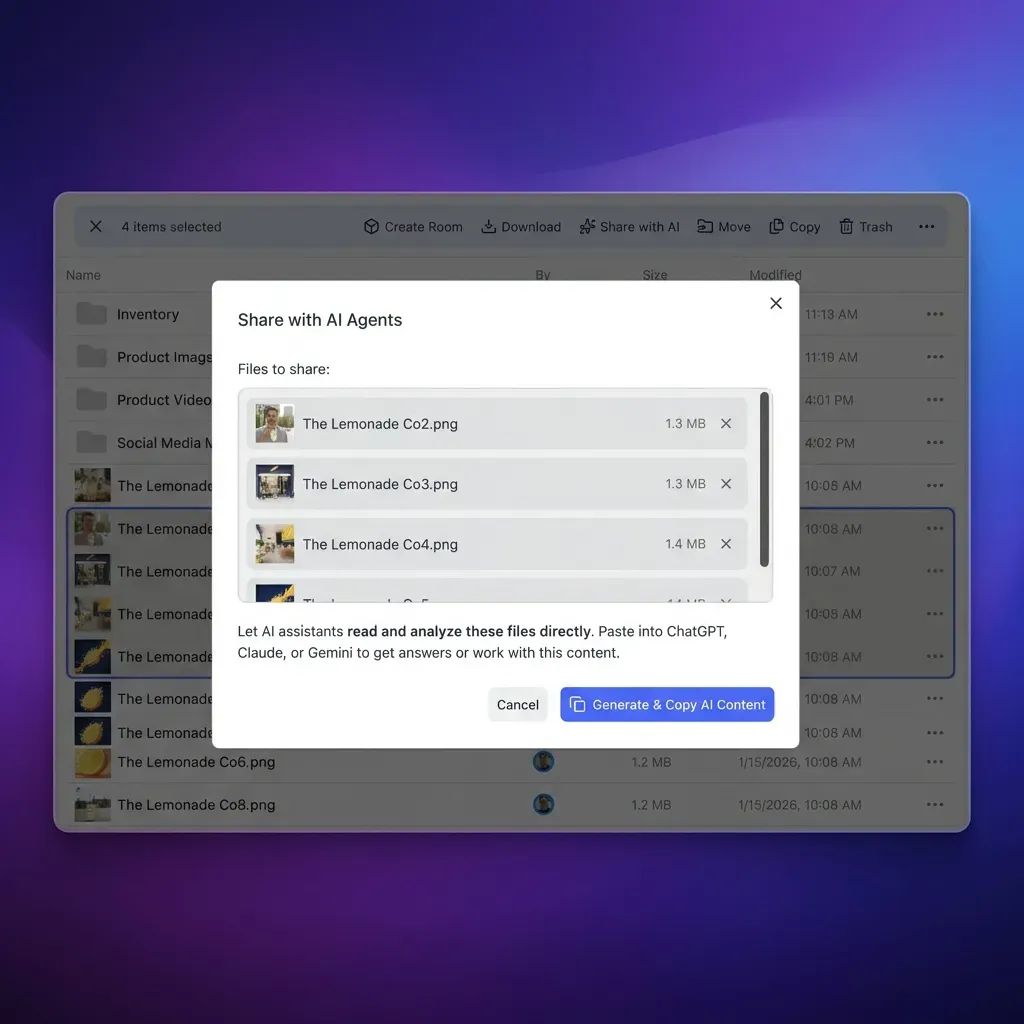
Steps to Configure Fast.io as the Persistent Storage Layer
While generic object storage buckets or traditional cloud drives can store files, they lack the coordination layer needed for team collaboration. Fast.io provides shared workspaces where humans and agents work on the same files. It exposes a consolidated MCP toolset over Streamable HTTP at the /mcp endpoint, as well as legacy Server-Sent Events (SSE) at the /sse endpoint.
To use Fast.io as your MCP storage backend, you must configure a paid organization. While creating a user account is free, any actual storage or automation work requires an organization on a paid subscription. Read more about Fast.io's pricing plans and features built specifically for AI storage. New organizations can sign up for a 14-day free trial, which requires a credit card. Fast.io offers three main pricing plans:
Starter: $9.99 per month (or $99 per year), supporting 3 seats, 250 GB of storage, and 100,000 credits.
Business: $49.99 per month (or $499 per year), supporting 10 seats, 5 TB of storage, and 600,000 credits.
Enterprise: $199.99 per month (or $1,999 per year), supporting 30 seats, 25 TB of storage, and 3 million credits.
Credits meter AI work, while storage and seats come with the plan. Document ingestion for AI indexing, agent runs, and AI chat all draw on the monthly allowance, and overage is billed at $10 per 100,000 credits. For developers using agents, the standard signup flow is for the developer or agent to create a free account, set up the initial configuration, and then hand off the organization to a human manager who inputs a credit card to start the trial.
Once the organization is active, you can generate a long-lived, scoped API key from the Fast.io dashboard. You then register the Fast.io Streamable HTTP endpoint /mcp in Manus under the Connectors tab, passing the API key in the Authorization header. This grants Manus secure access to your organization's workspaces. The agent uploads large files in chunks, so big datasets transfer reliably without needing a single unbroken request.


Provide Manus AI with persistent cloud storage
Connect your autonomous agents to a secure, shared workspace using our native MCP endpoint. Access per-file version history, automate RAG indexing, and manage collaborative notes with a 14-day free trial.
How to Structure Extracted Data with Metadata Views
Simply storing files is only the first step. To make the files useful for humans and other systems, the agent needs to organize the data. Fast.io differentiates between general search and structured extraction. When you enable Intelligence Mode on a workspace, all uploaded files are automatically indexed. This enables hybrid search, which combines exact full-text matching with semantic retrieval, allowing you to search by meaning or file content.
For structured extraction, Fast.io provides Metadata Views. This feature turns documents into a live, queryable database. Users describe the fields they want extracted in natural language, and Fast.io designs a typed schema. The system scans the workspace, matches matching files, and populates a sortable, filterable spreadsheet. This works with PDFs, images, Word documents, spreadsheets, presentations, and scanned pages without requiring manual OCR rules or templates.
The supported schema column types include:
Text: for names, addresses, or descriptions.
Integer: for whole numbers and counts.
Decimal: for financial amounts and ratios.
Boolean: for true or false flags.
URL: for web links.
JSON: for nested structured data.
Date & Time: for timestamps and deadlines.
Through the Fast.io MCP server, Manus can programmatically create Metadata Views, trigger extraction runs, and query the results. For example, in a legal workflow, the agent can upload a set of agreements, define columns to extract counterparty names and effective dates, and retrieve the extracted grid. To learn more about setting up structured data pipelines, you can read about document data extraction.
How to Manage Handoffs and Agent-to-Human Ownership Transfer
One of the key strengths of using a shared workspace like Fast.io is the ability to manage handoffs between autonomous agents and human team members. Instead of working in isolation, the agent and the human occupy the same folders and collaborative notes. When Manus completes a task, it does not leave the files in a disconnected system. It saves them in a shared workspace where humans can review them.
To manage clean handoffs, Fast.io supports ownership transfer. An agent can set up a workspace, import files from cloud services like Dropbox or Google Drive using Cloud Import, run extractions, and configure folder shares. Once the work is complete or the initial trial credits run out, the agent generates a claim link to transfer ownership of the organization to a human colleague. The agent can retain administrative access to keep running automations, while the human takes over billing and organization management.
Because security is a major concern for agentic workflows, Fast.io records every action in a detailed activity log, retained according to your plan. It shows what happened and when, so you can see who accessed and changed each file. If the agent modifies a file, Fast.io tracks the change and preserves a complete version history. If a human colleague disagrees with an edit, they can restore a prior version from the version history panel. Humans and agents can also co-edit documents in real time using Collaborative Notes, with visible multiplayer cursors showing exactly where each collaborator is typing.
Sources
References used to verify factual claims in this guide.
-
Over 72% of developers implementing the Model Context Protocol expect their deployment of this integration standard to expand over the next 12 months.
-
Manus officially supports custom MCP server configuration via the Connectors tab in Settings.
-
New organizations can sign up for a 14-day free trial, which requires a credit card. The Starter plan starts at $9.99 per month, providing 250 GB of storage and 100,000 usage-based credits. The Business plan starts at $49.99 per month, supporting 10 seats, 5 TB of storage, and 600,000 credits. The Enterprise plan starts at $199.99 per month, supporting 30 seats, 25 TB of storage, and 3 million credits.
-
Fast.io supports chunked uploads for transferring large files reliably.
Frequently Asked Questions
Does Manus AI support Model Context Protocol?
Yes, Manus AI officially supports the Model Context Protocol (MCP) as a client host. It can connect to prebuilt MCP connectors or custom HTTP-based MCP servers configured through its settings menu.
How do I configure custom MCP servers in Manus?
To configure custom MCP servers in Manus, navigate to Settings, click the Connectors tab, and select Add Custom MCP. Choose the Direct Configuration option, set the Transport Type to HTTP, input your HTTPS server URL, configure any required authorization headers, and save the settings.
Can I connect local MCP servers to Manus AI?
Because Manus AI runs its agent processes in a secure cloud environment, it cannot directly access local port addresses (such as localhost or private network IP addresses) on your machine. To connect a local server, you must expose it via a public secure tunnel like ngrok or Cloudflare Tunnels that provides an HTTPS endpoint, and use that endpoint in the settings.
How does Fast.io handle files written by Manus AI?
When Manus AI writes files through the Fast.io MCP server, the files are stored in your shared workspace. Fast.io automatically indexes the files for RAG retrieval and semantic search if Intelligence Mode is enabled, maintains a full version history, and tracks all actions in a detailed activity log.
Related Resources

Provide Manus AI with persistent cloud storage
Connect your autonomous agents to a secure, shared workspace using our native MCP endpoint. Access per-file version history, automate RAG indexing, and manage collaborative notes with a 14-day free trial.