How to Build a Clay File Handoff Workflow for Sales Teams
Automating lead file transfers between prospecting tools and sales workspaces is crucial for conversion speed. This guide details how to build a webhook-based file handoff workflow that automatically routes enriched datasets and generated sales collateral from Clay to Fast.io.

The Response Velocity Gap in B2B Lead Routing
Only 7% of B2B companies successfully follow up with inbound prospects within a five-minute window [Apten 2026 Survey], despite evidence that contacting a lead in this timeframe makes them 21 times more likely to qualify compared to a 30-minute delay [Aimdoc 2026 Report]. The remaining 93% of teams lose valuable momentum because their routing systems rely on manual data processing. In outbound and inbound campaigns alike, when contact databases are enriched, sales representatives often wait hours or days for operations managers to export spreadsheet files. Implementing an automated Clay file handoff workflow addresses this latency, bypassing manual steps to connect data directly to shared environments.
A Clay file handoff workflow is an automated pipeline that takes enriched lead data or generated files from Clay and delivers them to sales teams, client portals, or external CRMs without manual intervention.
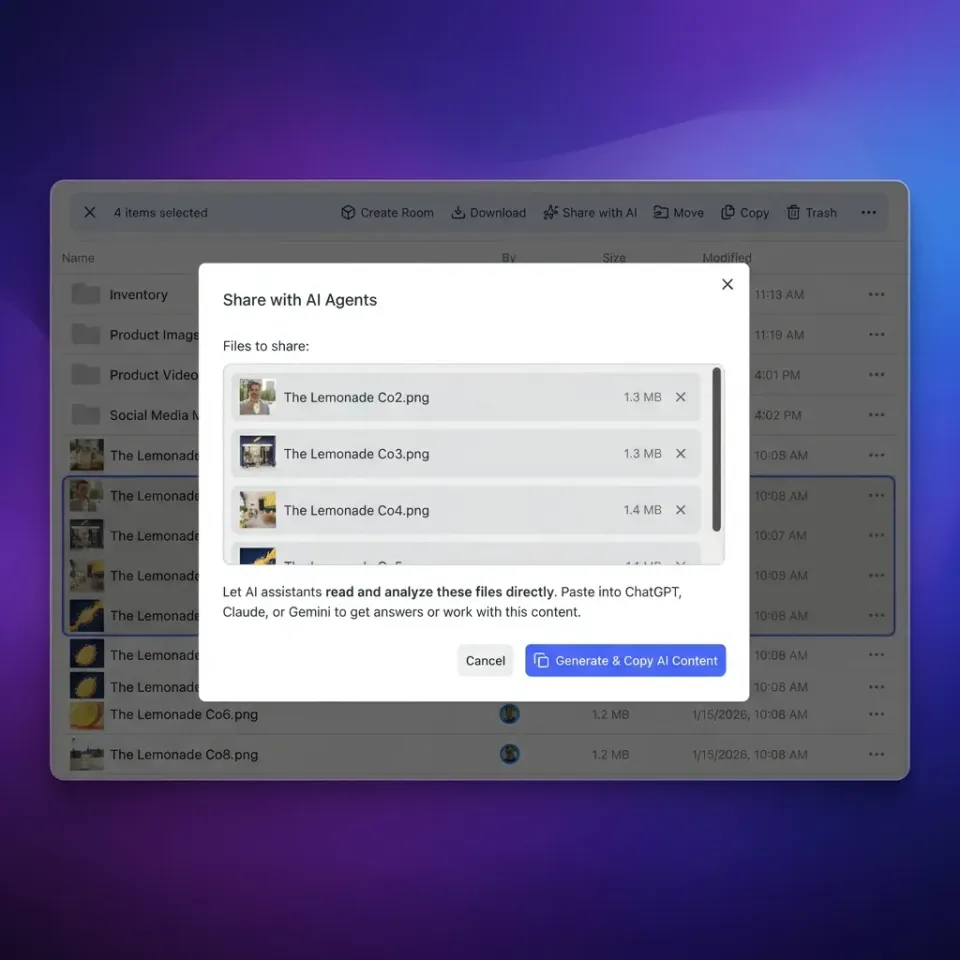
While traditional go-to-market tools focus exclusively on syncing row data directly to CRM contact objects, they frequently overlook the asset delivery layer. Outbound desks often generate customized collateral, including company-specific slide decks, PDF report cards, and customized pricing sheets. Pushing raw CRM rows does not provide sales reps with these generated assets. A file handoff automated workflow solves this by packaging the generated documents, importing them directly into a versioned workspace, and providing sharing tools. This ensures reps have access to personalized materials before they make a call.
To illustrate this, consider a typical enterprise sales campaign. An operations manager uses Clay to enrich a list of 500 target accounts with firmographic data, technology usage, and executive contact information. As a final step, they generate a personalized PDF audit of the prospect's security profile. Without an automated handoff, the operations manager must manually download 500 separate PDFs from their rendering engine and upload them to a file share, then copy the links one by one into their CRM. This manual process introduces delays, often causing a lead to go cold before a representative can reach out. An automated file handoff workflow solves this by routing both the raw lead records and the generated files to a shared workspace immediately, ensuring that sales representatives can access the right collateral the moment they contact the prospect.
Related guides
- How to Build a Hermes Agent Subagent File Handoff WorkflowCoordinating multi-agent systems requires structured file boundaries and task delegation. By combining Nous Research...
- Implementing a Cline File Handoff Workflow for TeamsApproximately 75% of software developers manually review every AI-generated code snippet before merging [Netcorp 2026...
- How to Build a B2B Data Enrichment Waterfall in ClayConfiguring sequential waterfall logic for clay data enrichment allows go-to-market teams to query multiple third-party...
- How to Build an Image to Text OCR Pipeline in ClayGoogle Cloud Vision achieves 80% to 95% handwriting accuracy, while open-source Tesseract drops to 20% to 40% [Eklavvya...
- How to Build an AI Image Upscaler Pipeline in Clay WorkflowsImages account for the largest mobile page payload, representing roughly 900 kilobytes of the median 2,360 kilobyte...
- How to Personalize Outreach Collateral with Canva Bulk Create and ClayPersonalized outreach significantly outperforms generic messaging, yet scaling custom visual collateral remains a...
More on this subject: Clay and GTM Agents (82 guides)
Outlining the Webhook-Based Flow from Clay to Fast.io
To eliminate manual lead list export steps, you can build a direct connection that sends generated files and structured records from Clay to Fast.io using webhooks. Using webhooks reduces manual lead list export time by over 90%, freeing operations managers from daily CSV maintenance and reducing human error. Immediate handoff of enriched data improves sales response rates, giving representatives the context they need within minutes of lead qualification.
The exact webhook-based flow from Clay to Fast.io for file sharing follows a five-step path:
- Data Enrichment: A Clay table imports prospect domains and runs waterfall enrichments, including email verifications, company metrics, and technology lookups.
- Collateral Generation: If the campaign includes personalized files, Clay triggers an API request to a document generation service like Storydoc or RenderForm. The service compiles data points into a PDF deck and returns a public URL.
- Webhook Trigger: Clay evaluates the row state. Once all waterfall columns and file generation columns finish, a final HTTP API column fires a POST request.
- Workspace Ingestion: A webhook receiver or middleware service parses the POST payload from Clay, extracts the document URL, and uploads it to a specific folder in Fast.io.
- AI Auto-indexing: Fast.io receives the file, preserves its version history, and automatically indexes the contents for search once Intelligence is enabled.
To configure the outbound request in Clay, add an HTTP API column and select the POST method. Paste your receiving endpoint URL, add the JSON application header, and map the table variables in the body payload:
{
  "lead_email": "{{Email}}",
  "company_name": "{{Company Name}}",
  "pdf_deck_url": "{{PDF Generation URL}}",
  "enrichment_status": "{{Verification Status}}"
}
Set the run condition to trigger only when the document URL column changes from empty to populated. This safeguards against sending incomplete data blocks.
To receive these payloads programmatically and write them to Fastio, developers can write a simple receiver script using Node.js and the Fastio API. Create an API key in Settings > Devices & Agents > API Keys. The script authenticates with that Bearer token, downloads the PDF from the URL provided by Clay, and posts it to https://api.fast.io/current/upload/ as multipart form data (name, size, chunk, action=create, instance_id, folder_id=root). A successful create returns HTTP 201 with new_file_id. The following example demonstrates this logic:
import axios from 'axios';
import FormData from 'form-data';

export async function handleClayWebhook(req, res) {
  const { company_name, pdf_deck_url } = req.body;
  if (!pdf_deck_url) {
    return res.status(400).send('No file URL provided.');
  }
  try {
    const fileResponse = await axios.get(pdf_deck_url, { responseType: 'arraybuffer' });
    const bytes = Buffer.from(fileResponse.data);
    const form = new FormData();
    form.append('name', `${company_name}_pitch.pdf`);
    form.append('size', String(bytes.length));
    form.append('chunk', bytes, `${company_name}_pitch.pdf`);
    form.append('action', 'create');
    form.append('instance_id', process.env.FASTIO_WORKSPACE_ID);
    form.append('folder_id', 'root');
    const response = await axios.post('https://api.fast.io/current/upload/', form, {
      headers: {
        ...form.getHeaders(),
        'Authorization': `Bearer ${process.env.FASTIO_API_KEY}`
      }
    });
    return res.status(201).json({ success: true, fileId: response.data.new_file_id });
  } catch (error) {
    console.error('File handoff failed:', error.message);
    return res.status(500).send('Failed to write file to Fastio.');
  }
}
This receiver bypasses local computer download queues, allowing the document to move from Clay's rendering engine directly to your team's workspace.
Mitigating Outbound Failures with Webhook Reliability Controls
Building automated workflows requires designing for failure boundaries, especially when coordinating API calls across multiple vendors. In June 2026, discussion in the Clay community regarding Clay Relay highlighted the reliability challenges of inbound and outbound enrichment flows. When a system triggers a webhook, it only confirms that the initial request left the source. It does not guarantee that the downstream API completed the task or that the payload arrived intact.
To build a reliable file handoff automated workflow, you must implement checks along the handoff boundary. Common failure points include API rate limits, temporary timeouts, and incomplete enrichment cascades. For example, if a document generation service takes more than 30 seconds to compile a PDF, the webhook may fire before the download link becomes active, resulting in a broken file transfer.
Your middleware or webhook receiver should perform three reliability actions:
- Callback Validation: Confirm that the incoming webhook matches an active, authorized run in your lead management tracker.
- Timeout Management: Set up a retry queue with exponential backoff if the document generation service returns a temporary server error.
- Success Confirmation: Verify that Fastio accepted the upload and generated a valid file identifier before changing the lead status to ready.
Additionally, configuring conditional runs in Clay ensures that you do not waste credits on failed enrichments. If an email verification returns invalid, the HTTP API column should skip execution. This keeps downstream workspaces clean and reduces unnecessary API charges.
Consider a failure scenario where the document rendering service suffers a transient outage. Without reliability checks, Clay would send a POST request with an empty or broken URL, resulting in a null entry in your workspace. By implementing a handoff checking script, your system registers the webhook call, detects the missing file, and queues the request for a retry after a short delay. Clay Relay patterns illustrate the value of keeping these waiting states visible, ensuring that your operations team is alerted if a lead fails to resolve within a designated period, rather than letting the record disappear silently.


Automate sales asset handoffs with Fastio
Move your Clay lead list exports into a version-controlled workspace with expiring shares and real-time activity tracking. Start your 14-day Business Trial.
Centralizing and Sharing Generated Sales Collateral in Fast.io
Once lead lists and custom assets leave Clay, they require a secure, version-controlled storage environment. While saving files to local folders or legacy platforms like Dropbox, Google Drive, or Box is common, these storage options often lack the workspace structure needed for agentic collaboration. Saving assets in Fastio workspaces ensures that your documents are organized, secure, and searchable by humans and AI agents.
Fastio provides organization-owned workspaces with granular permissions at the organization, workspace, folder, and file level. This allows sales leaders to restrict access to sensitive lead lists while permitting representatives to view their assigned accounts. When multiple team members or software agents edit a lead spreadsheet, Fastio maintains a detailed, per-file version history, allowing you to track changes and restore previous versions if formatting errors occur. All file actions are logged in the activity log, providing a record of who accessed each document.
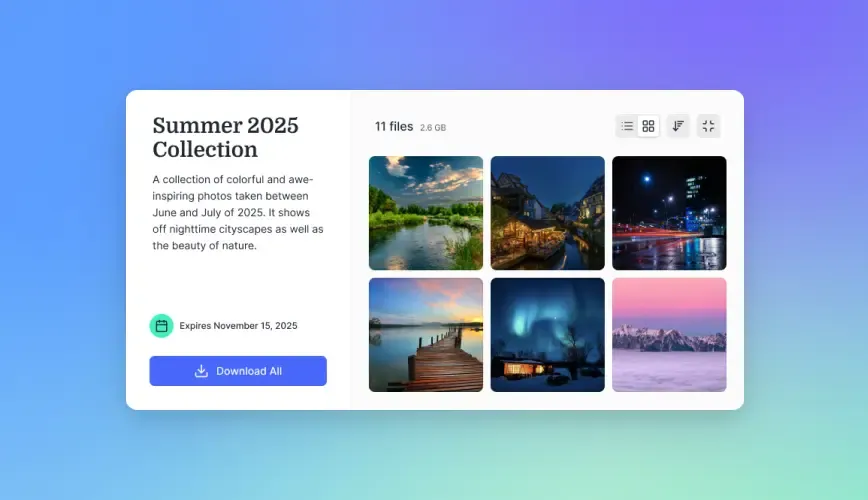
To share custom collateral with prospects, sales representatives can use branded shares. Fastio supports Send, Receive, and Exchange shares that can be configured with passwords, download controls, or expiration dates. For instance, a representative can send a personalized pitch PDF using an expiring link that revokes access after 48 hours, encouraging prompt review.
When files are saved to a workspace with Intelligence Mode enabled, Fastio auto-indexes the files, allowing reps to run hybrid search queries combining exact full-text matching with semantic retrieval. Representatives can also use Ripley, the built-in AI, to run RAG-powered chat queries over document folders. If you need to extract structured fields from raw files, you can use Metadata Views. This structured extraction layer suggestion, available at the /product/document-data-extraction/ page, turns unstructured documents like PDFs, invoices, or contracts into a queryable database by auto-designing a typed schema. This is separate from Ripley search and handles structured column extraction directly.
For example, if you upload 500 personalized security audits, you can define a Metadata View with columns for the counterparty name, the compliance score, and the primary security gap identified. Fastio's AI suggest columns, matches the files in the folder, and automatically populates the spreadsheet grid. This structured layer allows sales managers to filter their leads by compliance score directly in the dashboard, prioritizing accounts that require immediate outreach without opening a single document.

Orchestrating Human-Agent Collaboration and Workspace Handoffs
A modern lead routing pipeline often involves autonomous AI agents working alongside human operations managers. Fastio supports this collaboration by exposing a Model Context Protocol endpoint, allowing developers to connect custom agents to their workspace. Developers connect over Streamable HTTP at https://mcp.fast.io/mcp/tools, signing in with OAuth or, for a headless agent, sending a Bearer API key in the Authorization header of the connection, by following the official MCP server guidelines and reading the MCP documentation.
Agents can monitor workspaces for new Clay lead exports, extract metadata using Metadata Views, and update Collaborative Notes with real-time multiplayer cursors. This allows agents and humans to co-edit lead profiles and outreach copy side-by-side.
Once the agent client is connected, it calls named tools over JSON-RPC. This example imports a generated PDF into a workspace:
{
  "jsonrpc": "2.0",
  "id": 1,
  "method": "tools/call",
  "params": {
    "name": "upload_manage",
    "arguments": {
      "action": "web-import",
      "url": "https://example.com/report.pdf",
      "profile_type": "workspace",
      "profile_id": "1234567890123456789"
    }
  }
}
From there the agent can list and search storage, run Ripley over the folder, and work with notes, Metadata Views, and Send, Receive, or Exchange shares on behalf of your sales representatives.
When a developer or AI agent finishes building the initial workspace pipeline, they can execute an ownership transfer. The agent creates the assets and then passes organization ownership to a human administrator via a claim link. The administrator creates or joins an organization and starts the 14-day trial. Monthly plans start with a Business Trial of up to 14 days (credit card required); annual plans have no trial. Paid subscriptions include Starter ($9.99/month), Business ($49.99/month), and Enterprise ($199.99/month), which are documented on the pricing page. This structure ensures humans retain ultimate billing and administrative control over the GTM workspace.
Sources
References used to verify factual claims in this guide.
-
Only 7% of B2B companies successfully follow up with inbound prospects within a five-minute window.
-
Contacting a lead within 5 minutes makes them 21 times more likely to qualify compared to a 30-minute delay.
-
The script authenticates with a Bearer API key, downloads the PDF from the URL provided by Clay, and posts it to https://api.fast.io/current/upload/ as multipart form data (`name`, `size`, `chunk`, `action=create`, `instance_id`, `folder_id=root`).
-
Clay Relay enhances the reliability of enrichment workflows by monitoring handoff boundaries.
-
Fastio offers Starter plans at $9.99/month, Business at $49.99/month, and Enterprise at $199.99/month.
Frequently Asked Questions
How do I automate data export from Clay?
You can automate exports from Clay by adding an HTTP API action column in your table to trigger an outbound POST webhook containing the enriched row details. Alternatively, you can configure native CRM integrations to automatically sync verified leads, or use Google Sheets integrations to lookup and update rows as data is verified.
What is a GTM handoff workflow?
A go-to-market (GTM) handoff workflow is an automated pipeline that routes enriched marketing leads and generated sales files from the initial enrichment step to downstream systems like CRMs, databases, and shared team workspaces, eliminating the latency of manual data entry.
How does Fastio handle file sharing for automated sales workflows?
Fastio routes files directly into secure, shared workspaces where they are indexed for AI search. Teams can share files using branded shares (Send, Receive, Exchange) with passwords and custom expirations, allowing prospects to access materials without creating an account.
Related Resources

Automate sales asset handoffs with Fastio
Move your Clay lead list exports into a version-controlled workspace with expiring shares and real-time activity tracking. Start your 14-day Business Trial.