How to Establish Claude Human-Agent Coworking Workflows
Human-agent coworking involves establishing structured workflows where Claude and human team members collaborate on shared files and tasks. As Claude transitions from a conversational assistant into an autonomous team member, organizations need specialized environments to coordinate this work. This guide explains how to integrate Claude into your daily operations using shared workspaces, Model Context Protocol tools, and clear handoff processes.

What is Claude Human-Agent Coworking?
File sharing is the practice of distributing digital files between users over a network, but when we introduce artificial intelligence, the paradigm shifts entirely. Human-agent coworking involves establishing structured workflows where Claude and human team members collaborate on shared files and tasks. This represents a fundamental evolution from traditional prompt engineering to true delegation.
Historically, users treated artificial intelligence as a simple question-and-answer machine. You provide a prompt, and the model returns an output. However, modern iterations of Claude possess genuine agency. They can read complex documents, analyze directories, formulate plans, and execute multi-step operations. To use this potential, organizations must stop treating Claude as a chatbot and start treating it as a coworker. This means providing Claude with the same context, files, and workspace access that a human employee would require.
When you establish proper human-agent coworking processes, the results transform your operational efficiency. Instead of manually copying and pasting text into a chat interface, human employees can invite Claude directly into a shared workspace. The agent can review the existing project files, understand the historical context, and begin contributing immediately. This file-based workflow eliminates the friction of context transfer and ensures that both human and artificial intelligence operate from a single source of truth.
The most successful organizations recognize that effective coworking requires specialized infrastructure. You cannot expect Claude to perform meaningful work if it remains isolated in a disconnected browser tab. By bringing Claude into your primary storage and collaboration environment, you unlock its ability to coordinate with your team organically.
Helpful references: Fastio Workspaces, Fastio Collaboration, and Fastio AI.
Related guides
- Best OpenClaw Alternatives for AI Agent Workflows in 2026OpenClaw's 353k GitHub stars make it the most popular AI agent framework, but security issues in ClawHub and a growing...
- Best OpenClaw Workflows for AI Code ReviewOpenClaw's skills ecosystem includes several code review tools that analyze pull requests, scan for security...
- How to Build Claude Agent Coworking Workflows for Enterprise TeamsClaude agent coworking workflows manage how autonomous agents share context, hand off tasks, and collaborate with...
- How to Configure Claude Coworking Webhook NotificationsClaude coworking webhook notifications provide real-time alerts to teams and connected systems whenever an agent...
- How to Setup Claude Coworking Workspaces for Research TeamsResearch teams often struggle with fragmented literature and disorganized data silos. Claude Coworking acts as a...
- How to Build Claude Cowork WorkflowsAgentic workflows handle repetitive data processing, but setting them up requires structure. Learn how to build Claude...
More on this subject: Claude and Claude Code (280 guides)
The Core Pillars of Human-Agent Collaboration
To build successful Claude agentic teams, you must design your systems around three foundational pillars. These pillars ensure that your artificial intelligence acts cohesively with human counterparts rather than operating in an opaque silo.
The first pillar is shared context through persistent workspaces. Agents and humans must share the same workspaces, the same tools, and the same intelligence. When an employee uploads a project brief, Claude should have immediate access to that document without requiring manual uploads. Fastio provides intelligent workspaces where every file is automatically indexed and searchable by meaning. This built-in retrieval-augmented generation means that Claude can query your documents in natural language and retrieve exact citations. Shared persistent storage prevents the fragmentation that occurs when team members maintain separate conversations with their tools.
The second pillar is comprehensive tool access. For Claude to function as a coworker, it needs the ability to take action. This is achieved through the Model Context Protocol, which bridges the gap between the intelligence model and your file system. When you connect Claude to an official server, you grant it the capability to read, write, organize, and manage files autonomously. A capable integration provides extensive capabilities, ensuring that every user interface action has a corresponding agent tool.
The third pillar involves clear handoff processes. Human-agent workflows require explicit boundaries regarding ownership and review. For example, Claude might be tasked with generating an initial draft of a complex report based on multiple source files. Once the draft is complete, the system must support a smooth transfer of ownership to a human reviewer. This prevents endless loops and ensures that human judgment remains the final arbiter of quality. Using advisory file locks during concurrent access signals active writes so other agents can wait, while version history and granular permissions protect against conflicting edits when multiple entities work simultaneously.
How to Integrate Claude into Your File Workflows
Transitioning from theoretical concepts to practical implementation requires a systematic approach. Setting up a functional human-agent coworking environment involves configuring your storage infrastructure to support artificial intelligence natively.
Step 1: Establish an Intelligent Workspace The foundation of your integration is a storage environment built for agents. Traditional cloud storage focuses merely on saving files, but an intelligent workspace actively indexes content. Create a dedicated workspace for your project and enable the native intelligence features. This ensures that every document, spreadsheet, and image uploaded to the folder becomes instantly accessible and searchable by meaning. When your storage layer handles the indexing automatically, you eliminate the need to build and maintain separate vector databases.
Step 2: Connect Claude via the Model Context Protocol Once your workspace is established, you must build the bridge to your artificial intelligence. Configure Claude to connect with your storage environment using a dedicated server integration. This setup allows Claude to perceive the file system, read directory structures, and interact with specific documents. Because the connection uses standard protocols, the setup process is remarkably straightforward and requires minimal custom code.
Step 3: Define Access Permissions Treat your AI coworker with the same security rigor as a human contractor. Use granular privacy settings to scope Claude's access strictly to the necessary workspaces. You can mix public organization-wide folders with private, invite-only spaces. By restricting the agent to specific project boundaries, you maintain strict data governance while enabling deep collaboration within the approved context.
Step 4: Implement the Handoff Mechanism Determine exactly how Claude will signal that a task is complete. In a mature file-based workflow, Claude might create a new subfolder containing its analysis and outputs, then rely on activity feeds or event notifications to alert the human team. This asynchronous collaboration allows the human team to review the work, leave contextual comments directly on the files, and provide structured feedback without interrupting their flow.


Give Your AI Agents Persistent Storage
Give your AI agents the intelligent workspace they need to collaborate effectively with your human employees. Start with generous storage specifically designed for autonomous workflows.
Practical Scenarios for Claude Agentic Teams
Understanding the abstract mechanics of coworking is important, but examining real-world applications reveals the true value of this methodology. Teams across various disciplines use these workflows to accelerate complex deliverables.
Consider a research and development team conducting a comprehensive literature review. Historically, human researchers would spend weeks reading disparate PDF documents and compiling notes. In a coworking model, the team uploads hundreds of source documents into a shared intelligent workspace. They then instruct Claude to synthesize the findings, extract specific data points, and identify conflicting methodologies. Because Claude operates within the persistent workspace, it can output a formatted summary document complete with direct citations to the original files. The human researchers then review this summary, verify the citations, and focus their energy on high-level analysis rather than manual extraction.
Another powerful scenario involves client deliverables and ownership transfer. Agencies frequently build complex data rooms or project portals for their clients. A human manager can instruct Claude to provision a new workspace, populate it with the correct template folders, pull relevant background files via URL import from external services, and organize the initial structure. Once the architecture is perfectly arranged, the agent transfers ownership of the workspace back to the human manager. The manager can then invite the client into a pristine, beautifully organized environment. This workflow uses the agent for tedious organizational tasks while keeping the human in control of the final client interaction.
Finally, technical teams benefit immensely from automated code and documentation reviews. Developers can configure event feeds that notify Claude whenever a new specification document is added to a repository folder. Claude automatically reads the new document, cross-references it against existing architecture files in the workspace, and generates a risk assessment report. Human engineers review this report during their daily standups, effectively treating Claude as an asynchronous quality assurance partner.
Best Practices for Managing AI Coworkers
As you scale your human-agent collaboration, adhering to established best practices prevents organizational friction and maximizes efficiency. Managing an artificial intelligence requires distinct strategies compared to managing human personnel.
First, always maintain an exhaustive audit trail. When autonomous agents interact with your file system, you must have complete visibility into their actions. Ensure your workspace infrastructure logs every view, download, modification, and permission change. This comprehensive tracking is not merely about security; it is important for debugging complex workflows. If an agent misinterprets an instruction and reorganizes a critical folder incorrectly, a detailed audit log allows you to understand exactly what happened and reverse the changes confidently.
Second, use smart summaries to digest agent activity. Because artificial intelligence can process and generate information at incredible speeds, human managers can quickly become overwhelmed by the volume of output. Use built-in summarization features to get instant digests of document updates, comment threads, and workspace activity. This allows human overseers to monitor the agent's progress without reading every individual file it produces.
Third, design for multi-LLM support to avoid vendor lock-in. While Claude offers exceptional reasoning capabilities, the artificial intelligence landscape evolves rapidly. Your file-based workflows and integration architecture should remain model-agnostic. By building upon standard protocols rather than proprietary vendor APIs, you ensure that your workspaces can accommodate different models in the future. This flexibility guarantees that your team can always employ the best available intelligence for the specific task at hand.
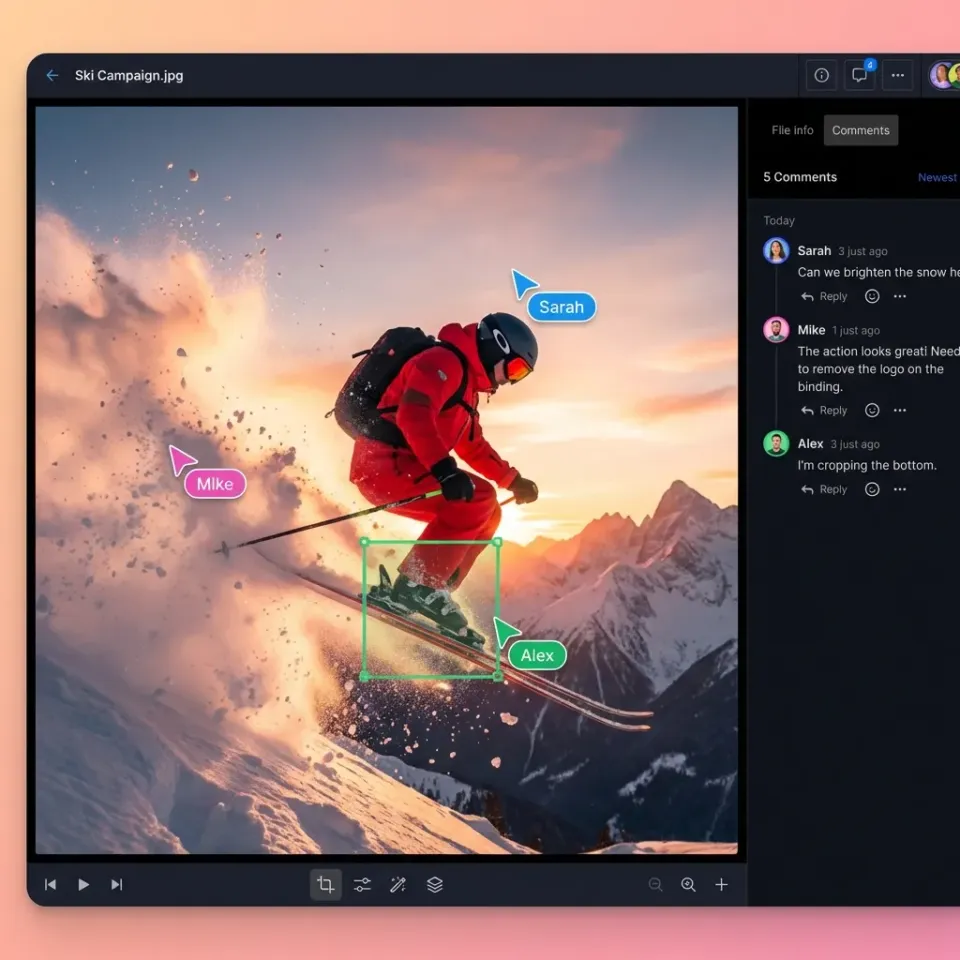
Finally, encourage precise, contextual communication. When providing feedback to an agent or discussing its output with human colleagues, use region-anchored comments. Instead of leaving vague instructions in a separate chat window, team members should leave threaded comments directly on the specific document paragraphs or video frames generated by the agent. This contextual feedback loop trains the system effectively and prevents miscommunication.
Frequently Asked Questions
How do humans and Claude collaborate?
Humans and Claude collaborate best within shared digital workspaces rather than isolated chat interfaces. By connecting Claude to your file system through the Model Context Protocol, both human and artificial intelligence can access, read, and edit the exact same documents simultaneously. This approach allows humans to delegate complex, multi-step tasks to Claude while maintaining full visibility and control over the final output.
What is human-agent coworking?
Human-agent coworking is the practice of establishing structured workflows where artificial intelligence and human employees collaborate on shared files and operational tasks. Instead of treating the AI as a simple question-answering tool, organizations treat it as an autonomous team member capable of executing complex projects within a shared persistent environment.
Does Claude need its own storage account?
Yes, for true coworking, AI agents should be provisioned with dedicated storage accounts and permissions, just like human contractors. This ensures their actions are properly tracked in audit logs and their access can be granularly controlled. Agents can sign up, create workspaces, and collaborate with humans smoothly.
How do I prevent Claude from deleting important files?
You prevent unauthorized deletions by using granular workspace permissions and comprehensive audit trails. Scope the agent's access only to necessary folders and employ advisory file locks so agents coordinate writes rather than colliding on the same file. Also, maintaining version history and activity logs allows administrators to review and revert any unintended modifications instantly.
Can Claude access files stored in other cloud services?
Yes, advanced intelligent workspaces support URL imports, allowing agents to pull files directly from external cloud providers without requiring local downloads. This feature enables Claude to synthesize information across disparate platforms while keeping the resulting analysis organized in your primary shared environment.
Related Resources

Give Your AI Agents Persistent Storage
Give your AI agents the intelligent workspace they need to collaborate effectively with your human employees. Start with generous storage specifically designed for autonomous workflows.