Best OpenClaw Tools for AI Competitive Intelligence
Buyers and sellers disagree on why deals are won or lost up to 70% of the time, which means most competitive intelligence built from CRM notes alone is unreliable. OpenClaw skills can automate the monitoring, analysis, and distribution of competitor data so your team works from current signals instead of stale assumptions. This guide covers 7 ClawHub skills that handle everything from real-time website change detection to auto-refreshing battle cards.


Why Manual Competitive Intelligence Breaks Down
Sellers and buyers give different reasons for deal outcomes between 50 and 70 percent of the time. That finding, compiled from win/loss research by Kilo.ai, points to a structural problem: the intelligence most teams rely on is filtered through memory, bias, and incomplete CRM data.
Traditional CI workflows compound the issue. A product marketer spends 3 to 4 hours per week scanning competitor websites, reading press releases, and updating a Google Doc that nobody checks. By the time a battle card reaches a sales rep, the competitor has already changed their pricing page twice.
OpenClaw skills fix this by embedding CI directly into the agent workflows developers and marketers already use. Instead of standalone SaaS dashboards that require yet another login, these skills run inside your OpenClaw agent on Telegram, Discord, or WhatsApp, building persistent context over time. ClawHub hosts over 13,700 community-built skills, and a growing subset targets competitive intelligence specifically. The skills covered here were tested against real competitor monitoring scenarios in early 2026.
Related guides
- Best n8n Tools for AI Agents: Top 10 Nodes for 2026n8n changed AI automation with its visual workflow builder. We rank the best nodes and integrations for building...
- Best Tools for CrewAI Agents: Top Picks for 2026CrewAI agents need good tools to be useful. The framework handles coordination, but external integrations let agents...
- Best OpenClaw Tools for AI Spreadsheet Analysis AutomationManual reporting still eats hours every week, even when the analysis itself takes minutes. OpenClaw skills for...
- Top OpenClaw Tools for Graphic DesignersGraphic designers use top OpenClaw tools to handle routine tasks like resizing files and generating palettes. These...
- Best OpenClaw Tools for Indie HackersGuide to openclaw tools indie hackers: OpenClaw tools give solo developers an automated team to handle code and...
- Best OpenClaw Tools for Legal Teams: Top 7 IntegrationsLegal teams use autonomous agents to handle repetitive tasks, and early adopters report significant efficiency gains....
More on this subject: OpenClaw Tools (101 guides)
How We Evaluated These Skills
We tested each skill against four criteria that matter for competitive intelligence work:
Signal quality: Does the tool separate meaningful competitor moves from noise? A pricing page rewrite matters. A footer copyright update does not.
Automation depth: Can it run on a schedule without human prompting, or does it require someone to type "check competitors" every morning?
Output format: Does it produce structured data (battle cards, SWOT matrices, alert tiers) that feeds directly into sales or strategy workflows?
Integration: Does it connect to the tools CI teams already use, including CRMs, messaging platforms, and cloud storage?
Here is a quick reference for the 7 skills covered:
- Scout - Automated competitor website monitoring with weekly intelligence briefs
- Competitor Intelligence Analyst - Structured battle cards for sales teams
- SWOTPal - AI-powered SWOT analysis and competitive comparisons
- Deep Research Agent - Multi-source research with confidence ratings and citations
- Fastio - Persistent storage and Intelligence Mode for CI file handoff
- Tavily - Real-time web search optimized for AI agents
- n8n - Workflow automation that connects CI skills into a pipeline
1. Scout
Scout monitors competitor websites on a configurable schedule and delivers structured intelligence briefs. It uses the Browser skill under the hood to detect meaningful changes while filtering out noise like cookie banners, CDN hashes, and timestamp updates.
Key strengths:
- Tiered alert priority: pricing page changes trigger immediate alerts, job postings get daily digests, feature announcements land in weekly briefs
- Sensitivity thresholds from 0.1 (catches minor CSS changes) to 0.5 (only flags substantial rewrites), so you can tune signal-to-noise per page type
- Monday morning intelligence summaries that cover new features, pricing experiments, positioning shifts, and job postings by department
Limitations:
- Focuses on website changes only; community extensions exist for social media and review site monitoring, but those require separate configuration
- Requires the Browser skill as a dependency, which adds to your agent's resource usage
Best for: Marketing and product teams that need automated competitor website surveillance without hiring a dedicated analyst.
Pricing: $9 one-time skill add-on from the OpenClaw agent store. The recommended configuration is sensitivity 0.3 for pricing pages and 0.5 for general pages.

2. Competitor Intelligence Analyst
The Competitor Intelligence Analyst skill produces structured battle cards designed for sales team deployment. Where Scout watches for changes over time, this skill generates point-in-time competitive analyses when you need to brief your team on a specific rival.
Key strengths:
- Outputs formatted battle cards with objection handlers, pricing comparisons, and suggested discovery questions
- Especially effective for unfamiliar competitors your team hasn't encountered before
- Battle cards can auto-refresh when paired with Scout, so reps stop citing a weakness the competitor fixed months ago
Limitations:
- Quality depends on publicly available information; private companies with minimal web presence produce thinner analyses
- Works best when combined with other research skills (Tavily, Browser) for richer source data
Best for: Sales enablement teams that need current, structured competitive positioning for deal support.
When Scout detects a competitor pricing increase, that signal can feed directly into the Competitor Intelligence Analyst to generate updated talk tracks. This pairing turns passive monitoring into active sales ammunition.
3. SWOTPal
SWOTPal generates structured SWOT analyses, TOWS matrices, and head-to-head competitive comparisons. It is the most comprehensive strategy analysis tool on ClawHub, designed for teams that need formal strategic frameworks rather than ad-hoc monitoring.
Key strengths:
- Produces full SWOT analyses with a TOWS matrix that maps strategic options across strength-opportunity and weakness-threat intersections
- Runs competitive comparisons between your product and specific rivals with structured output
- Free mode uses your existing LLM; API mode ($9.99/month) unlocks the full feature set including advanced frameworks
Limitations:
- SWOT frameworks are only as good as the input data; pairing SWOTPal with real-time research skills produces better results than running it standalone
- API mode adds a recurring cost on top of your OpenClaw infrastructure
Best for: Product managers and strategists who need formal competitive frameworks for board presentations, investor updates, or quarterly planning.
SWOTPal is available on ClawHub and can be added to your OpenClaw agent directly from the skill directory.


Store and search your competitive intelligence in one workspace
Workspace storage with Intelligence Mode for semantic search across battle cards, briefs, and research reports. Start with a 14-day trial.
4. Deep Research Agent
Deep Research Agent is the most downloaded skill on ClawHub with over 35,000 installations. It performs multi-source research with built-in confidence ratings and citations for every claim, making it the workhorse for any CI workflow that requires verified data.
Key strengths:
- Provides methodology transparency: you can see which sources it consulted, how confident it is in each finding, and where gaps exist
- Outputs citations alongside every claim, which makes the research defensible in strategy meetings
- Handles complex research requests like "compare pricing models across the top 5 competitors in our category and identify who changed pricing in the last 90 days"
Limitations:
- Designed for deep, one-off research rather than continuous monitoring; pair it with Scout for ongoing surveillance
- Longer research tasks can take several minutes to complete, depending on source complexity
Best for: Market research, competitive landscape reports, and any scenario where you need sourced, structured findings rather than quick summaries.
Deep Research Agent fills the gap between Scout's automated monitoring and SWOTPal's strategic frameworks. It provides the raw, cited intelligence that feeds into both.
5. Fastio
Competitive intelligence loses its value when it lives in scattered Slack threads and Google Docs that nobody can find. Fastio provides the persistent storage and collaboration layer where CI outputs from all your OpenClaw skills converge into a single, searchable workspace.
Local storage and S3 buckets work for raw file dumps, but they don't index content for search or let your team query documents with natural language. Google Drive handles basic sharing but lacks the agent-native access that makes automated CI pipelines practical.
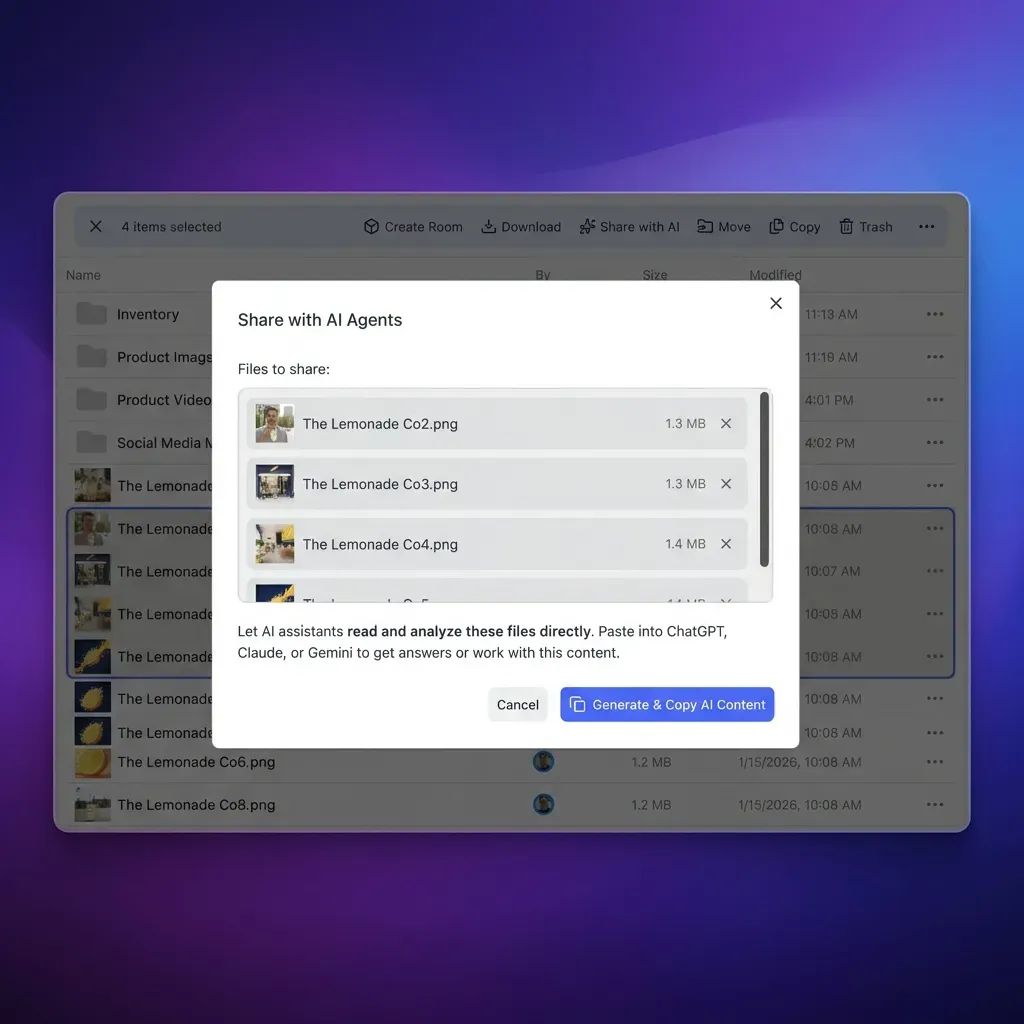
Fastio's Intelligence Mode auto-indexes every file uploaded to a workspace, turning your battle cards, research reports, and weekly briefs into a searchable knowledge base. When a sales rep needs the latest competitive positioning on a specific rival, they can ask the workspace directly and get cited answers from your accumulated CI data.
Key strengths:
- MCP server with consolidated tooling lets OpenClaw agents read, write, and organize CI files programmatically
- Intelligence Mode provides semantic search and RAG chat across all stored CI documents, no separate vector database needed
- Ownership transfer lets an agent build and maintain a CI workspace, then hand control to a human stakeholder
Limitations:
- Focused on storage, search, and collaboration rather than CI analysis itself; you still need skills like Scout and SWOTPal for the intelligence gathering
- Intelligence Mode consumes credits for document ingestion, so large research dumps draw down the monthly allowance
Best for: Teams that need a central, searchable repository for all CI outputs with agent-native access for automated updates.
Pricing: Plans start at $9.99/month ($99/year) with 3 seats, 250 GB of storage, and 100,000 credits. Credits meter AI work, while storage and seats come with the plan. Creating an account is free, but an organization needs a card and either a 14-day trial or a subscription.
6. Tavily
Tavily provides AI-optimized web search results specifically designed for agent consumption. While the Browser skill can scrape specific URLs, Tavily handles the broader "find information about this competitor" queries that CI workflows depend on.
Key strengths:
- Returns structured, AI-ready search results rather than raw HTML, which reduces token usage and improves downstream analysis quality
- Integrates directly with research and analysis skills (SWOTPal, Deep Research Agent) as a data source
- Handles fact-checking claims against current web data, useful for validating competitor marketing assertions
Limitations:
- Search-based rather than monitoring-based; it does not replace Scout for ongoing change detection
- Quality depends on what is publicly indexable; gated content and private forums will not appear in results
Best for: Ad-hoc competitive research, fact-checking competitor claims, and feeding current web data into analysis workflows.
Tavily is available on ClawHub and can be added to your OpenClaw agent from the skill directory.
7. n8n
Individual CI skills are useful on their own. A connected pipeline that runs without intervention changes how your team operates week to week. n8n is the workflow automation skill that ties Scout, SWOTPal, Tavily, and your storage layer into scheduled, repeatable intelligence workflows.
Key strengths:
- Automates multi-step CI pipelines: Scout detects a change, Tavily pulls context, Deep Research Agent builds the analysis, and the output lands in your Fastio workspace
- Supports scheduled execution, so your Monday morning intelligence brief compiles itself over the weekend
- Connects to 200+ external applications through its integration library
Limitations:
- Adds complexity; worth the setup cost only if you are running recurring CI workflows rather than occasional one-off research
- Requires configuration to define trigger conditions and data flow between skills
Best for: Teams running regular CI cadences (weekly briefs, monthly competitive reviews, quarterly landscape reports) who want the pipeline to execute without manual intervention.
n8n is available on ClawHub and can be added to your agent alongside the other skills in this list.
The real power of n8n emerges when you combine it with the other six skills. A practical pipeline looks like this: Scout monitors five competitor websites daily, flags changes above the 0.3 sensitivity threshold, triggers Tavily to pull additional context, routes the combined data through SWOTPal for structured analysis, and saves the output to a Fastio workspace where your team can search and query the results. That entire flow runs without anyone opening a browser.
Which OpenClaw Skill Should You Start With
If you are building a CI practice from scratch, start with Scout. At $9 for the skill and zero ongoing subscription costs beyond your OpenClaw infrastructure, it delivers the highest immediate return. A junior analyst doing equivalent manual monitoring costs $25 to $40 per hour, and the task takes 3 to 4 hours per week. Scout pays for itself before lunch on day one.
Once Scout is running, add the Competitor Intelligence Analyst to convert monitoring signals into sales-ready battle cards. Then layer in Deep Research Agent and SWOTPal for deeper strategic analysis when quarterly reviews or board meetings demand it.
For teams already generating CI content, Fastio is the missing piece that makes everything findable. Intelligence Mode turns a folder of PDFs and battle cards into a searchable knowledge base your whole team can query.
One important note on security: SWOTPal's team reported that over 820 malicious skills were discovered on ClawHub in February 2026. Before installing any skill, verify the publisher, review the source code on GitHub, check community ratings, and test in isolation before connecting it to sensitive competitive data.
The CI stack that works best is the one that runs without you. Pick two or three skills from this list, connect them with n8n, and point the output at a shared workspace. Within a week, you will have more current competitive intelligence than most teams produce in a quarter.
Sources
References used to verify factual claims in this guide.
-
Sellers and buyers give different reasons for deal outcomes between 50 and 70 percent of the time
-
ClawHub hosts over 13,700 community-built skills Deep Research Agent has over 35,000 installations on ClawHub
-
Over 820 malicious skills were discovered on ClawHub in February 2026
-
Scout is available as a $9 one-time skill add-on from the OpenClaw agent store
Frequently Asked Questions
What OpenClaw skills help with competitor monitoring?
Scout is the primary OpenClaw skill for competitor monitoring. It tracks competitor websites on a configurable schedule, filters out noise like cookie banners and timestamps, and delivers structured intelligence briefs with tiered alert priorities. For social media and review site monitoring, community extensions to Scout cover Twitter/X, LinkedIn, G2, Capterra, and Reddit.
How does the Scout skill work in OpenClaw?
Scout uses the Browser skill to visit competitor websites on a schedule you configure, either daily for high-priority targets or weekly for secondary ones. It compares page snapshots, strips irrelevant changes, and categorizes meaningful updates by priority: pricing changes trigger immediate alerts, job postings appear in daily digests, and feature announcements land in weekly briefs. Sensitivity thresholds from 0.1 to 0.5 let you control how much change triggers a notification.
Can OpenClaw automate competitive analysis?
Yes. The Competitor Intelligence Analyst skill generates structured battle cards with objection handlers and pricing comparisons. When paired with Scout for monitoring and n8n for workflow automation, OpenClaw can run a complete CI pipeline that detects competitor changes, researches the context, produces updated analysis, and delivers it to your team on a set schedule.
How much do OpenClaw competitive intelligence skills cost?
Scout is a $9 one-time purchase from the OpenClaw agent store. SWOTPal offers a free mode that uses your existing LLM, with an API mode at $9.99 per month for advanced features. Deep Research Agent, Tavily, Browser, and n8n are available on ClawHub with their own pricing models. The primary ongoing cost is your OpenClaw infrastructure and any LLM API fees for running the skills.
What is the difference between Scout and the Competitor Intelligence Analyst?
Scout is a monitoring tool that watches competitor websites over time and reports changes. The Competitor Intelligence Analyst is an analysis tool that produces structured battle cards and competitive positioning documents at a point in time. Scout tells you what changed; the Competitor Intelligence Analyst tells your sales team what to say about it. They work best together, with Scout feeding change data into the Analyst for auto-refreshing battle cards.
Related Resources

Store and search your competitive intelligence in one workspace
Workspace storage with Intelligence Mode for semantic search across battle cards, briefs, and research reports. Start with a 14-day trial.