Best AI Tools for Work in 2026, Sorted by What You Actually Do
Seventy-eight percent of knowledge workers who use AI at work bring their own tools, creating fragmented workflows and security gaps. The best approach is picking purpose-built tools for each work function rather than forcing one chatbot to do everything. This guide ranks the strongest AI tool in each category so you can build a coordinated stack instead of a patchwork.


Why Most Teams Get AI Adoption Wrong
Microsoft's 2024 Work Trend Index surveyed 31,000 workers across 31 countries and found that 75% of knowledge workers now use AI at work. That number sounds like progress until you read the next line: 78% of those workers bring their own tools, with no coordination from their employer.
The result is predictable. Marketing uses ChatGPT for copy. Sales uses a different meeting transcriber than customer success. Engineering uses Claude for code reviews while the analyst team uses a third tool for spreadsheets. Nobody's output connects to anyone else's.
This fragmentation creates real problems. There's no shared context, so the AI drafting your proposal doesn't know about the data your analyst pulled yesterday. There's no audit trail, so when an AI-generated report contains an error, tracking the source is painful. And free tiers on personal accounts mean company data flows through tools IT has never reviewed.
The fix is not picking one AI tool and mandating it company-wide. ChatGPT is excellent at certain tasks and mediocre at others. The same is true for Claude and Gemini. The better approach is choosing the right tool for each job function, then connecting them through a shared workspace where output is searchable, versioned, and accessible to the whole team.
We tested over 30 AI tools across five work categories and ranked the strongest option in each. Here is what we found.
Related guides
- Best Free AI Tools in 2026: What's Actually Free and Worth UsingMost free AI tool lists include 14-day trials that quietly start charging you. This guide covers 11 tools that are free...
- Best AI Note Taking Apps in 2026: 10 Tools We Actually TestedAI note taking apps now go far beyond basic transcription. The best ones identify speakers, extract action items, and...
- Best Generative AI Tools in 2026, Ranked by Output TypeThe generative AI market hit $69.85 billion in 2026, nearly doubling year over year, yet most users still default to...
- Best AI Tools for Excel in 2026Microsoft, OpenAI, and Anthropic all shipped native Excel add-ins in early 2026, joining established third-party tools...
- Superhuman AI Review 2026: What the Email Client's AI Actually DoesSuperhuman's AI features have evolved from basic reply suggestions into a system that auto-drafts follow-ups in your...
- Best AI Summarizers in 2026: 10 Tools Tested and ComparedKnowledge workers spend 1.8 hours every day just searching for information, according to McKinsey. AI summarizers cut...
More on this subject: AI Tool Directories and Comparisons (231 guides)
Best AI Tools for Email and Meetings
Communication eats the largest share of most knowledge workers' time. These tools target the two biggest drains: inbox management and meeting follow-up.
Superhuman
Superhuman started as a fast, keyboard-driven email client and has added AI features that actually fit the workflow. It drafts replies that match your writing style, surfaces important messages, and auto-sorts your inbox into categories. The AI works inside the email experience rather than bolting on a separate chat window.
Best for: High-volume email users in sales, support, or executive roles who need speed.
Limitations: Expensive at $30/month. Only supports Gmail and Outlook.
Fyxer AI
Fyxer sits inside Gmail or Outlook as a plugin and handles email drafts, inbox organization, and meeting notes. It reads incoming messages and proposes replies in your tone. Compared to standalone AI email writers, the integration approach means you never leave your inbox.
Best for: Professionals who want AI email drafts without switching apps.
Limitations: Narrower feature set than Superhuman. Starts at $18/month after a 7-day trial.
Fireflies.ai
Fireflies joins your video calls on Zoom, Teams, and Google Meet, transcribes the conversation, and generates structured notes with action items. It works alongside 70+ tools including Slack, HubSpot, and Notion, so meeting outcomes flow into the systems where work actually happens.
Best for: Sales teams that need CRM sync and anyone tired of manual meeting notes.
Limitations: Free tier caps transcription minutes. The AI summary quality varies with audio clarity. Business tier runs $19/seat/month.
Granola
Granola takes a different approach to meeting notes. Instead of joining calls as a visible bot, it runs locally and creates notes from your computer's audio. You type rough notes during the meeting, and Granola enriches them with the full transcript context afterward.
Best for: People who find meeting bots intrusive, or who take notes manually and want AI to fill gaps.
Limitations: Mac-only as of early 2026. Less automation than Fireflies for CRM workflows.
Best AI Tools for Writing, Research, and Data Analysis
These three tasks overlap more than most people realize. A good research tool reduces writing time. A good writing tool needs data awareness. The best AI tools in this category handle at least two of the three.
Claude
Claude (by Anthropic) handles long documents, nuanced writing, and code better than most alternatives. It processes up to 200K tokens of context, which means you can paste in an entire report, contract, or codebase and get useful analysis. Its writing tends to be cleaner and less formulaic than ChatGPT's defaults, and the Artifacts feature lets it build working code, documents, and interactive tools in a side panel.
Best for: Long-form writing, code review, document analysis, and technical work.
Limitations: Smaller plugin ecosystem than ChatGPT. Web search capabilities are less polished than Perplexity's.
ChatGPT
ChatGPT remains the most versatile general-purpose AI tool. Its Advanced Data Analysis mode (formerly Code Interpreter) lets you upload CSV or Excel files and ask questions in plain English. GPT-4o writes and runs Python in a sandbox to produce charts, clean data, and run statistical analysis. For people who need both a writing assistant and a data tool, ChatGPT covers the most ground with one subscription.
Best for: General productivity, data analysis, image generation, and teams that need one tool for multiple tasks.
Limitations: Output can be verbose and formulaic without careful prompting. The $20/month Plus plan is required for Advanced Data Analysis.
Perplexity
Perplexity is what search should have been. You ask a question, it pulls answers from dozens of sources, and it cites every claim. For workplace research, whether that's competitive analysis, technical documentation, or policy questions, Perplexity saves the tab-switching and source-verification loop that eats hours every week.
Best for: Research-heavy roles like analysts, strategists, and product managers who need cited answers quickly.
Limitations: Less useful for creative writing or code generation. Pro plan is $20/month.
Grammarly
Grammarly has moved well past spell-checking. The AI now adjusts tone, rewrites unclear sentences, and adapts suggestions to your company's style guide on enterprise plans. It works across browsers, email clients, and document editors, so it catches issues wherever you write.
Best for: Non-native English speakers, client-facing teams, and anyone who writes emails all day.
Limitations: Free tier is limited to basic corrections. Business plan is $15/member/month.
Julius AI
Julius handles the specific use case of spreadsheet analysis without requiring you to know Python or SQL. Upload a CSV or Excel file, describe what you want in plain English, and Julius writes the code behind the scenes to produce charts, summaries, and transformations. It fills the gap between "I have data" and "I need a chart for this presentation by noon."
Best for: Business analysts and non-technical teams who need quick data visualization.
Limitations: Less powerful than ChatGPT's Code Interpreter for complex analysis. Limited integrations with other workplace tools.


Give your AI tools a shared workspace
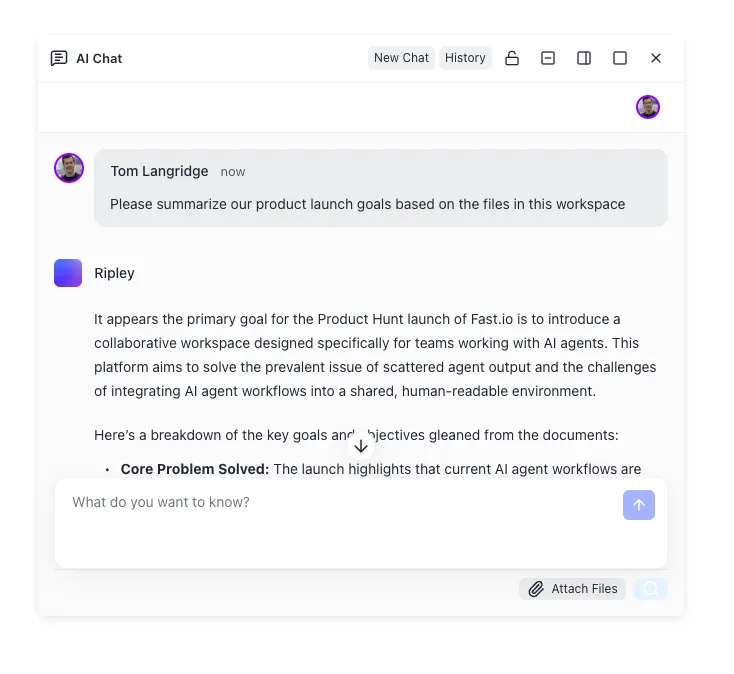
Fastio connects your AI-generated content, meeting notes, and project files in one searchable workspace with granular permissions and versioning.
Workflow Automation and File Management
Individual AI tools become more useful when they connect to each other and to the systems where your team already works. These tools handle the coordination layer.
Zapier
Zapier connects 9,000+ apps and lets you build automated workflows without code. The AI layer on top, Zapier Agents, pairs large language models with those integrations so an agent can read your email, check your CRM, and draft a follow-up based on real data. For teams already using five or more SaaS tools, Zapier is the fast way to connect AI to existing workflows rather than running each tool in isolation.
Best for: Teams running multiple SaaS tools that need AI to work across systems.
Limitations: Complex workflows require time to set up. Pricing scales with usage and can get expensive for high-volume automations.
Motion
Motion combines AI scheduling with project management. Feed it your team's tasks, deadlines, and priorities, and it books focused work time on everyone's calendar automatically. When priorities shift, Motion replans the schedule. This solves a problem that most project management tools ignore: the gap between "this task is due Friday" and "when exactly am I going to do it?"
Best for: Teams and individuals who struggle with time-blocking and realistic workload planning.
Limitations: Starts at $29/month per user. Best suited for teams with structured deadlines rather than ad-hoc creative work.
Fastio
Most AI tools generate output, but none of them store it well. Your ChatGPT conversation history is not a file system. Your Fireflies transcripts are locked inside Fireflies. Fastio solves this by giving your team a shared workspace where AI-generated content lives alongside your regular files.
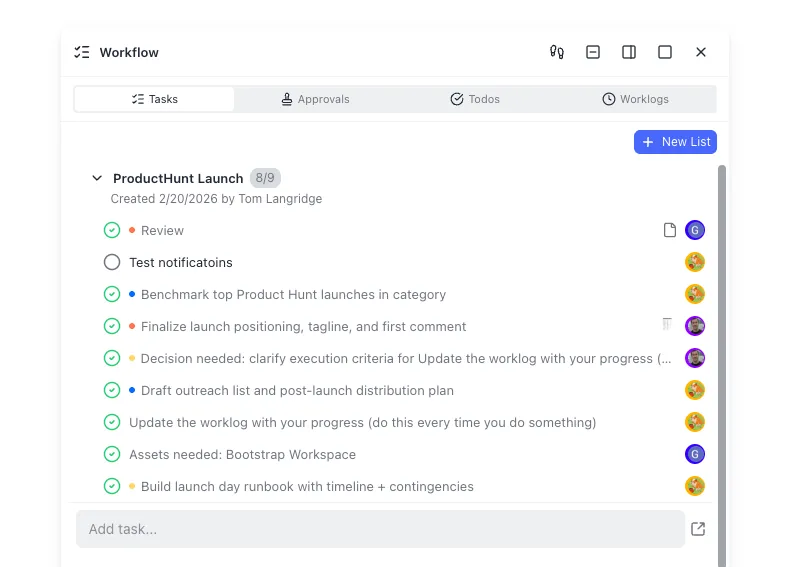
Intelligence Mode auto-indexes every file you upload, so you can search across meeting notes, proposals, and reports by meaning rather than filename. The MCP server exposes a consolidated MCP toolset that lets AI agents read, write, and organize files directly in your workspace. When one agent's output becomes another team member's input, the versioning, permissions, and audit trail keep assets organized across your team.
Plans include a 14-day Business Trial, with Starter ($9.99/month), Business ($49.99/month), and Enterprise ($199.99/month) tiers scaling storage and credits.
Best for: Teams that need a shared, searchable home for AI-generated output and project files.
Limitations: Newer platform with a smaller user base than Google Drive or Dropbox. Best value comes from using the AI and MCP features rather than treating it as generic cloud storage.
Notion
Notion AI adds a Q&A layer to your existing Notion workspace. Ask questions about your wiki, project docs, or meeting notes, and it pulls answers from across your workspace. If your team already uses Notion for documentation, the AI feature saves time without adding another tool to the stack.
Best for: Teams already using Notion as their knowledge base and project wiki.
Limitations: AI features require an add-on subscription at $10/member/month. Quality depends on how well-organized your Notion workspace already is.
How to Choose the Right Tools for Your Team
No single tool wins every category. Here is a practical framework for building an AI stack that actually sticks.
Start with your biggest time drain. If your team spends three hours a day in meetings, start with Fireflies or Granola. If your inbox is the bottleneck, try Superhuman or Fyxer. The tools that get adopted are the ones that solve problems people already feel, not the ones with the longest feature lists.
Test options before committing. ChatGPT, Claude, Perplexity, Grammarly, Fireflies, and Notion offer free plans. For shared workspaces, Fastio provides a 14-day Business Trial. Run each tool for two weeks on actual work tasks, not toy examples. An AI that impresses in a demo but doesn't fit your daily rhythm won't get used.
Pick two or three tools, not ten. The Microsoft data showing 78% of workers bringing their own AI tools is a warning, not a goal. More tools means more context fragmentation. Choose the best tool for your top two or three work functions, then connect them through a shared workspace or automation layer like Zapier.
Prioritize integration over features. A good AI email assistant that connects to your CRM and project management tool beats a great one that operates in isolation. Before you buy, check whether the tool exports data, offers an API, or connects to your existing stack.
Keep humans in the loop. Harvard Business School research found that AI users completed tasks 25.1% faster while achieving higher quality ratings, but only when they reviewed and edited AI output rather than accepting it wholesale. The productivity gains disappear when people blindly trust whatever the AI generates. The best workflow is AI-draft, human-review, then ship.
Sources
References used to verify factual claims in this guide.
-
75% of global knowledge workers use AI at work; 78% bring their own tools (BYOAI)
-
AI users completed tasks 25.1% faster while achieving 40%+ higher quality ratings
-
Worldwide AI spending forecast to total $2.59 trillion in 2026, a 47% increase
Frequently Asked Questions
What is the best AI tool for work?
It depends on the task. ChatGPT is the most versatile general-purpose option, handling writing, data analysis, and image generation in one tool. Claude is stronger for long-form writing and code. For email specifically, Superhuman leads. For meetings, Fireflies.ai offers the broadest integrations. The best approach is choosing purpose-built tools for your top two or three work functions rather than forcing one tool to do everything.
How should you start using AI at work?
Start with the task that wastes the most time in your day. If meetings are the drain, try a transcription tool like Fireflies or Granola. If writing takes too long, test Claude or ChatGPT. Use free tiers for two weeks on real work, not demos. Once you find a tool that saves 30 or more minutes daily, expand to the next pain point. Avoid adopting five tools at once. Sequential adoption lets you build habits before adding complexity.
What AI tools do companies use most?
Microsoft's 2024 Work Trend Index found that 75% of knowledge workers use AI, with ChatGPT being the most widely adopted tool. Enterprise teams commonly use Microsoft Copilot for Office apps, Grammarly for writing, Fireflies or Otter for meetings, and Zapier for automation. Gartner forecasts worldwide AI spending will reach $2.59 trillion in 2026, a 47% year-over-year increase, with 86% of companies planning to increase their AI budgets.
Can AI replace office workers?
Current research suggests AI changes jobs more than it eliminates them. Harvard Business School found that AI users complete tasks 25% faster with higher quality, but the gains require human review and editing. The workers who benefit most are those who learn to use AI as a drafting and research tool while applying their own judgment to the output. Roles heavy in routine data processing face the most change, while jobs requiring relationship-building, physical presence, or complex judgment remain AI-assisted rather than AI-replaced.
How much do AI work tools cost?
Most AI tools offer free tiers for individual use. Paid plans typically range from $10 to $30 per user per month. ChatGPT Plus is $20/month, Claude Pro is $20/month, Superhuman is $30/month, and Fireflies Pro starts at $10/month. Enterprise plans with team features and admin controls generally run $20 to $50 per seat. Several tools offer permanent free tiers, including Grammarly and Perplexity. Fastio offers a 14-day Business Trial with paid plans starting at $9.99/month.
Related Resources

Give your AI tools a shared workspace
Fastio connects your AI-generated content, meeting notes, and project files in one searchable workspace with granular permissions and versioning.