Best AI for Government: 8 Platforms for Public Sector Teams in 2026
Federal AI contract obligations jumped 966% between 2024 and 2026, reaching $7.2 billion, but 98.9% of that value flows to the Department of Defense. This guide evaluates eight AI platforms that civilian agencies, state governments, and local departments can adopt today. Each tool is ranked by compliance level, use case fit, and deployment speed so procurement teams can build a practical shortlist.


Federal AI Spending Jumped 966%, and Most of It Went to One Department
Federal agencies obligated $7.2 billion in AI contracts between September 2023 and March 2026, according to Brookings Institution tracking data. That is a 966% increase over 2024 levels. The number sounds like a government-wide AI boom, but the distribution tells a different story: 98.9% of federal AI contract value flows to the Department of Defense, whose total potential contract value rose 1,605% to $90.7 billion.
Civilian agencies are largely left to figure things out on smaller budgets with fewer dedicated AI staff. State and local governments face similar constraints with even less guidance.
The June 2, 2026, Executive Order on AI Innovation and Security signals that the White House expects adoption to accelerate. It establishes a cybersecurity clearinghouse for AI-powered systems and creates a voluntary framework giving agencies early access to frontier models. For government IT buyers, the message is clear: pick your tools now, because the mandate to deploy is coming even if the budget to do it lags behind.
Related guides
- 7 Best Streaming Data Platforms for AI Pipelines in 2026Streaming platforms let AI systems handle data feeds in real time, from sensor telemetry to user events. Market...
- Best AI Websites in 2026: 14 Platforms Across Every CategoryChatGPT doubled its user base to 900 million weekly users in a single year, but it represents just one entry in a much...
- Best AI Ad Generators for Marketing Teams in 2026Two-thirds of advertisers now use agentic AI for ad buying and campaign execution, according to the IAB 2026 Outlook...
- Best LLM Routing Platforms for Agents in 2026LLM routing platforms distribute agent requests across multiple language models based on task complexity, cost, and...
- Best Enterprise AI Platforms in 2026: A Buyer's ComparisonGartner projects $2.59 trillion in worldwide AI spending for 2026, but most enterprise agentic AI projects never leave...
- Best AI Agents in 2026: 10 Platforms That Actually Ship WorkGartner predicts 33% of enterprise software will include agentic AI by 2028, up from under 1% in 2024. That pace leaves...
More on this subject: AI Tool Directories and Comparisons (231 guides)
How We Evaluated These Platforms
Government procurement works differently from enterprise software buying. We evaluated each platform against five criteria.
Compliance certifications. FedRAMP authorization is the baseline for federal agencies. We note each platform's current authorization level. State and local governments are not bound by FedRAMP, but many use it as a proxy for security maturity.
Use case fit. A platform built for intelligence analysis solves a different problem than one designed for IT help desk automation. We categorized each tool by its primary government application.
Deployment speed. Some platforms require months of systems integration work. Others offer managed services or pre-built AI agents that agencies can pilot within a single budget quarter.
Cost structure. Government budgets are annual and rigid. We noted whether pricing is per-seat, consumption-based, or requires a custom enterprise contract.
Vendor ecosystem. Platforms with established government systems integrator partnerships (Booz Allen, Deloitte, Accenture) are faster to procure through existing contract vehicles like GSA schedules.
8 AI Platforms for Government in 2026
The tools below span different layers of the government AI stack. Some are full application platforms. Others provide cloud infrastructure with AI services layered on top. The right choice depends on what your agency needs to accomplish.

1. Palantir AIP
Palantir AIP connects large language models to an agency's operational data through its ontology layer, a structured map of how data objects relate to each other. Government analysts ask questions in natural language and get answers grounded in their own classified or sensitive datasets rather than generic training data. U.S. government revenue hit $687 million in Q1 2026 alone, up 84% year-over-year.
Key Strengths:
- Deep defense and intelligence community integration across classification levels from unclassified through TS/SCI
- Ontology layer keeps AI outputs grounded in real operational data
- Active deployments at scale across Army, Air Force, and intelligence agencies
Key Limitations:
- Pricing requires custom contracts, and costs rank among the highest in this category
- Implementation typically requires Palantir Forward Deployed Engineers on site
Best For: Defense, intelligence, and law enforcement agencies with complex data integration needs.
Compliance: FedRAMP authorized; operates at IL2 through IL6.
2. Microsoft Copilot for Government
Microsoft Copilot brings generative AI into the productivity tools most government employees already use: Word, Excel, PowerPoint, Teams, and Outlook. The GCC and GCC-High versions meet federal compliance requirements with data residency in U.S. government datacenters. In January 2026, Microsoft and GSA signed a deal worth up to $3.1 billion to bring discounted AI services to federal agencies, including free Copilot access for up to 12 months.
Key Strengths:
- Deploys where employees already work, cutting training and change management costs
- Analyst and Researcher agentic tools now available in GCC, GCC-High, and DoD clouds
- Backed by Azure Government with a broad ecosystem of FedRAMP-authorized services
Key Limitations:
- Outputs can be generic without careful data grounding and prompt engineering
- Requires Microsoft 365 E3 or E5 licensing as a prerequisite, adding to per-seat costs
Best For: Agencies already on Microsoft 365 that want to add AI productivity without a new vendor.
Compliance: FedRAMP High; U.S. government datacenter residency.
3. AWS GovCloud with Amazon Bedrock
AWS GovCloud provides isolated cloud infrastructure for federal workloads, and Amazon Bedrock adds managed access to foundation models from Anthropic (Claude), Meta (Llama), OpenAI, and NVIDIA. Amazon committed up to $50 billion to expand AI capacity across GovCloud, Secret, and Top Secret regions. Bedrock AgentCore launched in GovCloud (US-West) in May 2026, bringing agentic AI capabilities to compliance-sensitive workloads.
Key Strengths:
- Widest model selection of any government cloud, including Claude, Llama, GPT OSS, and Nemotron
- Bedrock AgentCore enables building and deploying AI agents at scale within GovCloud
- Structured outputs support makes AI responses schema-compliant for government reporting
Key Limitations:
- Building on Bedrock requires engineering resources; this is a platform, not a turnkey solution
- GovCloud pricing carries a premium over standard AWS regions
Best For: Agencies with engineering teams that need model flexibility and full control over their AI stack.
Compliance: FedRAMP High; supports IL2 through IL5.
4. Google Vertex AI for Public Sector
Google's Vertex AI platform is evolving into the Gemini Enterprise Agent Platform, combining model selection, model building, and agent-building tools for government customers. Vertex AI Search and Generative AI hold FedRAMP High authorization. The State Department's Bureau of Consular Affairs already uses Vertex AI Search to help citizens find travel advisories, passport details, and visa information.
Key Strengths:
- FedRAMP High authorized for search and generative AI capabilities
- Strong at search, summarization, and citizen-facing information retrieval
- Gemini 3.5 Flash deployed on the DoD's GenAI.mil platform
Key Limitations:
- Smaller government market share than AWS or Azure, meaning fewer pre-built integrations and contract vehicles
- Agent platform is still maturing compared to more established competitors
Best For: Agencies focused on search, document understanding, and citizen-facing information services.
Compliance: FedRAMP High for Vertex AI Search and generative AI.
5. ServiceNow Government AI
ServiceNow offers AI-powered workflow automation for IT service management, HR, and constituent services within its Government Community Cloud. At its March 2026 Government Forum, the company introduced Autonomous Workforce: AI specialists that execute tasks within GCC and National Security Cloud environments. The first offering, a Level 1 IT Service Desk AI specialist, independently handles software access requests and password resets.
Key Strengths:
- Pre-built AI agents for common government workflows reduce time to deployment
- EmployeeWorks combines conversational AI with enterprise workflow automation
- Runs in both Government Community Cloud and National Security Cloud
Key Limitations:
- Strongest for internal operations (IT, HR) rather than mission-specific analytics
- Licensing costs scale with the number of AI specialists and agent interactions
Best For: Agencies looking to automate IT service desks, employee requests, and internal case management.
Compliance: FedRAMP High; available in GCC and NSC.
6. IBM watsonx
IBM expanded its FedRAMP-authorized portfolio to 11 software solutions in April 2026, quadrupling its authorized AI offerings in a single year. The watsonx suite includes watsonx.ai for model building and fine-tuning, watsonx.governance for AI compliance tracking, and Watsonx Orchestrate for workflow automation with AI assistants and agents.
Key Strengths:
- watsonx.governance is purpose-built for the transparency and audit trail requirements of government AI deployments
- Supports open-source models alongside IBM's Granite models, giving agencies control over model selection
- Full FedRAMP authorization across the watsonx portfolio is now complete
Key Limitations:
- Smaller foundation model ecosystem than AWS Bedrock or Azure
- Implementation typically requires IBM consulting or a partner systems integrator
Best For: Agencies that need AI governance and compliance tooling alongside model deployment, especially those facing Executive Order reporting requirements.
Compliance: FedRAMP authorized across 11 solutions including watsonx.ai and watsonx.governance.
7. C3 AI
C3 AI delivers pre-built AI applications for government use cases including logistics readiness, fraud detection, intelligence analysis, and property appraisal. Federal bookings grew 89% year-over-year in fiscal Q2 2026, with defense and aerospace representing 45% of total company bookings. Booz Allen Hamilton joined the C3 AI Strategic Integrator Program to develop COTS solutions on the C3 Agentic AI Platform.
Key Strengths:
- Domain-specific applications deploy in one to two quarters rather than requiring custom builds
- Active deployments at U.S. Army (logistics) and HHS (data integration)
- Booz Allen partnership streamlines procurement through existing federal contract vehicles
Key Limitations:
- Application-centric approach limits flexibility for agencies with unusual requirements
- Pricing is opaque, typically requiring enterprise-level contract negotiations
Best For: Defense logistics, fraud detection, law enforcement analytics, and property appraisal at scale.
Compliance: FedRAMP authorized since December 2025.
8. Fastio
Fastio takes a different angle than the platforms above: it focuses on document processing and AI-powered workspace management. Metadata Views extract structured fields from PDFs, scanned pages, Word documents, spreadsheets, and handwritten notes using natural language descriptions instead of OCR templates. Describe the fields you need (contract dates, policy numbers, invoice totals) and the system builds a queryable spreadsheet from your files.
Once enabled, Intelligence Mode indexes uploaded documents for semantic search and AI chat with source citations. For agencies that need AI agents to interact with files programmatically, Fastio exposes an MCP server with a consolidated MCP toolset.
Key Strengths:
- Metadata Views turn unstructured government documents into searchable, structured databases without custom development
- 14-day Business Trial to test workspaces with team members and AI agents
- MCP server and API enable AI agents to read, write, and query files in shared workspaces
Key Limitations:
- No FedRAMP authorization, which limits adoption at federal agencies with strict compliance mandates
- Focused on document-centric workflows rather than broad analytics, intelligence, or IT automation
Best For: State and local government teams processing permits, contracts, public records, or constituent documents where FedRAMP is not required.


Process government documents without manual data entry
Fastio extracts structured data from PDFs, scanned documents, and images with Metadata Views. Start a 14-day Business Trial with MCP access for AI agents.
What the June 2026 Executive Order Changes for Procurement
The Executive Order titled "Promoting Advanced Artificial Intelligence Innovation and Security," signed June 2, 2026, introduces three provisions that matter for government AI buyers.
The order establishes an AI cybersecurity clearinghouse where agencies can coordinate with industry and critical infrastructure operators to identify and fix software vulnerabilities at scale. Security teams should expect new reporting touchpoints for AI-powered systems.
It creates a voluntary framework for frontier model access. AI developers can provide the federal government with access to frontier models up to 30 days before public release. Agencies that participate get earlier access to the newest capabilities from companies like Anthropic, OpenAI, and Google.
Notably, the order states that nothing authorizes mandatory licensing or permitting requirements for AI development or distribution. The compliance landscape stays centered on FedRAMP and existing authorization frameworks rather than new AI-specific mandates. For procurement teams, that means the tools in this guide can be evaluated on their current certifications without waiting for a new regulatory regime to settle.
Matching a Platform to Your Agency's Needs
Start with your constraints, not a vendor's feature list.
If your agency runs on Microsoft 365, Copilot for Government is the lowest-friction starting point. The GSA deal makes the first year nearly free, and Analyst and Researcher agents are already available in government clouds.
If you need to build custom AI applications and have engineering staff, AWS GovCloud with Bedrock gives you the widest model selection. Google Vertex AI is a strong alternative, especially for search and citizen-facing services.
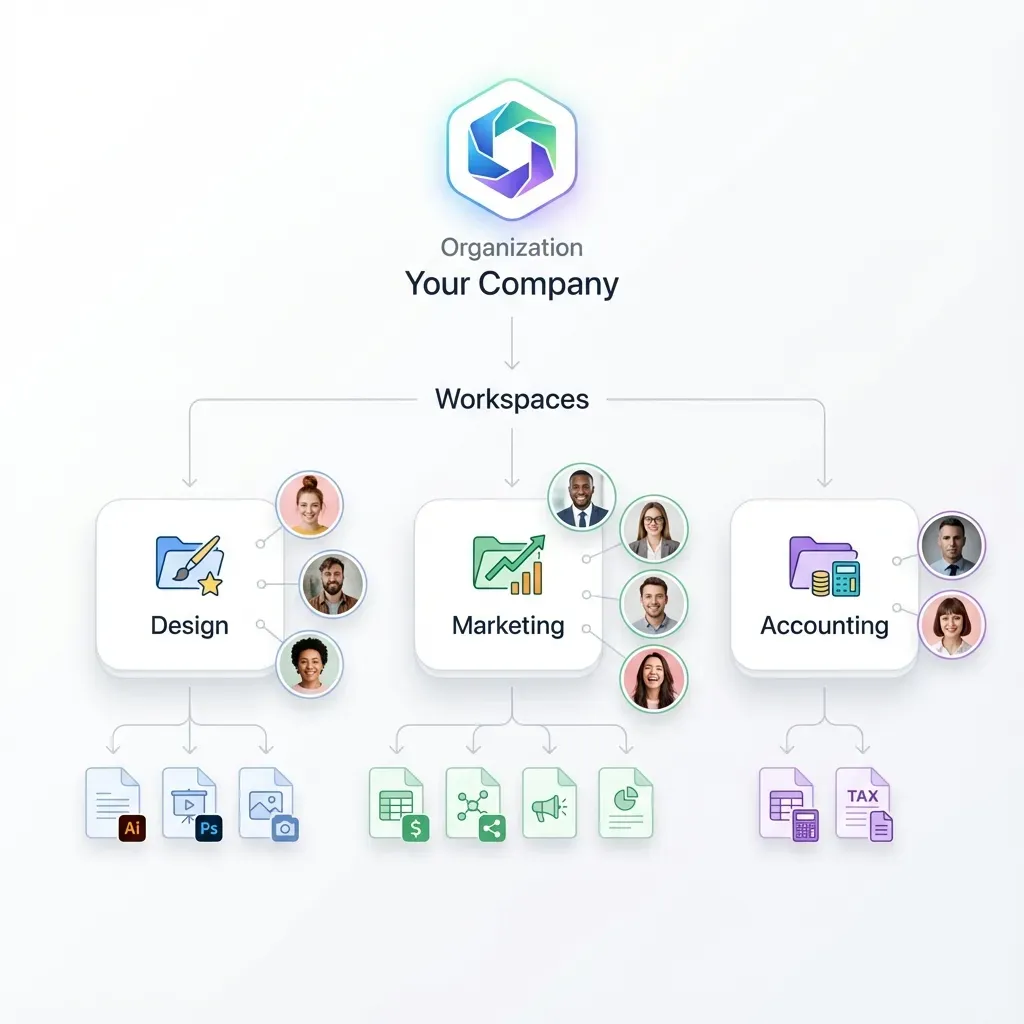
For agencies buried in unstructured paperwork, compare the document processing options. IBM watsonx handles governed AI workflows at enterprise scale with full FedRAMP coverage. Fastio offers a lighter-weight path with Metadata Views that extract structured data from scanned files, PDFs, and images. A 14-day Business Trial lets you test whether it fits your workflow before committing budget.
Defense and intelligence teams with classification requirements should evaluate Palantir AIP first, with C3 AI as an alternative for specific operational use cases like logistics and fraud detection.
Whatever you pick, start with a single workflow. Government AI projects that attempt enterprise-wide rollouts tend to stall in procurement review. Prove value on one use case, then use that success to justify broader adoption.
Sources
References used to verify factual claims in this guide.
-
Federal agencies obligated $7.2 billion in AI contracts between September 2023 and March 2026, a 966% increase from 2024; 98.9% of contract value flows to the Department of Defense
-
Executive Order titled Promoting Advanced Artificial Intelligence Innovation and Security signed June 2, 2026
-
Microsoft and GSA signed a deal worth up to $3.1 billion for discounted AI services including free Copilot access for up to 12 months
-
Amazon committed up to $50 billion to expand AI capacity across GovCloud, Secret, and Top Secret regions
-
Palantir U.S. government revenue grew 84% year-over-year to $687 million in Q1 2026
-
IBM expanded FedRAMP-authorized portfolio to 11 software solutions including watsonx in April 2026
-
C3 AI federal bookings grew 89% year-over-year in fiscal Q2 2026 with defense and aerospace at 45% of total bookings
Frequently Asked Questions
What AI tools does the government use?
Federal agencies use a range of AI platforms depending on their mission. The Department of Defense relies on Palantir AIP and AWS GovCloud for intelligence and data analysis. Civilian agencies commonly adopt Microsoft Copilot for Government for productivity and ServiceNow for IT workflow automation. The State Department uses Google Vertex AI Search for citizen-facing travel and visa information. All of these carry FedRAMP authorization.
Is AI allowed in government?
Yes. The June 2026 Executive Order on AI Innovation and Security actively encourages adoption. Federal agencies have obligated $7.2 billion in AI contracts since September 2023. The order establishes a cybersecurity clearinghouse and voluntary framework for frontier model access while explicitly avoiding mandatory licensing requirements.
What is the best AI for the public sector?
It depends on the use case. Microsoft Copilot for Government is the easiest starting point for agencies on Microsoft 365. AWS GovCloud with Bedrock offers the most model flexibility for technical teams. Palantir AIP leads in defense and intelligence analysis. For document processing, IBM watsonx and Fastio offer extraction capabilities at different compliance levels and price points.
How are cities using AI?
Cities deploy AI for traffic management, permit processing, constituent service chatbots, infrastructure monitoring, and fraud detection. Document processing platforms help city clerks extract structured data from building permits, zoning applications, and public records without manual data entry. ServiceNow and similar workflow tools automate internal IT and HR processes.
Do government AI tools need FedRAMP certification?
Federal agencies generally require FedRAMP authorization for cloud-based AI tools. State and local governments are not bound by FedRAMP, though many use it as a security maturity benchmark when evaluating vendors. Some agencies handle non-classified workloads with tools that lack FedRAMP authorization, but policies vary by department and data sensitivity.
How much does government AI software cost?
Costs vary widely. Microsoft offers Copilot for Government free for up to 12 months through the GSA OneGov agreement. Fastio offers plans starting at $9.99/month with a 14-day Business Trial. Enterprise platforms like Palantir and C3 AI require custom contracts that can cost millions annually. AWS and Google charge consumption-based pricing in their government cloud regions.
Related Resources

Process government documents without manual data entry
Fastio extracts structured data from PDFs, scanned documents, and images with Metadata Views. Start a 14-day Business Trial with MCP access for AI agents.