10 Best AI Competitive Intelligence Tools in 2026
AI competitive intelligence tools in 2026 go beyond dashboards and keyword alerts. The strongest platforms deploy autonomous agents that track competitor pricing, product changes, and market positioning, then deliver structured briefs without manual research. This guide ranks 10 tools across enterprise CI, financial intelligence, and autonomous monitoring, with pricing and capability breakdowns for each.


From Dashboards to Autonomous CI Agents
Competitive intelligence used to mean someone on your team checking competitor websites every week, compiling a spreadsheet, and emailing it around. That approach breaks when your team tracks dozens of competitors across pricing pages, job boards, product changelogs, press releases, and social media.
The 2026 generation of CI tools works differently. Instead of sending a firehose of alerts, the best platforms now deploy autonomous agents that continuously monitor data sources, identify what matters, and deliver structured briefs to your team in Slack, email, or your CRM. Gartner projects that 40% of enterprise applications will embed AI agents by the end of 2026, up from less than 5% in 2025. Competitive intelligence is one of the first categories where this shift is visible.
This guide ranks 10 tools across four categories: enterprise CI platforms, financial intelligence, autonomous monitoring, and workspace intelligence. Each entry includes verified pricing, key strengths, honest limitations, and the specific use case where each tool fits best.
Related guides
- Best Headless Browsers for AI Agents: Top Tools (2026)Finding the best headless browsers for AI agents matters for reliable automation. Old scrapers break on dynamic sites....
- Best Web Browsing Tools for AI Agents (2026)Web browsing tools let AI agents navigate the live web, fill forms, and extract real-time data. Traditional scrapers...
- Best Free AI Agent Tools 2026: Top 12 Platforms ComparedBuilding autonomous agents doesn't have to be expensive. The free AI agent ecosystem now offers professional frameworks...
- Top 5 Tools Every LangGraph Developer NeedsLangGraph lets you build stateful, cyclic AI agents, but the framework alone isn't enough. You need tools for...
- 5 Best Semantic Search Tools for AI AgentsSemantic search helps agents retrieve information based on meaning, not just keywords. It uses vector embeddings to...
- Best Pydantic AI Tools for Building Reliable Agents (2026)Building reliable AI agents requires more than just prompts; it demands structured, type-safe data. Pydantic AI tools...
More on this subject: AI Tool Directories and Comparisons (231 guides)
How We Evaluated These Tools
We assessed each tool across five criteria:
- Autonomy level: Does it passively collect data, or does it analyze patterns and proactively surface insights?
- Data source coverage: How many competitor signals can it monitor (pricing, product features, hiring, financial filings, social)?
- Integration depth: Can it push intelligence into CRM, Slack, and existing sales workflows?
- AI accuracy: Does the AI analysis produce findings you can act on, or mostly noise?
- Pricing accessibility: Is there a free tier or trial? What does enterprise-scale access actually cost?
Tools that scored highest combine broad data coverage with genuine autonomy, delivering summarized intelligence rather than raw data dumps.
Best Enterprise CI Platforms for Sales and Strategy Teams
These four platforms are purpose-built for competitive intelligence programs. They collect data at scale, generate battlecards for sales teams, and connect CI outcomes to revenue. All sit in the $20K+ annual range, so they're best suited for organizations with dedicated CI budgets.
A typical deployment starts with a pilot: pick your top three competitors, connect the platform to your CRM and Slack, and run it alongside your existing process for 30 days. Most teams see battlecard adoption plateau after 60 days, so build your business case around that first month of data. The main constraint is internal adoption. If sellers don't open battlecards during calls, the investment underperforms regardless of data quality.

1. Klue
Klue is the top-rated competitive intelligence platform on G2, built for B2B sales teams that need battlecards and deal-level competitive insights.
Key strengths:
- Compete Agent, Klue's autonomous AI, monitors sales calls for competitor mentions, sends personalized deal tips to sellers within minutes, and refreshes competitor profiles daily
- Battlecard quality rated 9.5/10 on G2, with cards that update automatically as new intelligence comes in
- Direct integration with Salesforce, HubSpot, and Slack so sellers get competitive context without switching tools
Limitations:
- Pricing starts at $20K-$40K/year, which puts it out of reach for small teams
- Strongest value is for sales enablement; less suited for product or strategy teams doing broader market research
Best for: B2B sales organizations with 50+ reps competing against well-known alternatives.
Pricing: $20K-$40K/year. Customers report a 28% increase in win rates against tracked competitors.
2. Crayon
Crayon tracks competitor activity across more than 100 data types, from pricing page changes to job postings, and packages that data into dynamic battlecards for sales teams.
Key strengths:
- Win Story Insights analyze recorded sales calls to identify the specific tactics and messaging that close deals
- AI classification filters the signal from the noise, surfacing only changes that matter to your competitive position
- Direct integration with Clozd for structured win/loss analysis that connects CI to revenue outcomes
Limitations:
- Enterprise pricing ($20K-$40K/year) is comparable to Klue, making it another premium commitment
- Requires dedicated CI program management to get full value from the platform
Best for: CI programs that want to measure how competitive intelligence directly impacts deal win rates.
Pricing: $20K-$40K/year.
3. AlphaSense
AlphaSense is a financial and market intelligence platform that uses semantic AI to search across earnings calls, SEC filings, analyst reports, and proprietary research. It serves 85% of S&P 100 companies.
Key strengths:
- Semantic search finds insights that keyword-based tools miss, surfacing relevant mentions across millions of financial documents
- Deep Research feature generates multi-source analysis on companies, industries, and market trends
- Combines competitive intelligence with financial data, consensus estimates, and broker research in one platform
Limitations:
- Pricing starts at approximately $24K/year per user, with enterprise deployments exceeding $60K
- Focused on financial and strategic research; not designed for real-time website monitoring or sales enablement
Best for: Strategy, finance, and corporate development teams that need intelligence grounded in financial filings and market data.
Pricing: Approximately $24K/year per user.
4. Contify
Contify monitors competitors, customers, and regulators across a broad competitive ecosystem, tracking more than 700,000 companies in 117+ languages.
Key strengths:
- Athena, Contify's agentic AI, extracts over 30 business facts automatically from monitored sources
- Maps your entire competitive landscape, including suppliers, regulators, and adjacent market entrants, not just direct rivals
- Custom AI taxonomies let you define exactly what types of competitive signals matter to your business
Limitations:
- Custom pricing (approximately $30K/year) puts it in the enterprise tier
- Broader ecosystem focus means it is less specialized for sales battlecard workflows than Klue or Crayon
Best for: Enterprise teams monitoring complex competitive ecosystems across geographies and industries.
Pricing: Custom, approximately $30K/year.
How to Monitor Competitors Without a $20K Budget
Not every team needs a $20K+ CI platform. These three tools handle specific parts of the competitive intelligence workflow, from website change detection to automated web scraping, at a fraction of the cost. They work well on their own for focused monitoring or as complements to a broader CI stack.
A practical starting point: set up Visualping on your top competitor's pricing page and product changelog, then add Browse AI robots for any pages that require structured data extraction. This two-tool setup covers the most common CI triggers (price changes, feature launches, positioning shifts) for under $100/month. The limitation is coverage. These tools watch specific URLs you configure, so you won't catch signals from earnings calls, hiring patterns, or social media without adding another layer.
5. Kompyte (by Semrush)
Kompyte, acquired by Semrush, delivers automated CI with website monitoring, AI-powered battlecards, and competitor tracking at a fraction of the cost of dedicated enterprise platforms.
Key strengths:
- Starting at $300/year, it is the most budget-friendly dedicated CI tool on this list
- fast time to value: data collection starts within 24 hours, with no setup fees
- Unlimited battlecards included on the base plan, making it practical for teams tracking many competitors
Limitations:
- Less sophisticated AI analysis compared to Klue or Crayon's autonomous agents
- Maximum value requires a Semrush subscription for the full ecosystem integration
Best for: Marketing and product teams already using Semrush that want CI capabilities without a six-figure annual commitment.
Pricing: Starting at $300/year.
6. Visualping
Visualping monitors specific web pages for visual changes and uses AI to filter and summarize what actually changed. G2 ranked it the highest performer in competitive intelligence for website change detection in its Winter 2026 report.
Key strengths:
- Visual comparison shows exactly what changed on a competitor's pricing page, product page, or terms of service
- AI filtering reduces noise by categorizing changes by significance and summarizing the business impact
- Free tier available, with paid plans scaling to $3,000/month for enterprise monitoring needs
Limitations:
- Focused narrowly on website change detection; does not analyze earnings calls, hiring data, or social media
- Most useful as a complement to a broader CI platform, not as a standalone intelligence solution
Best for: Teams that need reliable alerts when competitors change pricing, positioning, or product pages.
Pricing: Free tier available; paid plans up to $3,000/month.
7. Browse AI
Browse AI creates no-code monitoring robots that autonomously track competitor websites, extract structured data, and send alerts when something changes.
Key strengths:
- No-code robot builder lets non-technical users set up monitoring for any website in minutes
- Real-time price tracking, feature monitoring, and content change detection with automated alerts
- API access lets you pipe extracted data into CRMs, spreadsheets, or internal tools
Limitations:
- Web scraping robots can break when target websites change their layout or add anti-scraping protections
- Provides raw extracted data rather than strategic analysis; you still need someone to interpret the findings
Best for: Teams that need custom web scraping and monitoring without writing code.
Pricing: Free tier available; paid plans based on monitoring volume.


Turn scattered competitor reports into a searchable intelligence library
Upload battlecards, market reports, and competitor profiles, then query them with natural language. Start a 14-day Business Trial with Intelligence Mode and MCP access.
How to Store, Search, and Share Competitive Intelligence
CI data is only useful if your team can find it, search it, and share it. These three tools focus on different parts of that problem: organizing intelligence in a searchable workspace, enriching account-level competitive data, and generating AI-native briefs for lean teams.
The common failure mode in CI programs is the "intelligence graveyard," where reports get filed in a shared drive and never surface again. The tools below solve this differently: once enabled, Fastio indexes documents for semantic search so you can ask questions across your entire intelligence library, Clay enriches accounts with competitive signals from 150+ sources, and Parano.ai generates structured briefs so small teams get analyst-grade output without the headcount.
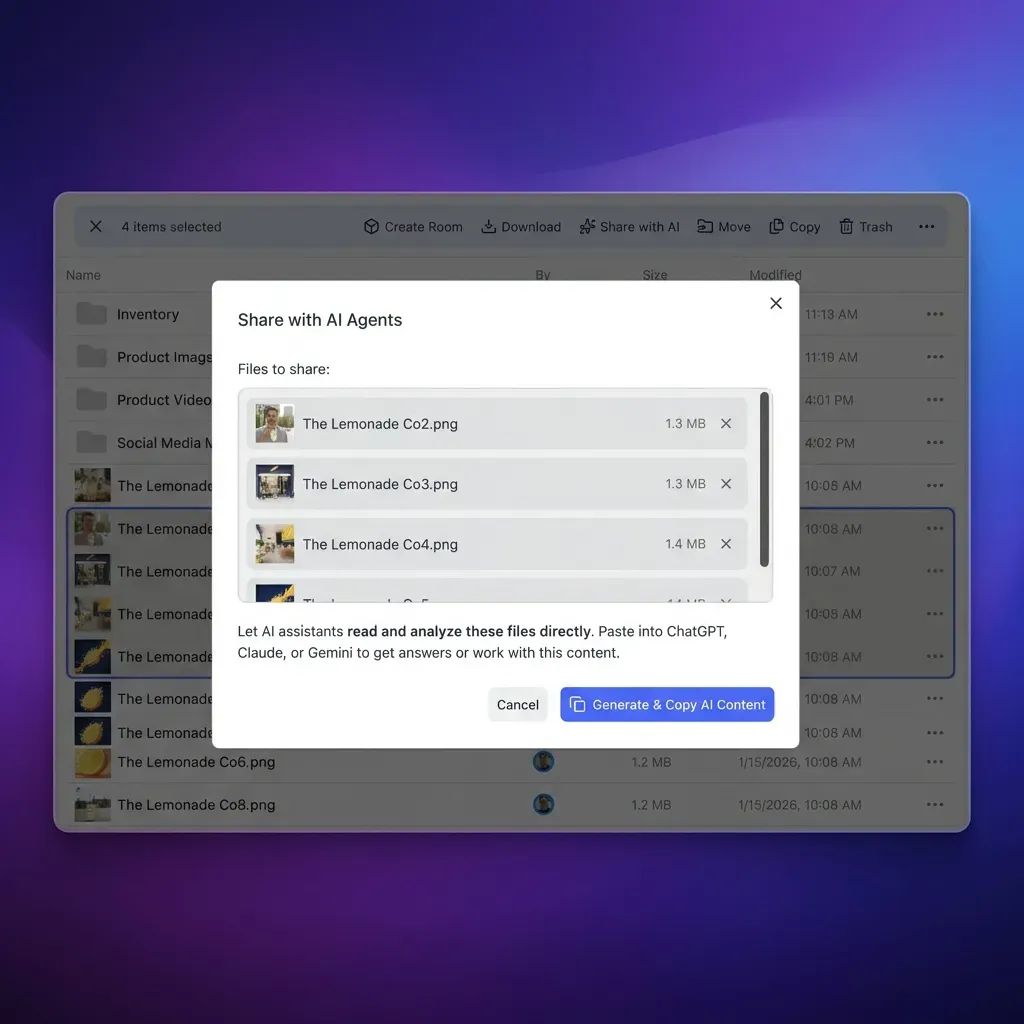
8. Fastio
Fastio is a workspace platform with built-in AI intelligence, positioned not as a CI data collection tool but as the shared layer where competitive intelligence gets stored, searched, and distributed across your team.
Key strengths:
- Intelligence Mode auto-indexes uploaded documents for semantic search and AI chat, turning a folder of competitor PDFs, battlecards, and market reports into a searchable knowledge base
- MCP server lets AI agents upload findings, query the intelligence layer, and deliver reports to team workspaces automatically
- 14-day Business Trial to test shared workspaces with team members and AI agents
Limitations:
- Not a CI data collection tool; it does not monitor competitor websites, track pricing changes, or scrape job boards
- Best used alongside a dedicated CI platform like Klue or Crayon, not as a replacement for one
Best for: CI teams that need a searchable, shareable intelligence hub where agents and humans collaborate on competitive research.
Pricing: Plans start at $9.99/mo (Starter) up to $199.99/mo (Enterprise), with a 14-day Business Trial. See fast.io/pricing.
9. Clay
Clay is a GTM data enrichment platform that connects to 150+ data sources and uses AI agents (called Claygents) to build competitive profiles at the account level.
Key strengths:
- Pulls data from website content, job postings, social profiles, tech stack detection, and funding databases in a single workflow
- Claygent AI visits competitor websites, summarizes their value propositions, and maps them against your ideal customer profiles
- Flexible enough for both competitive research and outbound prospecting, making it useful across RevOps
Limitations:
- Credit-based pricing can get expensive at scale, especially when enriching large competitor lists
- Better for account-level competitive profiling than for ongoing market monitoring
Best for: RevOps and sales intelligence teams building detailed competitive profiles for target accounts.
Pricing: Free tier available; paid plans from $149/month.
10. Parano.ai
Parano.ai is an AI-native competitive intelligence platform designed for lean teams that need structured CI output without hiring dedicated analysts.
Key strengths:
- AI generates complete competitor profiles and intelligence briefs automatically, reducing the gap between raw data and decisions
- Built for teams of one to five people who cannot justify $20K+ annual CI platform subscriptions
- Continuous monitoring with automated updates as competitor landscapes shift
Limitations:
- Newer platform with a smaller market presence than Klue, Crayon, or AlphaSense
- Limited public pricing information; requires contacting sales for a quote
Best for: Startups and small teams that need structured competitive intelligence without a large CI budget or dedicated headcount.
Pricing: Contact sales for pricing.
Which CI Tool Fits Your Team Size and Budget?
The right CI tool depends on your team size, budget, and which type of intelligence matters most.
For sales-focused CI with battlecards and deal support, Klue and Crayon lead the market. Klue's Compete Agent delivers proactive deal intelligence; Crayon's Win Story Insights connect CI to revenue outcomes. Both require $20K+ annual commitments and a dedicated CI team to manage them.
For financial and strategic research, AlphaSense is the strongest option, though its per-user pricing makes it expensive for large teams. Contify covers a broader competitive ecosystem with multi-stakeholder monitoring across 700,000+ companies.
For budget-conscious teams, Kompyte delivers CI fundamentals starting at $300/year, and Visualping's free tier handles website change monitoring. Browse AI adds custom web scraping without code for teams that need to track specific competitor pages.
For teams using AI agents, Fastio provides the shared workspace where agents and humans collaborate on competitive research, with built-in AI indexing and semantic search. Pair it with a data collection tool like Browse AI or Clay for a complete CI pipeline that runs on autopilot.
For lean teams without dedicated CI analysts, Parano.ai generates structured briefs automatically, and Clay builds competitive profiles from 150+ data sources with minimal manual effort.
Start with the narrowest tool that solves your biggest CI gap. Most teams get more value from one well-configured platform than from subscribing to five tools they half-use.
Sources
References used to verify factual claims in this guide.
-
Gartner projects that 40% of enterprise applications will embed AI agents by the end of 2026, up from less than 5% in 2025
-
Customers report a 28% increase in win rates against tracked competitors
-
AlphaSense serves 85% of S&P 100 companies Contify tracks more than 700,000 companies in 117+ languages
Frequently Asked Questions
What is the best AI tool for competitive intelligence?
Klue leads for B2B sales enablement with its Compete Agent delivering deal-level intelligence directly to sellers. For financial research, AlphaSense covers earnings calls, SEC filings, and analyst reports with semantic AI search. For budget-conscious teams, Kompyte by Semrush starts at $300/year and includes unlimited battlecards. The best choice depends on whether your primary CI need is sales enablement, market monitoring, or strategic research.
How do AI agents gather competitive intelligence?
AI agents monitor structured data sources like websites, job boards, SEC filings, and patent databases alongside unstructured sources like news articles, social media, and forum discussions. They use natural language processing to identify relevant changes, classify them by business impact, and generate summaries. Some agents, like Klue's Compete Agent, also analyze sales call recordings to detect competitor mentions and deliver context-specific selling tactics to reps in real time.
What competitive intelligence tools do enterprises use?
Large enterprises typically combine a dedicated CI platform (Klue, Crayon, or Contify) with financial intelligence (AlphaSense), social listening tools, and a shared workspace for distributing findings across teams. The specific stack depends on industry. B2B software companies lean toward Klue for sales enablement, while financial services firms favor AlphaSense for market research grounded in SEC filings and earnings data.
Can AI automate competitor monitoring?
Yes. Visualping automatically detects changes to competitor web pages, Browse AI creates no-code robots that extract structured data from any website, and platforms like Klue and Crayon continuously scan more than 100 data source types. Full automation works best for structured data like pricing, job postings, and product features. Interpreting strategic implications still benefits from human judgment, though AI summarization reduces analysis time from days to minutes.
How much do AI competitive intelligence tools cost?
Pricing ranges widely. Visualping offers a free tier and Browse AI includes starter credits, while Fastio provides a 14-day Business Trial before plans starting at $9.99/month. Mid-range tools like Kompyte start at $300/year and Clay at $149/month. Enterprise CI platforms (Klue, Crayon, Contify) typically cost $20K-$40K/year. Financial intelligence platforms like AlphaSense start around $24K/year per user. Most vendors offer demos but few publish transparent pricing.
Related Resources

Turn scattered competitor reports into a searchable intelligence library
Upload battlecards, market reports, and competitor profiles, then query them with natural language. Start a 14-day Business Trial with Intelligence Mode and MCP access.