Best AI Apps for Mac in 2026
Apple's MLX framework hits roughly 3x the token throughput of generic inference runners on identical M4 hardware. That performance gap explains why the strongest AI apps for Mac are increasingly Mac-native, built on Metal and unified memory rather than ported from Linux. We tested 11 tools across five categories and sorted out which ones are worth installing right now.


What unified memory means for AI performance
In a framework benchmark on a Mac Mini M4 Pro, Apple's MLX delivered about 130 tokens per second on Qwen3-Coder-30B. Ollama, running the same model through its llama.cpp backend on the same machine, managed about 43 tokens per second. That 3x gap is not an outlier. Across model sizes and quantization levels, apps that tap directly into Metal Performance Shaders and the unified memory pool consistently outperform generic cross-platform runners.
This is why "best AI app for Mac" has a different answer than "best AI app." Mac-native tools get more out of the chip. A 32GB M4 can comfortably run 14B-parameter models at conversational speed. A 64GB M4 Pro handles 30B+ models. And with Apple Intelligence now shipping system-wide, macOS itself is becoming an AI runtime.
We tested 11 apps across five categories: AI assistants, productivity tools, development environments, local model runners, and creative software. For each, we checked whether it runs locally, how well it uses Apple Silicon, what it costs, and where it falls short. Here is the full list.
AI Assistants: ChatGPT for Mac, Claude for Mac, Perplexity for Mac
Productivity: Raycast AI, Granola, Superwhisper
Development and Local AI: Cursor, Ollama, LM Studio
Creative and File Intelligence: Draw Things, Pixelmator Pro
Related guides
- 14 Best AI Apps in 2026 (Free and Paid)AI apps have gone from novelty to daily driver. With 900 million weekly ChatGPT users and global AI app downloads...
- Best Free AI Apps in 2026 (We Tested the Real Limits)Most "best free AI apps" roundups blur the line between genuinely free and trial-period freemium. We tested 11 apps,...
- Best AI Note Taking Apps in 2026: 10 Tools We Actually TestedAI note taking apps now go far beyond basic transcription. The best ones identify speakers, extract action items, and...
- Best AI Browsers in 2026: 8 Options Ranked by Use CaseAI-driven search now accounts for 30% of all query interactions, up from under 10% in 2023, and the browsers carrying...
- 7 Best Grammarly Alternatives for 2026Grammarly Pro costs $144 per year, but several alternatives match or beat its grammar accuracy at a fraction of the...
- Best Free AI Tools in 2026: What's Actually Free and Worth UsingMost free AI tool lists include 14-day trials that quietly start charging you. This guide covers 11 tools that are free...
More on this subject: AI Tool Directories and Comparisons (231 guides)
AI chat and research apps
The three major AI assistants all ship native Mac apps now, each with a different strength. ChatGPT has the broadest plugin ecosystem. Claude handles the longest documents. Perplexity cites its sources and can operate directly on your desktop.
All three run in the cloud, so the Apple Silicon advantage here is less about raw inference and more about system integration. Native Mac apps mean proper keyboard shortcuts, drag-and-drop from Finder, and smooth window management. The quality gap between the native apps and their browser versions is noticeable once you try Option+Space summoning in ChatGPT or dragging a 50-page PDF into Claude from your desktop.
1. ChatGPT for Mac
OpenAI's native Mac app puts GPT-4o and voice mode in a floating window you summon with Option+Space.
Key strengths:
- System-wide overlay that works in any app without switching windows
- Advanced Voice Mode for hands-free conversations
- Canvas mode for collaborative document and code editing
- Plugin and GPT marketplace for specialized tasks
Key limitations:
- Entirely cloud-based, no local processing even on Apple Silicon
- Trial limits GPT-4o access during peak hours
Best for: General-purpose AI chat, brainstorming, and quick answers across any workflow.
Pricing: Free with limits. Plus at $20/month. Pro at $200/month for unlimited access.
2. Claude for Mac
Anthropic's desktop app handles long documents up to 200K tokens and ships alongside Claude Code, a terminal-based coding agent with SSH support on Mac.
Key strengths:
- 200K context window fits full codebases, legal documents, and research papers in one conversation
- Claude Code runs directly in your terminal with file editing, git integration, and parallel sessions
- Projects feature for organizing instructions and reference files per workspace
- Native Mac app with keyboard shortcuts and drag-and-drop file uploads
Key limitations:
- Cloud-only processing, no local model option
- Extended usage and Claude Code require a paid plan
Best for: Developers and knowledge workers who process long documents or need AI-assisted coding directly in the terminal.
Pricing: Free tier available. Pro at $20/month. Team and Enterprise plans for higher usage.
3. Perplexity for Mac
Perplexity's Mac app now includes Personal Computer, an AI agent that can see your active apps, access local files, and execute multi-step workflows across your Mac.
Key strengths:
- Personal Computer operates across native Mac apps, local files, and the web
- Every answer includes inline citations from live sources
- Workflows are auditable and reversible, with user approval for sensitive actions
- Summoned with a double-Command-key shortcut from anywhere on your desktop
Key limitations:
- Personal Computer requires a Pro or Enterprise subscription
- Cloud-based processing for all queries
Best for: Research-heavy workflows where citation accuracy matters, or anyone who wants an AI agent that can interact directly with Mac apps.
Pricing: Free for basic search. Pro at $20/month includes Personal Computer.
Productivity and daily workflow tools
These three apps embed AI into actions you already do every day: launching apps, taking meeting notes, and dictating text.
The common thread is that they all sit at the OS level rather than in a browser tab. Raycast replaces Spotlight, Granola captures system audio without a meeting bot, and Superwhisper types into whatever text field is active. That native integration matters because it means you never switch context to use them. They just work inside the apps you already have open.

4. Raycast AI
Raycast replaces Spotlight with a programmable launcher that puts AI chat, clipboard history, window management, and thousands of extensions behind a single hotkey.
Key strengths:
- AI chat with multiple model providers (GPT-4o, Claude, Gemini) built into the launcher
- Thousands of community extensions for apps like GitHub, Jira, Notion, and Slack
- Built-in AI commands for quick text transformations: summarize, translate, rewrite
- Window management, snippets, and clipboard history without a separate app
Key limitations:
- AI features require the Pro plan at minimum
- Mac-only, so team workflows need accommodation for non-Mac users
Best for: Power users who want AI available at the OS level without opening a separate app.
Pricing: Free without AI. Pro at $8/month includes AI chat. Advanced AI add-on at $8/month extra for premium models.
5. Granola
Granola captures audio directly from your Mac during meetings and produces AI summaries, with the key difference that your own notes during the call guide what the AI focuses on.
Key strengths:
- Records system audio without a bot joining your meeting
- AI summaries incorporate your typed notes, so the output reflects your priorities
- Templates for different meeting types: standups, 1:1s, customer calls
- Local audio processing on your Mac
Key limitations:
- Free plan limits the number of meetings per week
- No transcription-only mode for pre-recorded audio files
Best for: Anyone in frequent video meetings who wants AI notes without an awkward recording bot joining the call.
Pricing: Free with limited meetings. Business at $14/month per user.
6. Superwhisper
Superwhisper runs Whisper-class speech recognition models locally on your Mac, converting voice to text in any app without sending audio to the cloud.
Key strengths:
- Fully local processing on Apple Silicon; audio never leaves your machine
- Works system-wide via a hotkey, typing directly into any active text field
- Multiple model sizes for the speed-versus-accuracy tradeoff you need
- Bring-your-own-key LLM integration for cleaning up dictated prose
Key limitations:
- Larger models need 16GB+ RAM for comfortable real-time performance
- No cloud sync or cross-device history
Best for: Privacy-conscious users who dictate frequently and want accuracy without cloud dependency.
Pricing: Free with basic models. Pro at $8.49/month for premium models and features.
Code editors and local model runners
For developers, the Mac is now a viable local AI workstation. An M4 with 32GB runs 14B-parameter models at 35 to 50 tokens per second, fast enough for interactive coding assistance without cloud latency.
The practical split here is between Cursor (cloud-powered, context-aware editing) and Ollama or LM Studio (local inference, no API costs). Many developers run both: Cursor for daily coding with its codebase indexing, and Ollama as a local API backend for scripts, testing, or privacy-sensitive projects. If your constraint is budget, Ollama plus a free editor gets you surprisingly far. If your constraint is speed and accuracy, Cursor's cloud models still outperform anything running locally on consumer hardware.
7. Cursor
Cursor is an AI-first code editor built on VS Code that integrates Claude, GPT-4o, and Gemini with full project context, so the AI understands your entire codebase rather than just the open file.
Key strengths:
- Codebase-aware AI that indexes your full project for relevant context
- Multi-file editing with AI agents that plan and execute changes across files
- Tab completion that predicts your next edit based on recent changes
- All VS Code extensions work without modification
Key limitations:
- Meaningful AI usage requires a paid plan
- Cloud-dependent for AI features, with no local model option
Best for: Developers who want AI integrated into their editor rather than switching between code and a chat window.
Pricing: Free with limited AI requests. Pro at $20/month. Business at $40/user/month.
8. Ollama
Ollama is the standard tool for running open-source LLMs locally on a Mac. It auto-detects Apple Silicon, uses Metal acceleration, and handles model downloads with a single terminal command.
Key strengths:
- One command to download and run Llama, Qwen, Mistral, Phi, and dozens of other models
- REST API for integration with any tool, script, or application on your Mac
- Automatic Metal backend optimization on Apple Silicon
- No cloud costs, no API keys, no data leaving your machine
Key limitations:
- Terminal-only interface (pair with a GUI frontend like Open WebUI for a chat experience)
- Lower throughput than MLX-native runners on the same hardware
Best for: Developers and tinkerers who want a local LLM API with broad model support and zero setup friction.
Pricing: Free and open source.
9. LM Studio
LM Studio wraps local LLM inference in a polished desktop app with one-click model downloads from Hugging Face, a built-in chat interface, and a local API server.
Key strengths:
- Visual model browser connected to Hugging Face for browsing and downloading models
- Integrated MLX inference engine (v0.3.4+) for faster performance on Apple Silicon
- Local server mode exposing an OpenAI-compatible API for other apps to connect
- Side-by-side model comparison for evaluating different models on identical prompts
Key limitations:
- Larger models need substantial RAM (32GB+ for 14B-parameter models and above)
- Closed source despite being free to use
Best for: Users who want local LLM access with a polished GUI and no terminal setup.
Pricing: Free.
Image generation and file intelligence
These tools cover the creative and document intelligence side of AI on Mac: generating images locally, editing photos with ML, and making uploaded files searchable by meaning.
Draw Things and Pixelmator Pro both run entirely on-device, which means your images and edits never leave your Mac. For photographers processing client shoots, that is a real selling point.
10. Draw Things
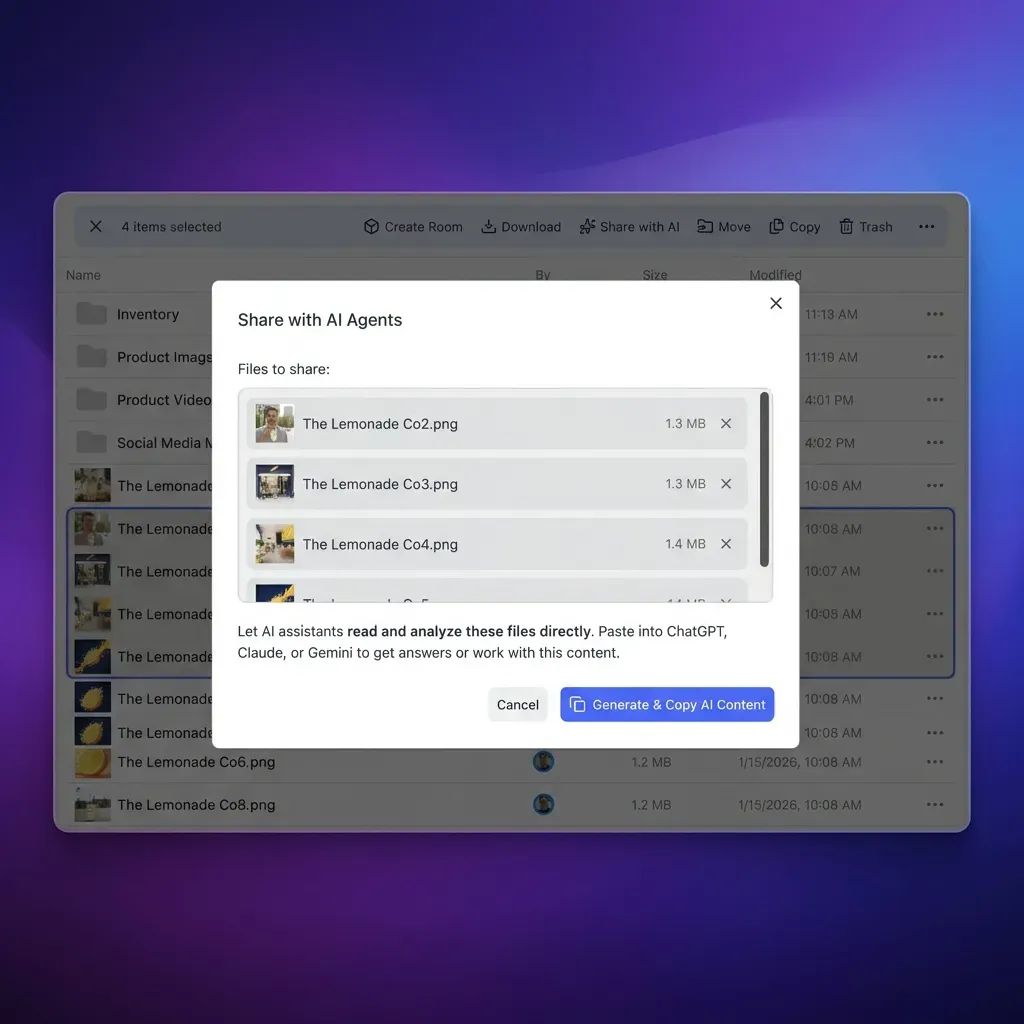
Draw Things is a SwiftUI app that runs Stable Diffusion, SDXL, and Flux models entirely on your Mac, built from scratch for Apple Silicon rather than ported from a Python stack.
Key strengths:
- Custom inference engine (s4nnc) with Metal FlashAttention, not a Python wrapper
- Supports SD 1.5, SDXL, Flux, LoRAs, ControlNet, and inpainting
- Free on the App Store with no subscription or cloud dependency
- Outperforms ComfyUI by roughly 20% on Apple Silicon in direct benchmarks
Key limitations:
- Steeper learning curve for advanced workflows like ControlNet
- Smaller community than ComfyUI, so fewer pre-built workflow templates
Best for: Mac users who want local AI image generation without Python, Docker, or cloud subscriptions.
Pricing: Free.
11. Pixelmator Pro
Pixelmator Pro is a Mac-exclusive photo editor whose ML tools, including background removal, super resolution, and intelligent color adjustments, run locally on Apple Silicon's Neural Engine.
Key strengths:
- ML tools process entirely on the Neural Engine with no cloud round-trip
- One-click background removal, smart object selection, and image upscaling
- Full RAW editing, non-destructive layers, and vector drawing tools
- Native macOS integration with Continuity Camera, Handoff, and iCloud sync
Key limitations:
- No generative AI features like text-to-image or AI inpainting
- Moved to a subscription model with version 4.0
Best for: Photographers and designers who want ML-powered editing without Adobe's subscription pricing.
Pricing: $49.99/year.
How to build your Mac AI stack
Most Mac users will run several of these apps at once. Here is a practical starting point for common workflows.
For AI chat, pick one of ChatGPT, Claude, or Perplexity based on what you value most. ChatGPT has the broadest plugin ecosystem. Claude handles the longest documents and has the best coding agent. Perplexity cites every source and can now operate across your Mac desktop.
For local AI, start with Ollama if you are comfortable in the terminal. LM Studio is the better choice if you want a visual interface. Both are free and perform well on any M-series Mac with 16GB or more of unified memory.
For development, Cursor is the leading AI code editor. Pair it with Ollama for offline or privacy-sensitive work where you want local inference alongside cloud-powered editing.
For daily productivity, Raycast AI at the system level plus Superwhisper for dictation covers most workflows without adding clutter. Add Granola if you are in frequent video meetings and want AI notes without a bot.
For creative work, Draw Things is the standout for local image generation on Apple Silicon. Pixelmator Pro fills the photo editing gap with Neural Engine-accelerated ML tools.
The strongest Mac AI setup is not one app. It is a handful of tools that match your workflow, with local processing where privacy matters and cloud power where scale does.
Sources
References used to verify factual claims in this guide.
-
Apple's MLX delivered about 130 tokens per second on Qwen3-Coder-30B versus about 43 tokens per second from Ollama's llama.cpp backend on the same M4 Pro hardware
-
M4 Mac Mini completed ML inference tasks 30% faster than comparable x86 cloud instances
-
M4 Pro with 24GB delivers 35 to 55 tokens per second for mid-size models, M4 Max benchmarks at 70 tokens per second on 70B models LM Studio version 0.3.4 and later ships with integrated MLX inference engine for Apple Silicon
-
M5 provides 19 to 27% performance boost compared to M4 with 28% higher memory bandwidth
-
Draw Things outperforms ComfyUI by roughly 20% on Apple Silicon
Frequently Asked Questions
What is the best AI app for Mac?
It depends on your use case. For general AI chat, ChatGPT and Claude both offer polished native Mac apps. For research with inline citations, Perplexity is the strongest option. For development, Cursor integrates AI directly into your code editor. For running models locally with no cloud dependency, Ollama is the standard starting point on Apple Silicon.
Can you run AI locally on a Mac?
Yes. Apple Silicon's unified memory architecture makes Macs one of the best platforms for local AI inference. Ollama, LM Studio, and Draw Things all run entirely on-device. An M4 with 32GB of unified memory can handle 14B-parameter language models at conversational speed, and 64GB opens up 30B+ models without swapping to disk.
Which AI tools are optimized for Apple Silicon?
Draw Things, Superwhisper, Pixelmator Pro, and Raycast are all built natively for Apple Silicon. Ollama and LM Studio support Metal acceleration, and LM Studio includes an MLX inference engine starting with version 0.3.4. Apps using Apple's MLX framework generally achieve the highest per-token throughput on M-series chips.
What AI features are built into macOS?
macOS includes Apple Intelligence with system-wide writing tools, smart replies, notification summaries, and a more capable Siri. The Photos app uses on-device ML for search, object recognition, and editing suggestions. macOS Sequoia and later versions expand these features with deeper integration across first-party apps, and macOS 27, expected in fall 2026, will add further Apple Intelligence capabilities.
Is Apple Silicon good for machine learning?
The unified memory architecture gives Apple Silicon a structural advantage for ML inference. Unlike discrete GPU setups where data moves over a PCIe bus, the CPU, GPU, and Neural Engine share the same memory pool. In benchmarks, an M4 Mac Mini completed ML inference tasks 30% faster than comparable x86 cloud instances, and the M5 generation adds roughly 19 to 27% more throughput on top of that.