How to Enforce AI Agent Quotas per Workspace
Per-workspace quota enforcement applies storage, request, and token limits to each agent workspace independently so one workspace cannot exhaust another's budget. This guide covers the five quota dimensions that matter, how to structure nested limits for multi-tenant agent platforms, and how to detect and stop runaway agents before they burn through a month of spend in an afternoon.


Why Per-Workspace Quotas Matter
A single misbehaving agent can burn a month of API budget in a few hours. That is not hypothetical. In March 2026, InformationWeek published a practical guide to controlling AI agent costs noting that autonomous agents running in tight loops will keep spending until something stops them. The "something" is almost always a quota, and the question is whether that quota is scoped correctly.
Most rate limit content you will find is written at the API key level. Your OpenAI key has a tokens-per-minute ceiling. Your Anthropic key has a requests-per-day ceiling. That works fine when one human sits behind one key. It stops working the moment you have ten agents, five tenants, and a shared pool of compute.
Per-workspace quotas solve a different problem. Instead of asking "how fast is this key spending?", they ask "is this workspace still within its allowance?" A workspace is the unit of isolation: a customer tenant, a project, a team, an individual agent, or a background job type. When quotas are enforced at that granularity, a runaway agent in Workspace A cannot consume resources owed to Workspace B.
The quotable definition: per-workspace quota enforcement applies storage, request, and token limits to each agent workspace independently so one workspace cannot exhaust another's budget.
Related guides
- How to Implement Multi-Tenant Workspaces with Fastio APIImplementing multi-tenant workspaces with the Fastio API allows B2B AI applications to guarantee strict data isolation...
- 8 Top AI Agent Workspace Platforms for 2026AI agent workspace platforms provide structured environments where autonomous agents can store files, execute code, and...
- How to Set Up an AI Agent Shared WorkspaceA shared workspace gives multiple AI agents a single place to read, write, and organize files without stepping on each...
- Dust AI Workspace: Features, Pricing, and AlternativesDust is an AI workspace that lets teams build custom assistants connected to company knowledge and tools. This guide...
- How to Set Up an Agentic Team WorkspaceAgentic team workspaces enable human-agent hybrid collaboration with shared intelligence and persistent storage. While...
- How to Set Up AI Agent Game Asset WorkspacesAI agent game asset workspaces store textures, models, and other files for game development. Agents and humans use...
More on this subject: Agent Memory and Storage (263 guides)
Five Quota Dimensions to Enforce per Workspace
Good quota models are multi-dimensional. Pick a single dimension and agents will find the one you forgot. A workspace that is capped on requests per minute but uncapped on tokens per request can still spend a fortune by stuffing long contexts into every call.
The five dimensions that matter:
- Requests per interval. Classic RPM or RPD. Protects downstream services from bursts and loops. Set this based on what the agent needs to do in a reasonable minute, not what you would tolerate in an emergency.
- Tokens per interval. The budget dimension. Tokens per minute (TPM) for burst control and tokens per month for spend control. Zuplo's 2026 guide on token-based rate limiting for AI agents makes the case that short-term and long-term token windows are both necessary, because one catches the runaway loop and the other catches the slow drain.
- Storage consumed. Bytes written to the workspace. Agents that ingest files, generate artifacts, or cache intermediate outputs can quietly fill a bucket. A storage quota per workspace is the simplest hedge.
- Concurrent sessions or jobs. A cap on how many parallel operations can run in a workspace at once. This is the dimension people forget, and it is the one that catches fork bombs where an agent spawns a new instance of itself on every tool call.
- Cost ceiling in dollars. A hard monthly spend cap that sits above all the unit quotas. If your token pricing changes or a model swap inflates per-call cost, the dollar ceiling still holds.
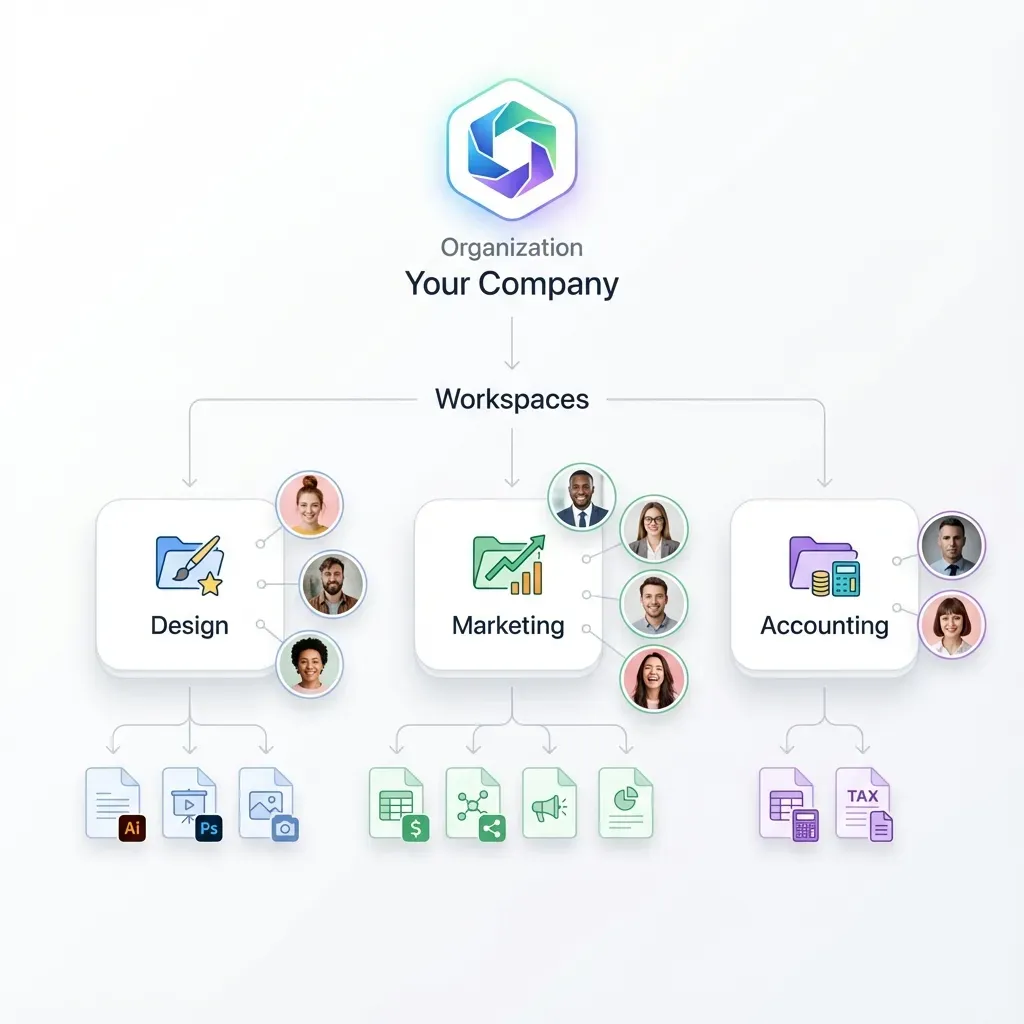
Nest these dimensions. A platform with tenants that contain workspaces that contain agents needs quotas at each layer. The tenant gets a monthly budget. The workspace gets a slice of that budget. Individual agents inside the workspace get fair-share allocations of the workspace slice. When an agent exceeds its slice, it is throttled, not the whole workspace.
How to Stop Runaway Agents
A runaway agent is any agent that keeps spending after it should have stopped. Causes vary: a prompt loop that never satisfies its exit condition, a tool call that errors and retries forever, a planner that decides to re-plan on every step. The behavior is the same. Cost climbs, and no human is watching in real time.
Detection is the first half. Your quota system should emit per-workspace usage metrics at a cadence fast enough to catch anomalies inside the hour. If the workspace's hourly token spend is ten times its trailing average, something is wrong. Fortune's April 2026 piece on agent governance framed this as the "agents act like employees but we manage them like software" gap. An employee who is doing something weird gets noticed. An agent that is doing something weird just keeps going.
Enforcement is the second half. When a workspace crosses a quota, the API returns 429 and the agent stops. This requires two design choices most teams get wrong.
First, return a real Retry-After header, not a generic rate-limit message. Agents that use standard HTTP clients will back off correctly. Agents that ignore the header will hit the next request and fail again, which is fine, because the quota is still enforced.
Second, expose the quota state through an endpoint the agent can read before it starts. A well-behaved agent should check its budget at the top of a task, not discover the budget when it runs out mid-sentence. Gemini Code Assist's quotas documentation, updated in March 2026, follows this pattern: separate endpoints for reading current usage versus triggering consumption.


Give every agent its own workspace, budget, and quota
Fastio scopes storage, credits, and shares per workspace by default. Pair it with your LLM rate limits for an end-to-end quota model that survives a runaway agent.
Implementation Patterns for Multi-Tenant Platforms
If you are building a platform where customers bring their own agents, nested quotas are non-negotiable. One tenant's loop must not take down another tenant's SLA. The standard pattern:
Token bucket at each scope
Maintain a token bucket per tenant and per workspace. Each request decrements both buckets. The smaller bucket controls the outcome. This is cheap to implement with Redis or any counter store that supports atomic decrement with expiry.
Pseudocode for the core check:
allowed = decrement(tenant_bucket, cost)
       and decrement(workspace_bucket, cost)
if not allowed:
    return 429 with Retry-After
Two time horizons
Run two buckets per scope: a short window for burst control (per minute) and a long window for budget control (per month). The short window refills automatically. The long window does not. This mirrors how cloud providers like Microsoft Foundry separate TPM from monthly caps.
Cost accounting, not just counts
For LLM traffic, cost is a function of input tokens, output tokens, and model choice. A GPT-4-class call is not equivalent to a Haiku call. Convert every operation to a canonical unit (credits, dollars, or normalized tokens) before you decrement. Otherwise a workspace that swaps to a more expensive model silently consumes more budget without tripping the quota.
Backpressure, not hard cutoff, for soft limits
Hard cutoffs at 100% of quota are fine for budget ceilings. For short-term rate limits, gradual backpressure works better. At 80% of the workspace's RPM quota, start returning Retry-After: 2. At 95%, return Retry-After: 10. At 100%, return 429 until the window rolls. Agents that support adaptive backoff will smooth themselves out without ever hitting the wall.
Audit every denial
Every 429 should be logged with workspace ID, agent ID, quota dimension, and current usage. This is how you catch systemic problems (one workspace is always at 100%, which means the quota is wrong) versus episodic ones (a specific agent misbehaved on April 12).
When Fastio Fits In
Fastio gives each workspace its own storage, credit, and share budget by default. Fastio offers a 14-day Business Trial (credit card required; see /pricing/). When an agent operates against a Fastio workspace through the MCP server or the API, the workspace itself is the unit of accounting. Storage consumed, intelligence queries run, shares created, all scoped to that workspace.
This does not replace an LLM-level quota system. You still need token budgets for the model calls themselves. It does replace the storage-and-artifact side of the quota model, which is the side most DIY systems forget. See /storage-for-agents/ for the workspace-level detail.
Observability: You Cannot Enforce What You Cannot See
A quota you cannot measure is a suggestion. Build the telemetry before the enforcement.
Track these signals per workspace:
- Rolling token consumption (1m, 1h, 24h, 30d windows)
- Request count and error rate
- Average cost per agent turn
- Storage growth rate in bytes per day
- Count of distinct agents active in the workspace
- 429 rate (your own enforcement signal)
Wire these into a dashboard before anything hits production. Set alerts at 50%, 80%, and 100% of monthly budget per workspace. The 50% alert on day 5 of the month is the signal that saves you. The 100% alert is just an incident report.
Nordic APIs' 2026 coverage of how agents are changing rate limiting frames the shift bluntly: traditional rate limits were designed for humans who give up after two 429s. Agents do not give up. They retry. Observability tells you when that retry behavior is pathological.
One practical note: attribute every call to both a workspace and an agent identity. If you only log workspace, you cannot tell which of the five agents running in Workspace X caused the spike. If you only log agent, you cannot enforce tenant-level policy. Log both.
A Minimum Viable Quota System
If you are starting from zero, here is the smallest system worth deploying:
- Give every workspace a row in a quota table with four numbers: monthly tokens, monthly credits, storage cap, concurrent jobs.
- On every request, middleware reads the current usage counter for that workspace, compares against the cap, and either proceeds or returns 429.
- On every response, middleware increments the usage counter with the actual cost of the call.
- A nightly job rolls up usage into historical tables and resets the monthly counters on the first of the month.
- A dashboard shows current usage against caps, per workspace.
- An alerting rule fires when any workspace crosses 80% before the 25th of the month.
That is enough to catch the vast majority of runaway-agent incidents. You will want to add nested tenant quotas, adaptive backoff, and dollar ceilings after that, but start with the floor. A system that enforces a simple per-workspace cap beats a beautifully designed system that is still in the draft stage when the first runaway agent shows up.
Sources
References used to verify factual claims in this guide.
-
Gemini Code Assist quotas and limits documentation, updated March 2026.
-
AI agents are acting like employees but company structures still treat them like software.
-
Practical guide to controlling AI agent costs before they spiral, March 2026.
-
Token-based rate limiting patterns for AI agents, 2026.
-
How AI agents are changing API rate limit approaches.
Frequently Asked Questions
How do you limit how much an AI agent spends?
Apply a multi-dimensional quota per workspace: tokens per minute for burst control, tokens per month for budget control, storage consumed, concurrent jobs, and a hard dollar ceiling. When any dimension is exceeded, the API returns 429 and the agent stops until the window rolls or the month resets.
What are per-workspace quotas?
Per-workspace quotas are usage limits scoped to a single workspace rather than a single API key or user. Each workspace gets its own allowance for requests, tokens, storage, and cost. When a workspace hits its cap, only that workspace is throttled, not the whole account.
How do you stop runaway agents?
Detect them with fast-cadence usage metrics that flag workspaces spending at ten times their trailing average. Stop them with 429 responses that include a Retry-After header. Prevent them by exposing a quota-read endpoint so agents can check their budget before starting a task instead of hitting the wall mid-run.
Why are API-key-level rate limits not enough for multi-agent systems?
A single API key shared across agents lets one agent consume the entire budget. Rate limits scoped to the workspace or tenant isolate agents from each other, so a bug in one agent's loop does not cause a service outage for the other agents sharing the key.
Should quota enforcement be hard or soft?
Use soft backpressure for short-term rate limits (escalating Retry-After values as usage climbs) and hard cutoffs for monthly budgets and dollar ceilings. Soft limits smooth out traffic without surprising well-behaved agents. Hard limits are the backstop that protects the bill.
Related Resources

Give every agent its own workspace, budget, and quota
Fastio scopes storage, credits, and shares per workspace by default. Pair it with your LLM rate limits for an end-to-end quota model that survives a runaway agent.