How to Build an AI Agent Document Redaction Pipeline
AI agent document redaction automation uses an autonomous agent to detect and remove sensitive information like names, SSNs, and account numbers from documents without manual review. This guide walks through building a five-stage redaction pipeline, from document ingestion to verified delivery, and explains how to connect it to a workspace where humans can review the output.


What Is AI Agent Document Redaction?
Document redaction means permanently removing sensitive information from files before sharing them. Traditionally, a paralegal or compliance officer opens each document, searches for personally identifiable information (PII), and blacks it out by hand. For a 100-page contract, that process takes two to four hours. Multiply that by hundreds of documents during litigation discovery or a regulatory audit, and you have a bottleneck that delays entire projects.
AI agent document redaction replaces most of that manual work. Instead of a human scanning each page, an autonomous agent ingests documents, runs named entity recognition (NER) and pattern matching to find sensitive data, applies redactions, and delivers cleaned files. The agent handles the full workflow end to end: fetching documents from storage, detecting PII types like Social Security numbers, bank account details, medical record numbers, and home addresses, then producing a new file with that data permanently removed.
The key difference between an agent-based approach and a standalone redaction tool is autonomy. A tool requires a human to upload each file, configure detection rules, and download the result. An agent fetches the files itself, applies rules based on the document type, logs every decision for audit, and routes the cleaned output to the right destination. The human reviews a summary rather than performing each step.

Related guides
- How to Build a Document Processing Pipeline with Fastio APIA document processing pipeline built on the Fastio API listens for new file uploads, automatically routes them for AI...
- Best Document Processing Tools for AI AgentsDocument processing tools for AI agents automate the extraction, parsing, and transformation of unstructured documents...
- How to Automate Document Processing with AI AgentsAI agent document processing uses autonomous agents to extract, analyze, and transform information from documents...
- How to Automate Share Link Revocation for AI AgentsAI agents generate share links at machine speed, and every link that outlives its purpose is a potential leak. This...
- How to Implement AI Agent RBAC File PermissionsRBAC for AI agent file permissions is a security model that assigns file access rights based on role, task scope, and...
- How to Build Base44 Metadata Views for Document ExtractionBase44 metadata views automatically parse file attributes to populate structured database tables and search filters....
More on this subject: Agent File and Document Workflows (325 guides)
Why Manual Redaction Fails at Scale
Manual redaction has three problems that compound as volume grows.
It's slow. A trained redactor processes roughly 25 pages per hour when checking for multiple PII categories. During discovery in litigation, firms may need to review tens of thousands of pages within weeks. The math doesn't work without either hiring temporary staff or accepting delays.
It's error-prone. Humans miss things, especially when fatigued. A 2024 IBM report found the average data breach costs $4.88 million globally, up 10% from $4.45 million the year before. A single missed Social Security number in a FOIA response or a client name left in a shared contract can trigger notification requirements, fines, and reputational damage. The same report found that organizations using AI in prevention workflows reduced breach costs by $2.2 million on average.
It doesn't create defensible records. When a regulator asks how you redacted a document set, "our paralegal did it manually" is a weak answer. Automated redaction generates a log of every detection, every redaction applied, and every human review decision. That audit trail is what makes your process defensible.
These problems are why tools like V7 Go, Redactable, and iDox.ai have built dedicated redaction products. V7's document redaction agent, for instance, can process documents up to 200 pages and generates irreversible redactions (new PDFs with text permanently removed, not just black boxes over recoverable data). Redactable claims a 98% reduction in redaction time for bulk document sets. Both platforms validate the demand for autonomous redaction workflows.
Common PII Categories
A production redaction agent needs to detect at least these categories:
- Direct identifiers: Full names, Social Security numbers, passport numbers, driver's license numbers
- Contact information: Email addresses, phone numbers, physical addresses
- Financial data: Bank account numbers, credit card numbers, tax IDs
- Health information: Medical record numbers, diagnosis codes, prescription details (PHI under HIPAA)
- Digital identifiers: IP addresses, device IDs, biometric data
- Custom patterns: Internal project codenames, employee IDs, proprietary reference numbers
Most NER models handle the first three categories well out of the box. Health data and custom patterns typically need fine-tuning or supplementary regex rules.
Five-Stage Redaction Agent Pipeline
A production redaction agent follows five stages. Each stage is a discrete step that can be logged, retried, and audited independently.
1. Ingest
The agent pulls documents from a source: a shared workspace, an email inbox, a cloud storage bucket, or an API endpoint. It validates that each file is a supported format (PDF, DOCX, XLSX, images with text, scanned documents) and queues it for processing. For scanned documents or images, the agent runs OCR first to extract machine-readable text.
If your documents live in Fastio workspaces, the agent can use the Fastio MCP server to search, list, and download files programmatically. The MCP server exposes a consolidated toolset for workspace operations, including file retrieval, metadata queries, and folder traversal. This eliminates the need to build custom storage connectors.
2. Detect
Detection combines multiple strategies:
- Named Entity Recognition (NER): Pre-trained models identify person names, organizations, locations, dates, and other entities. SpaCy, Presidio (Microsoft's open-source PII framework), and cloud NER APIs all work here.
- Pattern matching: Regex rules catch structured identifiers like SSNs (XXX-XX-XXXX), credit card numbers (Luhn-validated digit sequences), and phone numbers.
- Context-aware classification: An LLM evaluates ambiguous cases. Is "Jordan" a person's name or a country reference? Is "12345" a zip code or an account number? Context from surrounding text helps the agent decide.
The detection stage outputs a list of findings: each one tagged with the entity type, confidence score, and character position in the document.
3. Redact
The agent applies redactions based on the detection output. For PDFs, this means generating a new file where the original text is permanently removed and replaced with a category label like [SSN REDACTED] or [NAME REDACTED]. For DOCX files, the agent replaces the text content directly.
Permanent removal matters. Simply overlaying a black rectangle on a PDF is not redaction. The underlying text remains in the file and can be extracted with basic tools. Production redaction must strip the original text from the document structure entirely. V7 Go and Redactable both generate new PDFs with the sensitive content physically absent from the file, not just visually hidden.
4. Verify
Automated verification catches errors before delivery. The agent re-scans the redacted document to confirm no PII remains. It also runs a diff between the original and redacted versions to confirm that only the flagged content was changed and no unrelated text was altered.
This step catches edge cases: PII in headers or footers that the detection model missed, text embedded in images that OCR didn't extract cleanly, or table cells where the entity boundary was incorrectly detected.
5. Deliver
The agent routes the cleaned document to its destination. In an agentic workflow, this means uploading the redacted file to a workspace, notifying a reviewer, and attaching the redaction log. The log includes every entity detected, the confidence score, the redaction method applied, and whether a human approved or overrode any decision.
Fastio workspaces work well for this delivery step. The agent uploads the redacted document, the redaction log, and optionally the original (in a restricted-access folder). Granular permissions let you control who sees the original versus the redacted version. When Intelligence Mode is enabled on the workspace, the redacted documents are automatically indexed for semantic search and AI chat, so reviewers can ask questions about the cleaned document set without opening each file individually.



Give Your Redaction Agent a Workspace
Fastio provides the storage, permissions, and MCP access your redaction agent needs. generous storage.
Choosing a Detection Stack
Your detection strategy depends on document volume, PII categories, and accuracy requirements. Here are three practical approaches.
Open-source pipeline with Presidio. Microsoft's Presidio is the most widely used open-source PII detection framework. It combines NER models (SpaCy or Hugging Face transformers) with configurable regex recognizers. You can add custom recognizers for proprietary patterns. Presidio handles detection; you build the ingestion, redaction, and delivery layers around it.
Presidio works well when you need full control over detection rules and want to run everything on your own infrastructure. The tradeoff is integration effort: you need to handle PDF parsing, OCR, document reconstruction, and workflow orchestration yourself.
Managed redaction platforms. V7 Go, Redactable, and iDox.ai offer end-to-end redaction as a service. V7's document redaction agent supports 50+ languages, handles scanned and handwritten documents via OCR, and includes a QC workflow where your team reviews proposed redactions before the agent generates the final output. Redactable focuses on permanent redaction with SOC 2 and HIPAA compliance, audit certificates, and real-time collaboration for review teams.
These platforms reduce integration work but introduce vendor dependency. They work best when your primary need is high-volume document redaction and you want an out-of-the-box QC workflow.
LLM-based detection with human review. For complex documents where context matters more than pattern matching, you can use an LLM (Claude, GPT-4, or an open model) as the primary detector. The LLM reads each page, identifies sensitive content with reasoning, and outputs structured findings. This approach handles ambiguous cases better than NER alone, but it's slower and more expensive per page.
A practical hybrid uses Presidio for high-confidence structured patterns (SSNs, credit cards, phone numbers) and an LLM for ambiguous entities (names in context, indirect identifiers, sensitive business terms). The LLM only processes content that Presidio flagged as uncertain, keeping costs proportional to document complexity rather than volume.
Building the Workflow with MCP and Fastio
An agentic redaction workflow needs three infrastructure components: storage for source and redacted documents, an execution layer for the detection and redaction logic, and a delivery mechanism for human review. Here's how to wire them together.
Storage and retrieval. Fastio provides the workspace layer where documents live before and after redaction. The agent connects via the Fastio MCP server using Streamable HTTP at /mcp or legacy SSE at /sse. Through MCP, the agent can search for documents by name or content, download files for processing, and upload redacted versions back to designated folders.
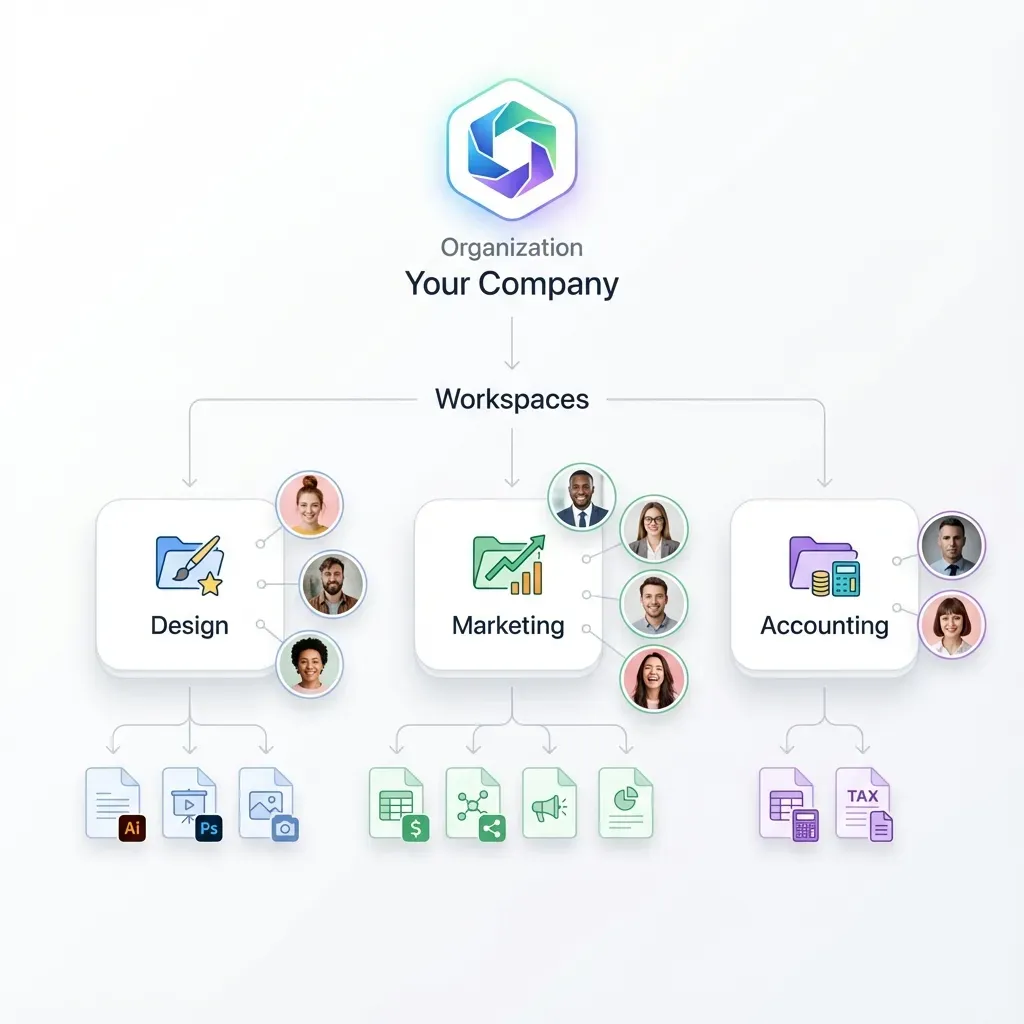
The 14-day Business Trial (credit card required; see /pricing/) provides workspace access and usage credits. For a redaction workflow, you might organize workspaces like this:
- Intake workspace: Source documents uploaded by clients or pulled via URL Import from Google Drive, OneDrive, Box, or Dropbox
- Processing workspace: Working copies with restricted access (agent-only)
- Delivery workspace: Redacted documents with redaction logs, shared with reviewers
Execution. The redaction agent itself runs in your preferred environment: a local script, a cloud function, or a containerized service. It uses MCP tools to pull documents from the intake workspace, processes them through your detection stack (Presidio, V7, or a hybrid), and pushes results to the delivery workspace. Advisory file locks let an agent lease a document before writing while others wait, and version history preserves every revision if multiple agent instances process documents concurrently.
Human review and handoff. After the agent completes a batch, reviewers access the delivery workspace through the Fastio UI. Once Intelligence Mode is enabled on the workspace, reviewers can search across all redacted documents semantically, ask questions like "which documents contained financial account numbers?" and get cited answers. Once review is complete, ownership transfer lets you hand the entire workspace to the client or legal team while retaining admin access for the agent.
Here's a simplified example of the agent workflow using MCP:
1. Agent authenticates via Fastio MCP server
2. Agent searches intake workspace for unprocessed documents
3. For each document:
   a. Download via MCP file retrieval
   b. Run OCR if scanned/image-based
   c. Detect PII using Presidio + LLM hybrid
   d. Generate redacted PDF with permanent text removal
   e. Upload redacted file + log to delivery workspace
   f. Tag original as "processed" in intake workspace
4. Agent sends webhook notification to review team
Webhooks notify the review team when a batch is ready, eliminating the need for reviewers to poll the workspace manually. The agent can also generate a batch summary: total documents processed, total entities detected by category, and any files flagged for manual review due to low-confidence detections.
Quality Assurance and Compliance
Automated redaction is only as good as your verification process. Here's how to build confidence in the output.
Dual-pass detection. Run two different detection methods on each document. If Presidio finds an entity that the LLM missed, or vice versa, flag it for review. Agreement between methods increases confidence. Disagreement highlights exactly where human attention is needed.
Sampling and spot checks. Even with automated verification, sample 5-10% of redacted documents for manual review. Track detection accuracy over time: false positives (content incorrectly redacted) and false negatives (PII that was missed). Use these metrics to tune detection thresholds and add custom recognizers for patterns your documents contain.
Redaction certificates. Generate a certificate for each document or batch that records the detection methods used, the software versions, the PII categories searched, and the total entities found and redacted. Redactable includes this feature natively. If you're building a custom pipeline, create a structured JSON log that serves the same purpose.
Retention and access policies. Decide how long to keep original (unredacted) documents after processing. In some workflows, the originals must be destroyed after redaction. In others, they're archived with strict access controls. Fastio's granular permissions let you set folder-level access so only designated compliance officers can reach the originals.
Regulatory alignment. Different regulations define PII differently. GDPR includes online identifiers and location data. HIPAA defines 18 specific PHI categories. CCPA covers household-level data. Your detection rules need to match the regulation that applies to each document set. Configure the agent to accept a "regulation profile" parameter that adjusts which entity categories are active for each processing job.
Sources
References used to verify factual claims in this guide.
-
The average data breach costs $4.88 million globally in 2024, up 10% from $4.45 million in 2023 Organizations using AI in prevention workflows reduced breach costs by $2.2 million on average
-
V7 document redaction agent supports 50+ languages and documents up to 200 pages
-
Redactable claims 98% reduction in redaction time with AI-powered workflows
Frequently Asked Questions
How do AI agents redact documents automatically?
An AI redaction agent follows a pipeline: it ingests documents from storage, runs named entity recognition and pattern matching to detect PII like names, SSNs, and financial data, generates a new document with sensitive text permanently removed, verifies no PII remains in the output, and delivers the cleaned file to a workspace or reviewer. The entire process runs without manual intervention, though most production setups include a human review step before final delivery.
What is the best AI tool for document redaction?
It depends on your requirements. V7 Go is strong for high-volume document processing with built-in QC workflows and supports 50+ languages. Redactable focuses on permanent redaction with SOC 2 and HIPAA compliance. Microsoft Presidio is the leading open-source option for teams that want full control. For an agentic approach where the tool connects to your storage and delivery systems autonomously, combining Presidio with an MCP-connected workspace like Fastio gives you flexibility without vendor lock-in.
Can AI remove PII from PDFs?
Yes. AI redaction tools extract text from PDFs (including scanned documents via OCR), detect PII entities, and generate new PDFs with the sensitive text permanently removed. The key distinction is permanent removal versus visual masking. Proper redaction strips the text from the PDF's internal structure so it cannot be recovered. Tools that only overlay black rectangles leave the original text extractable.
What types of PII can automated redaction detect?
Modern detection stacks identify direct identifiers (names, SSNs, passport numbers), contact information (emails, phone numbers, addresses), financial data (bank accounts, credit cards, tax IDs), health information (medical records, diagnosis codes), and digital identifiers (IP addresses, device IDs). Custom patterns like internal employee IDs or project codenames can be added through regex rules or fine-tuned NER models.
How accurate is AI document redaction compared to manual review?
AI redaction consistently detects structured PII (SSNs, credit card numbers, phone numbers) with over 95% accuracy. For unstructured entities like names and contextual references, accuracy depends on the model and document type. A hybrid approach using pattern matching for structured data and an LLM for contextual entities typically outperforms either method alone. The real advantage is consistency: unlike human reviewers, AI agents don't get fatigued or skip pages.
Is automated redaction legally defensible?
Automated redaction is defensible when paired with proper logging and quality controls. The agent must generate an audit trail documenting every detection and redaction decision, the methods and confidence scores used, and any human overrides. Courts and regulators care about process defensibility: showing you used validated tools, ran verification, and maintained records. Redaction certificates and sampling-based QA programs strengthen this position.
Related Resources

Give Your Redaction Agent a Workspace
Fastio provides the storage, permissions, and MCP access your redaction agent needs. generous storage.