How to Consolidate Multiple Cloud Storage Accounts Without Losing Files
Most teams scatter files across Google Drive, Dropbox, OneDrive, and Box without a plan. Over time, duplicate files pile up, permissions drift, and nobody knows which version of a document is current. This guide walks through six steps to consolidate multiple cloud storage accounts into a single workspace, covering audits, deduplication, permission mapping, and the actual transfer process.


Why Cloud Storage Sprawl Becomes a Problem
Cloud storage sprawl starts innocently. Marketing picks Dropbox. Engineering lives in Google Drive. A client insists on sharing through OneDrive. Before long, the same team is juggling three or four providers, each with its own login, sharing model, and permission structure.
Over half of users now rely on three or more cloud storage providers simultaneously, according to ConnectBit's 2025 cloud storage analysis. That fragmentation creates real problems beyond simple inconvenience.
Security exposure goes up. Each provider has its own access control model. Dropbox uses shared links and team folders. Google Drive relies on ownership-based sharing. OneDrive inherits SharePoint's role-based permissions. When files live across all three, it's nearly impossible to answer a basic question: who has access to what? A 2026 SentinelOne report found that 77% of organizations cite identity and access management as their top cloud-native security risk, and multi-cloud environments multiply that complexity because each platform handles identity differently.
Productivity goes down. Searching for a file means checking multiple apps. Version control breaks when someone edits a copy in Drive while the "official" version sits in Dropbox. Onboarding new team members requires granting access across every provider, and offboarding means revoking it everywhere too.
Costs are hard to track. Storage costs spread across multiple billing accounts are easy to overlook. Teams often pay for duplicate capacity, storing the same files in two or three places without realizing it.
The fix isn't switching from one provider to another. It's consolidating everything into a single workspace where files, permissions, and search work in one place.
Related guides
- How to Transfer Files Between Cloud Storage ServicesCloud-to-cloud file transfer moves files directly between storage providers without downloading to a local device...
- How to Plan a Cloud Storage Migration: The Complete ChecklistMoving files between cloud providers is straightforward until it isn't. Permission mismatches, broken sharing links,...
- How to Choose Video Cloud Storage for CreatorsVideo cloud storage is online storage optimized for large video files, offering streaming playback, organization, and...
- How to Transfer Google Drive Files to Another Account or ServiceGoogle Drive transfer is the process of moving files, folders, or entire accounts from Google Drive to another Google...
- File Hosting Services: What They Are, How They Work, and How to Choose OneA file hosting service is a cloud-based platform that stores, organizes, and enables sharing of digital files over the...
- How to Import Cloud Files Without Downloading Them FirstServer-side cloud import copies files directly between cloud providers without routing data through your local machine....
More on this subject: File Sharing (155 guides)
Step 1: Audit Everything Before You Move Anything
Consolidation fails when teams skip the audit. You need a complete picture of what exists, where it lives, and who touches it before you start moving files.
Start by listing every cloud storage account your team uses. Include personal accounts that people use for work, shared team drives, and any service accounts connected to automation tools. Check browser bookmarks, mobile apps, and integration settings in tools like Slack or Notion for cloud storage links you might have missed.
For each account, document:
- Total storage used and what's available on the current plan
- Number of files and folders, broken down by top-level directory
- Sharing links that are actively used by external stakeholders
- Connected integrations that read from or write to the account
- Last modified dates to identify dormant files versus active projects
Most providers offer a storage breakdown in their admin settings. Google Drive's storage management page shows file sizes and types. Dropbox's admin console reports per-user usage. OneDrive's storage metrics are buried in the Microsoft 365 admin center under Reports.
The goal is a spreadsheet or document that maps your entire cloud footprint. This becomes your migration manifest, and it prevents the most common consolidation mistake: moving active project files while leaving critical shared links pointing at the old location.
Step 2: Identify and Remove Duplicates
Deduplication before migration saves time, storage costs, and confusion. Most teams discover that 20-30% of their cloud storage is redundant once they actually look.
Duplicates accumulate in predictable patterns. Someone downloads a file from Google Drive, edits it locally, and uploads it to Dropbox. A shared folder gets copied instead of moved. Automated backup tools create mirror copies across providers. The result is the same file living in three places with slightly different names.
Manual deduplication works for smaller accounts. Sort files by size to find obvious duplicates, then check modification dates to identify the most recent version. Delete the older copies.
Automated deduplication tools handle larger volumes. Rclone's dedupe command can identify and resolve duplicates within a single provider. For cross-provider deduplication, tools like Duplicate Cleaner or Easy Duplicate Finder can scan local copies of your cloud storage (synced via desktop apps) and flag matches by content hash rather than filename.
Before deleting anything, establish a rule: keep the version with the most recent modification date and the richest permission set. If a file in Google Drive has been shared with six people but the Dropbox copy is newer, you'll need to merge both attributes into the consolidated version.
A practical approach for teams:
- Export file lists from each provider (name, size, modified date, path)
- Sort by file hash or size to group potential duplicates
- Review grouped files and pick the canonical version
- Tag files for deletion in the source after migration confirms success


Bring All Your Cloud Files Into One Workspace
Fastio imports files from Google Drive, Dropbox, OneDrive, and Box with folder structure preserved.
Step 3: Map Permissions Across Providers
Permission mapping is where most consolidation projects stall. Each cloud provider models access differently, and those differences matter.
Google Drive treats files as owned by individuals. The owner can share with specific people, anyone with the link, or the entire organization. Shared Drives shift ownership to the team, but personal Drive files still belong to whoever created them.
Dropbox uses team folders and shared links. Team folders have member-level access (edit or view). Shared links can be password-protected and time-limited. Dropbox Business adds group-based permissions.
OneDrive/SharePoint inherits Microsoft 365's permission model. Site-level permissions cascade to document libraries and individual files. Sharing links can be organization-wide, specific people, or anonymous.
Box uses a collaboration model with seven permission levels (from Uploader to Co-Owner) at the folder level.
To map these to a single destination, create a permission translation table:
- List every shared folder and file with external access
- Note the permission level (view, edit, upload, admin)
- Identify the equivalent permission in your destination platform
- Flag any permissions that don't have a direct equivalent
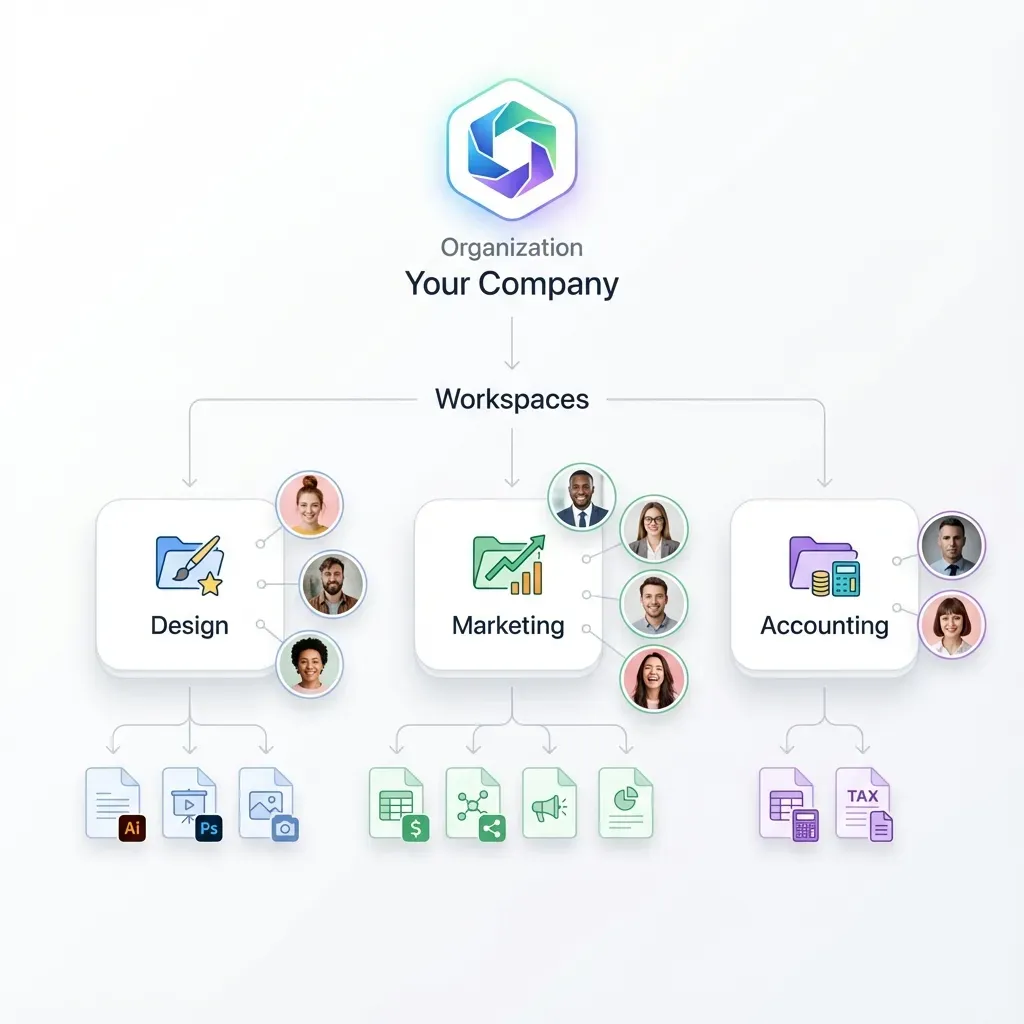
For example, if your destination supports granular permissions at the organization, workspace, folder, and file level, you can replicate most access patterns from any source provider. Fastio's permission model covers org-level, workspace-level, folder-level, and file-level access, which maps cleanly to the models used by Google Drive, Dropbox, OneDrive, and Box. The key is documenting the mapping before you move files, not trying to figure it out afterward.
External sharing links deserve special attention. If clients or vendors use shared links that point to your current provider, those links break the moment you move the files. Plan for redirect notices or re-share from the new location.
Step 4: Choose Your Consolidation Method
There are three practical approaches to consolidating cloud storage accounts. The right one depends on how much data you're moving, how many integrations depend on your current setup, and how much downtime you can tolerate.
Direct cloud-to-cloud import
The fastest option for most teams. Services that support cloud-to-cloud import connect to your source providers via OAuth and pull files directly, without downloading to a local machine first. This preserves folder structure and avoids bandwidth bottlenecks.
Fastio's Cloud Import supports Google Drive, Dropbox, OneDrive, and Box. You authenticate with each provider, select folders to import, and files transfer server-side with folder structure preserved. Imported files are automatically indexed by Ripley AI for search and chat, which means your consolidated workspace is immediately searchable across everything you've imported.
Other cloud-to-cloud tools include MultCloud, which supports transfers between 30+ providers, and rclone, an open-source command-line tool that handles syncing between virtually any storage backend.
Desktop sync and re-upload
If your destination doesn't support direct import, you can sync files to a local machine using each provider's desktop app, then upload to the new destination. This works but has drawbacks: it requires enough local disk space for all your files, it's slow for large datasets, and it doesn't preserve sharing permissions.
Hybrid approach
For large consolidation projects, combine both methods. Use cloud-to-cloud import for bulk transfers and handle edge cases (files with complex permissions, deeply nested integrations) through manual moves. This is the most realistic approach for teams with more than a terabyte of data spread across providers.
Whichever method you choose, run a test batch first. Move one folder, verify the files, check permissions, and confirm that nothing broke before migrating everything.

Step 5: Execute the Migration in Phases
Moving everything at once is tempting but risky. A phased migration lets you catch problems early and adjust before they compound.
Phase 1: Archive and inactive files. Start with files nobody is actively working on. Old project archives, completed deliverables, and reference documents that rarely change. These files are low-risk because nobody will notice if the transfer takes a few hours, and any permission issues won't block active work.
Phase 2: Shared team folders. Move collaborative workspaces next. These are higher-stakes because multiple people access them daily, but they're also well-structured, making them easier to verify post-transfer. Notify your team before moving shared folders so they know to check the new location.
Phase 3: Active projects. Move active project files last. Time this for a low-activity period, such as a Friday afternoon or weekend. Immediately after the transfer, verify that files open correctly, permissions match your mapping document, and any integrations still work.
Phase 4: External-facing shares. Shared links and client-facing portals come last because they require coordination with people outside your organization. Update shared links, notify recipients of the new location, and set up redirects from the old sharing URLs where possible.
Throughout each phase, maintain a parallel period where files exist in both the old and new locations. Don't delete source files until you've confirmed the transfer is complete and permissions are correct. Two weeks of overlap is a reasonable default for most teams.
Keep a migration log that tracks each batch: what was moved, when, any errors encountered, and the verification status. This log becomes essential if you need to roll back a specific batch.
Step 6: Set Up Your Consolidated Workspace
Consolidation isn't done when the files finish copying. The real value comes from organizing your unified workspace so the sprawl doesn't return.
Establish a folder structure standard. Define top-level categories that make sense for your team, such as by client, by department, or by project. Document the structure and share it with everyone who has access. The goal is making it obvious where new files should go.
Configure permissions from the top down. Set organization-wide defaults, then customize at the workspace and folder level where needed. This is more maintainable than file-by-file permissions because new files inherit the right access automatically.
Enable search and indexing. A consolidated workspace is only useful if people can find what they need. If your platform supports full-text search or semantic search, enable it during setup rather than after. Fastio workspaces with Intelligence enabled automatically index files for semantic search and AI-powered chat, so your team can ask natural language questions across the entire consolidated library.
Set up integrations. Reconnect any tools that previously pointed at your old cloud storage accounts. This includes Slack file previews, project management tool attachments, CI/CD pipelines, and any automation workflows. Update webhook URLs and API endpoints to reference the new location.
Create a "new files" policy. The most important step for preventing re-sprawl. Make it clear that all new files go into the consolidated workspace. If someone needs to use a different provider for a specific client, create a recurring import job that pulls those files into the central workspace automatically. Fastio's Cloud Import can handle ongoing imports from Google Drive, Dropbox, OneDrive, and Box for exactly this situation.
Decommission old accounts. After the parallel period ends and you've verified everything, downgrade or close the old storage accounts. Keep read-only access for 90 days as a safety net, then fully retire them.
Sources
References used to verify factual claims in this guide.
-
Over half of users now rely on three or more cloud storage providers simultaneously
-
77% of organizations cite identity and access management as their top cloud-native security risk
Frequently Asked Questions
How do I combine all my cloud storage into one?
Start by auditing every cloud account your team uses, including personal accounts used for work. Remove duplicates, map permissions across providers, then use a cloud-to-cloud import tool to transfer files directly without downloading them locally. Fastio Cloud Import supports Google Drive, Dropbox, OneDrive, and Box transfers that preserve folder structure. After the transfer, set up a folder structure standard and a clear policy for where new files go to prevent re-sprawl.
Can I merge Google Drive and Dropbox into one account?
You can't literally merge the accounts, but you can consolidate the files into a single workspace. Use a cloud-to-cloud transfer service to move files from both Google Drive and Dropbox into one destination. The main challenge is permission mapping, since Google Drive uses ownership-based sharing while Dropbox uses team folders with member access levels. Document the permission equivalents before you start transferring.
What is the best way to manage multiple cloud storage accounts?
If you must keep multiple accounts, use a cloud storage aggregator like MultCloud, Koofr, or rclone to view all providers in one interface. But aggregators only mask the problem. For a real solution, consolidate into a single workspace that supports cloud import from your existing providers, then set up recurring imports for any accounts you can't close. This gives you unified search, consistent permissions, and one place to manage access.
Will I lose file permissions when consolidating cloud storage?
Permissions don't transfer automatically between providers because each platform models access differently. Google Drive uses ownership-based sharing, Dropbox uses team folders, OneDrive inherits SharePoint roles, and Box has seven collaboration levels. Before migrating, create a permission translation table that maps each source permission to the equivalent in your destination platform. Rebuild permissions in the new location before granting team access.
How long does cloud storage consolidation take?
It depends on the volume of data and number of providers involved. A small team with under 100 GB across two providers can finish in a weekend. Larger organizations with terabytes of data across four or five providers should plan for 2-4 weeks, including audit, test migrations, phased transfers, and a parallel period where files exist in both old and new locations.
Should I delete files from old cloud accounts after consolidating?
Not immediately. Keep the old accounts in read-only mode for at least two weeks after migration, ideally 90 days. This gives your team time to discover any missing files, broken links, or permission gaps. Only delete source files after you've confirmed the transfer is complete, permissions are correct, and all external sharing links have been updated to point to the new location.
Related Resources

Bring All Your Cloud Files Into One Workspace
Fastio imports files from Google Drive, Dropbox, OneDrive, and Box with folder structure preserved.