Best Tools for AI Agent Prompt Versioning in 2026
Prompt versioning tools track changes to agent prompts over time, enabling teams to roll back regressions, A/B test variations, and maintain audit trails for production AI systems. This guide compares eight tools purpose-built for versioning agent prompts, from open-source CLI frameworks to full-lifecycle platforms with deployment gates and evaluation pipelines.


Why Prompt Versioning Matters for Production Agents
A single change to an agent's system prompt can cause it to hallucinate product details, select the wrong tool, or fail quality thresholds across an entire pipeline. Unlike traditional code, prompts are non-deterministic. You cannot run unit tests and be confident they will generate the same output every time. This makes version control both harder and more important than it is for application code.
Production agent teams typically iterate on prompts 5 to 15 times per week. Each iteration carries risk: research from Microsoft's AI agent evaluation library shows that prompt regressions are the leading cause of agent quality degradation in production, often manifesting as silent drift rather than hard failures. Standard error-rate monitoring misses these regressions entirely because the agent still responds, just worse.
The tools in this guide address that gap. They provide diff views so you can see exactly what changed, rollback mechanisms to revert bad deployments in seconds, evaluation gates that block regressions before they reach users, and audit trails that satisfy compliance requirements.
How we evaluated these tools:
- Version history with immutable snapshots and diff views
- Rollback speed (one-click or API-driven revert)
- Environment management (dev, staging, production promotion)
- Evaluation integration (automated quality gates on version changes)
- Agent-specific features (tool-use tracking, multi-step prompt chains)
- Deployment options (self-hosted, cloud, hybrid)
- Pricing accessibility for small teams
Related guides
- Top 5 Tools Every LangGraph Developer NeedsLangGraph lets you build stateful, cyclic AI agents, but the framework alone isn't enough. You need tools for...
- Top 7 Tools for AutoGen Agents in 2026Guide to tools autogen agents: AutoGen tools enable multi-agent conversations to execute code, browse the web, and...
- Best AI Tools for Developers in 2026Most "best AI tools" lists stop at coding assistants. This guide covers 14 tools across every phase of the software...
- Best AI Tools for Web Development in 202684% of developers use or plan to use AI coding tools, but only 29% trust what the tools produce. This guide evaluates...
- Best Tools for Multi-Modal AI Agents in 2026Multi-modal AI agents need more than a capable model. They need infrastructure to store, index, retrieve, and deliver...
- Best Agentic Coding Tools in 2026: A Developer's Honest RankingAgentic coding tools have moved past autocomplete into full task execution. We ranked the 10 most-used options of 2026...
More on this subject: AI Tool Directories and Comparisons (231 guides)
1. Langfuse
Langfuse is an open-source LLM engineering platform that combines prompt versioning with full observability. Every prompt change creates an immutable version with an auto-incrementing ID, and you can assign labels like "production" or "staging" to any version. Rolling back means moving the production label to a previous version, no code changes required.
Key versioning features:
- Immutable version history with automatic numbering
- Diff view showing changes between any two versions
- Label-based deployment (assign "production" to promote a version)
- One-click rollback by reassigning labels
- SDK caching for low-latency prompt retrieval at runtime
- Full trace linkage showing which prompt version produced which outputs
Best for: Teams that want self-hosted version control tightly coupled with tracing and evaluation. Langfuse gives you the full picture: which version ran, what it produced, and how it scored.
Limitations: The evaluation framework is less opinionated than dedicated eval platforms. You bring your own scoring logic rather than getting pre-built quality metrics out of the box.
Pricing: Free self-hosted (MIT license). Cloud plan starts free with usage-based pricing for higher volumes.

2. Braintrust
Braintrust treats prompt versioning and evaluation as inseparable. Every prompt update is automatically evaluated against real test data, so teams see whether output quality improves or degrades before changes reach production. The platform uses environment-based deployment where prompts move through dev, staging, and production only after passing defined quality gates.
Key versioning features:
- Environment-based promotion (dev to staging to production)
- Automatic evaluation on every version change
- Quality gates that block deployment if scores drop
- Production monitoring that surfaces quality drift in real time
- Loop AI co-pilot for non-technical prompt iteration
- Dataset versioning linked to prompt versions
Best for: Teams where evaluation rigor is the priority. If you want to guarantee that no prompt regression reaches production, Braintrust's gate system enforces that structurally rather than relying on manual review.
Limitations: The evaluation-first approach adds overhead for quick iteration. Teams doing rapid experimentation may find the gate system slows them down during early development phases.
Pricing: Free tier available. Pro plan with advanced features at usage-based pricing.


Store what your agents produce between prompt iterations
Fastio gives every agent run a persistent, searchable workspace. generous storage, MCP-native access.
3. Agenta
Agenta uses a Git-style versioning model with branches, commits, and environments. Each prompt variant gets its own branch with independent commit history, enabling parallel experimentation without affecting production. When a variant is ready, you deploy it to an environment, and the agent fetches the active version at runtime.
Key versioning features:
- Git-style branching with independent commit histories per variant
- Environment-based deployment (dev, staging, production)
- A/B testing with traffic splitting between variants
- Prompt and deployment registry for centralized management
- Human and LLM feedback scoring per version
- Full RBAC, SSO, and audit logs (open-source under MIT)
Best for: Teams running multiple prompt experiments simultaneously. The branching model lets five engineers iterate on five different approaches without stepping on each other, then deploy the winner without code changes.
Limitations: The Git metaphor can feel heavyweight for solo developers or small teams. If you have one prompt and one person iterating on it, the branching model adds unnecessary complexity.
Pricing: Free and open source (MIT). Cloud offering available for managed hosting.
4. Portkey
Portkey approaches prompt versioning as part of a broader AI gateway. It logs all prompt template changes with version history, author attribution, and timestamps. The platform supports any LLM provider through a unified interface, so you version prompts once and deploy them across OpenAI, Anthropic, Mistral, or open-source models without rewriting templates.
Key versioning features:
- Centralized prompt templates with full version history
- Author attribution and change timestamps on every version
- Provider-agnostic templates (write once, deploy to any model)
- Playground for testing versions before promotion
- Semantic caching with unlimited TTL on Pro plan
- Gateway-level observability and cost tracking per version
Best for: Teams using multiple LLM providers who want one versioning system across all of them. Portkey's gateway architecture means your prompt management layer is decoupled from any single model vendor.
Limitations: Prompt versioning is one feature within a larger gateway product. Teams wanting deep evaluation or branching workflows may find Portkey's versioning lighter than dedicated platforms.
Pricing: Free tier with basic features. Pro plan adds version control, semantic caching, and detailed observability. Enterprise includes enterprise security standards, strict security requirements, and private cloud deployment.
5. Promptfoo
Promptfoo takes a developer-first, CLI-driven approach. Prompts, test cases, and evaluations live in YAML files inside your existing Git repository, so version control comes from Git itself. The tool adds systematic evaluation on top: define assertions, run batch comparisons across prompt variants, and integrate into CI/CD pipelines as a quality gate.
Key versioning features:
- YAML-based prompt definitions stored in your Git repo
- Batch evaluation comparing multiple prompt versions simultaneously
- CI/CD integration (GitHub Actions, GitLab CI) for automated testing on PR
- Red-teaming and security scanning (prompt injection, PII exposure)
- Multi-provider testing across OpenAI, Anthropic, Google, open-source models
- Local execution for data privacy (nothing leaves your machine)
Best for: Engineering teams who want prompts versioned alongside application code using familiar Git workflows. If your team already reviews PRs for code changes, Promptfoo lets you review prompt changes the same way.
Limitations: No hosted UI for non-technical collaborators. Domain experts or product managers who want to iterate on prompts need to work through the CLI or a code editor. The lack of a prompt registry means runtime fetching requires custom infrastructure.
Pricing: Free and open source (MIT license).
6. LaunchDarkly AI Configs
LaunchDarkly extends its feature flag platform to AI prompt management through AI Configs. Prompts, model selections, and parameters become flags that you toggle at runtime without redeploying. The CI/CD pipeline tests prompt changes against golden datasets using LLM-as-judge scoring before starting a guarded rollout, catching quality regressions in PRs instead of production.
Key versioning features:
- Runtime prompt switching without code deploys
- Quality gates in CI/CD that test against golden datasets
- LLM-as-judge evaluation producing accuracy scores and latency metrics
- Percentage-based rollouts (serve new prompt to 5% of traffic, then expand)
- User segment targeting (different prompts for different user cohorts)
- Full audit trail of who changed what and when
Best for: Teams already using feature flags who want the same progressive delivery model for prompts. LaunchDarkly's strength is controlled rollouts: test with 1% of traffic, monitor quality scores, then expand or roll back based on data.
Limitations: This is a feature management platform with AI capabilities added, not a purpose-built prompt engineering tool. You get deployment control but not a prompt playground, evaluation framework, or observability layer. Requires pairing with other tools for the full workflow.
Pricing: Enterprise pricing. Contact sales for AI Configs access.
7. PromptLayer
PromptLayer positions itself as the prompt registry for production teams. It wraps your existing LLM calls with a few lines of code and immediately provides logging, version history, and deployment controls. The middleware approach means minimal integration friction, making it accessible for teams that want prompt versioning without overhauling their architecture.
Key versioning features:
- Prompt registry with deployment-oriented versioning
- Visual editor for non-technical collaborators
- Evaluation and ranking workflows with batch runs
- Regression-style checks on prompt updates
- Tracing with usage and cost visibility
- Minimal integration (2-3 lines of code to start logging)
Best for: Teams that want the fast path from zero to versioned prompts. PromptLayer's middleware design means you can add it to an existing agent in minutes and immediately get version history, without migrating to a new framework.
Limitations: Less depth on evaluation compared to platforms like Braintrust or Agenta. The trade-off for minimal integration is a lighter feature set around automated quality gates and multi-environment deployment.
Pricing: Free tier for individual developers. Team and enterprise plans with advanced features and support.
How Fastio Fits Into Your Prompt Versioning Workflow
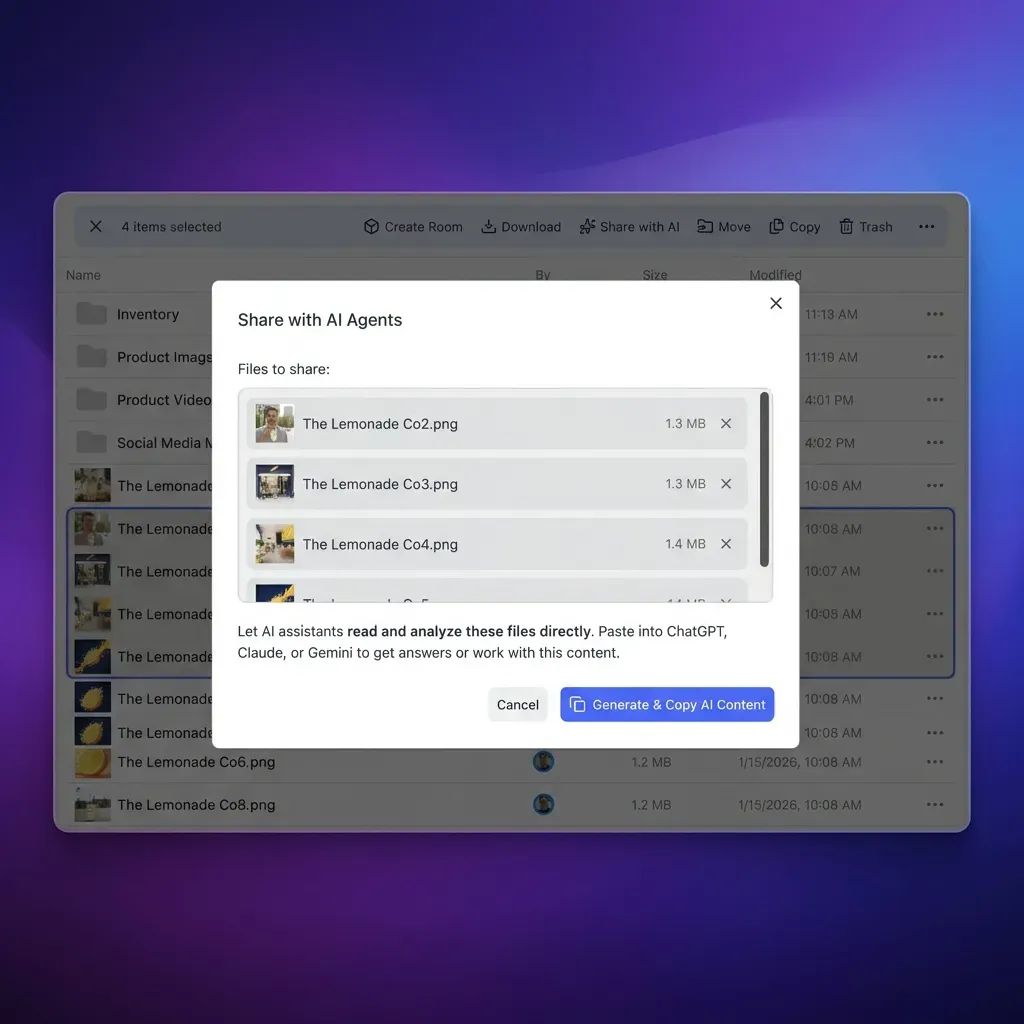
Prompt versioning tools handle the prompt lifecycle, but agents also produce artifacts: generated files, research documents, processed data, and handoff packages. Fastio provides the persistent workspace layer where those artifacts live, versioned and searchable through Intelligence Mode's built-in RAG.
For teams running prompt experiments across multiple agent configurations, Fastio workspaces give each variant its own storage context. The MCP server exposes a consolidated MCP toolset for workspace operations, so agents can read prompt outputs, write results, and hand finished work to humans, all through a single integration point.
A practical workflow looks like this: Braintrust or Langfuse manages your prompt versions and evaluation scores. Your agent runs with the promoted prompt version and writes its output to a Fastio workspace. Intelligence Mode indexes that output for semantic search. When the work is ready, you transfer ownership to the client or teammate who needs it, with full audit trail of what each prompt version produced.
Fastio offers a 14-day Business Trial (card required; see /pricing/) with paid plans starting at $9.99/mo.
Sources
References used to verify factual claims in this guide.
-
67% of production RAG systems experience significant retrieval accuracy degradation within 90 days
-
Langfuse provides immutable version history with diff views and label-based deployment
-
Braintrust uses environment-based deployment with quality gates that block deployment if scores drop
-
Agenta uses a Git-style versioning model with branches and environments under MIT license
-
LaunchDarkly AI Configs tests prompt changes against golden datasets with LLM-as-judge scoring in CI/CD
-
Promptfoo is open source under MIT license with CI/CD integration for automated prompt testing
Frequently Asked Questions
How do you version control AI prompts?
You can version prompts using dedicated platforms like Langfuse or Braintrust that maintain immutable version histories with diff views, or store prompts as YAML files in Git using tools like Promptfoo. Dedicated platforms add evaluation gates, environment-based deployment, and runtime fetching that plain Git does not provide. Most production teams use a hybrid: Git for source-of-truth storage and a prompt registry for runtime delivery and rollback.
What tools track prompt changes for agents?
Langfuse, Braintrust, Agenta, PromptLayer, and Portkey all provide prompt version tracking with change history, author attribution, and environment management. Langfuse and Agenta are open source and self-hostable. Promptfoo tracks changes through Git integration and adds automated evaluation. LaunchDarkly AI Configs adds feature-flag-style progressive rollouts to prompt changes.
Is Git good for prompt versioning?
Git handles the source-of-truth aspect well: you get diffs, blame, branching, and PR reviews for free. The gap is everything that happens after merge. Git does not provide runtime prompt fetching, environment-based deployment, evaluation on change, rollback without redeploying, or A/B testing between versions. Tools like Promptfoo bridge some of this gap by adding evaluation layers on top of Git, but most teams eventually add a dedicated prompt registry for production delivery.
How do teams manage prompt updates in production?
Production teams typically use environment-based promotion: prompts start in dev, pass automated evaluations to reach staging, then get promoted to production only after quality gates confirm no regression. Platforms like Braintrust enforce this structurally. LaunchDarkly adds percentage-based rollouts so you can test a new prompt with 5% of traffic before full deployment. The common pattern is: evaluate locally, gate in CI, canary in production, then expand or roll back based on quality metrics.
What is the difference between prompt management and prompt versioning?
Prompt management is the broader discipline covering creation, editing, organization, and collaboration on prompts. Prompt versioning is one component focused specifically on tracking changes over time, maintaining history, enabling rollback, and controlling which version runs in which environment. Most tools marketed as prompt management platforms include versioning as a core feature alongside playgrounds, evaluation, and observability.
Related Resources

Store what your agents produce between prompt iterations
Fastio gives every agent run a persistent, searchable workspace. generous storage, MCP-native access.