How to Secure AI Agents: A Practical Security Guide
AI agents operate autonomously, access sensitive files, and call external APIs, which makes them attractive attack targets. This guide covers ten security practices for production agent systems: scoped identities, least-privilege access, environment isolation, secure file handling, monitoring, dependency scanning, human oversight, webhook-based alerting, rate limiting, and lifecycle management.


Why Agent Security Is Different
Traditional application security assumes a human user behind every action. AI agents break that assumption. They authenticate with API keys, make thousands of decisions per minute, and access files across systems without anyone watching in real time.
That autonomy creates real risk. IBM's 2025 Cost of a Data Breach report found that 13% of organizations experienced breaches involving AI models or applications, and 97% of those organizations lacked proper AI access controls. Shadow AI incidents, where agents operate outside IT governance, cost an average of $4.63 million per breach, $670,000 more than standard incidents.
Agent file access is the most common attack surface in autonomous systems. An agent that can read, write, and delete files across an organization needs the same security scrutiny as a privileged service account. The difference is that agents are harder to predict: their behavior emerges from model reasoning, not deterministic code paths.
OWASP's AI Agent Security Cheat Sheet identifies twelve major risk categories for agents, including prompt injection, tool abuse, data exfiltration, and memory poisoning. The common thread across all of them is excessive trust: agents granted too much access, running without monitoring, operating with shared credentials.
Three principles anchor effective agent security:
- Clear ownership. Every agent has a documented owner and business justification. No orphaned agents making decisions without accountability.
- Scoped permissions. Agents get only what they need for their specific task. Broad access is a security failure, not a convenience.
- Full observability. Every agent action is logged, tracked, and available for review. You can't secure what you can't see.
Related guides
- Best AI Agent Security Tools in 2026Autonomous AI agents introduce new attack vectors like prompt injection, unauthorized actions, and data exfiltration....
- Best AI Agent Sandboxes for Secure Code Execution in 2026AI agents need a safe place to run code. Sandboxes provide isolated compute environments where agents can execute...
- Agentic AI Security Risks: Threats, Vulnerabilities, and MitigationsAI agents that can plan actions, call tools, and access files introduce security risks that go well beyond prompt...
- AI Agent Output Attestation: A Practical GuideAI agents now write contracts, generate reports, and trigger payments. Before any of that output moves downstream, the...
- How to Implement Secure Data Versioning for AI AgentsSecure AI agent data versioning tracks changes to files and data generated by agents, using access controls and audit...
- Best Code Execution Sandboxes for AI Agents in 2026Code execution sandboxes let AI agents run generated code in isolated environments without risking your host system....
More on this subject: Agent Security and Governance (65 guides)
Identity, Access, and Isolation
1. Treat Agents as Non-Human Identities
The single most effective control is giving each agent its own scoped identity. When agents share API keys or inherit broad service account roles, you lose the ability to audit individual actions and revoke access granularly.
Each agent should:
- Register with its own account and unique credentials
- Never share API keys with other agents
- Have role-based access at the agent level
- Be individually revocable without affecting other systems
On Fastio, AI agents sign up for their own accounts, create workspaces, and manage permissions independently. Disabling one agent means revoking that single identity, not rotating credentials across your entire fleet.
2. Apply Least-Privilege Access
Start with zero permissions and add only what the agent's task requires. If an invoice-processing agent needs to read files from one folder, don't grant write access to the entire organization.
Think about permissions at every level:
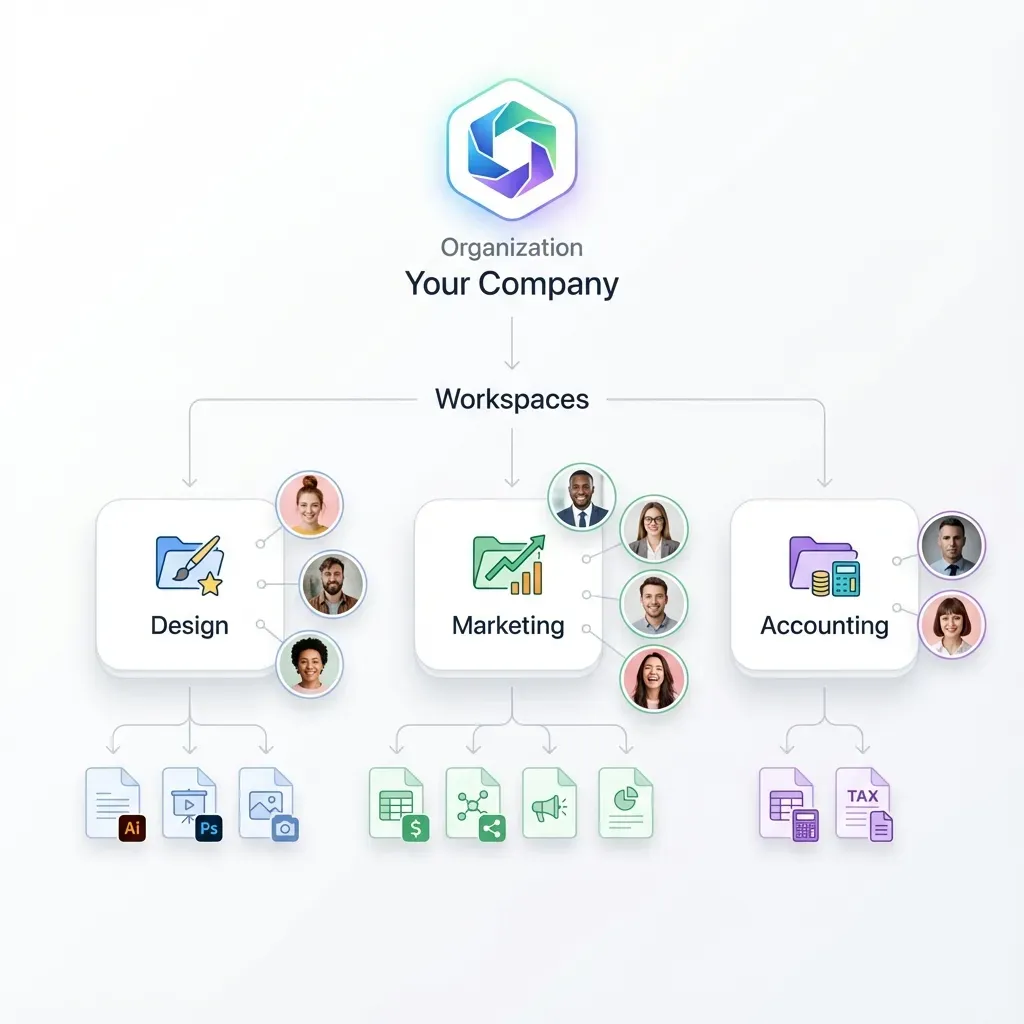
- Organization: Can the agent see all workspaces or only specific ones?
- Workspace: Read-only, comment-only, or full edit access?
- Folder: Access to specific project directories only
- File: Some files should remain completely off-limits
Fastio enforces granular permissions at organization, workspace, folder, and file levels. An agent processing invoices gets read access to the "Invoices" workspace but cannot touch "Legal Contracts."
3. Isolate Agent Environments
Run agents in sandboxed environments. Segment their network access. If one agent is compromised, isolation prevents lateral movement to other systems.
Practical isolation includes:
- Container-based execution with restricted system calls
- Network segmentation limiting which APIs and services agents can reach
- Separate storage namespaces per agent or project
- Blocked access to production databases unless explicitly required
On Fastio, each workspace acts as an isolation boundary. Files uploaded by one agent stay isolated from other agents unless a workspace member explicitly shares them. This prevents accidental data leakage between unrelated tasks.



Secure Your Agent Workflows from Day One
Fastio provides workspaces, granular permissions, encryption, and a detailed activity log for agent file storage.
Securing Agent File Operations
4. Lock Down File Access
File handling is where most agent security breaks down. Agents download sensitive documents, process them in temporary directories, upload outputs, and leave artifacts behind. Without controls, those artifacts become data leaks.
A secure file workflow has six layers:
- Authentication. The agent uses its dedicated credentials, not a shared key.
- Authorization. Before touching a file, the system verifies the agent has the required permission level.
- Encryption. Files are encrypted at rest and in transit. TLS for transfers, encryption for storage.
- Locking. File locks prevent race conditions when multiple agents work on the same document.
- Audit logging. Every access is recorded with agent identity, file path, timestamp, and action type.
- Isolation. Files in different workspaces remain separated unless explicitly shared.
Fastio provides encryption, advisory file locks to coordinate concurrent writes, granular permissions, and a detailed activity log. Workspace membership and permissions help prevent cross-project data access.
For additional file security, consider:
- Scoped file access tokens that expire after a set period
- Download watermarking for traceability on sensitive documents
- File-type restrictions that block agents from accessing certain formats
5. Scan Dependencies and Patch Regularly
AI agents run on deep dependency stacks that change frequently. A single vulnerable library can open a backdoor into your entire agent infrastructure.
Automated security scanning should be part of every agent deployment pipeline:
- Run dependency vulnerability scans on every build
- Use static analysis tools like Semgrep or CodeQL to catch insecure patterns
- Monitor CVE databases for vulnerabilities affecting your agent frameworks
- Review third-party libraries before integrating them into agent code
- Keep agent framework versions current, not pinned to outdated releases
Don't wait for production to discover that your agent framework has a remote code execution vulnerability. Automated scanning catches these issues before deployment.
Monitoring, Oversight, and Response
6. Monitor Agent Behavior Continuously
Treat AI agents like production microservices. That means logging, alerting, anomaly detection, and clear escalation paths when something looks wrong.
Track these signals:
- API call patterns. A sudden spike in requests may indicate compromise or a runaway loop.
- File access patterns. An agent that normally reads ten files a day accessing thousands is a red flag.
- Error rates. Unusual failure patterns can indicate injection attacks or tool abuse.
- Resource consumption. Monitor CPU, memory, and network to catch resource exhaustion attacks.
- Credential usage. Detect when agent credentials are used from unexpected locations or IP ranges.
Fastio audit logs capture workspace joins, file uploads, permission changes, and download activity. Export those logs to your SIEM for correlation with other security events and build dashboards that surface unusual patterns.
7. Use Webhooks for Real-Time Alerting
Polling for security events introduces lag. By the time you check logs, a compromised agent may have exfiltrated data hours ago.
Webhooks enable real-time response:
- Alert your security team when an agent accesses a restricted workspace
- Trigger review workflows for bulk file downloads
- Notify on sensitive file modifications or deletions
- Forward agent activity to external SIEM systems as events occur
Use Fastio's activity feed or WebSocket events feed to monitor file and workspace activity during security workflows.
8. Require Human Oversight for High-Risk Operations
Some agent actions need a human in the loop. This isn't optional for many regulated industries, and it's good practice everywhere.
Require human approval before agents can:
- Delete files or data
- Change access control policies or permissions
- Execute high-value financial transactions
- Communicate with external parties
- Access personally identifiable information (PII) in bulk
Fastio's ownership transfer supports this pattern well. An agent builds a complete data room with files, structure, and permissions, then transfers ownership to a human who reviews everything before sharing externally.

Governance and Lifecycle Management
9. Set Rate Limits and Quotas
Rate limiting prevents runaway agents from exhausting resources or racking up unexpected costs. OWASP calls this the "denial of wallet" attack: an agent stuck in a loop burns through API credits or storage capacity before anyone notices.
Set quotas on:
- API requests per minute and per hour
- File uploads and downloads per day
- Storage capacity per agent
- Bandwidth consumption limits
- AI inference token budgets
When an agent hits a rate limit, investigate the cause. Legitimate workload increases should be planned and gradual. Sudden spikes usually indicate bugs, infinite loops, or compromise.
Set operational guardrails in your agent environment, such as rate limits and spend alerts. Fastio plans start at $9.99 a month for Starter, with a 14-day trial; see /pricing/ for current plan details.
10. Maintain an Agent Inventory
You can't secure agents you don't know about. Maintain a complete registry of every agent, its purpose, its owner, and its access scope.
Agent lifecycle management:
- Provisioning. Document the agent's purpose, owner, and intended access scope before deployment.
- Operation. Conduct regular access reviews to verify permissions are still appropriate for the agent's current role.
- Credential rotation. Update API keys on a fixed schedule. Quarterly is a reasonable starting point.
- Decommissioning. Disable agents that are no longer needed. Revoke all access tokens. Remove workspace memberships.
Orphaned agents are a serious risk. When a team member leaves the company, their experimental agents need to be identified, reviewed, and either reassigned or disabled. Treat agent credentials with the same rigor as any other privileged identity in your organization.
Production Readiness Checklist
Before deploying any AI agent to production, walk through this checklist:
- Agent has a unique, non-shared identity with its own credentials
- Permissions follow least privilege (you can list what the agent cannot do)
- Agent runs in an isolated environment (container, sandbox, or separate workspace)
- All file access is logged with agent identity, timestamp, and action type
- Dependencies are scanned for known vulnerabilities
- High-risk operations require human approval before execution
- Rate limits and resource quotas are configured
- Monitoring and alerting are active with defined escalation paths
- Agent has a documented owner and business justification
- Incident response plan covers agent compromise scenarios
This isn't a one-time exercise. Schedule quarterly reviews to verify that permissions haven't drifted, credentials have been rotated, and agents that are no longer needed have been decommissioned.
For teams building agent workflows that involve file storage and collaboration, Fastio workspaces provide workspaces, a detailed activity log, granular permissions, advisory file locks, and encryption. The Business Trial lasts 14 days and requires a credit card; see /pricing/ for current details.
Sources
References used to verify factual claims in this guide.
-
13% of organizations reported breaches of AI models or applications, 97% of which lacked proper AI access controls
-
Shadow AI breaches cost $4.63 million on average, $670,000 more than standard incidents
-
OWASP identifies 12 major risk categories for AI agents
-
AI incidents jumped 56.4% year-over-year with 233 reported cases in 2024
Frequently Asked Questions
How do you secure AI agent credentials?
Give each agent its own unique API key or account. Never share credentials across multiple agents. Store secrets in a dedicated vault, not hardcoded in config files. Rotate credentials on a regular schedule, quarterly at minimum. Set up automatic revocation when agents are decommissioned. This ensures you can track individual agent activity and revoke access without disrupting other systems.
What are the biggest security risks with AI agents?
The top risks are excessive permissions (agents with broader access than their task requires), shared credentials (losing individual accountability), prompt injection (attackers manipulating agent behavior through malicious input), lack of monitoring (inability to detect compromise), dependency vulnerabilities (outdated libraries with known CVEs), and insufficient isolation (one compromised agent affecting others). File access is the most common attack surface in autonomous systems.
Should AI agents run in sandboxed environments?
Yes. Sandboxing limits the blast radius if an agent is compromised. Use container-based execution, network segmentation, and separate storage namespaces. An isolated agent cannot pivot to other systems or access resources outside its designated boundaries. For file storage, workspace-level isolation prevents agents from accessing data belonging to other projects or teams.
How do you monitor AI agent security?
Set up comprehensive audit logging of all agent actions including file access, API calls, and permission changes. Configure anomaly detection for unusual patterns like sudden activity spikes or access to restricted resources. Export logs to a SIEM for correlation with other security events. Use webhooks for real-time alerting on sensitive operations rather than relying on periodic log reviews.
What is least-privilege access for AI agents?
Least privilege means agents receive only the minimum permissions required for their specific task. Start with zero access and add permissions incrementally as justified. If an agent processes invoices, grant read access to the invoices folder only, not write access to the entire organization. Review permissions quarterly to catch scope creep.
Do AI agents need human oversight?
Yes, especially for high-risk operations like data deletion, permission changes, financial transactions, or communication with external parties. Human-in-the-loop workflows require approval before sensitive actions execute. In regulated industries, this is often a legal requirement. Build approval workflows where agents prepare work and humans review before it takes effect.
How do you protect agent file access?
Encrypt files at rest and in transit. Use scoped access tokens that expire automatically. Implement file locks for concurrent access scenarios. Log every file operation with agent identity and timestamp. Control whether agents can download files or only view them. Use workspace-level isolation to prevent agents from reaching files outside their assigned scope.
What should an AI agent incident response plan include?
Cover five phases: detection (monitoring alerts and log analysis to identify compromise), containment (revoke credentials, disable the agent, isolate affected systems), investigation (determine the scope of the breach and which data was affected), remediation (patch vulnerabilities, rotate credentials, restore from clean backups), and communication (notify stakeholders and document lessons learned for future prevention).
Related Resources

Secure Your Agent Workflows from Day One
Fastio provides workspaces, granular permissions, encryption, and a detailed activity log for agent file storage.