How to Manage an AI Agent Knowledge Base That Stays Accurate
AI agent knowledge base management is the practice of maintaining, updating, and monitoring the document collections that agents use for retrieval-augmented generation. This guide covers everything after the initial setup: versioning strategies, staleness detection, access control, and a weekly maintenance checklist you can start using today. If your agents are returning outdated answers, the problem is almost always the knowledge base, not the model.


Why Knowledge Base Management Matters More Than Model Selection
Most teams spend weeks picking the right LLM and minutes thinking about what goes into the knowledge base. That ratio is backwards. An estimated 60% of enterprise RAG projects fail not because of poor retrieval or hallucination, but because they cannot maintain data freshness at scale.
AI agent knowledge base management is the practice of maintaining, updating, and monitoring the document collections that agents use for retrieval-augmented generation. It covers versioning, staleness detection, access control, deduplication, and the ongoing hygiene work that keeps agent answers accurate.
The pattern is familiar: a team sets up a knowledge base, loads it with documents, and gets great results for a few weeks. Then product specs change, policies get updated, and new procedures roll out. Nobody updates the KB. The agent keeps retrieving old information and generating confident, wrong answers. Users lose trust, and the project gets shelved.
Knowledge bases with stale content can degrade agent accuracy by up to 40%. The fix is not a better embedding model or a fancier retrieval strategy. It is a maintenance workflow that treats the knowledge base as a living system, not a one-time upload.
This guide skips the setup phase. If you already have a working RAG pipeline, everything here focuses on keeping it accurate over weeks and months.
Related guides
- How to Manage LLM Context Windows EffectivelyLLM context management is the practice of efficiently handling the limited context window of large language models by...
- Best Knowledge Graph Tools for RAG: Enhancing Agent MemoryRAG systems often fail when they only use vector search. Adding a knowledge graph gives AI agents the context to...
- Azure OpenAI Context Window: Model Limits, Payload Caps, and Context ManagementThe Azure OpenAI context window defines the total token capacity available for prompt ingestion and completion across...
- How to Manage Financial AI Agent Document StorageFinancial AI agent document storage is the secure management of financial documents, such as statements, contracts,...
- How to Manage LlamaIndex Storage for Production RAG ApplicationsLlamaIndex storage handles the persistence of document embeddings, index metadata, and raw document nodes required for...
- How to Perform RAG with Large Files: Strategies for Heavy DocumentsRetrieval Augmented Generation (RAG) on large files requires smart chunking, indexing, and retrieval strategies to...
More on this subject: Agent Memory and Storage (261 guides)
What to check before scaling ai agent knowledge base management
Effective KB management breaks down into five areas. Neglect any one of them and agent quality degrades over time.
1. Document Lifecycle Management
Every document in your knowledge base should have a clear owner, a review date, and a defined expiration policy. When a document enters the KB, tag it with metadata: creation date, last verified date, content category, and the team responsible for accuracy.
Set review cadences based on content type. Product documentation might need monthly review. Legal policies might need quarterly review. Industry reference material might be valid for a year. Without explicit review dates, documents become stale by default.
2. Version Control and Change Tracking
Treat your knowledge base like a codebase. Every update should be traceable: what changed, when, and why. This matters for two reasons. First, when an agent gives a wrong answer, you need to trace it back to the source document and understand which version was retrieved. Second, rollback capability prevents a bad update from breaking agent behavior across the board.
Snapshot-based versioning gives you rollback capability, but test your rollback process before you need it. A recent research framework called VersionRAG models document evolution through hierarchical graph structures that capture version sequences and content boundaries, routing queries through specialized paths based on whether the user wants the current answer or a historical one.
3. Staleness Detection
Staleness is the silent killer of AI knowledge systems. You need automated monitoring that flags documents past their freshness threshold. Define thresholds by document type:
- Critical operational docs: 0-day threshold (update immediately when source changes)
- Product documentation: 30-day review cycle
- Reference material: 90-day review cycle
- Evergreen content: annual review
Track three metrics: maximum staleness (the oldest document in active retrieval), average staleness (median document age across retrieved results), and staleness distribution (a histogram showing how documents cluster across freshness bands). If your average staleness is climbing, your refresh pipeline is falling behind.
4. Deduplication and Conflict Resolution
Duplicate documents cause two problems. They waste embedding storage and retrieval bandwidth, and they create contradictions when one copy gets updated and the other does not. Run deduplication checks whenever new documents enter the KB. Use content hashing to catch exact duplicates and semantic similarity to catch near-duplicates that restate the same information in different words.
When duplicates exist, decide on a canonical source and remove or redirect the others. For content that legitimately exists in multiple forms (a summary and a detailed version, for example), add metadata linking them so updates propagate.
5. Access Control and Segmentation
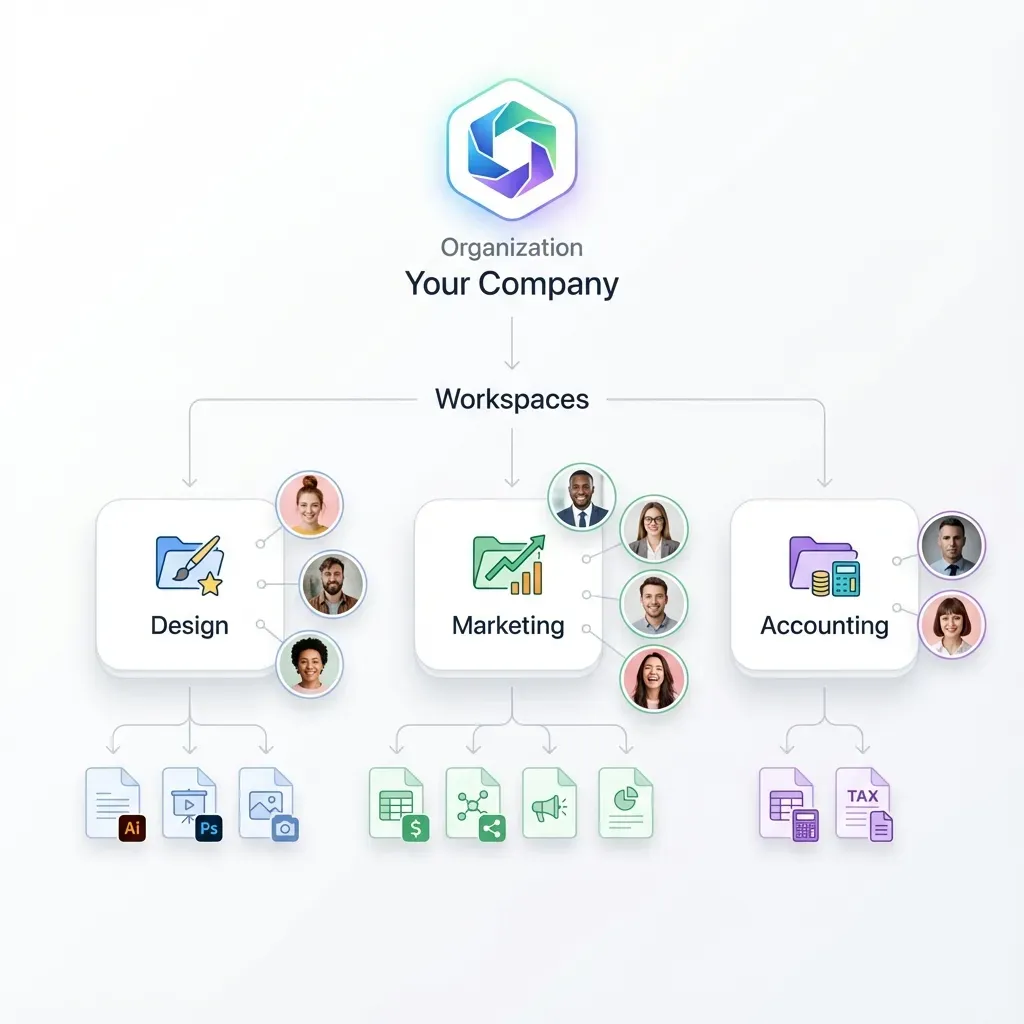
Not every agent needs access to every document. Segment your knowledge base by audience, sensitivity, and use case. A customer-facing agent should not retrieve internal pricing strategy documents. A coding assistant should not retrieve HR policies.
Granular permissions at the folder and file level prevent accidental retrieval of sensitive content. Audit trails let you see which agents accessed which documents and when, which is critical for debugging bad answers and for compliance reviews.
Building a Weekly Maintenance Workflow
Teams managing agent knowledge bases spend an average of 5 hours per week on document hygiene. That time is well spent if structured properly. Here is a weekly checklist that covers the essentials.
Monday: Freshness Audit
Run your staleness detection pipeline and review flagged documents. For each stale document, decide: update, archive, or extend the review deadline with a justification. Pull a report of which documents were most frequently retrieved in the past week. High-retrieval stale documents are the highest priority fixes.
Wednesday: Ingestion Review
Review any documents added to the KB since the last check. Verify they follow naming conventions, have proper metadata tags, and do not duplicate existing content. Check that new documents were indexed correctly by running test queries that should retrieve them.
Friday: Quality Spot Check
Pick 5-10 real agent queries from the past week and trace them back to the retrieved documents. Ask:
- Did the agent retrieve the most relevant documents?
- Were any retrieved documents outdated?
- Did the agent miss documents that should have been retrieved?
- Were there any contradictions between retrieved documents?
Log findings in a shared tracker. Patterns in quality issues point to systemic KB problems: a poorly tagged category, a missing document, or a chunk-size mismatch.
Ongoing: Change Detection
Set up automated change detection for source systems. When a product spec changes in your wiki, a policy updates in your document store, or a new version ships, the KB should be flagged for update. Event-driven approaches work better than scheduled crawls here. Document changes trigger events that flow through a processing pipeline: event capture, preprocessing, re-embedding, index update, and cache invalidation.
For teams using Fastio as their agent workspace, Intelligence Mode handles indexing automatically. Upload a document to a workspace with Intelligence enabled, and it is indexed for semantic search and RAG chat without a separate ingestion pipeline. File versioning tracks changes natively, and audit trails log every modification. The Fastio MCP server lets agents upload, search, and manage workspace files programmatically, which means your maintenance scripts can run as agent workflows rather than manual processes.



Build a Knowledge Base Your Agents Can Actually Maintain
Fastio gives your agents a workspace with built-in Intelligence Mode, automatic indexing, file versioning, and audit trails. generous storage. Built for agent knowledge base management workflows.
Versioning Strategies That Scale
Version control for knowledge bases is harder than version control for code. Code has clear boundaries (files, functions, modules). Knowledge base documents get chunked, embedded, and stored as vectors. When you update a document, you need to update the chunks, regenerate embeddings, and refresh the index. Here are three approaches, ordered from simplest to most strong.
Approach 1: Snapshot and Replace
The simplest strategy. When a document updates, delete all its chunks from the vector store and re-embed the new version. This guarantees no stale chunks linger, but it is expensive for large documents and creates a brief window where the document is unavailable for retrieval.
Best for: small knowledge bases under 10,000 documents where full re-indexing takes minutes, not hours.
Approach 2: Incremental Chunk Updates
Track which chunks belong to which document sections. When a section changes, re-embed only the affected chunks. This reduces processing time and avoids the availability gap, but requires more sophisticated tracking of chunk-to-section mappings.
Implement this by storing chunk metadata that includes: source document ID, section identifier, content hash, and embedding timestamp. When a document updates, compare section hashes to identify which chunks need regeneration.
Best for: medium-sized knowledge bases (10,000-100,000 documents) where full re-indexing is too slow.
Approach 3: Streaming Integration
For large-scale systems, use an event-driven architecture where document changes trigger embedding updates within seconds. The pipeline looks like this:
- Source system emits a change event (webhook, CDC stream, file watcher)
- Preprocessing service extracts and chunks the changed content
- Embedding service generates new vectors
- Index service updates the vector store atomically
- Cache invalidation removes any cached retrievals that referenced the old version
This approach keeps your stale retrieval rate near zero. The stale retrieval rate measures what fraction of retrievals return a document whose embedding was computed before the document's most recent update.
Best for: production systems serving real users where freshness directly affects answer quality.
Platforms like S3, Google Cloud Storage, or Fastio each handle the storage layer differently. Fastio's file versioning tracks every revision automatically, and workspace audit trails log who changed what and when, which simplifies the "trace a bad answer back to its source" debugging workflow. For teams that want the agent to manage its own KB, the MCP server supports file uploads, downloads, and search operations that agents can call directly.
Access Control and Multi-Agent Architectures
When multiple agents share a knowledge base, you need coordination. Without it, agents can overwrite each other's updates, retrieve documents meant for a different context, or exhaust API rate limits by all querying the same source simultaneously.
Segmentation by Agent Role
Create workspace boundaries that match agent responsibilities. A customer support agent gets access to product docs, troubleshooting guides, and FAQ content. A sales agent gets access to pricing, competitive positioning, and case studies. A coding assistant gets access to API docs, architecture decisions, and code examples.
This is not just about preventing information leakage. Smaller, focused knowledge bases produce better retrieval results because there is less irrelevant content to filter through. A customer support agent that retrieves from 500 focused documents will outperform one retrieving from 50,000 mixed documents.
Concurrency and Versioning
When agents update the knowledge base programmatically, coordination prevents conflicting edits. Without structure, two agents can update the same document simultaneously, causing unexpected overwrites.
Fastio provides advisory file locks that agents can acquire and release through the REST API or MCP server (using storage actions lock-acquire, lock-status, and lock-release). An agent acquires a file lock before updating a document, heartbeats it while working, and releases it when done. Another agent attempting to lock the file receives an HTTP 409 and can wait or move to another task. Because locks are advisory, version history retains every revision as a safety net if concurrent writes occur.
Ownership and Handoff
For knowledge bases that agents build and maintain, plan for the handoff to human reviewers. An agent might curate a collection of documents for a client project, organize them into folders, and add metadata. When the project is ready for human review, ownership transfer lets the agent hand the workspace to a human who can review, approve, and publish.
This agent-to-human handoff pattern works for knowledge base management specifically because it separates the mechanical work (collecting, organizing, tagging) from the judgment work (verifying accuracy, approving for production use). Agents handle volume. Humans handle trust decisions.
Measuring Knowledge Base Health
You cannot manage what you do not measure. Set up dashboards tracking these metrics, and review them weekly alongside your maintenance workflow.
Retrieval Quality Metrics
- Relevance rate: percentage of retrieved documents rated as relevant by human reviewers or an LLM judge. Target above 80%.
- Answer accuracy: percentage of agent responses that are factually correct based on the KB content. Measure through periodic spot checks.
- Citation accuracy: when agents cite sources, how often does the cited document actually support the claim? This catches hallucinated citations, a common failure mode.
Freshness Metrics
- Stale retrieval rate: fraction of retrievals returning documents with embeddings older than the source document. Should be near zero for streaming systems, under 5% for batch systems.
- Average document age: median age of documents in the active retrieval index. Track trends, not absolutes. A rising trend means your refresh rate is not keeping up.
- Freshness coverage: percentage of documents within their defined review window. Target above 90%.
Operational Metrics
- Ingestion latency: time from document update to new embeddings being available for retrieval. Directly affects how long stale content persists.
- KB growth rate: documents added per week. Rapid growth without corresponding review capacity leads to quality problems.
- Deduplication rate: percentage of incoming documents flagged as duplicates. A rising rate suggests upstream content management issues.
Setting Up Automated Alerts
Configure alerts for:
- Any document past its freshness threshold by more than 7 days
- Stale retrieval rate exceeding 10%
- Relevance rate dropping below 75% over a rolling week
- Ingestion latency exceeding your SLA (varies by system, but 15 minutes is a common target)
For teams running their knowledge base on Fastio, workspace activity feeds and WebSocket event streams can feed directly into your monitoring pipeline. When a document updates, the event notification prompts your pipeline to re-embed, and your freshness metrics update automatically. Combined with the built-in audit trail, you get a complete picture of what changed, when it was re-indexed, and whether retrieval quality held steady.

Sources
References used to verify factual claims in this guide.
-
60% of enterprise RAG projects fail because they cannot maintain data freshness at scale Knowledge bases with stale content can degrade agent accuracy by up to 40%
-
Teams managing agent KBs spend an average of 5 hours per week on document hygiene
Frequently Asked Questions
How do I keep my AI agent knowledge base up to date?
Set review cadences by document type: monthly for product docs, quarterly for policies, annually for reference material. Automate change detection so source-system updates trigger re-indexing. Run a weekly freshness audit to catch documents that slipped through automated pipelines. Track your stale retrieval rate and keep it below 5%.
What is the best way to manage documents for AI agents?
Treat your knowledge base like a codebase. Every document should have an owner, a review date, and version history. Use metadata tagging for content type, audience, and freshness thresholds. Segment documents by agent role so each agent retrieves from a focused collection. Run deduplication checks on every ingestion to prevent contradictions from duplicate content.
How often should I update my agent's knowledge base?
It depends on how fast your source information changes. Critical operational documents should update immediately when the source changes (event-driven). Product documentation typically needs a 30-day review cycle. Reference material can go 90 days between reviews. Track your average document staleness weekly and adjust cadences if retrieval quality drops.
What causes AI agents to give outdated answers?
The most common cause is stale documents in the knowledge base. The source information changed, but the KB was not updated, so the agent retrieves old content and generates a confident but incorrect response. Other causes include duplicate documents where one copy was updated and the other was not, poor chunk boundaries that cut relevant context, and missing metadata that prevents the retrieval system from filtering by recency.
How do I measure knowledge base quality for RAG?
Track four key metrics. Relevance rate measures how often retrieved documents are actually relevant to the query (target above 80%). Stale retrieval rate measures how often the agent retrieves outdated embeddings (target near zero). Citation accuracy checks whether agent-cited sources actually support the claim. Ingestion latency measures the delay between a document update and its new embeddings being available for retrieval.
Can AI agents manage their own knowledge bases?
Partially. Agents can handle mechanical tasks like collecting documents, extracting metadata, running deduplication, and flagging stale content. But trust decisions, like whether a document is accurate enough for production use, should stay with humans. The best pattern is agent curation with human approval: agents do the volume work, humans make judgment calls and approve changes before they go live.
Related Resources

Build a Knowledge Base Your Agents Can Actually Maintain
Fastio gives your agents a workspace with built-in Intelligence Mode, automatic indexing, file versioning, and audit trails. generous storage. Built for agent knowledge base management workflows.