How to Compare Documents with AI Agents
Traditional diff tools show you what changed between two documents. AI agents go further, comparing meaning, flagging risk, and producing structured reports that teams can act on. This guide walks through how AI agent document comparison works, what to look for in a comparison pipeline, and how to build one that delivers results to the right people.


What AI Agent Document Comparison Actually Does
Standard document comparison tools work at the character or word level. They highlight insertions, deletions, and formatting changes. That covers version tracking, but it misses what most reviewers actually care about: did the meaning change?
AI agent document comparison uses large language models to read two or more documents and identify differences in content, structure, intent, and compliance. Instead of a line-by-line diff, the agent produces a structured report that explains what changed and why it matters.
A practical definition: AI agent document comparison uses autonomous agents to analyze two or more documents for differences in content, structure, meaning, and compliance, generating structured comparison reports stored in shared workspaces.
The difference shows up most clearly in contract review. A traditional diff tool flags that "30 days" became "15 days" on page 12. An AI agent flags that the payment terms shortened by half, connects it to the penalty clause on page 8, and rates the change as high risk. That contextual understanding is what separates AI comparison from text diffing.
The same logic applies across industries. Product teams compare spec versions to catch scope creep. Compliance officers compare policy drafts against regulatory requirements. Research teams compare study protocols across trial sites. In each case, the value comes not from spotting the text change, but from understanding its implications.
Related guides
- Best Document Processing Tools for AI AgentsDocument processing tools for AI agents automate the extraction, parsing, and transformation of unstructured documents...
- How to Automate Document Processing with AI AgentsAI agent document processing uses autonomous agents to extract, analyze, and transform information from documents...
- How to Build an AI Agent Document Redaction PipelineAI agent document redaction automation uses an autonomous agent to detect and remove sensitive information like names,...
- How to Build a Document Processing Pipeline with Fastio APIA document processing pipeline built on the Fastio API listens for new file uploads, automatically routes them for AI...
- How to Set Up AI Agent File Indexing (The Easy Way)Most AI agent file indexing requires complex Python pipelines and vector databases. This guide shows you how to skip...
- How to Use AI Assistants for File Management and OrganizationAI assistant file management uses artificial intelligence to organize, categorize, search, and manage files...
More on this subject: Agent File and Document Workflows (325 guides)
How AI Agents Compare Documents Step by Step
Building a document comparison workflow with AI agents follows a predictable pattern, whether you are using a hosted platform or wiring up your own pipeline.
1. Upload Documents to a Shared Workspace
The agent needs access to both documents. Upload them to a workspace where the agent can read file contents, either through an API, an MCP server, or a direct file integration. Formats like PDF, Word, and scanned images all work if the pipeline includes OCR or native document parsing.
On platforms like Fastio, uploading to a workspace automatically indexes files when Intelligence Mode is enabled. That means the agent can search and query document contents immediately, without a separate ingestion step.
2. Extract and Normalize Content
Before comparison, the agent extracts text and structure from each document. This step handles differences in formatting, page layout, headers, and embedded tables. The goal is to get both documents into a consistent representation so the comparison is apples-to-apples.
For scanned or image-based documents, OCR runs first. Modern document AI handles multi-column layouts, handwritten annotations, and embedded charts without manual configuration.
3. Run Semantic Comparison
This is where AI agents diverge from traditional tools. Instead of diffing tokens, the agent reads both documents and identifies:
- Content changes: Added, removed, or modified text
- Structural changes: Sections reordered, merged, or split
- Meaning shifts: Same words but different implications in context
- Compliance gaps: Missing required clauses or terms that conflict with a baseline
Tools like Stack AI let you build this as a visual workflow where two document inputs feed into an LLM node configured for comparison. The output is a structured markdown table with section-by-section analysis.
4. Score and Prioritize Differences
Not every change matters equally. A strong comparison agent ranks differences by significance. A changed indemnification clause gets flagged as critical. A corrected typo in a header gets noted but marked low priority.
Docsie's comparison tool calls this "intelligent scoring," and it is one of the clearest advantages over basic diff output. Reviewers spend time on what matters instead of scanning through cosmetic edits.
5. Generate a Structured Report
The agent produces a comparison report in a format the team can use. Common outputs include:
- Markdown tables with section, original text, revised text, and risk rating
- JSON objects for downstream automation
- Summary narratives highlighting the top 5 changes
The report gets stored in the same workspace as the source documents, creating a complete audit trail. On Fastio, this means the comparison output sits alongside the originals, versioned and searchable through Intelligence Mode.

Where Document Comparison Agents Save Real Time
The time savings from AI-assisted document review are well documented. According to the 2026 Wolters Kluwer Future Ready Lawyer Survey, 62% of legal professionals reported weekly time savings of 6% to 20% from AI adoption, with document and contract review cited as the primary driver.
The cost context makes those percentages significant. Attorney rates for document review range from $100 to $750 per hour depending on specialization and firm size. Even a 10% reduction in review hours on a large contract set translates to meaningful savings.
Beyond raw time, AI comparison reduces errors. The Association of Corporate Counsel reports that manual contract review produces error rates between 15% and 25%, particularly during high-volume periods or when handled by junior staff. An AI agent applies the same comparison criteria consistently across every document pair.
Contract Redlining and Negotiation
Legal teams compare contract drafts across negotiation rounds. The agent tracks every change from the counterparty, flags deviations from approved templates, and generates a summary for the reviewing attorney. Instead of reading both versions side by side, the attorney reads a prioritized change list.
Regulatory Compliance
Compliance teams compare internal policies against updated regulations. When a new rule drops, the agent compares the regulation text against the company's current policy documents and identifies gaps. This turns a multi-day manual review into a same-day assessment.
M&A Due Diligence
Due diligence rooms contain hundreds of documents that need cross-referencing. AI agents compare financial statements across reporting periods, flag inconsistencies between representations in different documents, and produce exception reports. Teams using AI-driven categorization in eDiscovery have seen document promotion rates drop from 25-30% to around 5%, according to Reveal Data, meaning far fewer documents need human review.


Store comparison reports where your whole team can find them
Cloud workspaces with built-in AI indexing. Upload documents, run comparisons with any agent framework, and deliver structured reports to human reviewers.
Building a Comparison Pipeline with Workspaces and MCP
A document comparison agent needs three things: access to files, a way to run comparisons, and somewhere to deliver results. You can build this with local scripts, but a workspace-based approach scales better and keeps everything auditable.
The Workspace Pattern
Store source documents and comparison outputs in the same workspace. This gives you versioning, access control, and searchability without building those features yourself. When a new document version arrives, the agent picks it up, runs the comparison against the previous version, and writes the diff report back to the workspace.
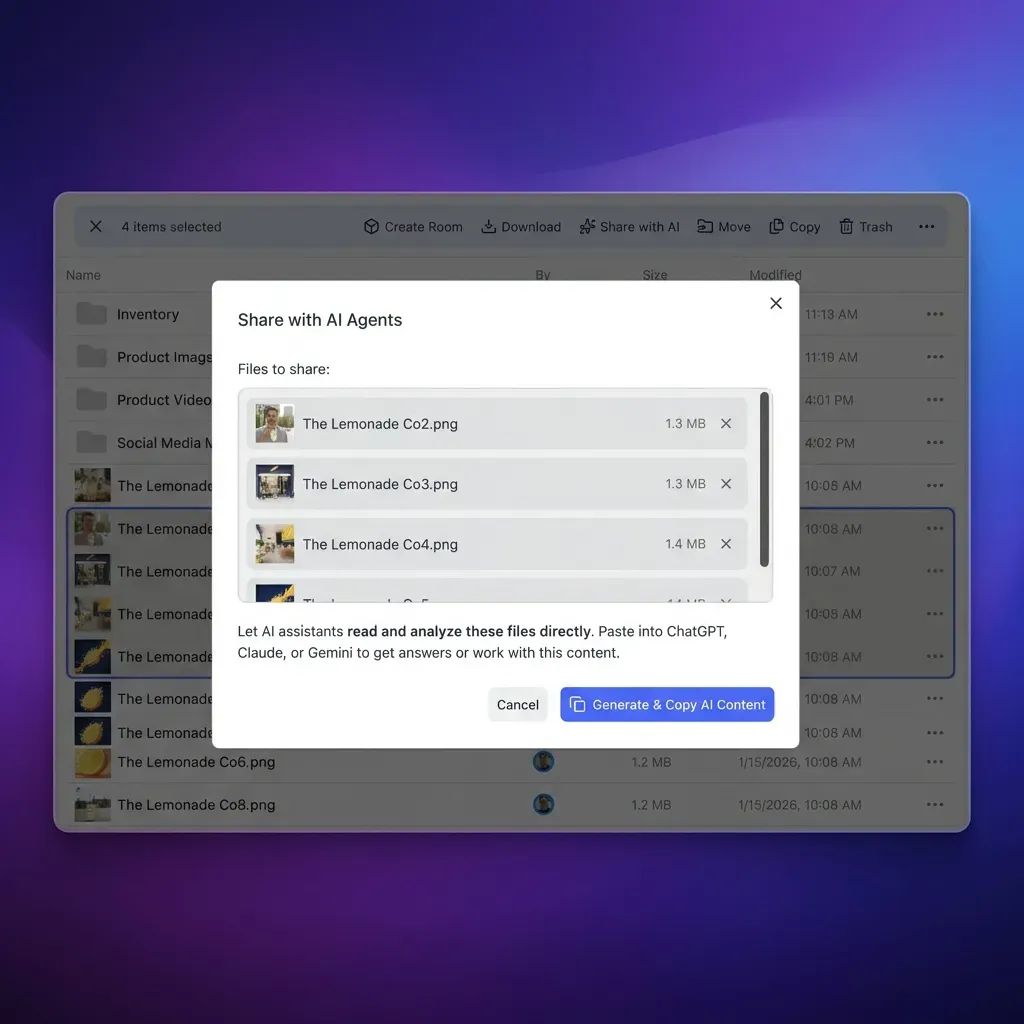
Fastio workspaces support this pattern directly. Upload documents through the MCP server or API, enable Intelligence for automatic indexing, and let the agent write comparison reports as new files. The workspace becomes the single source of truth for both originals and analysis.
Connecting Agents via MCP
The Model Context Protocol gives AI agents standardized access to workspace operations. An agent built on Claude, GPT-4, Gemini, or any other LLM can use Fastio's MCP server to:
- Read document contents from a workspace
- Upload comparison reports
- Query previous comparisons through Intelligence Mode
- Lock files during comparison so other agents know to wait
Fastio exposes Streamable HTTP at /mcp and legacy SSE at /sse. Any MCP-compatible agent framework can connect without custom integration code.
Structured Extraction with Metadata Views
For recurring comparison tasks, Metadata Views add another layer. Describe the fields you want extracted from comparison reports in natural language, and the system builds a typed schema. Every new comparison report gets automatically parsed into a sortable, filterable spreadsheet.
For example, a legal team comparing vendor contracts could extract counterparty name, contract value, payment terms, and risk rating from each comparison report. The result is a live dashboard of contract changes across the entire vendor portfolio, without anyone manually entering data.
Ownership Transfer
When the comparison work is done, the agent can transfer workspace ownership to a human reviewer. The agent keeps admin access for future runs, but the human owns the workspace and controls sharing. This is particularly useful for consultancies or agencies where an agent builds a comparison package and hands it off to a client.
Choosing the Right Tools for Your Pipeline
The document comparison agent space has matured quickly. Here is how the main approaches compare.
Hosted Agent Builders
Platforms like Stack AI and V7 provide visual workflow builders where you connect document inputs to LLM comparison nodes. These are the fastest way to get a working comparison agent without writing code. The tradeoff is less control over prompting, model selection, and output format.
Best for: Teams that need a working comparison tool this week and do not require deep customization.
Custom LLM Pipelines
Build your own pipeline using an LLM API (Claude, GPT-4, Gemini) with a document parsing library like Unstructured, LlamaParse, or Apache Tika. You control every step: how documents are chunked, what comparison prompts look like, and how results are structured.
Best for: Engineering teams with specific comparison requirements, like custom risk scoring or integration with internal compliance systems.
Enterprise Document AI
Tools like Hebbia, Kira Systems, and Luminance offer purpose-built document analysis for legal and financial workflows. These include pre-trained models for contract comparison, regulatory analysis, and due diligence. They cost more but come with domain-specific accuracy and compliance features.
Best for: Legal and financial teams processing high volumes of regulated documents where accuracy is non-negotiable.
Storage and Delivery Layer
Regardless of which comparison engine you choose, you need somewhere to store documents and deliver results. Local filesystems work for prototyping, but production pipelines need versioning, access control, and audit trails.
Fastio fills this role as the workspace layer. The 14-day Business Trial (card required; see /pricing/) provides workspace access and usage credits to run and evaluate comparison pipelines. Documents are indexed for search once Intelligence Mode is enabled on the workspace, so comparison agents can query previous results without a separate database.
S3 or Google Cloud Storage work if you only need raw file storage. But if your workflow involves human review, shared access, or audit trails, a workspace platform saves you from building those features on top of object storage.
Common Pitfalls and How to Avoid Them
Document comparison agents fail in predictable ways. Knowing the failure modes helps you build a more reliable pipeline.
Comparing Formatting Instead of Content
If your extraction step preserves too much formatting metadata, the agent will flag layout changes as content differences. Strip formatting early in the pipeline. Compare semantic content, not visual presentation. Tables and lists should be normalized into a consistent structure before the comparison step runs.
Missing Context Windows
Long documents can exceed the LLM's context window. If a 200-page contract gets truncated, the agent misses changes in later sections. Handle this by chunking documents into sections and comparing section pairs, then assembling the results. Some frameworks handle this automatically, but verify that your pipeline covers the full document.
Hallucinated Differences
LLMs can report differences that do not exist, especially when documents use similar but not identical phrasing. Always include source quotes in comparison output so reviewers can verify flagged changes against the original text. A comparison report that says "the payment terms changed" without quoting both versions is not trustworthy.
No Baseline for Comparison
Comparing two arbitrary documents is less useful than comparing against a known-good baseline. For contract review, that baseline is your approved template. For compliance, it is the current regulation text. Store baselines in your workspace and configure the agent to always compare against the latest approved version.
Ignoring the Delivery Step
A comparison report that sits in an S3 bucket does not help anyone. Route results to where reviewers will actually see them. In a workspace like Fastio, the report appears alongside the source documents, and reviewers get notified through workspace activity feeds. For integration with existing tools, use webhooks to push comparison results to Slack, email, or a project management system.
Sources
References used to verify factual claims in this guide.
-
62% of legal professionals experienced weekly time savings of 6% to 20% from AI adoption
-
Manual contract review produces error rates between 15% and 25% Document promotion rates drop from 25-30% to around 5% with AI-driven categorization
Frequently Asked Questions
How do AI agents compare documents?
AI agents use large language models to read both documents, extract text and structure, then identify differences in content, meaning, and compliance. Unlike traditional diff tools that match characters or words, AI agents understand context, so they can flag that a shortened deadline affects a penalty clause elsewhere in the contract.
What is AI document comparison?
AI document comparison is the process of using artificial intelligence to analyze two or more documents and identify meaningful differences. It goes beyond text-level changes to detect shifts in intent, missing sections, compliance gaps, and structural reorganization. The output is typically a structured report with prioritized findings.
Can AI detect differences between contracts?
Yes. AI agents can compare contract versions and identify changes to key terms, obligations, liability clauses, payment schedules, and compliance language. They can also compare a draft against an approved template to flag deviations. The Association of Corporate Counsel notes that manual contract review has error rates of 15-25%, which AI comparison helps reduce by applying consistent criteria across every document.
How do you automate document comparison with AI?
Set up a pipeline with three stages: document ingestion (upload files to a workspace or storage layer with parsing support), comparison (route both documents through an LLM configured for structured comparison), and delivery (write the diff report to a shared workspace where reviewers can access it). Tools like Stack AI offer visual builders for this pipeline. For custom setups, connect an LLM API to a document parser and store results in a workspace like Fastio.
What file formats work with AI document comparison?
Most AI comparison agents handle PDF, Word (.docx), plain text, and scanned images (via OCR). Advanced tools also support spreadsheets, presentations, and handwritten documents. The key requirement is a document parsing layer that can extract structured text from the source format before the comparison step.
How accurate is AI document comparison?
Accuracy depends on the model, the document type, and how well the pipeline handles extraction. For well-formatted text documents like contracts and policies, modern LLMs produce reliable comparisons. Scanned or handwritten documents introduce OCR errors that can affect accuracy. Always include source quotes in comparison output so reviewers can verify flagged differences against the originals.
Related Resources

Store comparison reports where your whole team can find them
Cloud workspaces with built-in AI indexing. Upload documents, run comparisons with any agent framework, and deliver structured reports to human reviewers.