Top RAG Storage Backends for AI Applications
RAG adoption surged as developers rushed to use private data with AI models. Choosing the right backend matters. We review the top RAG storage solutions, from specialized vector databases to integrated platforms that handle the entire file pipeline.

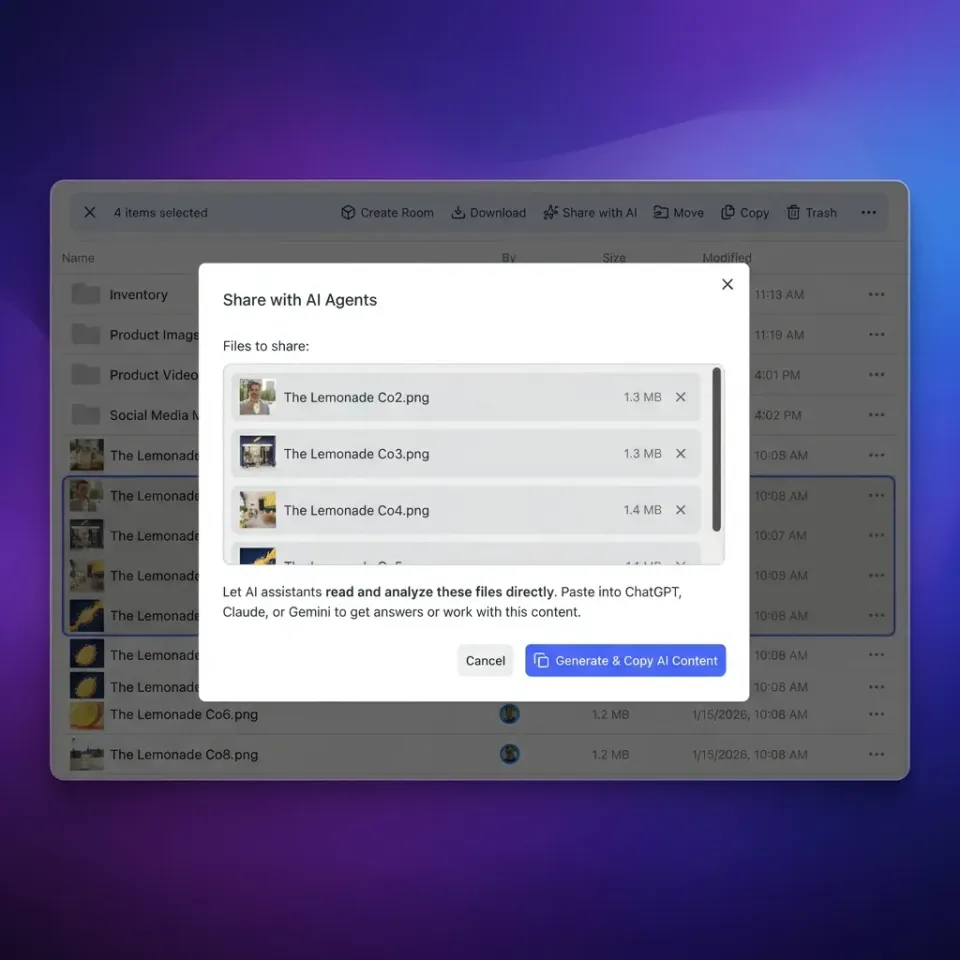
What to check before scaling top rag storage backends
RAG storage backends manage the documents and embeddings that power Retrieval Augmented Generation systems. This lets AI agents query knowledge bases and cite sources. Early on, developers often combined a vector database for embeddings with a separate object store (like S3) for the files. This approach was complex because you had to sync your vector index with your file storage manually.
Now, the market is different. Average RAG systems now query tens of thousands of documents per request, so speed and integration matter more. We see a split between dedicated vector databases that focus on index retrieval and integrated storage platforms that handle files, chunking, embedding, and retrieval in one layer.
Your choice depends on your needs. Do you need raw billion-scale vector performance, or a system that manages the entire document lifecycle for your AI agents?
Related guides
- Top 10 Cloud Storage APIs for AI ApplicationsA cloud storage API for AI is a programmatic interface that lets AI applications store, retrieve, and manage files and...
- How to Add File Storage to Vercel AI SDK ApplicationsThe Vercel AI SDK gives you React hooks and server utilities for building AI-powered applications, but file storage for...
- RAG Architecture: Storage Strategies for Document RetrievalRAG storage architecture encompasses the document store, vector database, and file management layer that power...
- How to Master Haystack AI File Storage for RAG PipelinesHaystack AI file storage uses two systems: one for raw source files and another for processed vector data. While...
- 7 Best Cloud Storage Options for Machine Learning DatasetsML training datasets regularly exceed 1 TB, and data preparation eats up about 80% of project time according to...
- Best RAG Tools and Platforms for 2026Retrieval-augmented generation tools connect large language models to external knowledge sources, letting AI generate...
More on this subject: Agent Memory and Storage (263 guides)
Quick Comparison: Top RAG Backends
Here is how the leading solutions stack up for AI application development.
Below, we evaluate each platform based on performance, ease of use, and suitability for modern agentic workflows.
1. Fastio
Fastio works differently than other RAG storage options. It does not require a separate vector database and file storage bucket. Instead, it offers a platform where files are central. When you turn on Intelligence Mode for a workspace, Fastio automatically chunks, embeds, and indexes your documents.
This helps AI agents. Fastio offers an MCP server with a consolidated MCP toolset, so agents like Claude can interact directly with the storage. An agent can upload a PDF, and Fastio makes it searchable with semantic query right away. You do not need an external pipeline.
Pros:
- Automatic RAG: Intelligence Mode auto-indexes files without manual pipelines.
- Built for Agents: A consolidated MCP toolset for programmatic control.
- Unified Storage: Stores the actual source files (up to 5TB) alongside the vectors.
- Business Trial: 14-day Business Trial available (card required; see pricing).
Cons:
- Focus: Optimized for file-based RAG (PDFs, docs), not purely structured record data.
- Ecosystem: Newer than established vector databases.
Best For: Developers building AI agents who want "files-to-RAG" without building a complex ingestion pipeline.
Pricing: Starter starts at $9.99/mo (250 GB storage), with a 14-day Business Trial (card required; see pricing).



Give Your AI Agents Persistent Storage
Stop building complex RAG pipelines. Store your files in Fastio and let Intelligence Mode handle indexing once enabled.
2. Pinecone
Pinecone is a popular vector database. It is a managed service designed to store and query high-dimensional vectors. Pinecone works well for massive scale (billions of vectors) with low latency.
Pinecone does not store your actual documents. You send it vectors, and it returns matches. You must keep a separate map to your source content. Its 'serverless' index option makes it easier to start, as costs scale down to zero when not in use.
Pros:
- Performance: High speed and scalability.
- Serverless: Pay-as-you-go pricing model is cost-effective for irregular workloads.
- Integrations: Connects with most AI frameworks (LangChain, LlamaIndex).
Cons:
- Vectors Only: You must manage file storage separately.
- Data Sync: Keeping Pinecone in sync with your source data requires external logic.
Best For: Enterprise applications with massive vector datasets where scale is the primary concern.
Pricing: Free tier available; Serverless starts at usage-based rates.
3. Weaviate
Weaviate offers a "hybrid" database that stores both objects and vectors. This allows for hybrid search, which combines keyword search (BM25) with semantic vector search. This often gives better results than vector search alone, especially for exact matches like product names.
Weaviate is open-source, so you can run it yourself via Docker or Kubernetes, or use their managed cloud service. Its modular design lets you plug in different vectorization modules.
Pros:
- Hybrid Search: Combines keyword and vector retrieval.
- Flexibility: Open-source core allows self-hosting.
- Modules: works alongside various embedding models.
Cons:
- Complexity: More configuration required than fully managed options.
- Management: Self-hosting requires operational overhead.
Best For: Applications requiring precise hybrid search and the option for self-hosting.
Pricing: Open source is free; Cloud managed service offers usage-based pricing.
4. MongoDB Atlas Vector Search
For teams using MongoDB, Atlas Vector Search is a good option. It adds vector storage and search directly to your existing MongoDB documents. This removes the need to sync data between a primary database and a separate vector store.
Storing vectors with document metadata simplifies the architecture. However, as a general-purpose database, it may not match the speed of specialized engines like Pinecone for high-throughput use cases.
Pros:
- Simplicity: One database for application data and vectors.
- Familiarity: No new query language to learn for Mongo developers.
- Filtering: Powerful pre-filtering based on document metadata.
Cons:
- Performance: Higher latency than specialized vector DBs at extreme scale.
- Cost: Atlas costs can scale quickly with data volume.
Best For: Teams already invested in the MongoDB ecosystem.
Pricing: Part of standard MongoDB Atlas pricing (based on instance size).
5. Chroma
Chroma is an open-source embedding database. It is easy to set up (often just pip install chromadb), which makes it popular for local development and prototyping.
Chroma started as a local tool but now works for production. It handles the embedding process and offers a simple API. It has fewer features than Weaviate but is easier to learn.
Pros:
- Ease of Use: Great developer experience for getting started.
- Open Source: Free to run locally or on your own infrastructure.
- Integration: Integrated into the Python AI stack.
Cons:
- Scalability: Historically less proven at massive scale than Pinecone or Milvus.
- Features: Fewer advanced features like hybrid search tuning.
Best For: Prototyping, local development, and smaller production workloads.
Pricing: Open source is free.
How to Choose the Right Backend
Three factors matter when choosing a RAG backend:
- Data Scalability: Do you have thousands of documents or millions? For smaller, file-based datasets, integrated tools like Fastio simplify the stack. For billion-scale records, specialized vector DBs like Pinecone are necessary.
- Development Velocity: Do you want to build ingestion pipelines? If you prefer to drop files in a folder and have them searchable by agents, a unified platform works better. If you need custom chunking logic, a separate vector DB gives you that control.
- Agent Integration: If you build with Claude, AutoGen, or OpenAI Assistants, look for tools with native protocol support. Fastio's MCP support connects storage and agent action.
Industry surveys show that much of AI engineering time goes to data pipelines. Choosing a backend that minimizes this work is an important decision.
Sources
References used to verify factual claims in this guide.
-
Fastio MCP server provides a consolidated MCP toolset for agents to interact with storage programmatically. Fastio provides a consolidated toolset built for agents with programmatic control.
-
Fastio offers a 14-day Business Trial with card required. Fastio unified storage stores source files up to 5TB alongside vectors.
-
Average RAG system queries over 10000 documents per request requiring fast integration.
Frequently Asked Questions
Do I need a vector database for RAG?
Not necessarily. While you need vector search capabilities, you don't always need a standalone vector database. Integrated storage platforms like Fastio offer built-in vector indexing (Intelligence Mode) alongside file storage, eliminating the need to manage a separate Pinecone or Weaviate instance for many use cases.
What is the difference between vector storage and object storage?
Object storage (like S3 or Fastio) holds the actual files: PDFs, images, videos. Vector storage holds the numerical representations (embeddings) of that content. A complete RAG system needs both: the vector store finds the relevant 'chunk', and the object store delivers the full source context or citation.
Can I use Fastio with LangChain?
Yes. Fastio works alongside LangChain and other frameworks through its API and MCP server. You can use Fastio as both your document loader and your retrieval engine, simplifying the process by removing the need for separate embedding steps.
How does RAG improve AI accuracy?
Retrieval Augmented Generation reduces hallucinations by grounding the AI's responses in your specific data. Instead of relying solely on its training data, the model retrieves relevant facts from your storage backend before generating an answer, providing accurate, cited information.
Related Resources

Give Your AI Agents Persistent Storage
Stop building complex RAG pipelines. Store your files in Fastio and let Intelligence Mode handle indexing once enabled.