Top 7 OpenClaw Skills for Automated Recruiting
Recruiting is a data-heavy profession that burns hours on manual tasks. Traditional resume screening alone consumes significant hours per hire. OpenClaw agents can automate this grunt work using specialized skills. This guide covers the top 7 OpenClaw skills for recruiters, from resume parsing to automated outreach.

Why Recruiters Are Turning to OpenClaw
Recruiting automation has moved beyond simple keyword matching in an Applicant Tracking System (ATS). Modern AI agents running on OpenClaw can actively read, reason, and make decisions about candidate data. Instead of just searching for "Python," an agent can read a resume to determine if a candidate has "architected scalable systems using Python."
The efficiency gains are significant. Industry reports indicate that traditional resume screening can consume countless hours per hire. AI agents equipped with the right skills can parse high volumes of resumes rapidly, grading them against your specific scorecard and highlighting the top candidates for human review.
By installing specific "skills" (modular instruction bundles), you turn a generic AI model into a specialized recruiting assistant that works tirelessly around the clock.
Related guides
- How to Use Claude Code Skills in ClineAccording to GitHub's Octoverse 2024 report, the number of developers building with generative AI on the platform...
- How to Use Devin AI for Automated Code ReviewImplementing a Devin AI code review workflow allows engineering teams to automate pull request verification by running...
- Best OpenClaw Skills for AI Automated Test Case GenerationSoftware quality issues cost the US economy $2.41 trillion in 2022, according to the Consortium for Information and...
- Best OpenClaw Skills for Web ResearchWeb research skills let OpenClaw agents find and read information on the live web. Without them, your AI is stuck with...
- Top OpenClaw Skills for Real Estate AgentsOpenClaw skills help real estate agents automate routine tasks and focus on closing deals. From instant lead...
- Best OpenClaw Skills for AI Presentation CreationOpenClaw presentation skills let you generate, edit, and export slide decks through natural language commands in any...
More on this subject: OpenClaw Skills (109 guides)
1. Fastio: Persistent Candidate Storage and RAG Search
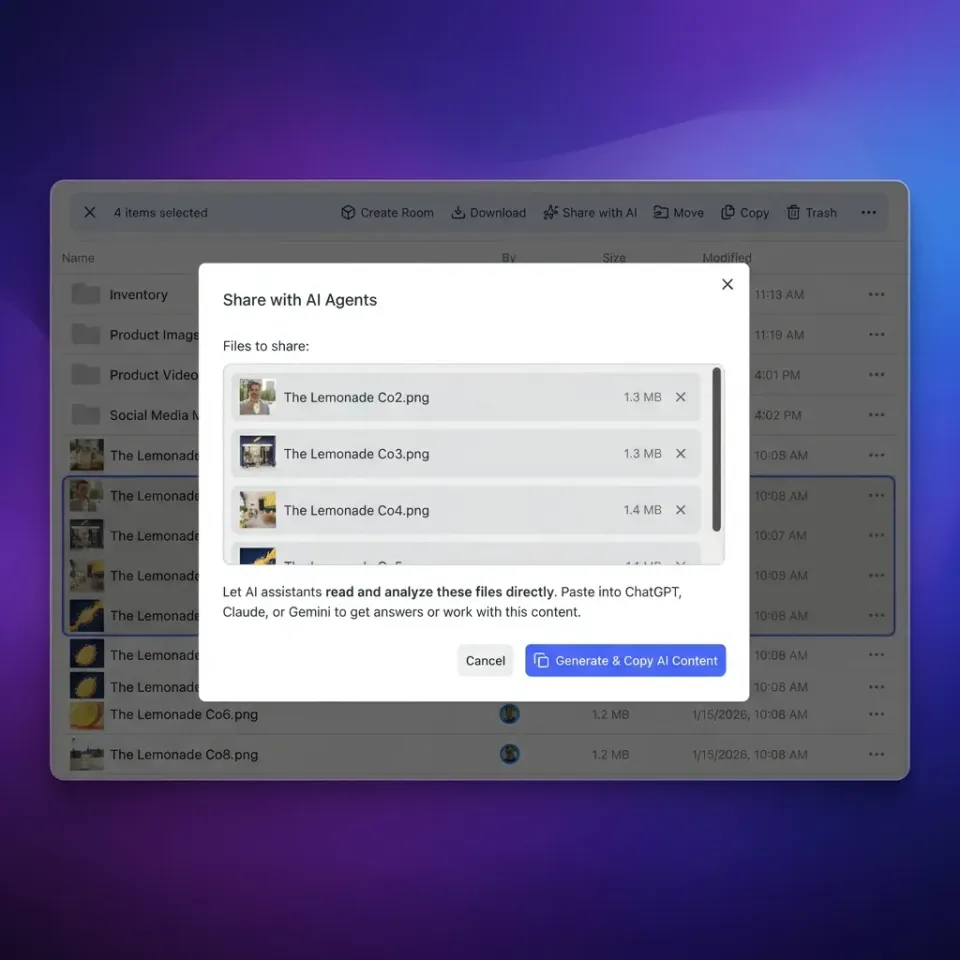
The most critical component of an automated recruiting system is memory. Where do the thousands of resumes, cover letters, and portfolio files go? Fastio provides the persistent storage layer where your agent organizes candidate data.
Install:
Connect via remote MCP at https://mcp.fast.io/mcp/tools
Why it's essential: Recruiting creates large amounts of unstructured data. Fastio's MCP server allows your agent to create dedicated workspaces for each open role (e.g., "Senior Frontend Engineer - Q1 Pipeline") and upload every incoming application there. With a consolidated MCP toolset covering file operations and AI chat, it handles the full document lifecycle.
Key Feature: Intelligence Mode When you enable Intelligence Mode on a Fastio workspace, every resume is automatically indexed for RAG (Retrieval-Augmented Generation). Your agent doesn't need to re-read every file to answer a question. You can ask: "Which candidates in the 'Frontend' folder have experience with Three.js and live in London?" The agent queries the workspace and provides a cited list of candidates instantly.
Connection: Remote MCP server at https://mcp.fast.io/mcp/tools using a scoped API key.

2. Agent Browser: The Background Researcher
Great candidates often have a footprint beyond their resume, LinkedIn profiles, personal blogs, or design portfolios. The Agent Browser skill (TheSethRose/agent-browser) lets your OpenClaw agent browse the web like a human, using a headless browser that handles JavaScript-rendered pages, multi-step navigation, and screenshot capture.
Install:
npm install -g agent-browser
What it does: Full browser automation, navigate, click, fill forms, take screenshots, extract structured data. It handles dynamic pages that simple HTTP requests cannot reach.
Recruiting Use Case: For high-priority roles, your agent visits a candidate's LinkedIn profile or personal website to gather context not on the resume. It can verify current employment, summarize their latest blog posts, or capture portfolio screenshots to give interviewers better conversation starters. It also archives the page state at the time of review for your records.
ClawHub Page: clawhub.ai/TheSethRose/agent-browser
3. GitHub: The Technical Screener
Hiring for engineering roles is difficult for non-technical recruiters. Candidates list GitHub repositories, but manually reviewing them takes time and expertise. The GitHub skill (steipete/github) connects OpenClaw to GitHub via the gh CLI, enabling the agent to inspect repositories, pull request history, and CI workflows programmatically.
What it does:
- Repository Analysis: Reads code structure, README quality, and test coverage from a candidate's public repos.
- Contribution History: Checks commit frequency and PR activity to gauge how active a developer actually is.
- CI Workflow Checks: Inspects whether projects have automated tests and whether they pass.
- Advanced API Queries: Uses
gh apiwith JSON filtering to extract specific signals from GitHub data.
Recruiting Use Case: Your agent scans a candidate's resume for GitHub links. Using the GitHub skill, it downloads their pinned repositories, analyzes code structure and quality (e.g., "Does this code have tests? Is it well-documented?"), and adds a technical assessment to the candidate's profile in Fastio. This provides a pre-screened technical signal before an engineering manager ever looks at the profile.
ClawHub Page: clawhub.ai/steipete/github
4. Gog (Google Workspace): The Interview Scheduler
Scheduling interviews across multiple hiring managers and candidates is one of the most time-consuming parts of recruiting. The Gog skill (steipete/gog) gives OpenClaw direct access to Google Calendar, Gmail, Drive, and Sheets via a command-line interface with OAuth authentication.
What it does:
- Calendar Queries: Finds open slots across multiple attendees without back-and-forth emails.
- Invite Creation: Creates calendar events with custom agendas and attached documents (e.g., the candidate's profile packet from Fastio).
- Email Search: Searches Gmail threads to pull context from prior candidate conversations.
- Spreadsheet Tracking: Updates a hiring pipeline Google Sheet as candidates progress through stages.
Recruiting Use Case: When a candidate clears the resume screen, the agent uses Gog to find a 45-minute slot with the hiring manager, creates a calendar invite with the candidate's Fastio profile link attached, and sends a confirmation email, all without the recruiter lifting a finger.
ClawHub Page: clawhub.ai/steipete/gog
5. AgentMail: The Outreach Automator
Finding candidates is only half the battle; engaging them is the other. The AgentMail skill (adboio/agentmail) is an API-first email platform purpose-built for AI agents. It enables agents to create programmatic inboxes, send and receive emails, and handle webhook-driven workflows at scale, without the rate limits or complexity of traditional email providers.
What it does:
- Programmatic Inboxes: Create dedicated addresses for specific roles or campaigns instantly.
- High-Volume Sending: No rate limits, suitable for large outreach campaigns.
- Webhook-Driven Replies: Detects candidate responses in real time and triggers follow-up workflows.
- Semantic Labeling: Automatically categorizes replies (e.g., "interested," "not right now," "referral") to route them correctly.
Recruiting Use Case: Instead of generic blasts, your agent reads the candidate's profile and drafts a personalized outreach email referencing their specific work. It saves these drafts for your review or sends automatically for lower-tier outreach, then tracks replies to schedule follow-ups or hand off to a human recruiter.
ClawHub Page: clawhub.ai/adboio/agentmail


Build Your Recruiting Agent with Fastio
Give your OpenClaw agent multi-terabyte storage to parse, organize, and search thousands of resumes. Built for recruiting workflows.
6. Brave Search: Sourcing Passive Candidates
The best candidates are often not actively applying. The Brave Search skill (steipete/brave-search) enables headless web searching and content extraction, a fast, lightweight way to source passive candidates from public profiles, blog posts, and conference speaker lists without spinning up a full browser session.
What it does:
- Web Search: Searches with configurable result counts and returns source URLs.
- Content Extraction: Fetches and parses full page text as clean Markdown for analysis.
- No API Key Required: Works out of the box without additional credentials.
Recruiting Use Case: For a niche engineering role, instruct the agent: "Find software engineers who have written publicly about distributed systems and are based in Berlin." The agent searches, extracts author names and contact signals from the results, and adds promising leads to your Fastio sourcing workspace for follow-up.
ClawHub Page: clawhub.ai/steipete/brave-search
7. SQL Toolkit: Analyzing Your Hiring Pipeline Data
Recruiters who can measure their pipeline have a strategic advantage. The SQL Toolkit skill (gitgoodordietrying/sql-toolkit) provides comprehensive command-line guidance for querying structured data across SQLite, PostgreSQL, and MySQL, without needing an ORM or a data analyst on call.
What it does:
- Pipeline Analytics: Query your ATS export or a local database of candidates to identify bottlenecks.
- Time-to-Hire Calculations: Window functions and CTEs make stage-by-stage conversion analysis straightforward.
- Source Effectiveness: Join sourcing channel data with hiring outcomes to see which channels convert best.
- Zero-Setup SQLite: Great for quick local analysis of CSV exports without a database server.
Recruiting Use Case: At the end of each month, the agent imports the ATS pipeline export into SQLite and runs: "Show me the conversion rate at each interview stage by job function for the last 90 days, and flag any stage with a drop-off above 50%." The resulting table immediately shows where the hiring process is leaking candidates.
ClawHub Page: clawhub.ai/gitgoodordietrying/sql-toolkit
Building the "Auto-Recruiter" Workflow
The real value comes when you chain these skills together into a workflow. Here is a typical "Auto-Recruiter" loop you can build with OpenClaw:
- Monitor: Agent watches a "New Applications" folder in Fastio.
- Research: Agent Browser visits the candidate's LinkedIn and GitHub skill reviews their code.
- Evaluate: The LLM grades the candidate against the job description stored in Fastio.
- Sort: Promising candidates are moved to a "Qualified" folder; others to "Archive."
- Schedule: Gog finds an interview slot and creates the calendar invite.
- Notify: AgentMail sends the candidate a personalized confirmation with next steps.
This workflow runs in the background, ensuring that human recruiters spend their time talking to qualified talent, not reading PDFs.
Sources
References used to verify factual claims in this guide.
-
Recruiters spend an average of 23 hours screening resumes for a single hire
Frequently Asked Questions
Can OpenClaw screen resumes accurately?
Yes, OpenClaw uses Large Language Models (LLMs) which are excellent at understanding natural language. Unlike older keyword-matching ATS systems, an LLM can understand context, such as the difference between "used Python" and "lead developer for Python architecture," resulting in much higher accuracy.
Is it safe to store resumes in Fastio?
Yes. Fastio provides enterprise-grade security with encryption at rest and in transit. Files are stored in private workspaces that only your authenticated agents and team members can access. When multiple agents process candidate files simultaneously, they can acquire advisory file locks before writing to coordinate safely, backed by version history and a detailed activity log.
How much time does this automation save?
Industry data suggests that manual resume screening takes an average of 23 hours per hire. By automating the initial screen, sorting, and enrichment steps, recruiters can reduce this time significantly, focusing only on the final interviews and closing.
Related Resources

Build Your Recruiting Agent with Fastio
Give your OpenClaw agent multi-terabyte storage to parse, organize, and search thousands of resumes. Built for recruiting workflows.