Top 10 File APIs for AI Applications
A file API for AI applications provides programmatic endpoints for uploading, downloading, searching, and managing files that AI models and agents need to process, store, or deliver. This guide compares 10 leading file APIs built for AI workflows, from persistent storage to RAG-enabled document management.


What Makes a File API AI-Ready?
Not all file APIs work well for AI applications. Traditional storage solutions like AWS S3 or Google Cloud Storage require custom integration to support AI workflows. API-first platforms integrate faster than SDK-only solutions using standard HTTP endpoints. The vast majority of enterprise data is unstructured. AI applications need to ingest, process, and organize files ranging from documents and spreadsheets to images and video. A file API built for AI should provide:
Document Processing: Native support for parsing PDFs, Word files, and spreadsheets without local dependencies.
RAG Integration: Built-in indexing and semantic search so AI agents can query file contents in natural language.
Agent-Friendly Authentication: Token-based auth that agents can manage programmatically, not user-facing OAuth flows.
Persistent Storage: Files that don't expire after a session or API call completes. AI agents need to retrieve context across conversations.
Webhooks and Events: Real-time notifications when files change, so agents can react without polling.
Helpful references: Fastio Workspaces, Fastio Collaboration, and Fastio AI.
Related guides
- Best OCR Tools for AI Agents: Vision-to-Text APIs for DevelopersOCR tools for AI agents use computer vision to extract text from images, scans, and handwritten notes, feeding the...
- How to Build an AI Document Processing WorkflowAn AI document processing workflow automates the ingestion, extraction, validation, and routing of documents using...
- Top 5 File Sharing Tools for AI WorkflowsOver 60% of AI workflows involve document or file processing. Multi-agent systems can generate hundreds of artifacts...
- Intelligent Document Processing APIs for DevelopersIntelligent Document Processing (IDP) APIs use AI to automatically extract, classify, and validate data from...
- How to Share Files Between Multiple AI AgentsMulti-agent file access lets AI agents read, write, and share files through a centralized storage system with proper...
- How to Use Redis as a Cache for AI Agent FilesRedis caching for AI agent files uses Redis as a high-speed intermediate cache layer for agent artifacts, processed...
More on this subject: Agent File and Document Workflows (325 guides)
How We Evaluated These APIs
We assessed each file API based on criteria that matter for AI applications:
- RAG and Search: Does it support semantic search or vector indexing out of the box?
- Agent Accessibility: Can AI agents authenticate and manage files programmatically?
- Persistence: Do files stay available beyond a single session or assistant run?
- LLM Compatibility: Does it work with multiple LLMs or lock you into one provider?
- MCP Support: Does it offer Model Context Protocol integration for Claude and compatible assistants?
- Free Tier: Can you build and test without a credit card?
- Document Processing: Can it parse PDFs, spreadsheets, and other formats for ingestion?
1. Fastio API
Fastio is cloud storage built specifically for AI agents, offering a consolidated MCP toolset and built-in RAG capabilities once Intelligence is enabled. AI agents sign up for accounts, create workspaces, and manage files just like human users.
Key Strengths:
- 14-day Business Trial with usage-based credits and generous storage limits
- Consolidated MCP toolset via Streamable HTTP (https://mcp.fast.io/mcp/tools)
- Advisory file locks and automatic version history to coordinate multi-agent writes
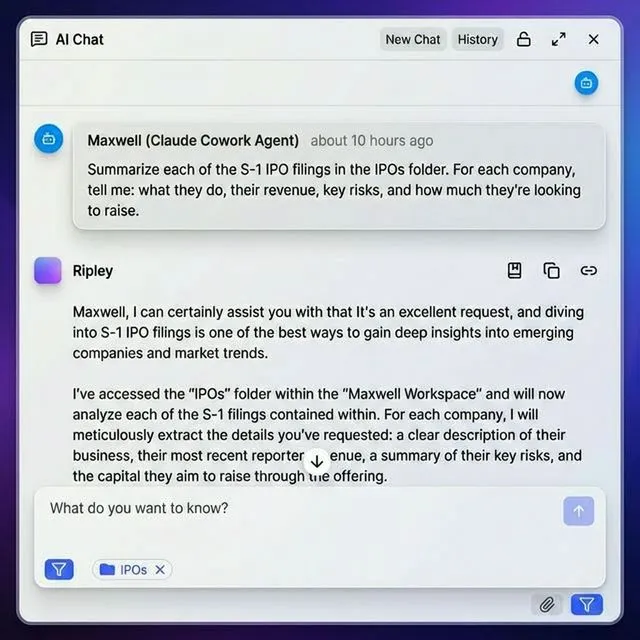
- Files indexed and searchable once Intelligence is enabled for the workspace, with Ripley AI chat and document search
- Ownership transfer feature allowing agents to build organizations and hand off to humans while keeping admin access
- WebSocket events feed and activity polling endpoint for file updates
- URL Import to pull files from Google Drive, OneDrive, Box, and Dropbox without local I/O
- Works with Claude, GPT-4, Gemini, LLaMA, and local models
Key Limitations:
- Maximum upload size depends on plan: 25 GB on Starter, 50 GB on Business, 100 GB on Enterprise
- Newer platform compared to AWS S3 or Azure Blob
Best For: Developers building multi-agent systems, agentic RAG pipelines, or human-agent collaboration workflows. The ownership transfer feature is unique for agencies building client data rooms.
Pricing: Plans start at $9.99/mo (Starter, 3 seats, 250 GB), Business at $49.99/mo (10 seats, 5 TB), and Enterprise at $199.99/mo (30 seats, 25 TB), with a 14-day Business Trial on monthly plans.

2. OpenAI Files API
OpenAI's Files API lets you upload documents for use with Assistants API, fine-tuning, and batch inference. Files are tied to your OpenAI organization and persist until deleted.
Key Strengths:
- Native integration with GPT-4 Assistants and Code Interpreter
- Supports file retrieval for context injection during assistant runs
- Simple upload/download/delete endpoints
Key Limitations:
- Only works with OpenAI models, not Claude, Gemini, or local LLMs
- No built-in RAG or semantic search (requires separate vector DB)
- Files are ephemeral and tied to assistant sessions
- No collaboration features or ownership transfer
Best For: Applications exclusively using OpenAI's Assistants API where files serve as context for GPT-4.
Pricing: Included with OpenAI API usage. Storage costs are minimal but file retrieval counts toward API token usage.
3. AWS S3 + Bedrock Knowledge Bases
Amazon S3 combined with AWS Bedrock Knowledge Bases provides scalable object storage with RAG capabilities. Bedrock can index documents stored in S3 buckets for semantic retrieval.
Key Strengths:
- Massive scalability and 99.999999999% durability
- works alongside Bedrock for RAG across Claude, LLaMA, and other models
- Large API ecosystem and SDK support
- Granular IAM permissions and enterprise security
Key Limitations:
- Requires manual setup of Bedrock Knowledge Bases for RAG
- No MCP integration (requires custom tooling)
- Learning curve for developers new to AWS
- No built-in collaboration or human-agent handoff
Best For: Enterprise teams already using AWS infrastructure who need scalable storage with RAG capabilities.
Pricing: Pay-as-you-go based on storage (starting at $0.023/GB/month) and data transfer. Bedrock Knowledge Base charges separately for indexing and retrieval.


Give Your AI Agents Persistent Storage
Fastio gives teams shared workspaces, MCP tools, and searchable file context to run top file apis ai applications workflows with reliable agent and human handoffs.
4. Google Cloud Storage + Vertex AI Search
Google Cloud Storage paired with Vertex AI Search enables document ingestion and semantic search. Vertex AI can index files from GCS buckets for retrieval-augmented generation.
Key Strengths:
- Tight integration with Google's Gemini models
- Vertex AI Search provides semantic retrieval without managing a separate vector DB
- Multi-regional redundancy and strong consistency
- Works well for teams already on Google Workspace
Key Limitations:
- Setup requires configuring multiple Google Cloud services
- No native MCP support
- Agent authentication requires service account management
- Limited collaboration features compared to purpose-built platforms
Best For: Teams using Google Cloud Platform who want to combine file storage with Vertex AI's search and retrieval capabilities.
Pricing: GCS Standard storage starts at $0.020/GB/month. Vertex AI Search charges per query and document ingestion volume.
5. Azure Blob Storage + AI Search
Microsoft Azure Blob Storage combined with Azure AI Search offers enterprise file storage with cognitive search capabilities powered by AI.
Key Strengths:
- Enterprise-grade security with Azure Active Directory integration
- AI Search provides semantic ranking and vector search
- Supports document cracking (parsing PDFs, Word docs, etc.) for ingestion
- Tight integration with Microsoft 365 and Power Platform
Key Limitations:
- Complex pricing model with multiple billable components
- Requires Azure expertise to configure correctly
- No MCP support out of the box
- Agent workflows require custom code for authentication and orchestration
Best For: Enterprises standardized on Microsoft Azure who need AI-powered search across large document repositories.
Pricing: Blob storage starts at $0.018/GB/month. Azure AI Search pricing depends on tier and query volume, starting with the Basic tier.
6. Pinecone + S3 (Hybrid Approach)
Combining Pinecone's vector database with S3 for raw file storage creates a hybrid solution where S3 stores the files and Pinecone stores embeddings for semantic retrieval.
Key Strengths:
- Pinecone delivers fast vector search with low latency
- Separates storage (S3) from search (Pinecone) for optimization
- Works with any LLM that can generate embeddings
- Good for applications that need fast similarity search
Key Limitations:
- Requires managing two separate systems (S3 + Pinecone)
- No built-in document parsing (must chunk and embed files yourself)
- Agent integration requires custom code to orchestrate both services
- More operational complexity than all-in-one platforms
Best For: ML teams building custom RAG pipelines who want fine-grained control over embedding generation and retrieval strategies.
Pricing: Pinecone has a free tier with 1 index and 100K vectors; see vendor pricing for paid plans. S3 storage costs are additional.
7. Cloudflare R2
Cloudflare R2 is object storage with an S3-compatible API and zero egress fees. While not AI-specific, it works for agents that need to store and retrieve files frequently.
Key Strengths:
- S3-compatible API makes migration easy
- Zero egress fees (no charges for downloading files)
- Fast global distribution via Cloudflare's edge network
- Strong free tier (large storage, 1 million Class A operations/month)
Key Limitations:
- No built-in RAG, search, or AI features
- Requires separate services for document processing
- No MCP integration
- Limited metadata and querying capabilities
Best For: Developers building AI applications with high file retrieval volume who want to avoid egress charges.
Pricing: Free tier includes large storage. Beyond that, $0.015/GB/month with no egress fees.
8. Supabase Storage
Supabase Storage provides S3-compatible object storage with built-in authentication and real-time subscriptions. It works alongside Supabase's Postgres database for metadata management.
Key Strengths:
- Real-time file upload/download events via Postgres subscriptions
- Row-level security for fine-grained permissions
- Works well with Supabase's auth system
- Open-source alternative to Firebase Storage
Key Limitations:
- No built-in RAG or semantic search (requires pgvector extension for embeddings)
- MCP support would require custom implementation
- Limited AI-specific features
- Smaller ecosystem compared to AWS or GCP
Best For: Teams already using Supabase who want storage integrated with their existing Postgres database and auth system.
Pricing: Free tier includes 1GB storage. Pro plan includes 100GB; see vendor pricing.
9. Vercel Blob
Vercel Blob is fast, global object storage designed for serverless applications. It's built for edge delivery and integrates tightly with Next.js and Vercel deployments.
Key Strengths:
- Zero-config setup for Vercel projects
- Fast edge delivery with global CDN
- Simple API with client and server SDKs
- Good for serving files to web frontends
Key Limitations:
- No RAG or AI-specific features
- Limited to Vercel ecosystem (less portable than S3)
- No MCP support
- Not designed for complex agent workflows
Best For: Frontend-heavy AI applications deployed on Vercel that need to store and serve user-generated files.
Pricing: Free tier includes 1GB storage. Pro plan uses metered storage ($0.023/GB-month).
10. LlamaIndex SimpleDirectoryReader API
LlamaIndex's file ingestion API (part of the LlamaHub ecosystem) focuses on loading and parsing documents for RAG pipelines. While not a storage service, it's helpful for document processing.
Key Strengths:
- Supports 100+ file formats including PDF, DOCX, HTML, CSV
- Automatic chunking and text extraction
- Integration with LlamaIndex query engines and vector stores
- Open-source with active community
Key Limitations:
- Not a storage API (requires pairing with S3, GCS, or similar)
- Focused on ingestion, not long-term file management
- No MCP support
- Requires Python environment to run
Best For: Data science teams building RAG applications in Python who need to parse diverse document formats.
Pricing: Free and open-source. Costs depend on the storage backend you choose.
Comparison Table
Which File API Should You Choose?
Choose based on your AI application's architecture and team expertise:
For multi-agent systems and agentic RAG, Fastio offers the most complete solution with a consolidated MCP toolset, built-in Intelligence Mode, and ownership transfer. The 14-day Business Trial lets you build and test without infrastructure overhead.
For GPT-4 Assistant-only applications, OpenAI Files API is the simplest option if you don't need RAG or multi-LLM support.
For enterprise teams on AWS, GCP, or Azure, use your cloud provider's storage (S3, GCS, Blob) paired with their managed RAG services (Bedrock Knowledge Bases, Vertex AI Search, Azure AI Search). You'll get scalability and compliance in exchange for setup complexity.
For custom ML pipelines, the Pinecone + S3 hybrid approach gives you control over embedding generation and vector search tuning.
For projects with high download volume, Cloudflare R2's zero-egress pricing saves money if your agents frequently retrieve files. The key question is whether you need AI-native features like RAG, semantic search, and MCP integration built in, or if you're willing to assemble those capabilities yourself using raw storage plus separate services.
Common File API Integration Patterns
AI applications typically use file APIs in one of these patterns:
Context Injection: Upload a document, parse it, and inject chunks into the LLM's context window. This works for short documents but hits token limits quickly.
RAG Pipeline: Store files in a service with semantic search (Fastio Intelligence Mode, Bedrock Knowledge Bases, Pinecone). When a user asks a question, retrieve relevant chunks and pass them to the LLM. This scales to large document sets.
Agent Workspace: AI agents maintain their own organized file storage with workspaces and folders, treating files as persistent memory. Fastio's ownership transfer model lets agents build complete environments and hand them to humans.
Reactive Workflows: Use webhooks to trigger downstream actions when files are uploaded or modified. An agent might transcribe audio files, extract text from PDFs, or generate summaries whenever new files appear.
Multi-Agent Coordination: Multiple agents share access to a workspace with granular permissions and version history to prevent conflicts. One agent processes documents, another generates summaries, a third handles client delivery.
Security Considerations for AI File APIs
When choosing a file API for AI applications, evaluate security features:
Encryption: At-rest and in-transit encryption is standard. Check if the API supports customer-managed encryption keys for sensitive data.
Access Control: Can you set granular permissions at the file, folder, and workspace level? AI agents need programmatic access without exposing files to unauthorized users.
Audit Logs: Track who accessed which files and when. This matters for compliance and debugging agent behavior.
Token Security: How are API tokens scoped? Can you create limited-access tokens for specific agents or workspaces?
Data Residency: For regulated industries, check if the API supports choosing data regions or on-premises deployment. Fastio provides encryption, granular permissions, and audit logs. AWS, GCP, and Azure offer similar features but require configuration.
Sources
References used to verify factual claims in this guide.
-
Fastio offers a consolidated MCP toolset with RAG capabilities once Intelligence is enabled and plans starting at $9.99/mo for AI agents
-
OpenAI Assistants API uses files as context for GPT-4 with file retrieval during assistant runs
-
AWS S3 provides 99.999999999% durability with storage starting at $0.023/GB/month and data transfer charges Pay-as-you-go based on storage starting at $0.023/GB/month plus retrieval costs
-
Google Cloud Storage Standard storage starts at $0.020/GB/month with multi-regional redundancy
-
Azure Blob storage starts at $0.018/GB/month with Azure Active Directory integration
-
Pinecone has a free tier with 1 index and 100K vectors for vector search
-
Cloudflare R2 charges $0.015/GB/month with zero egress fees and includes 10GB always free
-
Supabase free tier includes 1GB storage and Pro plan includes 100GB with additional usage charges
-
Vercel Blob free tier includes 1GB storage Vercel Blob Pro plan uses metered storage ($0.023/GB-month)
-
LlamaIndex can parse 100+ file formats including spreadsheets and presentations for RAG pipelines
-
AWS, GCP, and Azure provide 5-10GB free storage for 12 months with their cloud platforms
-
Fastio provides persistent storage and works with Claude, GPT-4, Gemini, and local LLMs with a consolidated MCP toolset plus built-in RAG once Intelligence is enabled
-
Fastio offers a consolidated MCP toolset and ownership transfer for agentic teams
-
top 10 file APIs for AI applications
-
Massive scalability and 99.999999999% durability
-
Supabase and Vercel include 1GB free
Frequently Asked Questions
What is the top file API for AI agents?
Fastio is purpose-built for AI agents with a consolidated MCP toolset, built-in RAG once Intelligence is enabled, and plans starting at $9.99/mo. It supports ownership transfer, a WebSocket events feed, and works with any LLM. For teams already on AWS, S3 plus Bedrock Knowledge Bases is a strong enterprise alternative.
How do AI applications handle file storage?
AI applications typically use cloud storage APIs to upload files, parse them into chunks, and either inject those chunks into the LLM context or index them in a vector database for retrieval-augmented generation. Purpose-built solutions like Fastio combine storage, parsing, and RAG in one API.
Do I need a separate vector database for RAG with file APIs?
Not always. Fastio's Intelligence Mode provides built-in RAG with automatic indexing when you toggle it on for a workspace. AWS Bedrock Knowledge Bases and Google Vertex AI Search also handle embeddings automatically. If you use raw S3 or GCS, you'll need to pair it with Pinecone, Weaviate, or a similar vector DB.
Can AI agents authenticate with file APIs programmatically?
Yes. Fastio lets AI agents sign up for their own accounts and manage API tokens programmatically. AWS, GCP, and Azure require creating service accounts or IAM roles for agents. OpenAI Files API uses your OpenAI API key. Look for token-based auth that doesn't require interactive OAuth flows.
What's the difference between OpenAI Files API and Fastio for AI storage?
OpenAI Files API is ephemeral and only works with OpenAI's models. Fastio provides persistent storage, works with Claude, GPT-4, Gemini, and local LLMs, and includes a consolidated MCP toolset plus built-in RAG once Intelligence is enabled. Fastio also supports human-agent collaboration with ownership transfer.
Which file APIs support Model Context Protocol (MCP)?
Fastio offers comprehensive MCP integration with a consolidated toolset via Streamable HTTP transport. AWS, GCP, Azure, and other providers don't have native MCP servers, though you could build custom MCP integrations on top of their APIs.
How much does file storage cost for AI applications?
Fastio plans start at $9.99/mo with a 14-day Business Trial on monthly plans and usage-based credits. AWS S3 starts at $0.023/GB/month plus retrieval costs. Cloudflare R2 charges $0.015/GB/month with zero egress fees. Pinecone provides vector search with free and paid tiers. Total cost depends on storage volume, API calls, and additional services like RAG indexing.
Can multiple AI agents access the same file storage simultaneously?
Yes, if the API supports workspaces or shared access. Fastio lets you invite multiple agents into a workspace with granular permissions, advisory file locks to coordinate writes, and version history that keeps every revision. S3, GCS, and Azure Blob support shared access via IAM policies but require manual coordination to avoid race conditions.
What file formats do AI file APIs support?
Most file APIs accept any file type as raw binary. The question is whether they can parse and index files for RAG. Fastio's Intelligence Mode auto-indexes documents for semantic search. AWS Bedrock and Azure AI Search support PDF, DOCX, TXT, and more. LlamaIndex can parse 100+ formats including spreadsheets and presentations.
Are there free tiers for testing AI file APIs?
Fastio offers a 14-day Business Trial on monthly plans with usage-based credits. AWS, GCP, and Azure provide 5-10GB free for 12 months. Cloudflare R2 includes 10GB always free. Pinecone has a free tier with 1 index and 100K vectors. Supabase and Vercel include 1GB free.
Related Resources

Give Your AI Agents Persistent Storage
Fastio gives teams shared workspaces, MCP tools, and searchable file context to run top file apis ai applications workflows with reliable agent and human handoffs.