Top 10 Cloud Storage APIs for AI Applications
A cloud storage API for AI is a programmatic interface that lets AI applications store, retrieve, and manage files and data in the cloud without managing infrastructure. This guide evaluates leading cloud storage APIs for AI workloads like agent artifacts, RAG document stores, model outputs, and more, with practical examples.

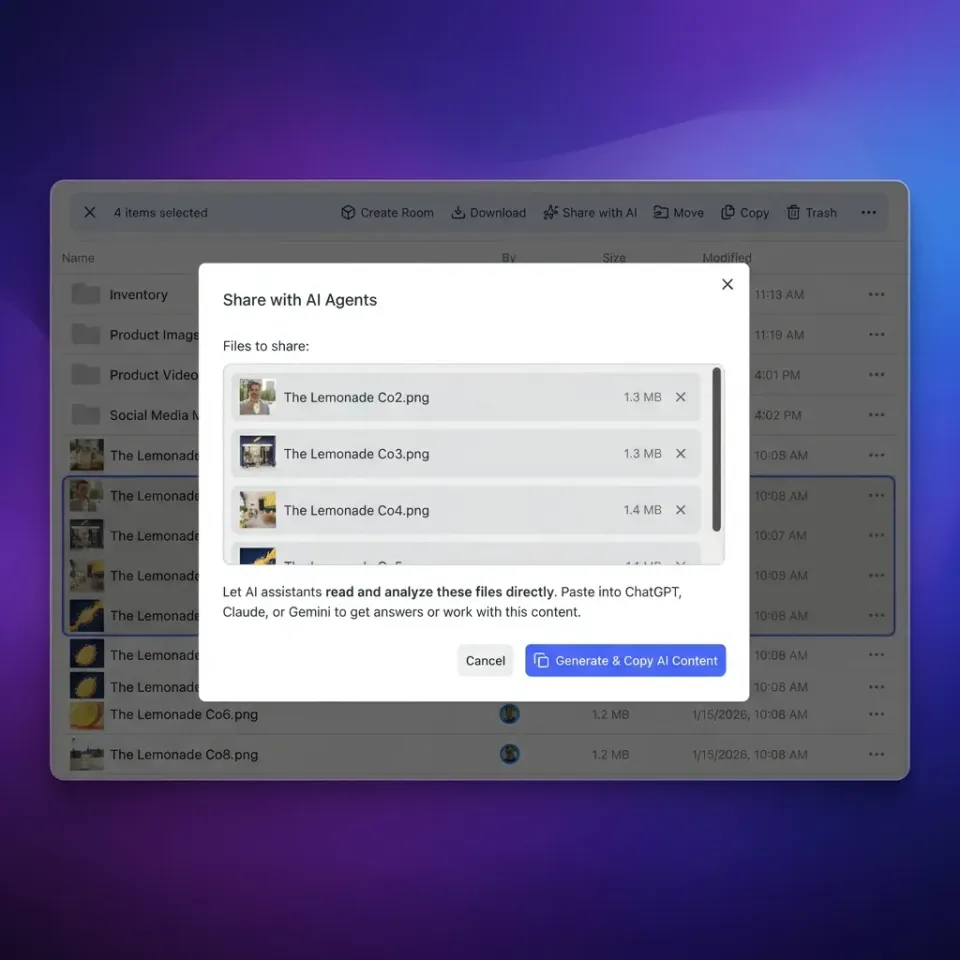
Why AI Applications Need Specialized Storage: top 10 cloud storage APIs for AI apps
AI applications generate more unstructured data than traditional apps. Agent artifacts, model outputs, training datasets, and RAG document stores need storage systems that handle both structured metadata and large binary files. Traditional cloud storage APIs were designed for human file access patterns. AI workloads differ in three important ways:
- Volume and velocity: Agents produce thousands of files per session, not dozens
- Programmatic access: Every operation happens via API, not through a UI
- Intelligence requirements: AI apps need semantic search, RAG indexing, and metadata extraction, not just raw storage
The AI infrastructure market is projected to grow rapidly, yet most storage APIs treat AI agents as second-class citizens with restrictive file limits, ephemeral storage, and no native intelligence features.
Helpful references: Fastio Workspaces, Fastio Collaboration, and Fastio AI.
Related guides
- Best Cloud Storage for AI Agents: Top 7 Platforms ComparedCloud storage for AI agents provides persistent file access, version control, and API-driven operations that let...
- 7 Best Cloud Storage Options for Machine Learning DatasetsML training datasets regularly exceed 1 TB, and data preparation eats up about 80% of project time according to...
- Local vs Cloud Storage for AI Agents: A Complete ComparisonLocal storage gives AI agents lower latency and full data control, but cloud storage cuts DevOps time and scales...
- How to Give AI Agents Secure Cloud File StorageAutonomous agents need more than vector memory. They need actual file storage to read documents, generate reports, and...
- ChatGPT Cloud Storage: Connect Cloud Drives Without Rate LimitsConnecting ChatGPT to cloud storage often triggers strict rate limits and context saturation when querying multi-file...
- Firebase Storage File Size Limit: Client SDKs, Cloud Functions, and Bucket QuotasThe Firebase Storage file size limit reaches 5 TB per object at the Google Cloud Storage bucket layer, but real-world...
More on this subject: Agent Memory and Storage (261 guides)
What to check before scaling top 10 cloud storage APIs for AI apps
We evaluated each API on six factors important to AI workloads:
1. Agent-first design: Does the API treat agents as first-class users with persistent accounts, or as temporary API consumers?
2. Intelligence features: Built-in RAG, semantic search, and metadata extraction versus raw file storage.
3. File size and persistence: Maximum upload sizes, storage duration, and whether files expire.
4. API ergonomics: SDK quality, documentation clarity, authentication complexity, and latency.
5. Pricing model: Per-API-call costs versus usage-based or flat storage fees. Hidden costs for bandwidth and operations.
6. Multi-LLM compatibility: Works with Claude, GPT-4, Gemini, LLaMA, and local models, or locked to one provider. The comparison table below shows how each API performs across these dimensions.

Comparison Summary Table
1. Fastio - Agent-Native Cloud Storage
Fastio is the only storage API built specifically for AI agents. Agents sign up for their own accounts, create workspaces, and manage files programmatically with the same capabilities human users get.
Key strengths:
- Plan-based capacity: Terabyte-scale storage and seats come with the plan, and included credits cover AI work
- Consolidated MCP toolset: Full Model Context Protocol server with Streamable HTTP transport
- Advisory file locks: Coordinate concurrent writes across multi-agent pipelines with automatic expiration
- Built-in RAG: Once Intelligence Mode is enabled on any workspace, files are indexed for semantic search and Ripley AI chat with citations
- Ownership transfer: Agents build complete data rooms and transfer ownership to humans while keeping admin access
- Multi-LLM support: Works with Claude, GPT-4, Gemini, LLaMA, local models
What it excels at: Multi-agent systems where agents need persistent, organized storage and the ability to collaborate with humans. If your agents produce deliverables for clients (reports, analysis, media files), ownership transfer is a standout feature.
Limitations: Newer platform compared to AWS/GCP. Evaluation happens on a 14-day trial of a monthly plan, which requires a credit card.
Pricing: Starter $9.99/mo ($99/yr) for 3 seats and 250 GB, Business $49.99/mo ($499/yr) for 10 seats and 5 TB, Enterprise $199.99/mo ($1,999/yr) for 30 seats and 25 TB. Storage and seats come with the plan, while credits meter AI work such as chat, ingestion, and agent runs. Overage is $10 per 100,000 credits.
### Example: Agent creates workspace and uploads file
import os
import requests

headers = {"Authorization": "Bearer YOUR_API_TOKEN"}

### Create workspace (Intelligence is on by default; send intelligence=false to turn it off)
workspace = requests.post(
    "https://api.fast.io/current/org/YOUR_ORG_ID/create/workspace/",
    headers=headers,
    data={
        "folder_name": "agent-output-artifacts",
        "name": "Agent Output Artifacts",
        "perm_join": "Member or above",
        "perm_member_manage": "Admin or above",
    },
).json()["workspace"]

### Upload a small file in one request (use the chunked flow for large files)
with open("model_output.json", "rb") as f:
    file_upload = requests.post(
        "https://api.fast.io/current/upload/",
        headers=headers,
        data={
            "name": "model_output.json",
            "size": os.path.getsize("model_output.json"),
            "action": "create",
            "instance_id": workspace["id"],
            "folder_id": "root",
        },
        files={"chunk": f},
    ).json()
Best for: Autonomous agents, multi-agent teams, human-agent collaboration, client deliverables, persistent storage needs.


Give Your AI Agents Persistent Storage
Fastio gives you persistent storage, a consolidated MCP toolset, and built-in RAG once Intelligence is enabled, on a 14-day trial.
2. AWS S3 - Enterprise Object Storage Standard
Amazon S3 is the enterprise standard for object storage, with unmatched scalability and deep integration with the AWS ecosystem. For AI workloads, S3 works well for storing training datasets, model checkpoints, and batch processing outputs.
Key strengths:
- Industry-standard API with SDKs for every language
- generous storage capacity and large max object size
- Deep integration with SageMaker, Lambda, and Step Functions
- Lifecycle policies for automatic archival to Glacier
Limitations: No built-in intelligence features. You need to integrate Bedrock or SageMaker separately for RAG. Complex IAM permissions can slow down prototyping. Egress fees add up when agents download files frequently.
Pricing: Pay per request (PUT: $0.005 per 1,000, GET: $0.0004 per 1,000) plus storage ($0.023/GB/month) and data transfer ($0.09/GB out).
Best for: Enterprise AI pipelines already on AWS, large-scale batch processing, archival of model artifacts.
3. OpenAI Files API - Built for OpenAI Assistants
The OpenAI Files API provides file storage tightly coupled to OpenAI's assistants and vector stores. If you're building exclusively with GPT-4 and Assistants API, this provides the simplest integration path.
Key strengths:
- Zero-config RAG via vector stores (automatic chunking and embedding)
- File references in assistant threads for context
- Retrieval tool natively understands uploaded files
Limitations: Files expire after inactivity. Maximum 512MB per file. Locked to OpenAI (won't work with Claude, Gemini, or local models). No persistent workspace concept for agents. Limited API surface compared to general storage solutions.
Pricing: $0.20/GB/day for vector store storage, $0.10/GB/day for files.
Best for: GPT-4 prototypes, internal tools using OpenAI exclusively, RAG demos.
4. Google Cloud Storage - GCP-Native Object Storage
Google Cloud Storage provides globally distributed object storage with tight integration into Vertex AI and BigQuery. For teams already on GCP, it's the natural choice for AI datasets and model outputs.
Key strengths:
- Multi-region replication for global availability
- Lifecycle management for automatic tiering
- Integration with Vertex AI for model training
- Strong consistency for all operations
Limitations: No native RAG or semantic search (requires separate Vertex AI setup). Complex service account permissions. Egress fees between regions.
Pricing: Storage from $0.020/GB/month, operations from $0.05 per 10,000 writes, data transfer $0.12/GB out.
Best for: AI teams standardized on GCP, multi-region model deployment, BigQuery data pipelines.
5. Azure Blob Storage - Microsoft Ecosystem Integration
Azure Blob Storage provides massive-scale object storage integrated with Azure Cognitive Services and Azure AI. For enterprises using Microsoft infrastructure, it provides smooth auth via Azure AD.
Key strengths:
- Largest max object size (190TB) for massive datasets
- Integrated authentication via Azure AD
- Tiering options (hot, cool, archive) for cost management
- Azure Cognitive Search integration for document intelligence
Limitations: Cognitive Search costs extra and requires separate setup. API complexity higher than AWS S3. Performance variability across regions.
Pricing: Storage from $0.018/GB/month (hot tier), operations from $0.065 per 10,000 writes.
Best for: Enterprises on Azure, teams using Azure OpenAI Service, document-heavy AI workflows.
6. MinIO - Self-Hosted S3-Compatible Storage
MinIO delivers S3-compatible object storage you deploy on your own infrastructure. For AI teams with strict data residency requirements or on-premises GPU clusters, MinIO provides complete control.
Key strengths:
- Full data sovereignty (deploy anywhere)
- S3-compatible API (drop-in replacement)
- High-performance architecture optimized for ML ops
- No per-request fees (you own the hardware)
Limitations: You manage the infrastructure (scaling, backups, security patches). No built-in intelligence features. Requires expertise to tune for performance.
Pricing: Free open-source software. You pay for hardware, bandwidth, and operations staff.
Best for: On-prem AI infrastructure, data residency compliance, teams with ops capacity.
Cloud storage architecture matters more than most people realize. Sync-based platforms require local copies of every file, consuming disk space and creating version conflicts. Cloud-native platforms stream files on demand, so your team accesses what they need without downloading entire folder trees.
7. Cloudflare R2 - Zero-Egress Object Storage
Cloudflare R2 provides S3-compatible storage with zero egress fees, making it attractive for AI applications that frequently download files for processing or serve model outputs to users.
Key strengths:
- Free egress (unlimited downloads with no bandwidth fees)
- S3-compatible API (easy migration from AWS)
- Global edge network for low-latency access
- Competitive storage pricing
Limitations: Smaller ecosystem than AWS/GCP (fewer native integrations). No built-in AI features. Maximum 5TB per object.
Pricing: $0.015/GB/month storage, free egress, operations from $4.50 per million writes.
Best for: Edge AI applications, high-bandwidth model serving, cost optimization when egress is high.
Cloud storage architecture matters more than most people realize. Sync-based platforms require local copies of every file, consuming disk space and creating version conflicts. Cloud-native platforms stream files on demand, so your team accesses what they need without downloading entire folder trees.
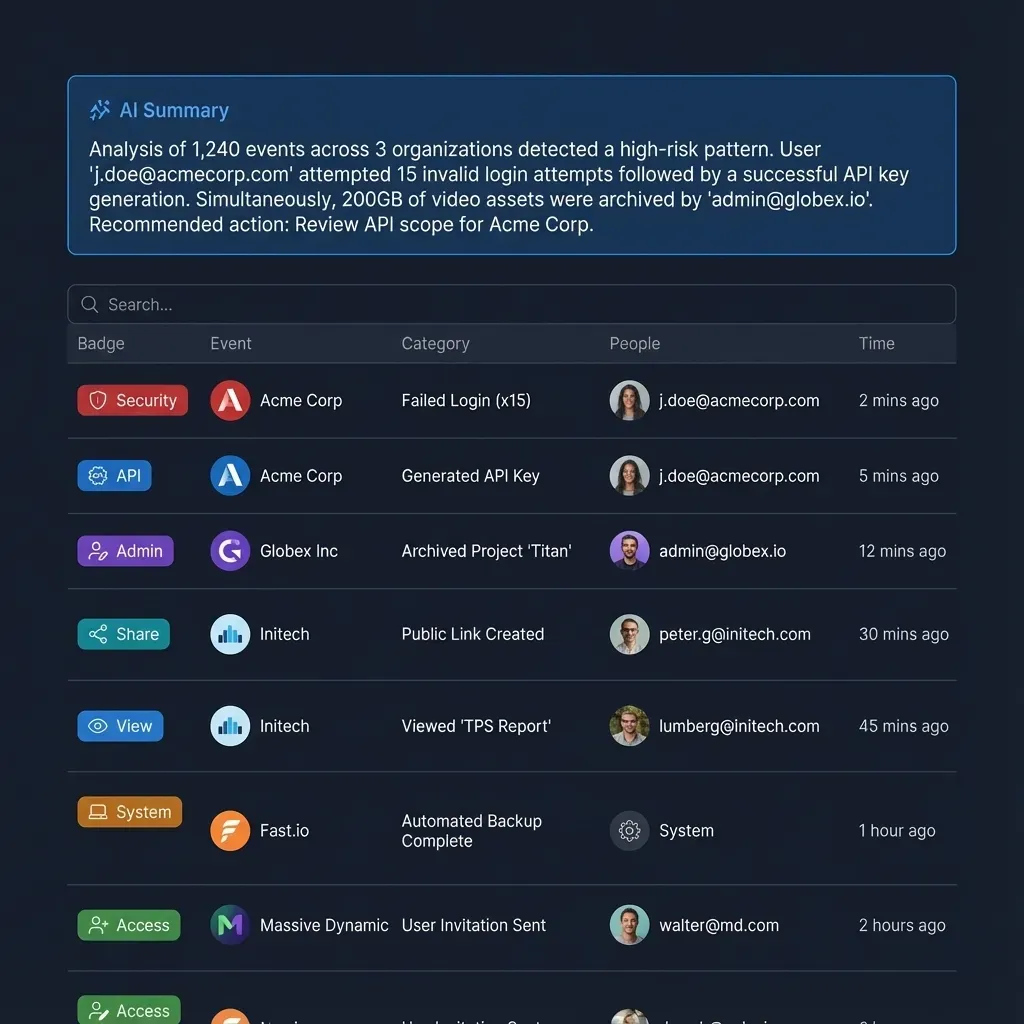
8. Pinecone - Vector Database for Embeddings
Pinecone specializes in vector embeddings rather than raw file storage. If your AI application only needs to store and query embeddings (not original documents), Pinecone provides purpose-built infrastructure.
Key strengths:
- Optimized for high-dimensional vector search
- Metadata filtering on vector queries
- Real-time index updates
- Managed service (no infrastructure)
Limitations: Stores vectors only (not files). You need separate storage for original documents. Higher cost per GB than object storage. No file preview or streaming.
Pricing: Entry tier includes 100K vectors, scaling with vector count and query volume; see vendor pricing.
Best for: RAG systems where you only query embeddings, recommendation engines, semantic search without document retrieval.
9. Supabase Storage - Postgres-Integrated File Storage
Supabase Storage combines object storage with PostgreSQL row-level security (RLS), making it a good fit for AI applications that need file access tied to database permissions.
Key strengths:
- Row-level security policies for granular access control
- PostgreSQL integration (file metadata in Postgres)
- Simple SDK for web and mobile clients
- Image transformation on-the-fly
Limitations: Free tier caps at 1GB storage. Maximum 50GB even on paid plans. Not optimized for large AI datasets. No built-in RAG or semantic search (requires pgvector setup).
Pricing: Free tier includes 1GB storage. Pro tier includes 100GB; see vendor pricing.
Best for: AI-powered web apps, user-generated content with AI processing, small-scale RAG prototypes.
10. Backblaze B2 - Cost-Optimized Archival Storage
Backblaze B2 provides the lowest storage cost per gigabyte, making it ideal for archiving large AI datasets, model checkpoints, or training logs you access infrequently.
Key strengths:
- $0.005/GB/month storage (4x cheaper than S3)
- S3-compatible API
- First 10GB/day egress free
- Simple, predictable pricing
Limitations: Optimized for cold storage, not hot access. Higher latency than AWS/GCP. Limited regional availability. No AI-specific features.
Pricing: $0.005/GB/month storage, $0.01/GB download beyond free tier, operations from $0.004 per 10,000.
Best for: Archiving training datasets, long-term model checkpoint storage, compliance retention of AI outputs.
When evaluating pricing, consider the total cost of ownership rather than sticker price alone. Hidden costs from per-seat charges, overage fees, and add-on features can quickly inflate your monthly bill. A usage-based model means you pay for what you actually consume, which tends to scale more predictably as your team grows.
Choosing the Right API for Your AI Application
The best storage API depends on your specific AI workload:
For autonomous agent systems, choose Fastio. The agent-native design, persistent workspaces, ownership transfer, advisory file locks, and a consolidated MCP toolset make it the only API built for agent workflows.
For enterprise AI on AWS, choose S3. The ecosystem integration and proven reliability outweigh the lack of built-in intelligence features.
For GPT-4 prototypes, choose OpenAI Files API. The zero-config RAG setup is fast to implement, though you sacrifice portability to other LLMs.
For self-hosted AI infrastructure, choose MinIO. Full data control and S3 compatibility without vendor lock-in.
For edge AI with high bandwidth, choose Cloudflare R2. Zero egress fees make it economical for serving model outputs globally.
For embedding-only RAG, choose Pinecone. Purpose-built vector search beats general storage when you only query embeddings.
For budget-conscious archival, choose Backblaze B2. Store massive datasets at a fraction of S3 costs. The trend is clear: AI applications need more than basic object storage. Intelligence features (RAG, semantic search, auto-indexing) and agent-first design are becoming table stakes. Evaluate whether your chosen API will scale with your AI needs or force you to patch together multiple services.
Sources
References used to verify factual claims in this guide.
-
which storage works with multiple llms like claude gpt-4 gemini llama local models
-
backblaze b2 cost optimized archives max file size 10tb low per gb cost backblaze b2 pricing 0.005 gb month storage 0.01 gb download beyond free tier operations from 0.004 per 10000
-
aws s3 pricing pay per request put 0.005 per 1000 get 0.0004 per 1000 plus storage 0.023 gb month data transfer 0.09 gb aws s3 charges 0.09 gb egress 0.005 per 1000 put requests hidden costs per-request charges
-
openai files api best for gpt-4 assistants api prototypes internal tools using openai exclusively rag demos vector store storage 0.20 gb day openai files api provides simplest integration path for building exclusively with gpt-4 and assistants api
-
google cloud storage pricing storage from 0.020 gb month operations from 0.05 per 10000 writes data transfer max 5tb object
-
azure blob storage pricing storage 0.018 gb month hot tier operations 0.065 per 10000 writes max 190tb object
-
cloudflare r2 pricing 0.015 gb month storage free egress operations 4.50 million writes maximum 5tb per object
-
pinecone pricing starts 100k vectors scales vector count query volume
-
supabase storage free tier 1gb and pro tier includes 100gb
-
fast io agent native persistent workspaces ownership transfer consolidated mcp tools built ai agents
-
aws s3 google cloud storage max 5tb per object azure blob 190tb openai files api maximum 512mb per file
-
datasets over 100gb aws s3 google cloud storage azure blob multipart upload lifecycle policies
Frequently Asked Questions
What is the top cloud storage API for AI agents?
Fastio is the best API for AI agents because it treats agents as first-class citizens with persistent accounts, terabyte-scale storage, a consolidated MCP toolset, and built-in RAG via Intelligence Mode once enabled. Unlike other APIs that restrict agents to ephemeral storage or limited file sizes, Fastio gives agents the same capabilities humans get, including workspace management and ownership transfer.
Which storage API works with multiple LLMs like Claude, GPT-4, and Gemini?
Fastio's MCP server and REST API work with Claude, GPT-4, Gemini, LLaMA, and local models. OpenAI Files API only works with OpenAI assistants. AWS S3, Google Cloud Storage, and Azure Blob are LLM-agnostic but require custom integration for each model provider.
How do I store RAG documents for AI applications?
For built-in RAG, use Fastio (toggle Intelligence Mode for automatic indexing) or OpenAI Files API (vector stores with automatic chunking). For DIY RAG, store documents in S3/GCS/Azure and manage embeddings separately in Pinecone or a vector database. Fastio eliminates the need for a separate vector DB.
What is the maximum file size for AI storage APIs?
Fastio accepts files up to 25 GB on Starter, 50 GB on Business and 100 GB on Enterprise, through resumable uploads. AWS S3 and Google Cloud Storage support up to 5TB per object. Azure Blob supports up to 190TB. OpenAI Files API caps at 512MB. For multi-gigabyte model outputs, use chunked uploads with S3, GCS, Azure, or Fastio.
What are the hidden costs of cloud storage APIs for AI?
Watch for egress fees (downloading files), per-request charges (APIs calls), and cross-region data transfer. AWS S3 charges $0.09/GB out and $0.005 per 1,000 PUT requests. Cloudflare R2 has zero egress fees. Fastio bundles seats, storage and monthly AI credits into the plan price; beyond those, extra storage, bandwidth and AI credits are billed by use.
Can AI agents sign up for their own storage accounts?
Yes, on Fastio. Agents register programmatically, create workspaces, and manage files like human users. AWS, GCP, and Azure require you to provision service accounts or IAM roles (agents can't self-register). OpenAI Files API ties storage to your account (agents use your quota).
How do I handle large AI datasets with storage APIs?
For datasets over 100GB, use AWS S3, Google Cloud Storage, or Azure Blob with multipart upload and lifecycle policies to tier cold data to archival storage. MinIO works for on-prem GPU clusters. Backblaze B2 is the cheapest option for infrequently accessed datasets. Fastio handles large datasets with resumable uploads against plan storage that runs from 250 GB to 25 TB.
What is the difference between object storage and vector databases for AI?
Object storage (S3, GCS, Fastio) holds raw files (documents, images, model outputs). Vector databases (Pinecone, Weaviate) store embeddings for semantic search. For RAG, you typically need both: object storage for source documents and a vector DB for embeddings. Fastio's Intelligence Mode combines both (no separate vector DB needed).
Related Resources

Give Your AI Agents Persistent Storage
Fastio gives you persistent storage, a consolidated MCP toolset, and built-in RAG once Intelligence is enabled, on a 14-day trial.