Top 10 AI Agent Infrastructure Platforms in 2026
AI agent infrastructure platforms build backends for multi-agent systems. The market is expected to grow from $7.63 billion in 2025 to $182.97 billion by 2033. We evaluated leading platforms for scalability, integrations, pricing, and workspace support. LangChain excels at orchestration. Fastio works well for agent-human teams.

How We Evaluated These Platforms
We scored platforms on criteria agent developers care about:
Scalability (25%): Production readiness, multi-agent support, auto-scaling.
Integrations (20%): LLM providers, tools, APIs like MCP for file ops.
Pricing (15%): Free tiers for prototyping.
Observability (20%): Tracing, metrics, debugging.
Workspace Primitives (20%): Persistence and collaboration. Areas most competitors miss.
Data from GitHub stars (>10k for top), docs, community forums.

Related guides
- Best AI Agent Hosting Platforms in 2026AI agent hosting platforms provide compute, storage, and orchestration for deploying autonomous agents in production....
- Best AI Agent Infrastructure Stacks in 2026Guide to agent infrastructure stacks: Choosing an AI agent stack means balancing storage, orchestration, and...
- How to Automate AI Agent InfrastructureAI agent infrastructure automation helps you scale agent workflows from one bot to thousands. Most teams focus on...
- How to Build AI Agent Infrastructure: The Complete Stack GuideAI agent infrastructure is the comprehensive technology stack required to build, deploy, and run autonomous agents in...
- How to Deploy AI Agents: The Complete Production GuideThis AI agent deployment guide explains how to move autonomous systems from development to production. Most AI agents...
- Best Self-Hosted AI Agent Platforms (2026 Guide)Self-hosted AI agent platforms let teams run agents on their own infrastructure, keeping data on-premise and avoiding...
More on this subject: Agent Infrastructure and Deployment (55 guides)
Quick Comparison Table


Give Your AI Agents Persistent Storage
Fastio gives teams shared workspaces, MCP tools, and searchable file context to run top ai agent infrastructure platforms workflows with reliable agent and human handoffs.
How to Choose the Right AI Agent Infrastructure Platform?
When selecting a platform, align it with your specific agent workflow needs:
- Orchestration and complex chains: LangChain or CrewAI
- RAG and knowledge retrieval: LlamaIndex
- Role-based agent teams: CrewAI or AutoGen
- Observability and monitoring: Helicone
- Persistent workspaces for human-agent collaboration: Fastio
Start with free tiers to test integrations and scalability for your use case.
Define clear tool contracts and fallback behavior so agents fail safely when dependencies are unavailable. This improves reliability in production workflows.
What Makes Agent Infrastructure Production-Ready?
Production-ready platforms provide:
- Scalable multi-agent support and auto-scaling
- Integrations with LLMs, tools, and APIs like MCP
- Observability tools for tracing, metrics, and debugging
- Workspace primitives for persistence, sharing, and collaboration
- Cost-effective pricing with free prototyping options
No single platform excels everywhere, combine them (e.g., LangChain + Fastio + Helicone) for complete stacks.
Define clear tool contracts and fallback behavior so agents fail safely when dependencies are unavailable. This improves reliability in production workflows.
Top 10 AI Agent Infrastructure Platforms
These platforms cover orchestration (LangChain, CrewAI), RAG (LlamaIndex), observability (Helicone), and workspaces (Fastio). They perform well in their niches but often lack workspace tools for human-agent collaboration.
Each includes strengths, limitations, best use cases, and pricing to help decide.
Rankings based on scalability, integrations, pricing, and community support. Agent teams needing persistent storage and MCP should try Fastio.
Define clear tool contracts and fallback behavior so agents fail safely when dependencies are unavailable. This improves reliability in production workflows.
1. LangChain / LangGraph
LangChain builds LLM chains, agents, and retrieval apps. LangGraph adds graph-based multi-agent flows.
Strengths:
- Large tool ecosystem and integrations.
- LangSmith for debugging (paid).
Limitations:
- Steep learning curve for complex setups.
Best for: Production LLM apps. Pricing: Free OSS, with paid LangSmith Developer plans.
2. LlamaIndex
LlamaIndex indexes data for LLM apps, with strong RAG and agent toolkits.
Strengths:
- Solid data connectors.
- Query engines for agents.
Limitations:
- Limited multi-agent orchestration.
Best for: RAG-focused agents. Pricing: Free OSS, LlamaCloud Starter $50/mo.
3. CrewAI
Framework for role-based autonomous AI agent teams.
Strengths:
- Simple multi-agent setups.
- Task delegation.
Limitations:
- Young ecosystem.
Best for: Team agent workflows. Pricing: Free OSS.
4. AutoGen
Microsoft framework for multi-agent conversations.
Strengths:
- Human-in-the-loop.
- Code execution tools.
Limitations:
- Python-only.
Best for: Conversational agents. Pricing: Free OSS.
5. Fastio
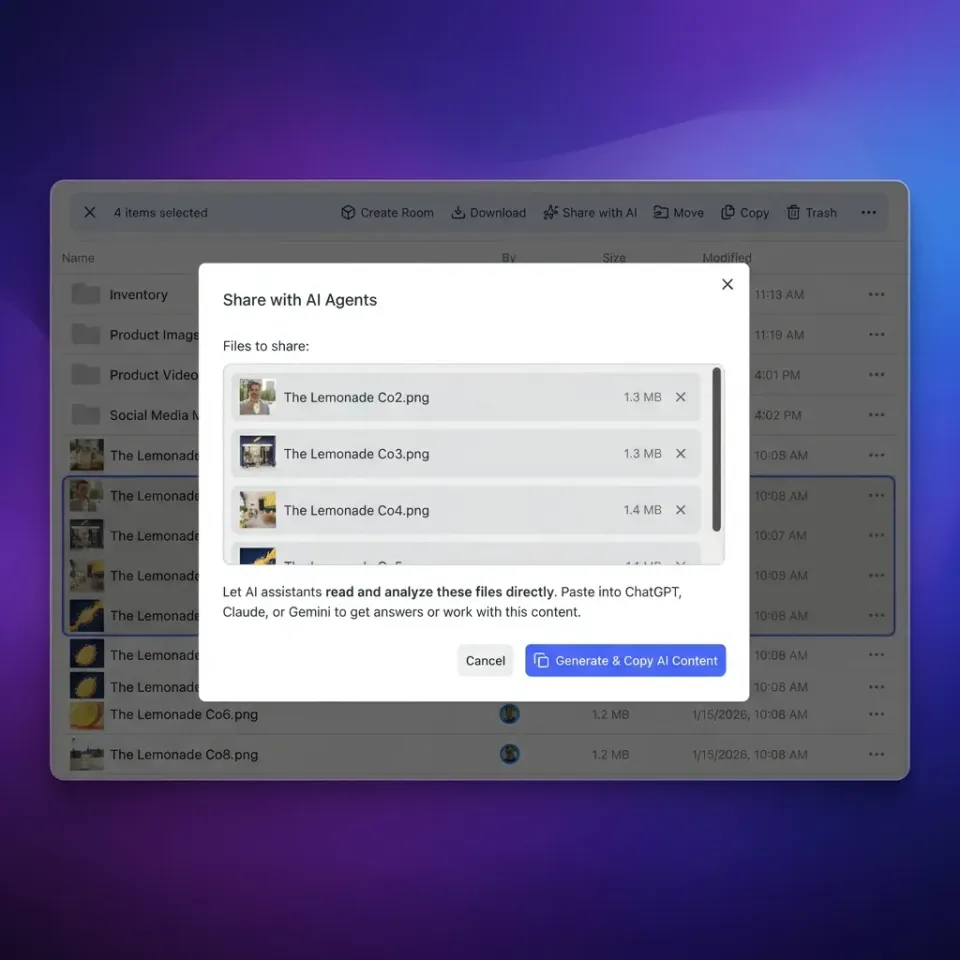
Fastio offers workspaces for agent teams, with a consolidated MCP toolset matching UI capabilities.
Agents authenticate with scoped API keys or PKCE browser login, create workspaces, import files from cloud providers (Google Drive, Dropbox, OneDrive, Box) or public URLs, query documents via Ripley once Intelligence is enabled, and transfer ownership to humans.
Strengths:
- Business Trial: 14-day Business Trial (card required; see /pricing/).
- Native RAG with citations once Intelligence is enabled, WebSocket events feed, advisory file locks, and version history.
- Remote MCP integration: Connect via Streamable HTTP at
https://mcp.fast.io/mcp/tools.
Limitations:
- Storage/workspace-focused; pair with LangChain/CrewAI for orchestration.
Best for: Human-agent collaboration and persistent agent state. Pricing & docs.
6. Semantic Kernel
Microsoft SDK for AI orchestration and plugins.
Strengths:
- .NET/C#/Java support.
- Agent planners.
Limitations:
- Microsoft-focused.
Best for: .NET enterprise apps. Pricing: Free OSS.
7. Haystack
Open-source NLP framework for search and agents.
Strengths:
- Modular pipelines.
- Strong retrieval.
Limitations:
- Setup-heavy.
Best for: Search agents. Pricing: Free OSS.
8. Flowise
Low-code builder for LLM flows and agents.
Strengths:
- Drag-and-drop UI.
- Embeddings support.
Limitations:
- Less suited for production scale.
Best for: Quick prototypes. Pricing: Free OSS, Cloud plans from $35/mo.
9. SuperAGI
Platform for autonomous agents.
Strengths:
- Agent GUI.
- Tool marketplace.
Limitations:
- Smaller community.
Best for: Agent management. Pricing: Free OSS; see vendor pricing for Pro plans.
10. Helicone
Observability for LLM and agent calls.
Strengths:
- Real-time tracing.
- Cost tracking.
Limitations:
- Observability only.
Best for: Monitoring. Pricing: Free tier, Pro $79/mo.
Sources
References used to verify factual claims in this guide.
-
The market is expected to grow from $7.63 billion in 2025 to $182.97 billion by 2033.
-
Scalability (25%): Production readiness, multi-agent support, auto-scaling. Integrations (20%): LLM providers, tools, APIs like MCP for file ops. Pricing (15%): Free tiers for prototyping. Observability (20%): Tracing, metrics, debugging. Workspace Primitives (20%): Persistence and collaboration. We identified the Top 10 AI Agent Infrastructure Platforms based on our evaluation criteria.
-
Data from GitHub stars (>10k for top), docs, community forums.
-
Pricing: Free OSS, LlamaCloud Starter $50/mo.
-
Fastio offers workspaces for agent teams, with a consolidated MCP toolset matching UI capabilities.
-
Pricing: Free OSS, Cloud plans from $35/mo.
-
Pricing: Free tier, Pro $79/mo.
-
LangChain LangSmith Developer plan at $39/month
-
Fastio provides a 14-day Business Trial and plans starting at $9.99/mo with usage-based credits
Frequently Asked Questions
What are the top AI agent platforms?
LangChain for orchestration, LlamaIndex for RAG, CrewAI for teams, Fastio for workspaces top the list. Pick based on your needs like scale or collaboration.
What is the best infra for AI agents?
Depends on the job. LangChain for orchestration, Fastio for workspaces and storage, Helicone for monitoring. Fastio's 14-day Business Trial and Starter plan ($9.99/mo, 250 GB) provide persistent storage for teams.
What are agent infra stacks?
Stacks mix orchestration (CrewAI), storage (Fastio), observability (Helicone), and LLMs. MCP compatibility makes integration easy.
How does Fastio fit in agent infra?
Fastio offers persistent workspaces with MCP tools, RAG, and human handoff. Agents work, humans review in one space.
Do AI agent infrastructure platforms offer free options?
Yes. Open source frameworks like LangChain and CrewAI are free to self-host. Fastio offers a 14-day Business Trial (card required; see /pricing/) with plans starting at $9.99/mo.
Related Resources

Give Your AI Agents Persistent Storage
Fastio gives teams shared workspaces, MCP tools, and searchable file context to run top ai agent infrastructure platforms workflows with reliable agent and human handoffs.