How to Choose a Secure File Sharing Platform
Picking a secure file sharing platform means understanding what "secure" actually requires for your team. This guide compares seven platforms across encryption type, access controls, audit logging, compliance, and API security so you can make an informed decision without wading through marketing pages.


What Makes a File Sharing Platform Secure
A secure file sharing platform is a cloud-based workspace that protects files with encryption, access controls, and audit trails while enabling team collaboration and external sharing. That definition sounds simple, but the details matter. Two platforms can both claim "bank-grade encryption" while offering different levels of protection.
The distinction starts with who holds the encryption keys. Most platforms encrypt files at rest using AES-256 and protect transfers with TLS. That's table stakes. The real question is whether the provider can access your files after encryption. In a zero-knowledge architecture, only you hold the decryption keys. The provider is mathematically locked out, even under a subpoena or a breach of their own infrastructure.
Beyond encryption, security depends on three layers working together:
- Access controls that go beyond basic roles. You need folder-level and file-level permissions, time-limited sharing links, download restrictions, and device trust policies.
- Audit trails that record who accessed what, when, and from where. Without logging, you can't investigate incidents or prove compliance.
- API security that protects programmatic access. As more teams use automation and AI agents to manage files, OAuth scopes, API key management, and webhook verification become critical.
The IBM 2024 Cost of a Data Breach Report found that the global average breach cost reached $4.88 million, a 10% jump from the previous year. For file sharing specifically, the 2025 Ponemon/OPSWAT State of File Security Report found that 61% of organizations have experienced file-related breaches caused by negligent or malicious insiders, costing an average of $2.7 million per incident. Those numbers make the case that choosing the right platform is not just an IT decision.
Helpful references: Fastio Workspaces, Fastio Collaboration, and Fastio AI.
Related guides
- How to Set Up Secure File Sharing for Your BusinessSecure file sharing for business is the practice of transferring sensitive documents between team members, clients, and...
- How to Password Protect Files Before Sharing ThemPassword protected file sharing adds an authentication layer to shared files, requiring recipients to enter a password...
- How End-to-End Encrypted File Sharing Works (and When You Actually Need It)End-to-end encrypted file sharing ensures that only the sender and recipient can read a file, with the service provider...
- How to Share Files with External Stakeholders SecurelyExternal file sharing is the secure exchange of documents and digital assets with people outside your organization,...
- How to Share Files Securely with EncryptionEncrypted file sharing protects files with cryptographic algorithms during transfer and storage, ensuring only...
- How to Choose a Managed File Transfer SolutionManaged File Transfer (MFT) is a secure platform for moving sensitive files between systems, partners, and customers...
More on this subject: Security and Access Control (32 guides)
Comparing the Top Secure File Sharing Platforms
Here is a side-by-side comparison of seven platforms across the security features that matter most for teams handling sensitive files.
Encryption Comparison
Every platform on this list encrypts data at rest with AES-256 and uses TLS for transit. The differentiator is what happens at the application layer. Tresorit is the one of the few platforms here offering true zero-knowledge encryption as a core feature, not an add-on. Box and Google Drive offer customer-managed keys, but the provider still has theoretical access to decrypted content in normal operation.
Compliance Certifications
If you work with US federal agencies, Box, Google Workspace, and Microsoft OneDrive (GCC/GCC High) are the only government security requirements-authorized options on this list. For healthcare, most platforms support strict security requirements with a signed Business Associate Agreement, though Dropbox restricts this to Advanced and Enterprise plans.
Platform-by-Platform Breakdown
Tresorit
Tresorit leads on privacy. Its zero-knowledge architecture means encryption keys never leave your device, and Tresorit's own staff cannot access your files. It is a strong fit for legal teams, healthcare organizations, and anyone handling data subject to strict privacy regulations.
Best for: Teams where privacy is non-negotiable and you need zero-knowledge guarantees.
Limitations: No government security requirements authorization. Smaller integration ecosystem compared to Box or Google. Starts at $14.50/user/month.
Box
Box has the broadest compliance coverage of any platform on this list. government security requirements authorization, enterprise security standards, security requirements, strict security requirements, GxP, and ITAR support make it the default for regulated industries. Box Shield adds threat detection and automated classification.
Best for: Large enterprises in regulated industries that need a single platform to satisfy multiple compliance frameworks.
Limitations: Not zero-knowledge. Box holds encryption keys unless you add KeySafe. Business plans are priced per user per month and scale up quickly at the enterprise level.
Citrix ShareFile
ShareFile (now under Progress Software) targets professional services firms. Built-in e-signatures via RightSignature, client-facing portals, and strong audit trails make it popular with accounting and legal firms.
Best for: Professional services firms that need secure client file exchange with built-in e-signatures.
Limitations: Base pricing requires a minimum of 5 users, making it expensive per-user for smaller teams. Not zero-knowledge.
Egnyte
Egnyte differentiates with hybrid deployment (cloud plus on-premises) and ML-powered content governance. Its data loss prevention uses machine learning to classify sensitive content automatically, and it includes ransomware detection that flags suspicious file activity.
Best for: Organizations that need hybrid cloud/on-prem storage with automated content classification.
Limitations: No government security requirements. The full feature set requires Enterprise tier pricing ($38-55/user/month).
Dropbox Business
Dropbox remains one of the most widely adopted file sharing platforms, largely because of its ease of use. The Advanced plan adds admin audit logs, advanced key management, and strict security requirements eligibility.
Best for: Teams that prioritize user adoption and broad third-party integrations over advanced security features.
Limitations: strict security requirements support only on Advanced+ plans. Not zero-knowledge. Advanced plans are priced per user per month; see the vendor's pricing page.
Google Drive (Google Workspace)
Google Drive's strength is its deep integration with the Google ecosystem. For teams already using Gmail, Docs, and Sheets, adding Drive keeps everything in one place. Client-side encryption is available on Enterprise Plus, but it requires significant setup.
Best for: Google-centric organizations that want file sharing embedded in their existing workflow.
Limitations: Not zero-knowledge by default. Client-side encryption requires Enterprise Plus (custom pricing) and an external key management service. Google holds encryption keys on all other tiers.
Microsoft OneDrive
OneDrive pairs with the Microsoft 365 ecosystem and SharePoint-based permissions. It is the lowest-cost option on this list at $5-6/user/month for standalone plans, and it is included in most Microsoft 365 subscriptions.
Best for: Microsoft-centric organizations that want file sharing integrated with Teams, SharePoint, and Outlook.
Limitations: Not zero-knowledge. Customer Key for customer-managed encryption requires E5 licensing. The permission model inherits SharePoint complexity.


Need secure file sharing for AI-powered teams?
Fastio gives agents and humans scoped access, audit trails, and file locks in shared workspaces. Built for secure file sharing.
Security Features That Matter Most
Not every security feature carries equal weight. Here is how to prioritize based on what actually prevents breaches and satisfies auditors.
Encryption architecture matters more than encryption strength. Every platform uses AES-256. The question is whether the provider can decrypt your files. If your threat model includes provider-side breaches or government data requests, zero-knowledge encryption is the only architecture that protects you. If your primary concern is compliance checkbox requirements, provider-managed encryption with customer-managed keys is usually sufficient.
Granular permissions prevent the most common breaches. The Ponemon/OPSWAT research found that insider-caused file breaches are the leading vector. Folder-level and file-level permissions, combined with time-limited external links and download restrictions, reduce this risk directly. Look for platforms that let you set different permissions at the organization, workspace, folder, and individual file level.
Audit trails are not optional. If you cannot answer "who accessed this file on Tuesday at 3pm," you cannot investigate incidents or satisfy compliance audits. Good audit logging covers file operations, membership changes, permission modifications, and AI-related activity like automated indexing or search queries.
API security is the emerging gap. As teams adopt AI agents and automation tools that access files programmatically, the API surface becomes a primary attack vector. Look for OAuth 2.0 with scoped tokens, API key management with rotation, and webhook signature verification. The IBM 2025 report found that 97% of organizations that experienced AI-related breaches lacked proper AI access controls.
DLP catches what permissions miss. Data loss prevention automatically scans outgoing files for sensitive content like social security numbers, credit card data, or proprietary document markers. Egnyte and Box offer the advanced DLP with ML-powered classification. For most teams, basic DLP rules covering PII patterns are sufficient.

How Fastio Approaches Workspace Security
Fastio takes a different approach from the platforms above. Rather than competing on compliance certifications, it focuses on workspace-level security architecture designed for teams that include both humans and AI agents.
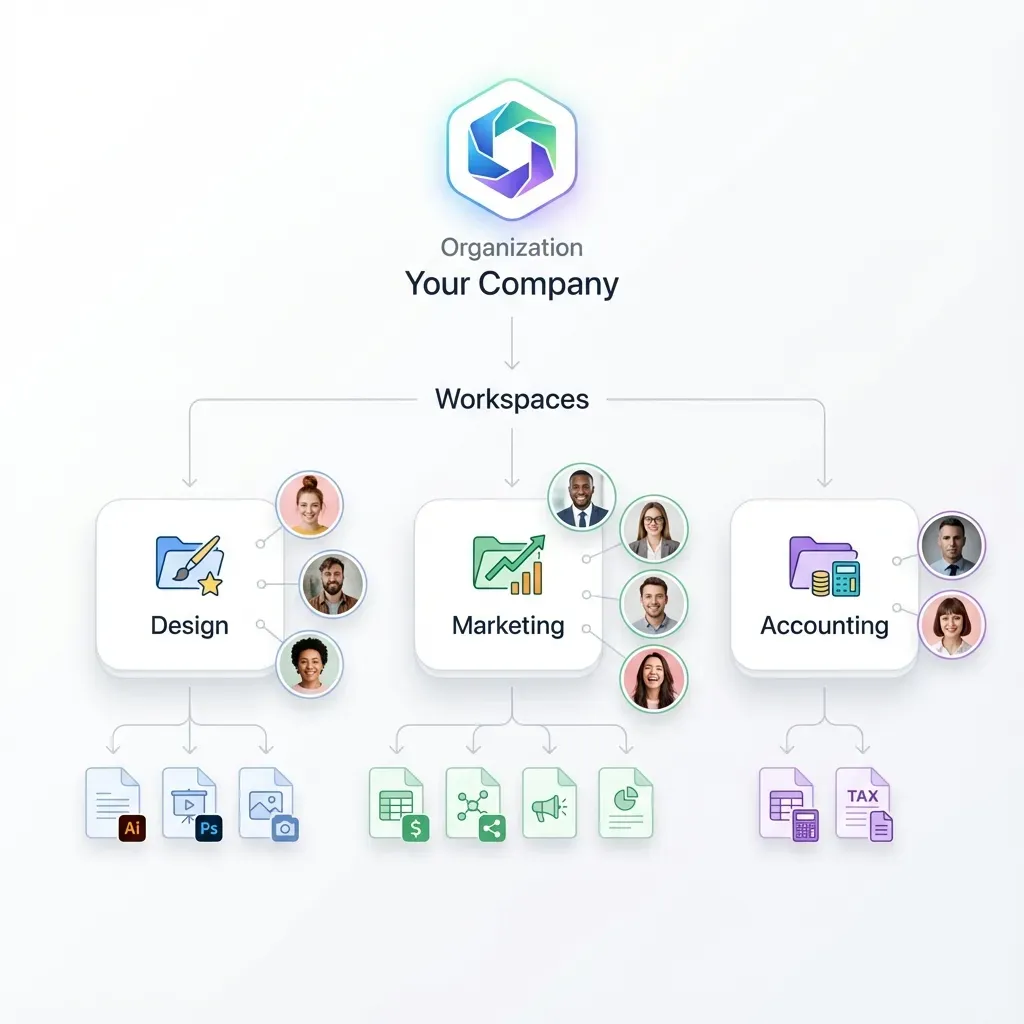
Fastio's permission model operates at five levels: organization, workspace, share, folder, and file. Each level has independent controls, so you can give an AI agent write access to a specific workspace without exposing your entire organization. Scoped API keys and OAuth tokens mean programmatic access is restricted to exactly the resources an agent needs.
The audit trail covers file operations, membership changes, comments, and AI activity. When an agent indexes files for semantic search or runs a RAG query, those actions appear in the event log alongside human activity. This matters because most platforms treat AI access as an afterthought, logging API calls but not distinguishing between human-initiated and agent-initiated operations.
For external sharing, Fastio uses purpose-built share types: Send for outbound delivery, Receive for inbound collection, and Exchange for bidirectional workflows. Each share type supports branding, guest access, download controls, and expiration settings. Room storage mode gives shares independent storage with their own permissions, while shared folder mode keeps shares synchronized with a workspace folder.
Fastio runs on certified infrastructure partners (GCP, Cloudflare). If your compliance requirements mandate specific certifications for the platform itself, platforms like Box or Google Workspace Enterprise are better choices today. Where Fastio stands out is in its agent-aware security model. Advisory file locks and automatic version history coordinate writes and keep every version when multiple agents access the same files. Ownership transfer lets an agent build a complete workspace and hand it off to a human client through a claim link. Once Intelligence is enabled for the workspace, files are indexed for semantic search and citation-backed chat, with all AI activity logged in the audit trail.
Fastio offers a 14-day Business Trial (credit card required; see /pricing/), allowing teams experimenting with AI-assisted workflows to test workspace security, permissions, and agent collaboration in practice.
Choosing the Right Platform for Your Team
The right platform depends on your specific constraints. Here is a decision framework based on the most common scenarios.
If privacy is your top priority: Tresorit. Zero-knowledge encryption means the provider cannot access your files under any circumstances. This is the strongest guarantee available.
If you need maximum compliance coverage: Box. government security requirements, enterprise security standards, security requirements, strict security requirements, GxP, and ITAR in one platform. No other provider matches this breadth.
If you need hybrid cloud and on-prem: Egnyte. Its hybrid deployment model and ML-powered content governance handle complex infrastructure requirements.
If your team lives in Google Workspace: Google Drive. The integration benefits outweigh the security limitations for most non-regulated use cases.
If budget is the primary constraint: OneDrive. Starting at $5-6/user/month (or included in Microsoft 365), it offers solid baseline security at the lowest cost.
If your team includes AI agents: Fastio. Scoped API access, advisory file locks, version history, agent-aware audit trails, and ownership transfer are designed for workflows where software agents handle files alongside humans. The 14-day Business Trial lets you evaluate this in practice (see /pricing/).
If you need broad adoption with minimal training: Dropbox Business. Its familiar interface drives higher adoption rates than enterprise-focused alternatives.
Before making a final decision, run a 30-day pilot with your actual workflow. Upload representative files, test sharing with external partners, verify that permissions work as expected, and confirm that audit logs capture the events your compliance team needs. Security features on a comparison chart only matter if your team actually uses them.
Sources
References used to verify factual claims in this guide.
-
The global average breach cost reached $4.88 million in 2024, a 10% increase
-
61% of organizations experienced file-related breaches caused by negligent or malicious insiders, costing an average of $2.7 million
-
97% of breached organizations with AI incidents lacked proper AI access controls
Frequently Asked Questions
What is the highly secure file sharing platform?
Tresorit offers the strongest privacy guarantees with zero-knowledge encryption, meaning even Tresorit staff cannot access your files. For compliance breadth, Box leads with government security requirements, enterprise security standards, security requirements, and strict security requirements certifications. The highly secure choice depends on whether you prioritize privacy (zero-knowledge) or compliance coverage.
How do I share files securely with external clients?
Use a platform that supports password-protected sharing links with expiration dates and download limits. Set granular permissions so clients can only view or download specific files. Enable audit logging to track when files are accessed. Platforms like ShareFile, Box, and Fastio offer purpose-built external sharing workflows with guest access controls.
What security features should a file sharing platform have?
At minimum: AES-256 encryption at rest, TLS encryption in transit, granular folder and file-level permissions, comprehensive audit trails, multi-factor authentication, and SSO support. For sensitive data, also look for zero-knowledge or customer-managed encryption keys, data loss prevention, and API security with scoped access tokens.
Is cloud file sharing secure for sensitive documents?
Cloud file sharing can be secure for sensitive documents when the platform provides end-to-end encryption, granular access controls, and proper audit logging. The key factor is the encryption architecture. Platforms with zero-knowledge encryption (like Tresorit) or customer-managed keys provide stronger protection than platforms where the provider holds encryption keys.
What is the difference between end-to-end encryption and zero-knowledge encryption?
End-to-end encryption protects data in transit so only the sender and recipient can decrypt it. Zero-knowledge encryption goes further: the service provider itself cannot access stored data because it never possesses the decryption keys. Zero-knowledge requires end-to-end encryption as a foundation but adds the guarantee that the provider is mathematically excluded from accessing your content.
Related Resources

Need secure file sharing for AI-powered teams?
Fastio gives agents and humans scoped access, audit trails, and file locks in shared workspaces. Built for secure file sharing.