How to Manage Persistent State for LLM Tool Calls
Persistent state for LLM tool calls keeps context across sessions and interruptions. Without it, agents lose progress on complex tasks like multi-step workflows or long-running processes. This guide covers options from simple caches to durable workspaces. Fastio workspaces provide persistent storage through MCP tools and shared files.


What Is Persistent State for LLM Tool Calls?
Persistent state for LLM tool calls means data that lasts beyond one interaction. LLMs are stateless by design. Each tool call starts fresh unless you save state externally.
In a multi-step workflow, pass full context every time or risk losing results, preferences, file handles, and chat history. Consider a research agent that searches the web, extracts facts, and drafts a report. Without state, it restarts searches each time. With it, the agent remembers checked sources, extracted data, and draft progress. This cuts down on repeat work.
Agents can pick up after timeouts, errors, rate limits, or context limits. Workflows that run for hours or days depend on persistence.
Helpful references: Fastio Workspaces, Fastio Collaboration, and Fastio AI.

Related guides
- How to Implement Tool Calling with Persistent File State for AI AgentsAI agents that call tools across multiple LLM invocations need durable file state to avoid losing context, repeating...
- How to Manage LLM Context Windows EffectivelyLLM context management is the practice of efficiently handling the limited context window of large language models by...
- AI Agent Tool State Persistence: Strategies That Actually WorkAI agent tool state persistence saves intermediate tool data across sessions so agents can resume work, recover from...
- How to Build Tool Calling Persistent Memory for AI AgentsTool calling persistent memory stores function states between invocations. This approach allows AI agents to maintain...
- How to Set Up Agentic AI Storage for Persistent Agent MemoryAgentic AI storage provides persistent file and data access that autonomous agents need to complete multi-step tasks...
- How to Build Persistent Storage for Agentic WorkflowsAgentic workflow storage lets autonomous agents maintain state, share files, and persist progress across long-running...
More on this subject: Agent Memory and Storage (263 guides)
Why State Loss Breaks LLM Agents
State loss undermines agent reliability from the start. Agents forget file paths from previous tool calls, API keys temporarily stored for one session, or intermediate results like parsed JSON from a data extraction tool. Chat history grows until token limits force old messages out, erasing context for decision-making. Common failure modes include: - Context overflow: Long conversations exceed token limits, forcing restarts that duplicate work.
- Timeouts and rate limits: API calls time out or hit limits, killing the session and wiping memory.
- New sessions: Starting a fresh chat loses all prior tool outputs and variables.
- Unexpected restarts: Server crashes, network issues, or LLM provider hiccups clear in-memory state. In multi-agent systems, problems compound. Agent A completes web research and saves findings to a temporary cache, but Agent B starts without access and repeats searches. Handoffs between researcher, analyzer, and writer agents fail when shared state is not durable. Frameworks like LangGraph or LlamaIndex offer in-memory checkpointers for development, but production demands external persistence. Save structured checkpoints after major milestones, after research completes, before code generation begins, or at workflow branch points. Store as JSON or pickled objects in durable storage like workspaces or databases. On resume, load the latest valid checkpoint, validate it against schema, and continue from the current step. Consider a code generation agent building a web app. It scaffolds files, runs tests, and iterates fixes. Without persistence, a token limit mid-generation loses the partial codebase. With checkpoints, it saves the directory structure, test results, and fix history every multiple tool calls. Recovery takes seconds, not hours. Research agents face similar issues. They scrape sites, extract facts, and cross-reference sources. State loss means rescraping multiple% of sites on resume. Persistent storage lets them append new data and query previous extracts via semantic search. The cost adds up. Developers spend hours debugging "lost context" errors. Users experience inconsistent outputs. Persistence turns unreliable prototypes into production tools that handle interruptions gracefully, from dev laptops rebooting to cloud functions scaling.


Give Your AI Agents Persistent Storage
Get cloud workspaces with version history and a consolidated MCP toolset. Built for persistent state llm tool calls workflows.
Comparing State Backends for LLM Tools
Pick storage based on durability, speed, cost, and needs. Consider session length, recovery, and team scale.
In-memory caches suit tests but vanish on restart. Redis holds data over the network but requires management. PostgreSQL handles queries well, though slower.
Durable Objects deliver speed and persistence for connections. They fit live agent sessions.
Fastio workspaces enable safe file sharing with advisory file locks, granular permissions, and version history. The Business Trial offers full workspace functionality, suitable from development to production.
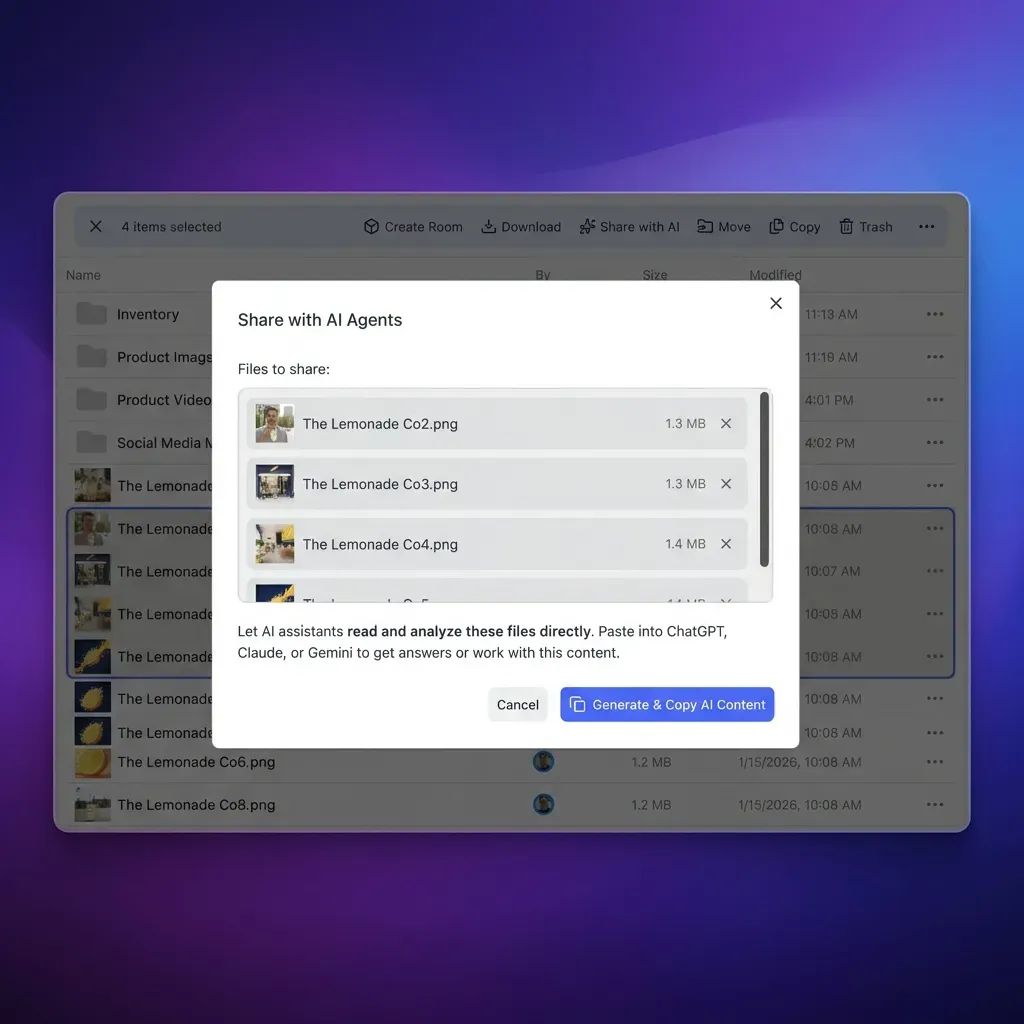
Implement Persistence with Fastio MCP Workspaces
Fastio's MCP server provides a consolidated toolset for state management, handling workspace files and structured metadata for long-term persistence. The Business Trial gives full access to test agent persistence workflows. Here's a step-by-step implementation.
Step 1: Set up your workspace.
Sign up at Fastio for the Business Trial and create an API key. Point your MCP client at https://mcp.fast.io/mcp/tools and send the key as a Bearer header. Create a dedicated workspace for state with the org_manage tool, which handles workspace creation, and turn on Intelligence if you want semantic queries on checkpoints later.
Step 2: Checkpoint state after key tool calls.
After tools like web search or file processing, serialize the state. Include history summaries, variables, tool results, and metadata, then write it to a checkpoints folder in the workspace with upload_manage action=stream-upload, passing the JSON as content and a filename such as state-<timestamp>.json. Compress history if token-heavy. Add a checksum for validation.
Step 3: Resume from the latest checkpoint.
List the checkpoints folder with storage action=list, pick the newest file, and read it with storage action=read-content (raw bytes, up to 1 MB) or a download action=file-url link. Parse it and inject it into the LLM context.
Step 4: Preserve version history for concurrent multi-agent access.
To keep one rolling checkpoint, upload to the same folder with the same filename: Fastio overwrites the file in place, keeps its node ID, and stores the previous content as a version you can list with storage action=version-list and roll back with storage_manage action=version-restore. Version history prevents accidental loss in team workflows.
Step 5: Use Intelligence Mode for state queries. With Intelligence Mode on, query checkpoints semantically: - "Summarize tool failures from last session"
- "Find variables from an earlier step yesterday" Step 6: Handoff to humans. Use ownership transfer tools to give workspaces to team members. Agents retain admin for monitoring. This connects directly over Streamable HTTP at https://mcp.fast.io/mcp/tools, and scales without ops overhead. Test by killing processes mid-workflow, recovery happens in seconds.
Best Practices for Durable LLM Tool State
Effective persistence requires strategy, not just dumping data. Follow these practices to build reliable agents that scale.
Checkpoint at Logical Boundaries. Save after complete phases: post-research, pre-generation, after validation. Aim for multiple-multiple checkpoints per workflow to balance freshness and overhead. Structure as versioned JSON:
{
  "checkpoint_id": "chk_20260221_1430",
  "workflow_step": "code_review",
  "data": {
    "code_files": ["/app/main.py", "/app/tests.py"],
    "test_results": {"passed": 12, "failed": 1}
  },
  "metadata": {
    "parent_id": "chk_20260221_1420",
    "llm_model": "claude-multiple.5-sonnet",
    "tokens_used": 45000
  }
}
Parent links enable branching or rollback.
Name Files for Easy Retrieval.
Use ISO timestamps or UUIDs: state-multiple-multiple-21T14:multiple:00Z.json or chk_uuid-v1.json. Sort by name for latest-first. In Fastio, folder structure like /checkpoints/daily/ organizes by date.
Coordinate with Advisory Locks and Version History. In multi-agent flows, safe coordination prevents overwriting data:
- Researcher writes
/research/data.json, acquiring an advisory file lock before writing. - Granular permissions control which agents can edit or view specific folders.
- Advisory locks expire automatically unless renewed by heartbeat, avoiding hangs.
Fastio version history and the activity log track all changes and enable rollbacks.
Query State Semantically. Enable Intelligence Mode. Ask natural questions:
- "List checkpoints where tests failed"
- "Show variables from research phase last week"
- "Summarize all tool outputs containing 'error'"
Built-in RAG handles this without custom indexing.
React with Activity Feeds and WebSockets. Subscribe to checkpoint changes via the WebSocket events feed or poll the realtime activity feed:
{
  "feed": "activity",
  "events": ["file.created", "file.modified"],
  "path": "/checkpoints/*"
}
Trigger resumes or alerts using realtime event streams.
Optimize Storage.
Retain last multiple checkpoints, gzip older ones, delete on success. Monitor credits and storage across your active workspace plans. Compress JSON with keys like hist_sum for summarized history.
Draw from LangChain checkpointer patterns and Fastio MCP docs. Agents built this way resume after days, handle failures, and support team handoffs easily.
Troubleshooting State Persistence Issues
Even reliable systems hit snags. Here's how to diagnose and fix common persistence problems.
Token Limits When Loading State. Loaded checkpoints exceed context windows. Solution: Summarize history during save. Keep full logs in files and load a condensed version with the last multiple exchanges. Use LangChain's ConversationSummaryBufferMemory or custom truncation. Test: Load full state, measure tokens, compress until under multiple% limit.
Race Conditions in Multi-Agent Writes. Two agents update simultaneously, corrupting JSON. Make ops idempotent: append with unique IDs, use ETags for conflict detection. Acquire an advisory file lock before writing; Fastio file locks expire automatically unless renewed by heartbeat, avoiding hangs. Version history preserves every update regardless.
Stale or Irrelevant Checkpoints. Resuming from outdated state leads to wrong paths. Embed timestamps, workflow UUIDs, and TTL (e.g., discard >48h old). On load, compare against current config. Fastio sort="modified_desc" helps pick freshest.
Missing or Unreachable Checkpoints. Network blip or deletion. Gracefully fall back: start fresh workflow, log incident, notify via activity polling. Implement exponential backoff retries (1s, 2s, 4s). Dual-write to backup like Redis for redundancy.
Permission and Token Errors. Fastio uses human-granted, scoped, long-lived API keys and PKCE browser login for agents. Review Fastio audit logs for 403s. Query Intelligence Mode once enabled: "List permission errors last hour."
Corrupted or Malformed State. LLM hallucinations or network corruption. Validate on load with Pydantic models or JSON Schema:
from pydantic import BaseModel
class Checkpoint(BaseModel):
  timestamp: str
  step: int
state = Checkpoint.model_validate_json(raw_state)
Rollback to parent on failure.
Fastio-Specific Tips. Full audit trails track every access. Semantic search uncovers patterns: "Failed checkpoint saves this week." Simulate chaos: kill processes, drop networks, verify <10s recovery.
Architecting for Production Reliability
Production agents demand resilience beyond dev prototypes. Layer these patterns for high availability.
Write-Ahead Logging (WAL).
Log every action before state mutation. On crash, replay logs sequentially. Store logs as append-only files in Fastio /logs/session-uuid/. Constraint: Adds multiple% overhead; prune after replay.
Dual-Write for Redundancy. Write to Fastio (durable, shared) and fast cache (Redis). On read, use cache if fresh, else Fastio. If primary fails, promote replica. Measurable: Dual-write latency <100ms, failover <1s.
Comprehensive State Validation. On load: schema check (Pydantic), checksum verify, business logic assert (e.g., step <= total_steps). Reject invalid, rollback:
import hashlib
def validate_state(raw):
  expected_checksum = raw.pop("checksum")
  computed = hashlib.sha256(json.dumps(raw, sort_keys=True).encode()).hexdigest()
  if computed != expected_checksum: raise ValueError("Checksum fail")
Graceful Degradation. Cache last multiple checkpoints in-memory. On storage outage, proceed with memory until resolved. Alert immediately.
Circuit Breakers and Backpressure.
After multiple consecutive persistence fails, open breaker: use memory-only, queue writes. works alongside libraries like pybreaker. Reset after 5min success.
Observability Stack. Stream checkpoint events to monitoring tools. Metrics: save_success_rate (>multiple.multiple%), recovery_time (<3s), checkpoint_size (avg 50KB).
Real-world example: Market research agent. WAL logs tool calls (search, extract, analyze). Dual-writes Fastio + Redis. Recovers from restarts in 2s, handles multiple sessions/day with multiple.8% success.
Tradeoff: Complexity vs reliability. Start simple (single durable store), layer as scale demands.
Real-World State Persistence Patterns
Teams mix these patterns for reliable setups: Compressed Chat History: Summarize early parts ("User wanted market analysis; findings: X, Y, Z"). Use LangChain summarizers.
Tool Result Caching: Hash inputs, store outputs. Reuse matches to speed up repeated calls.
Checkpoint Linking: Link to parent ID. Trace history or branch experiments.
Namespaced State: /agents/agent123/project456/checkpoints/. Good for multiple tenants.
State Migrations: Version schemas, run upgrades on load. Example: Report generator, researcher saves summaries, writer loads by namespace, reviewer adds notes. All cached, linked, compressed. With Fastio, namespaces are folders. Intelligence Mode finds "writer's draft from last week." Document choices, owners, and rollbacks for repeatable scaling.
Frequently Asked Questions
How do I persist LLM tool state across sessions?
Save externally: files, DBs, workspaces. JSON after calls, load to resume. Fastio MCP for file storage, advisory locks, and state retrieval.
What is the best storage backend for LLM tool calls?
Depends. Redis fast short-term. Postgres queries durable. Fastio for teams with advisory locks, shared workspaces, and audit trails.
What causes state loss in LLM agents?
Timeouts kill processes, context drops history, crashes wipe memory, new chats reset. External storage fixes.
Can multiple agents share persistent state?
Yes, through shared workspaces with granular permissions and file version history. Agents write checkpoints while preserving previous versions for rollback.
How does Fastio support persistent storage for AI agents?
Fastio provides cloud workspaces with a detailed activity log, file versioning, and a consolidated MCP toolset, accessible during the 14-day Business Trial.
How do I recover from a failed agent checkpoint?
Logs + versions. Validate load-time.
Related Resources

Give Your AI Agents Persistent Storage
Get cloud workspaces with version history and a consolidated MCP toolset. Built for persistent state llm tool calls workflows.