How to Set Up File Storage in OpenClaw Workspaces
OpenClaw agents need files that stick around between sessions in shared workspaces. Developers set up persistent storage on Fastio using the remote MCP server for file operations and RAG. This guide walks through remote MCP configuration, workspace setup, file handling, version history, and AI queries. Test workflows with the 14-day Business Trial.


What Is OpenClaw Persistent File Storage?
OpenClaw file storage keeps files in cloud workspaces across agent sessions. Local storage wipes out on every restart or machine switch. OpenClaw, an open-source personal AI assistant, runs locally. Cloud storage helps keep workflows running smoothly.
Fastio workspaces let OpenClaw upload files, organize folders, track versions, and share them with a consolidated MCP toolset.
Changes get versioned automatically with restore. Granular permissions and audit logs protect against overwrites. Files index once Intelligence is enabled.
Fastio workspaces offer persistent cloud storage starting with 250 GB on Starter. Good for developers building OpenClaw workflows.
Key Benefits:
- Persistence: Files available across OpenClaw sessions and machines.
- Collaboration: Multiple agents work on files with version history and audit logs to avoid conflicts.
- Intelligence: Enable Intelligence Mode. Files index for queries once enabled, such as "Summarize all reports from Q1."
Related guides
- How to Set Up Hermes Agent File StorageOnly 57% of organizations report having AI agents in production environments, largely due to challenges with state...
- How to Set Up File Storage for n8n AI Workflowsn8n AI workflows need persistent file storage to save documents, process AI outputs, and build RAG pipelines. This...
- How to Set Up Persistent Storage in OpenClawOpenClaw agents forget their state between sessions. Persistent storage lets them save memory, files, and data to...
- How to Set Up OpenClaw MCP ServerConnect OpenClaw to Fastio's hosted MCP server for consolidated tools covering files, sharing, and AI. Connect directly...
- How to Set Up OpenClaw WhatsApp IntegrationOpenClaw WhatsApp integration lets AI agents reply on WhatsApp while handling files through MCP skills. OpenClaw...
- How to Integrate OpenClaw with Supabase for AI Backend StorageRoughly 15% of new Supabase projects now enable pgvector, reflecting how PostgreSQL is becoming the default memory...
More on this subject: OpenClaw Setup and Guides (199 guides)
Why Persistent Storage Matters for OpenClaw Agents
OpenClaw agents run locally. They manage emails, calendars, and files through WhatsApp or Telegram chats. They build reports, process documents, analyze data, and team up with other agents on complex tasks.
Local storage works for single sessions. Files disappear on shutdown or reboot. Multiple agents clash on edits without coordination. Humans struggle to get agent outputs without manual handoffs.
Fastio workspaces solve this:
- Files last across sessions and machines.
- Advisory file locks, version history, and granular permissions coordinate multi-agent writes.
- Ownership transfer hands work from agent to human.
- URL imports from Drive/Dropbox skip local downloads.
Fastio docs note the MCP server provides a consolidated MCP toolset for full API access.
Common Pain Points Solved
Developers hit these issues without persistent storage:
- Chat attachments vanish: Files in WhatsApp or Telegram disappear when chats end or machines restart.
- No multi-agent sync: Agents overwrite each other's work without file locks, version history, or audit logs.
- File handoff mess: Agents zip and email files to humans, causing version mixups and security issues.
- Can't search contents: No easy way to query across project files semantically.
Evidence from Fastio Benchmarks
Fastio MCP server includes a consolidated MCP toolset, matching web UI access. Video files use HLS streaming, which loads 50-60% faster than standard downloads, per Fastio docs.
Prerequisites
Make sure you have:
- OpenClaw installed (openclaw.ai) via one-liner or npm.
- Fastio account (go.fast.io/signup) with a 14-day Business Trial or Starter plan.
- Terminal access for commands.
- Optional: Set LLM (Claude, GPT, Gemini, LLaMA, local) in OpenClaw.
Fastio plans provide persistent storage starting at 250 GB on Starter, with usage-based credits across plans.
Examples:
- Store 10GB: covered by the plan's included storage
- Index 100 pages: draws on the monthly AI credits
Step 1: Connect to Fastio Remote MCP Server
Connect OpenClaw directly to the remote Fastio MCP server at https://mcp.fast.io/mcp/tools over Streamable HTTP.
Add the server to OpenClaw as a remote MCP server with this URL:
https://mcp.fast.io/mcp/tools
Tools register right away. No config files, env vars, or dashboard steps.
First use opens the browser for OAuth sign-in. Sign-in shows a Review Permissions screen where you choose permissions and workspaces.
Expected: Fastio tools available via remote MCP connection.



Set Up OpenClaw File Storage
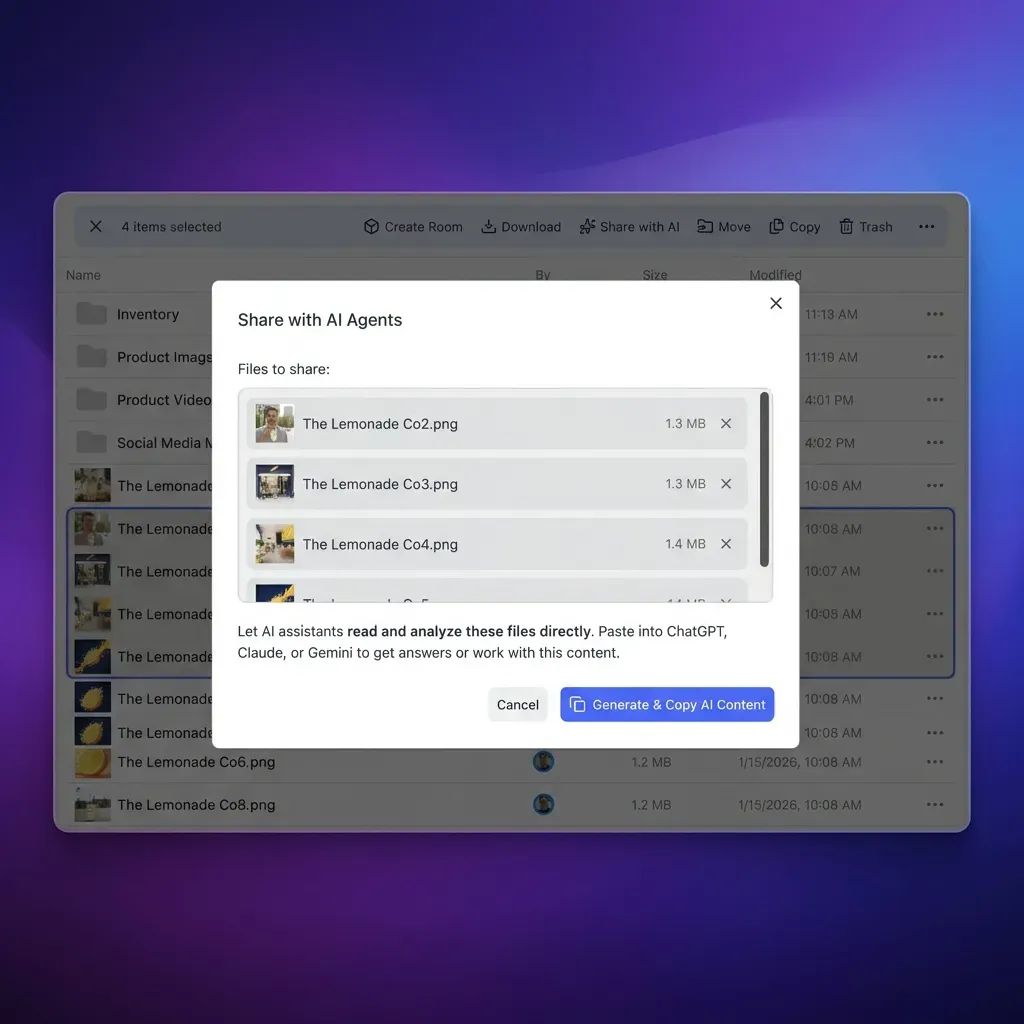
Set up persistent OpenClaw file storage with Fastio workspaces. Connect via remote MCP for agent file access, version history, and shares.
Step 2: Create and Configure Workspace
Tell OpenClaw: "Create a Fastio workspace called 'project-files' with intelligence enabled."
It creates the workspace and sets intelligence: true.
List files: "Show files in project-files."
Upload: "Upload this attachment to /docs in project-files."
Folders create automatically.
Other commands: "List all workspaces", "Transfer ownership of project-files to email@example.com", "Enable intelligence on project-files".
Step 3: File Operations and Versioning
Agents handle file operations with natural language while Fastio preserves version history: "Upload this attachment to /docs in project-files."
Fastio supports chunked uploads for large files and automatically versions every update.
Agents can acquire an advisory file lock before writing, heartbeat it while working, and release it when done. If another agent tries to lock the same file, it receives an HTTP 409 error and can wait or read. Even if writes occur concurrently, version history preserves every revision with one-click restore. A detailed activity log records every agent action.
Step 4: AI Querying and Sharing
Once Intelligence is enabled for the workspace, ask OpenClaw: "Summarize Q1 reports in project-files."
Ripley and document chat find files, summarize, and cite sources with pages or timestamps.
Share: "Create Send share for /deliverables in project-files, password protected, 30-day expiry."
Gets branded link. Videos stream HLS, 50-60% faster loads.
Example: Share: https://go.fast.io/project-files-deliverables-abc123 Password: generated-pass Expires: 2026-03-19
RAG queries provide cited answers across workspace files. Shares include Send/Receive/Exchange modes with granular controls.
Advanced: Remote MCP Connectivity
Connect to https://mcp.fast.io/mcp/tools over Streamable HTTP for a consolidated MCP toolset.
Interactive clients sign in with OAuth in the browser, while headless workflows send an Authorization: Bearer <api key> header on the connection.
Remote MCP connectivity provides unified control suited for custom or high-volume agent workflows.
Define clear tool contracts and fallback behavior so agents fail safely when dependencies are unavailable. This improves reliability in production workflows.
Sources
Frequently Asked Questions
How to configure OpenClaw file storage?
Configure OpenClaw to connect to `https://mcp.fast.io/mcp/tools` over Streamable HTTP, sign in with OAuth in the browser, and manage workspaces with natural language.
What is OpenClaw persistent storage?
Fastio cloud workspaces keep files across sessions, with automatic version history, granular permissions, and semantic search once Intelligence is enabled.
Does it support multi-agent file sharing?
Yes, advisory file locks coordinate writes, while workspace permissions, version history, and a detailed activity log keep edits safe.
What plans are available for OpenClaw storage?
Fastio offers Starter ($9.99/mo, 250 GB), Business ($49.99/mo, 5 TB), and Enterprise ($199.99/mo, 25 TB), plus a 14-day Business Trial at /pricing/.
Does it work with any LLM?
Yes, Claude, GPT-4, Gemini, LLaMA, and local models can connect to Fastio via MCP.
How to handle usage-based credits?
Fastio plans include monthly credits with usage-based billing for additional credits. Transfer workspace ownership to human accounts when handoffs are complete.
What about large video files?
Fastio supports chunked uploads and automatic HLS streaming, loading previews 50-60% faster.
How to query file contents?
Once Intelligence is enabled for the workspace, ask "Summarize reports in /docs" for document chat with citations.
Related Resources

Set Up OpenClaw File Storage
Set up persistent OpenClaw file storage with Fastio workspaces. Connect via remote MCP for agent file access, version history, and shares.