OpenAI Files API Alternatives for AI Document Storage
OpenAI Files API provides basic document storage for GPT applications, but has significant limitations for production AI systems. Alternative solutions offer persistent storage, support for files beyond 512MB, and compatibility with multiple AI frameworks beyond OpenAI.


Why Developers Need OpenAI Files API Alternatives
OpenAI's documentation shows the Files API supports individual files up to 512 MB, with a total storage quota of 2.5 TB per project. This works fine for basic prototypes. Problems appear when you build production AI applications. The storage model locks files into OpenAI's ecosystem. Want to use Claude, Gemini, or local models alongside GPT-4? You're managing separate storage for each. The OpenAI Developer Community has documented frustrations with the large storage limit for multi-user applications. The 20-file limit per Assistant creates bottlenecks for RAG systems that need hundreds or thousands of documents.
Key limitations:
- 512MB maximum file size blocks large video, datasets, or archives
- Storage pricing at $0.10/GB/day for vector store indexing adds up quickly
- No visual dashboard for file management (API-only access)
- Files tied to OpenAI ecosystem (no multi-LLM portability)
- Slow batch operations (no bulk upload/delete endpoints)
Developers building production AI systems need alternatives that treat file storage as a real feature, not something added on as an afterthought.
Related guides
- Top 5 File Sharing Tools for AI WorkflowsOver 60% of AI workflows involve document or file processing. Multi-agent systems can generate hundreds of artifacts...
- How to Connect AI Agents to Files and Cloud StorageConnecting AI agents to files is the practical bottleneck most developers hit after getting their agent logic working.
- How to Manage Files with the Gemini APIGoogle's Gemini API offers powerful multimodal capabilities, allowing you to analyze images, audio, and video directly....
- Multi-Agent File Sharing: Patterns, Storage & CodeHow multiple AI agents share, read, write, and collaborate on files in production systems. Covers storage...
- Best AI File Organizers in 2026: 8 Tools That Actually Sort Your FilesMcKinsey estimates that employees spend 1.8 hours every day just searching for and gathering information. AI file...
- How to Secure Files Accessed by AI AgentsAI agent file security includes the access controls, encryption, and audit mechanisms that protect sensitive documents...
More on this subject: Agent File and Document Workflows (325 guides)
What to check before scaling openai files api alternative
The Files API serves a narrow purpose: temporarily storing documents for OpenAI Assistants and vector stores. For most use cases, you'll need a more complete storage solution that separates file management from your LLM provider.
What the Files API Provides
The Files API handles uploads for three specific purposes: fine-tuning datasets, Assistants API knowledge retrieval, and batch processing inputs. Files are referenced by ID in API calls, and OpenAI automatically indexes them for semantic search within Assistants. This works fine if you're building a simple chatbot that references 5-10 PDFs. The problem appears when you need to organize thousands of files, provide client access to documents, or build multi-agent systems where different AI frameworks need access to the same data.
What's Missing from the Native API
eesel AI's analysis shows the raw API lacks bulk operations. You have to write scripts that loop through files one by one for uploads or deletions. Slow and error-prone. There's no built-in way to organize files into folders, no permission system for sharing with external users, and no preview capability for images, videos, or documents. The OpenAI Help Center confirms that hitting the 100GB project storage limit triggers hard errors. For AI applications handling user-uploaded documents at scale, you hit this ceiling fast.
When You Need an Alternative
You should look beyond the Files API when:
- You're building multi-LLM applications (using Claude, Gemini, GPT-4 together)
- File sizes exceed 512MB (video content, large datasets, CAD files)
- You need human users to access the same files your AI processes
- Your application requires file versioning or audit trails
- You want persistent storage that survives beyond a single assistant's lifecycle
- You need to organize files into projects, clients, or categories


Give Your AI Agents Persistent Storage
Fastio gives teams shared workspaces, MCP tools, and searchable file context to run openai files api alternative workflows with reliable agent and human handoffs.
Fastio: Persistent Storage Built for AI Agents
Fastio provides cloud storage designed for AI agent workflows from day one. It gives agents their own accounts, workspaces, and complete file management capabilities instead of adding file storage as an extra feature on top of an LLM API.
Getting Started
Creating a Fastio account is free. To run an organization, you start a 14-day trial (a credit card is required) or take a subscription. Storage and seats come with the plan you pick: Starter is $9.99 per month for 3 seats and 250 GB, Business is $49.99 per month for 10 seats and 5 TB, and Enterprise is $199.99 per month for 30 seats and 25 TB. Credits meter AI work rather than raw storage, covering things like chat, document ingestion, and agent runs. The included allowance is 100,000 credits a month on Starter, 600,000 on Business, and 3,000,000 on Enterprise, and if you exhaust it, overage is $10 per 100,000 credits. That structure means a document processing agent's bill tracks how much AI work it does, not how many gigabytes it parks.
Consolidated MCP Toolset for File Operations
Fastio runs the largest Model Context Protocol server for file storage. The MCP server at mcp.fast.io provides a consolidated MCP toolset covering file operations: uploads, downloads, sharing, permissions, workspace management, activity polling, and URL imports. Unlike the Files API which requires custom code for every operation, MCP tools work through standardized protocols. Your agent can upload a file, create a branded share, and invite a collaborator using the same natural language interface across Claude, GPT-4, or any MCP-compatible client. The server uses the Streamable HTTP transport.
Built-In RAG with Intelligence Mode
Enable Intelligence Mode on any workspace and Fastio automatically indexes files for semantic search. Your agent can ask questions like "Find the contract with Acme signed in Q3" and get cited answers pulled from the actual documents. No need to manage a separate vector database like Pinecone or Weaviate. The indexing happens automatically, query responses include source citations, and you can scope searches to specific folders or the entire workspace.
Ownership Transfer to Humans
Agents can build complete data rooms, client portals, or project workspaces, then transfer ownership to a human user. The agent creates the organization, uploads files, configures shares, sets permissions, and hands everything off to the client. The agent retains admin access for ongoing management. This workflow solves a common problem in AI automation: how to deliver organized, branded deliverables to end users without requiring them to interact with APIs or technical interfaces.
URL Import Without Local I/O
Agents can import files from Google Drive, OneDrive, Box, or Dropbox using OAuth, without downloading anything to local storage. The URL Import feature pulls files directly between cloud services. Especially useful for serverless functions or containerized agents with ephemeral file systems.
Multi-LLM Support
Fastio works with Claude, GPT-4, Gemini, LLaMA, and local models. The MCP server and OpenClaw integration are LLM-agnostic, which means you can switch providers or run multi-model systems without rewriting file handling code. For developers concerned about vendor lock-in, this flexibility matters. Your file storage layer persists regardless of which LLM provider you're using this month.
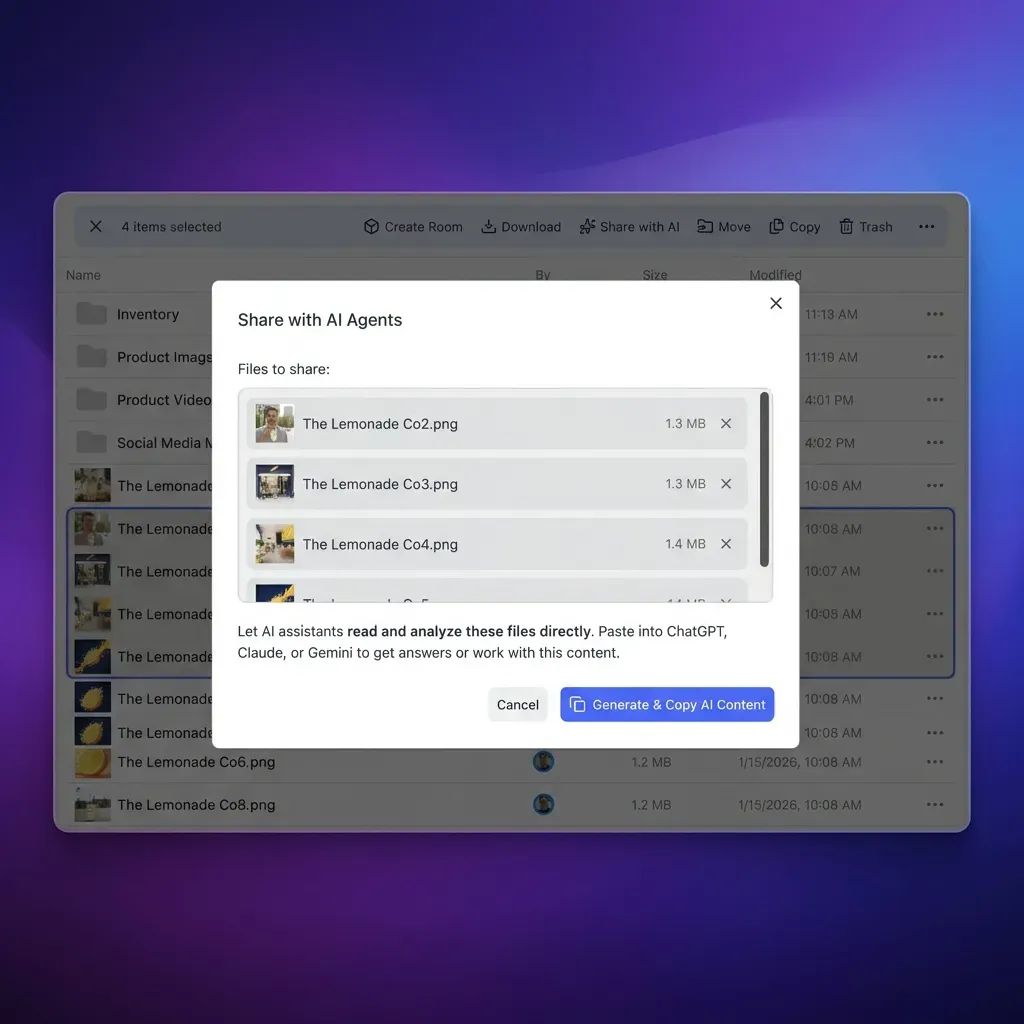
OpenClaw Integration for Natural Language File Management
Fastio connects to OpenClaw through its remote MCP server at https://mcp.fast.io/mcp/tools, providing a consolidated toolset for file operations without local package installation. Configure OpenClaw with your scoped API key and the remote endpoint to gain immediate access to uploads, downloads, sharing, and workspace operations. The tools authenticate securely and work with any LLM that supports tool calling. This approach works well for agents that need file storage without building custom infrastructure. You write "Upload the report to the Q1 workspace" and the underlying tool handles authentication, transfer, and error handling. The toolset covers:
- File uploads and downloads
- Workspace creation and management
- Share generation (Send, Receive, Exchange)
- Permission configuration
- File search and organization
- Metadata retrieval
For developers building with frameworks like LangChain, CrewAI, or AutoGen, the OpenClaw integration provides a simpler abstraction than managing API clients directly.
Event-Driven Workflows via Polling and WebSockets
Fastio supports a realtime activity feed you can poll and a WebSocket events feed for file events: uploads, modifications, deletions, and access. You can build reactive agent workflows that process updates when files change. When a client uploads documents to a Receive share, your agent detects the new upload via the WebSocket feed or activity polling and can start processing right away. When a teammate updates a spreadsheet in a shared workspace, downstream agents react to the new data cleanly.
Version History and Permissions for Multi-Agent Systems
Fastio coordinates multi-agent and human collaboration through granular workspace and folder permissions, comprehensive file version history with restore, and a detailed activity log of human and agent actions. When multiple agents or humans work within the same workspace, versioning preserves every revision so conflicting edits can be audited and restored without overwriting critical work.
Comparing Self-Hosted vs Managed Storage Solutions
Developers choosing alternatives to the Files API often evaluate whether to build on object storage (S3, Google Cloud Storage) or use a managed solution like Fastio.
Self-Hosted with S3/GCS
Advantages: Complete control, lower cost at high scale (multi-TB), flexibility to implement custom features.
What you build yourself: File upload/download endpoints with chunked transfer support, authentication and permission systems, file versioning, search indexing, preview generation, share link creation with expiration/passwords, audit logging, webhook infrastructure, and monitoring/alerting. For teams with dedicated infrastructure engineers, this makes sense. For AI startups trying to ship features quickly, it's a distraction from core product work.
Managed Solutions
Advantages: Ship faster, focus on AI logic instead of file infrastructure, built-in features like preview, streaming, and RAG, predictable plan pricing.
Trade-offs: Less control over infrastructure, vendor lock-in risk, limits on customization for highly specialized use cases. Fastio sits in the managed category but with developer-friendly pricing (flat plans with seats included) and full API access (a consolidated MCP toolset, complete REST API). The 14-day Business Trial provides enough capacity to evaluate it against a real workload before committing. The decision usually comes down to whether file storage is core to your product (build) or infrastructure that enables your product (buy). For most AI applications, it's infrastructure.
Migration Path from OpenAI Files API
Moving existing assistants from the Files API to an alternative storage layer requires updating file references in your code. Here's the general approach:
1. Export existing files: Use the Files API to list all file IDs and download them locally or to your new storage system. The API doesn't provide bulk export, so you'll need to loop through files programmatically.
2. Upload to new storage: Push files to your chosen alternative (Fastio, S3, etc.) and capture the new file IDs or paths.
3. Update agent code: Replace OpenAI file references with the new storage endpoints. For Fastio, this might mean swapping openai.files.create() calls with MCP tool invocations or REST API uploads.
4. Implement retrieval integration: If you were using OpenAI's vector store for RAG, you'll need to either enable Intelligence Mode in Fastio or set up your own vector database with embeddings from your new storage.
5. Test thoroughly: File handling errors show up at the edges (large files, network timeouts, concurrent access). Run tests that exercise your full file lifecycle before switching production traffic. The migration complexity depends on how tightly coupled your code is to OpenAI-specific file IDs. Well-architected agents abstract file storage behind an interface layer, making provider swaps easy. Tightly coupled code requires more refactoring.
Alternative Storage Options for Different Use Cases
Different AI applications have different storage priorities. Here's how various alternatives map to common scenarios:
Document-heavy RAG systems: Fastio (built-in indexing), Pinecone (if you're already managing embeddings elsewhere), or LangChain with S3 + vector DB combo.
Large file processing (video, datasets): Fastio (up to 25 TB of storage on the Enterprise plan), S3/GCS for raw storage with separate processing pipeline, or specialized video platforms like Cloudflare Stream.
Multi-tenant agent platforms: Fastio (workspace isolation and ownership transfer), or self-hosted S3 with custom permission logic.
Temporary file staging: Direct S3 with lifecycle policies to auto-delete after N days, or Fastio Receive shares with expiration dates.
Human-agent collaboration: Fastio (humans and agents share workspaces), Google Drive if you need real-time document co-editing, or Notion/Airtable if structure matters more than raw files. The Files API works adequately for the simplest case: a single assistant that references a handful of static documents. Everything else benefits from purpose-built storage.

Sources
References used to verify factual claims in this guide.
-
OpenAI Files API supports individual files up to 512 MB with storage beyond that limit and compatibility with multiple AI frameworks Storage pricing at $0.10/GB/day for vector store indexing on OpenAI platform Files API has a 512MB per-file limit, charges $0.10/GB/day for vector storage, and caps assistants at 20 files each Store large files for AI agents beyond 512MB using cloud storage services with larger limits
-
The 100GB file storage limitation is problematic for multi-user applications on OpenAI platform Want to use Claude, Gemini, or local models alongside GPT-4 requires managing separate storage for each provider
-
The 20-file limit on assistants is not useful for large retrieval augmented generation systems needing hundreds of documents OpenAI imposes a 20-file limit per Assistant
-
Works fine for a simple chatbot that references 5-10 PDFs but breaks down for production systems
-
Hitting the 100GB project storage limit triggers hard errors for API users
-
The MCP server provides a consolidated toolset covering file operations including uploads, downloads, sharing, permissions, and workspace management Agent can upload a file, create a branded share, and invite a collaborator using the same interface across Claude, GPT-4, or any MCP-compatible client
-
Fastio works with Claude, GPT-4, Gemini, LLaMA, and local models through LLM-agnostic MCP server
-
Fastio sits in the managed category with developer-friendly pricing (flat plans with seats included) and full API access (a consolidated MCP toolset, complete REST API)
-
Use external storage with ChatGPT or GPT-4 Assistants through custom integration work
-
AWS S3, Google Cloud Storage, and Azure Blob support files up to 5TB for large file storage
Frequently Asked Questions
What are the main limitations of OpenAI Files API?
The Files API has a 512MB per-file limit, charges $0.10/GB/day for vector storage, caps assistants at 20 files each, and provides no visual interface for file management. Files are tied to OpenAI's ecosystem, making multi-LLM architectures difficult. The API also lacks bulk operations, forcing developers to loop through files individually for uploads or deletions.
Can I use external storage with ChatGPT or GPT-4 Assistants?
Yes, but it requires custom integration work. You'd store files in your chosen platform (S3, Fastio, etc.), generate temporary access URLs, and pass those URLs to the assistant in messages or function call responses. For RAG use cases, you need to manage embeddings and retrieval separately, then inject context into prompts. Fastio makes this easier through MCP integration and built-in Intelligence Mode for automatic indexing.
How do I store large files for AI agents beyond 512MB?
Use cloud storage services that support larger files. Fastio handles large files with resumable uploads and plan storage from 250 GB to 25 TB. AWS S3, Google Cloud Storage, and Azure Blob support files up to 5TB. For video or dataset processing, consider specialized platforms with chunked upload support and CDN delivery. The key is separating file storage from your LLM provider, using APIs to bridge the two.
Is Fastio free for AI agent development?
Creating a Fastio account is free. To run an organization you start a 14-day trial, which requires a credit card, or take a subscription. Starter is $9.99 per month with 3 seats and 250 GB, Business is $49.99 per month with 10 seats and 5 TB, and Enterprise is $199.99 per month with 30 seats and 25 TB. Storage and seats come with the plan. Credits meter AI work such as chat, document ingestion, and agent runs, with overage at $10 per 100,000 credits.
What's the difference between OpenAI Files API and cloud storage for AI?
The Files API is designed specifically for OpenAI assistants and fine-tuning, with automatic vector indexing but limited flexibility. Cloud storage platforms provide file persistence, larger size limits, multi-LLM compatibility, and features like sharing, permissions, and an activity feed agents can poll. Files API is simpler for basic use cases but doesn't scale well for production systems that need organized storage, human access, or multi-framework support.
Can multiple AI agents access the same files concurrently?
Yes, with the right storage infrastructure. Fastio provides advisory file locks (via MCP storage actions or REST API), granular permissions, and automatic version history with restore to coordinate access when multiple agents collaborate. Agents acquire a lock before writing, heartbeating while active, and release it when finished; concurrent writers that bypass locks are safely preserved in version history. S3 and similar object stores support concurrent reads but require custom application-level locking for writes. The Files API doesn't address this scenario, which can cause conflicts in multi-agent systems where agents process shared data.
How do I handle file uploads from users in an AI application?
Store user-uploaded files in a dedicated cloud storage service, not the Files API. Fastio offers Receive shares where clients upload files through a branded portal, with changes tracked in the realtime activity feed and WebSocket events feed. S3 provides presigned URLs for direct browser uploads. Once files land in storage, your agent can reference them for processing. The Files API isn't designed for direct user uploads at scale.
What happens to files when I delete an OpenAI Assistant?
Files uploaded to the Files API persist even after deleting the assistant that used them, but they continue consuming your storage quota and accruing charges. You must explicitly delete files through the Files API to reclaim storage. This differs from platforms like Fastio where deleting a workspace can optionally delete all contained files in one operation.
Related Resources

Give Your AI Agents Persistent Storage
Fastio gives teams shared workspaces, MCP tools, and searchable file context to run openai files api alternative workflows with reliable agent and human handoffs.