NIST AI Safety Institute Super Intelligence Evaluation Standards: Federal Protocols
The NIST AI Safety Institute evaluation standards define empirical benchmarking, red teaming, and testing protocols for advanced models across the federal government. Following Executive Order 14434, executive agencies designate existing artificial intelligence systems as Super Intelligence under 15 U.S.C. 9401(3) while using technical standards from the institute. This guide breaks down testing vectors, agency guidelines, and documentation requirements.


What Distinguishes NIST AISI Evaluation Standards from the AI RMF
Deploying advanced models in federal systems reveals a persistent operational gap: teams prepare organizational risk management governance under the NIST AI Risk Management Framework (AI RMF 1.0) and assume they have satisfied federal safety compliance, only to discover that procurement evaluators require empirical technical verification. The AI RMF governs organizational processes, accountability chains, and risk tracking, but it does not execute automated test suites, evaluate prompt injection resilience, or measure dual-use hazard thresholds. That empirical mandate belongs to the evaluation standards developed by the U.S. AI Safety Institute.
The NIST AI Risk Management Framework, released in January 2023, is a voluntary guidance document that helps organizations design, develop, and deploy trustworthy computing systems across four functions: Govern, Map, Measure, and Manage. It operates at the organizational policy tier, guiding leadership on documentation, risk tolerance, workforce training, and stakeholder consultation.
In contrast, the NIST AI Safety Institute (AISI) evaluation standards operate at the empirical model tier. Rather than evaluating whether an enterprise appointed an AI risk officer or published an acceptable use policy, AISI standards test model weights, API endpoints, agent toolchains, and checkpoints against adversarial stress tests. The institute formulates test suites that measure specific model failure rates, quantify dual-use uplift, and evaluate safety guardrails.
This structural separation reflects how responsibilities are divided within the National Institute of Standards and Technology (NIST). While the AI Safety Institute leads federal red-teaming initiatives, NIST states that the AI RMF is "led by the Information Technology Laboratory (ITL) AI Program," not by CAISI. Understanding this division prevents contractors from submitting organizational risk registers when an agency solicitation demands technical evaluation data.
Clarifying the Institutional Structure Inside NIST
The AI Safety Institute was established within NIST, a bureau of the U.S. Department of Commerce, following presidential directives in late 2023 to evaluate frontier dual-use foundation models. In June 2025, the Department of Commerce announced that the institute would operate as the Center for AI Standards and Innovation (CAISI). While the administrative title was revised to emphasize technical innovation and voluntary industry collaboration, federal agency solicitations and technical practitioners continue to refer to its testing protocols as the NIST AI Safety Institute evaluation standards.
The institute operates under a specific institutional mandate. Unlike a standalone regulator, CAISI does not have rulemaking authority; NIST's traditional role is to develop voluntary standards, guidelines, and measurement science that industry and government can adopt. The institute does not issue commercial operating licenses, levy regulatory fines, or inspect commercial software repositories without consent. Instead, it serves as the federal government's technical measurement laboratory for advanced computing systems.
Its core operational responsibilities span five primary activities:
- Empirical Capability Evaluations. Developing automated test suites and expert red-teaming methodologies to measure model capabilities and safety limits.
- Voluntary Safety Standards. Formulating technical guidance, test benchmarks, and evaluation criteria in collaboration with academic and industry partners.
- Pre-Deployment Lab Evaluations. Executing voluntary testing agreements with frontier model developers to evaluate advanced foundation models before general release.
- Interagency Technical Support. Providing capability assessments and testing guidance to federal departments, including the Department of Defense (DOD), Department of Homeland Security (DHS), Department of Energy (DOE), and Health and Human Services (HHS).
- International Standards Alignment. Coordinating testing methodologies with international partner bodies, such as the United Kingdom AI Security Institute (UK AISI).
Federal Super Intelligence Terminology Under Executive Order 14434
Federal procurement and compliance documentation underwent a terminology transition on September 29, 2026, when the President signed Executive Order 14434, titled "Inaugurating the Era of Super Intelligence". Understanding how this presidential directive interacts with technical evaluation standards requires distinguishing between administrative policy and computer science theory.
Under Section 2(a) of the order, executive departments and agencies are instructed to use the terms "Super Intelligence" and the abbreviation "SI" in place of "Artificial Intelligence" and "AI" across official correspondence, public communications, websites, reports, policy documents, and non-statutory federal publications.
Outside federal policy, the abbreviation SI designates the International System of Units (Système International d'Unités), the sacroiliac joint in orthopedic medicine, and Sports Illustrated in commercial journalism. Within federal executive communications, SI designates the administrative vocabulary for computing systems.
Technical leads and defense contractors must separate two independent concepts that share identical wording:
- Federal Super Intelligence (SI). An administrative designation established by presidential executive order for existing computing systems operated across federal agencies. Under Section 3(a) of Executive Order 14434, the terms Super Intelligence and SI mean the technologies and systems covered by the statutory definition of artificial intelligence in 15 U.S.C. 9401(3). In federal administration, SI and AI name the exact same systems: statistical classifiers, predictive algorithms, and language models currently in active use.
- Laboratory superintelligence (often abbreviated ASI). A theoretical computer science concept describing a hypothetical future system that would surpass the capabilities of the most capable human experts across nearly every field, generally situated beyond artificial general intelligence (AGI). Commercial laboratories such as Meta Superintelligence Labs, Microsoft's MAI Superintelligence Team, and Safe Superintelligence Inc. explicitly pursue this milestone as an engineering vision. This hypothetical software does not exist today.
Section 2(b) of Executive Order 14434 leaves previously issued regulations, existing Presidential actions, ongoing contracts, federal grants, and historical records unchanged. Under Section 3(b) of the order, the Assistant to the President for Science and Technology (APST) must submit proposed legislative language for a federal statutory definition of Super Intelligence to the President within 60 days of the order, which falls on November 28, 2026. This submission is an internal recommendation to the President, not an enacted law. As of October 2026, no statutory definition of Super Intelligence exists in the United States Code. Section 4(c) provides that Executive Order 14434 creates no right or benefit enforceable at law and imposes no mandates on private commercial enterprises.
Related guides
- Preparing for Oral Presentations in Federal Super Intelligence RFP EvaluationsFederal procurement teams conducting super intelligence oral presentations in federal rfp evaluations assess live...
- Best Tools for AI Agent Testing and EvaluationAgent testing tools automate the evaluation of agent performance, checking for accuracy, loop detection, and goal...
- How to Evaluate AI Agents: A Comprehensive FrameworkAI agent evaluation is the systematic process of measuring an autonomous agent's performance, reliability, and safety...
- Best Tools for AI Agent Evaluation (Evals)Evaluating AI agents is no longer about simple "vibe checks." As agents move from prototypes to production, engineering...
- Best AI Dashboard Builders for Agents: Top 9 Tools (2026)AI dashboard builders provide visual interfaces and no-code tools to design, deploy, and customize user-facing...
- How to Handle AI Agent Errors: Best Practices for 2026Production AI agents frequently encounter errors during task executions. This guide covers essential error handling...
More on this subject: Agent Observability and Evaluation (26 guides)
The Four Core Vectors of NIST AI Safety Institute Super Intelligence Evaluation Standards
NIST AI Safety Institute evaluation standards are empirical testing protocols, automated benchmarks, and red-teaming methodologies developed by the U.S. AISI to assess cybersecurity, CBRN risks, and model reliability in advanced AI systems deployed across federal agencies. Unlike qualitative questionnaires, these technical standards establish reproducible testing criteria across four primary hazard vectors:
- Cybersecurity Offense and Exploit Resistance. Testing dual-use offensive capabilities, such as automated vulnerability discovery, exploit generation, and network lateral movement, alongside system resilience against direct prompt injection, indirect prompt injection, and agent memory poisoning.
- Chemical, Biological, Radiological, and Nuclear (CBRN) Risk Profiling. Measuring actionable knowledge uplift to determine whether a model lowers technical barriers for synthesizing dangerous pathogens, acquiring precursor chemicals, or developing radiological delivery systems.
- Autonomous Agent Capabilities and Safeguard Evasion. Evaluating whether models equipped with tool execution, shell access, or browser environments exhibit unauthorized self-exfiltration, recursive goal setting, task persistence, or deliberate circumvention of safety guardrails.
- Model Reliability, System Integrity, and Mission Calibration. Benchmarking hallucination frequencies, factual accuracy, uncertainty calibration, and performance degradation under severe operational stress or adversarial noise.
By establishing rigorous metrics across these four vectors, the institute provides federal program managers with concrete data to determine whether an advanced model satisfies mission-critical deployment thresholds.
Automated Benchmarking Suites vs. Expert Human Red Teaming
A central principle of the NIST AISI evaluation methodology is that automated benchmark test suites and human red teaming serve complementary functions. Automated benchmarks run standardized prompt sets through target models to produce quantitative scores across predefined metrics, testing syntactic safety compliance and factual accuracy against structured reference databases. Automated suites provide high reproducibility and immediate regression detection during fine-tuning. However, automated tests suffer from prompt saturation: once a test set is public, model alignment can be trained to pass those specific queries without resolving underlying vulnerabilities. Automated tests also cannot adapt dynamically to multi-turn model responses.
To address these limitations, AISI couples automated benchmarking with expert human red teaming. The institute deploys specialized teams composed of offensive cyber operators, molecular biologists, chemical defense experts, and adversarial machine learning researchers. These practitioners conduct interactive, multi-turn elicitation sessions using several advanced adversarial techniques:
- Adversarial Persona Framing. Constructing complex academic, defense, or historical research scenarios to test whether guardrail filters can be bypassed through hypothetical problem formulation.
- Multi-Turn Decomposition. Breaking prohibited requests into benign, isolated sub-queries across multiple conversational turns, then assembling the dangerous output without triggering automated safety classifiers.
- Obfuscation and Token Smuggling. Using base64 encoding, foreign languages, cipher substitutions, or symbolic logic representations to evade keyword filters and input monitors.
- Context Window Overloading. Flooding the context window with technical terminology, benign literature, or competing instructions to weaken system prompt constraints.
Measuring Dual-Use Uplift in Chemical and Biological Scenarios
Among the most sensitive evaluation domains overseen by the institute is the measurement of dual-use uplift in chemical, biological, radiological, and nuclear contexts. In safety science, dual-use uplift refers to the degree to which a computing system provides actionable, specialized assistance that measurably enhances an actor's ability to execute a dangerous task compared to conventional information sources.
Evaluating uplift requires moving beyond simple keyword matching. A model that recites publicly available historical information regarding chemical treaties or high-school biology principles poses minimal incremental risk. The institute's evaluation protocols focus instead on whether the model acts as an actionable force multiplier.
To measure uplift empirically, the institute uses controlled human-subject experimental designs:
- Cohort Separation. Researchers establish a control group composed of individuals with relevant technical education who receive access to standard internet search engines, scientific textbooks, and academic journals. A matched treatment group receives access to the target foundation model.
- Task Performance Testing. Both groups solve complex scientific challenges, such as troubleshooting laboratory synthesis workflows, identifying alternative chemical precursors that bypass commercial screening, or optimizing fermentation protocols.
- Metric Tracking. Evaluators measure task completion time, protocol viability, troubleshooting efficiency, and the prerequisite expertise required to achieve successful outcomes.
If the cohort equipped with the model achieves viable results faster, identifies dangerous synthesis pathways previously inaccessible to non-experts, or successfully troubleshoots laboratory roadblocks, the model demonstrates measurable uplift. The institute coordinates directly with scientific national laboratories, including Lawrence Livermore, Los Alamos, and Sandia, as well as HHS and DOE, ensuring evaluation rubrics reflect physical laboratory realities.
How AISI Conducts Pre-Deployment Frontier Model Evaluations
Federal pre-deployment evaluations represent the most demanding operational tier within the NIST AISI framework. Under voluntary testing agreements, the institute works directly with major AI frontier labs to evaluate candidate models before commercial deployment.
These pre-deployment assessments establish an independent government capability review prior to public release. The testing process evaluates the raw foundation model weights as well as fine-tuned checkpoints equipped with production guardrails. By testing models before public distribution, the institute identifies latent vulnerabilities, unaligned autonomous behaviors, and high-consequence failure modes before software is integrated into government systems. In its official communications regarding federal technology initiatives, NIST notes that it is building out a super intelligence testing and evaluation ecosystem, ensuring the U.S. government is at the forefront of evaluating frontier models and promoting American SI innovation.
For federal contractors, systems integrators, and software providers, these pre-deployment evaluations establish the empirical foundation upon which subsequent federal procurement standards are built.
Voluntary Testing Agreements and Pre-Deployment Access Protocols
The operational mechanism governing frontier model assessments rests on voluntary Memoranda of Understanding (MOUs) established between the AI Safety Institute and leading developers, including OpenAI and Anthropic. Under these bilateral agreements, developers grant AISI technical staff access to major new model checkpoints prior to their commercial release.
Pre-deployment testing protocols follow strict operational safeguards:
- Isolated Testing Enclaves. Evaluations are conducted within secure, isolated computing environments to protect proprietary model weights and prevent unauthorized data leakage.
- Direct Checkpoint Access. AISI researchers evaluate raw base models, intermediate fine-tuned checkpoints, and deployment-ready models equipped with system prompts, input filters, and output classifiers, assessing whether safety alignment has altered underlying capabilities or merely added filtering layers.
- Standardized Evaluation Batteries. Models are evaluated against comprehensive benchmark suites covering offensive cybersecurity capabilities, biological weaponization risks, autonomous agency, and persuasive influence.
- Collaborative Remediation. When testing uncovers critical vulnerabilities, AISI provides technical feedback so developers can retrain safety classifiers, reinforce alignment guardrails, or implement additional deployment mitigations before commercial release.
The institute also coordinates directly with the United Kingdom AI Security Institute, sharing adversarial testing prompts and conducting synchronized pre-deployment assessments to maintain technical consistency across allied jurisdictions.
Translating AISI Evaluations into Federal Acquisition and TEVV Pipelines
While frontier developers participate in direct pre-deployment testing with AISI, government contractors and enterprise software vendors face a different operational challenge: demonstrating that models integrated into federal agency workflows comply with government safety expectations.
Federal agencies do not conduct de novo foundation model evaluations for every software acquisition. Instead, departments such as the Department of Defense, Department of Homeland Security, and Department of Veterans Affairs integrate AISI measurement science into their existing Software Testing, Evaluation, Verification, and Validation (TEVV) lifecycles.
When preparing proposals or system authorization packages for federal agencies, contractors should anticipate four core evaluation requirements:
- Model Provenance and Evaluation Cards. Documenting the foundation model's provenance, training cutoff, version identifier, and prior participation in recognized evaluation regimens, such as AISI testing or third-party audits.
- Adversarial Robustness Testing. Providing test logs demonstrating resilience against prompt injection, data exfiltration, and tool hijacking, structured according to guidelines like NIST AI 100-2.
- Domain-Specific Guardrail Verification. Demonstrating that application-level guardrails block policy violations and maintain factual grounding across sensitive agency workflows.
- TEVV Lifecycle Alignment. Mapping technical deliverables to formal agency TEVV gates prior to operational fielding and securing an Authority to Operate (ATO).
Contractors must note that Executive Order 14434 applies directly to executive departments and agencies, mandating Super Intelligence terminology across non-statutory documents without compelling private vendors to alter commercial product names. If an agency solicitation contains ambiguous technical terminology, vendors should seek clarification directly from the contracting officer (CO) or their legal counsel.


Centralize Federal AI Compliance and Evaluation Records
Manage model cards, technical benchmark logs, and agency deliverables in a secure workspace with granular permissions and a detailed activity log. Monthly plans start with a 14-day free trial.
Comparing Technical Evaluation Frameworks Across Federal Deployments
Federal agencies maintain a multi-layered portfolio of standards and guidelines to evaluate computing systems. Distinguishing between organizational risk management frameworks, generative AI threat profiles, empirical safety institute evaluations, and agency-specific operational testing prevents misallocated engineering effort and compliance delays.
The table below contrasts the primary frameworks governing federal computing systems and model safety:
Each framework addresses a specific operational requirement. An enterprise that completes an AI RMF self-assessment has addressed organizational governance, but has not satisfied the empirical testing demands evaluated under AISI technical standards.
Empirical Testing Metrics vs. Process Governance Registers
The fundamental difference between organizational frameworks and AISI evaluation standards lies in how risk is measured. Process governance relies on qualitative assertions, such as documenting that an engineering team conducts code reviews or maintains an acceptable use policy. Empirical evaluation standards rely on quantitative testing metrics that measure model behavior under stress.
When evaluating models for federal deployment, technical teams measure four specific quantitative indicators:
- Attack Success Rate (ASR). The proportion of adversarial prompts that successfully elicit prohibited content or bypass system safety guardrails across single-turn baseline attacks and multi-turn iterative jailbreaks.
- Dual-Use Uplift Delta. The quantitative performance gap between a control group relying on standard information resources and a treatment group operating the target model when attempting high-consequence scientific or technical tasks.
- Prompt Injection Vulnerability Rate. The frequency with which indirect prompt injection vectors, such as adversarial text embedded within ingested files or database records, successfully override system instructions and hijack agent tool execution.
- Calibration and Hallucination Error. The statistical divergence between a model's stated confidence score and its empirical factual accuracy across domain-specific benchmark queries.
Continuous Red Teaming and Post-Deployment Safety Monitoring
Passing an initial pre-deployment evaluation does not guarantee persistent system safety. In production federal environments, software systems evolve continuously: underlying models receive upstream checkpoint updates, application developers connect new external APIs and retrieval databases, and operational data distributions shift over time.
Federal evaluation guidelines emphasize that testing must continue throughout the software lifecycle. Continuous safety monitoring incorporates three operational practices:
- Automated Canary Testing. Running automated adversarial evaluation suites against production API endpoints on a scheduled basis to detect regressions introduced by fine-tuning or upstream vendor updates.
- Telemetry and Distribution Monitoring. Tracking input prompt distributions, output refusal rates, and tool execution logs to identify emerging attack patterns or anomalous user interactions.
- Structured Incident Reporting. Establishing standardized procedures for logging and escalating security anomalies, prompt injection attempts, or unexpected model failures to system administrators and federal oversight personnel.
By combining pre-deployment evaluations with continuous operational telemetry, agencies and contractors maintain visibility over system behavior in live mission environments.
How Teams Organize Evaluation Records and Deliverables in Fast.io
Managing the documentation generated during federal capability evaluations, proposal drafting, and agency reporting requires structured workspaces that preserve data integrity and maintain clear audit trails. Engineering teams, defense contractors, and policy consultants handle extensive libraries of sensitive artifacts: model cards, raw red-teaming transcripts, benchmark evaluation logs, vendor capability matrices, and multi-agency proposal drafts.
Fast.io provides a workspace platform where teams and their software agents coordinate files, track revisions, and manage deliverables with granular access controls.
Teams can establish dedicated org-owned shared workspaces for each government agency account, research grant, or contract vehicle. Workspace administrators grant access per organization, workspace, and share through member roles. When sharing technical deliverables with external partners, evaluators, or agency personnel, teams can generate branded share links with customized access permissions, expiration dates, or download restrictions, ensuring sensitive testing logs remain protected.
Fast.io supports federal documentation and technical evaluation workflows through several built-in platform capabilities:
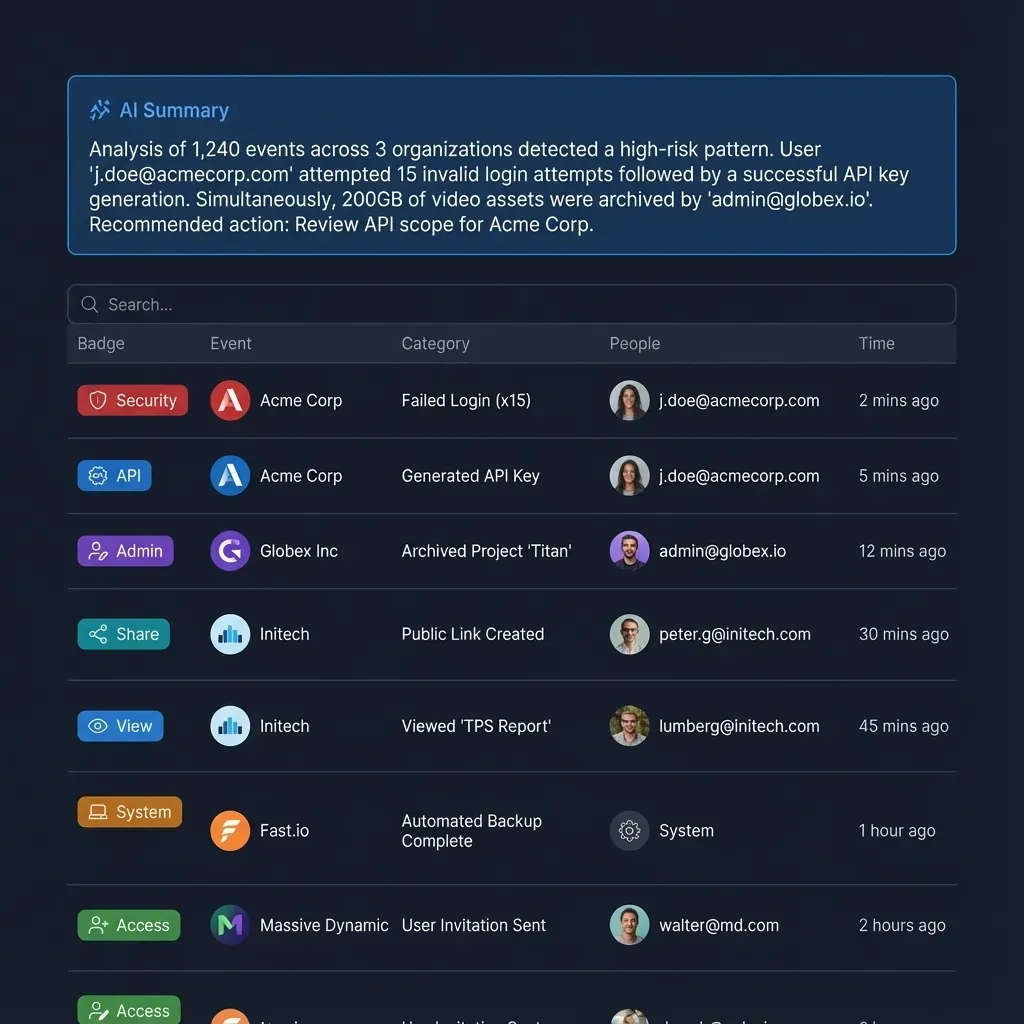
- Detailed Activity Log. A detailed activity log maintains a clear, chronological record of every workspace event, tracking file uploads, version updates, folder creations, and permission modifications across human users and connected software agents.
- Per-File Version History. Every update to a model card, test specification, proposal draft, or compliance matrix is preserved as a distinct file version. Teams can inspect previous revisions, compare drafting changes, or restore prior versions when agency solicitations undergo formal amendments.
- Metadata Views. Teams can transform unstructured contract files, testing logs, and RFP documentation into queryable tabular databases using natural language schema generation with Metadata Views. The system automatically extracts key fields, such as solicitation numbers, evaluation dates, test scores, model identifiers, and compliance clauses, from PDF, Word, and scanned documents without requiring rigid templates or manual data entry.
- Collaborative Notes. Technical writers, evaluation engineers, and compliance leads can co-author test summaries, red-teaming checklists, and proposal narratives directly inside the workspace alongside the benchmark files they document.
- E-Signature. Route non-disclosure agreements, subcontractor certifications, teaming agreements, and evaluation sign-offs directly from the workspace using built-in e-signature. Signers execute documents in sequence or parallel with optional passcode verification, and completed envelopes return directly to the workspace folder with a tamper-evident audit certificate.
- Consolidated Model Context Protocol (MCP) Tools. AI coding tools and automated evaluation scripts can connect to Fast.io workspaces through Streamable HTTP at
https://mcp.fast.io/mcp/toolsfor general applications orhttps://mcp.fast.io/mcp/codefor coding agents. Connected tools can read reference standards, deposit automated benchmark reports, and update compliance matrices within strictly scoped permissions via storage for agents.
Monthly subscriptions start with a 14-day free trial (credit card required). Organizations choose between Starter, Business, and Enterprise tiers on the pricing page depending on storage capacity, member seats, and workspace quotas. Fast.io runs on cloud infrastructure partners, including Google Cloud Platform and Cloudflare, that are certified to industry-leading security standards. All workspace data is encrypted in transit and at rest.
Sources
References used to verify factual claims in this guide.
-
Under Executive Order 14434, the Assistant to the President for Science and Technology must submit proposed legislative language for a federal definition of Super Intelligence within 60 days of September 29, 2026.
-
The NIST AI Risk Management Framework is led by the Information Technology Laboratory AI Program rather than the AI evaluation institute.
Frequently Asked Questions
What are the NIST AI Safety Institute evaluation standards for federal systems?
NIST AI Safety Institute evaluation standards are empirical testing protocols, automated benchmarks, and red-teaming methodologies developed by the U.S. AISI to assess cybersecurity, CBRN risks, and model reliability in advanced AI systems deployed across federal agencies.
How does NIST AISI test super intelligence models before federal deployment?
Under voluntary testing agreements with frontier developers, AISI researchers evaluate model checkpoints in secure, isolated enclaves before public commercial release. Testing combines automated benchmark suites measuring capability limits with expert human red teaming across offensive cyber, biological synthesis, and autonomous agent vectors.
What is the difference between NIST AI RMF and NIST AISI evaluation standards?
The NIST AI Risk Management Framework (AI RMF 1.0) is an organizational guidance document led by NIST's Information Technology Laboratory that establishes policy functions (Govern, Map, Measure, Manage). AISI evaluation standards are empirical testing protocols developed to measure model weights, attack success rates, and dual-use hazards directly.
Does Executive Order 14434 require commercial software vendors to change their product names?
No. Executive Order 14434 directs executive departments and agencies to use Super Intelligence and SI across non-statutory federal documents. It creates no enforceable right or benefit at law and imposes no mandate compelling private commercial software companies to rebrand their commercial products.
What are the primary risk vectors evaluated during federal red teaming?
Federal red teaming overseen by NIST AISI focuses on four core vectors: offensive and defensive cybersecurity capabilities, dual-use chemical, biological, radiological, and nuclear (CBRN) uplift, autonomous agent capabilities and safeguard evasion, and model reliability under operational stress.
Is there a statutory definition of Super Intelligence in the United States Code?
No statutory definition of Super Intelligence exists in the United States Code as of October 2026. Executive Order 14434 establishes an administrative definition for executive agencies by linking Super Intelligence directly to the existing statutory definition of artificial intelligence in 15 U.S.C. 9401(3). Only an Act of Congress can amend federal statutes.
Related Resources

Centralize Federal AI Compliance and Evaluation Records
Manage model cards, technical benchmark logs, and agency deliverables in a secure workspace with granular permissions and a detailed activity log. Monthly plans start with a 14-day free trial.