Best Tools for AI Agent Testing and Evaluation
Agent testing tools automate the evaluation of agent performance, checking for accuracy, loop detection, and goal completion. AI agents are probabilistic and dynamic, so standard unit tests often miss their complex behaviors. This guide reviews the top frameworks for evaluating LLM agents. It covers best tools for ai agent testing with practical examples.


What to check before scaling best tools for ai agent testing
Selecting the right testing tool depends on your specific needs, whether you require deep observability, CI/CD integration, or a secure sandbox for file operations. The table below compares the leading options for testing AI agents.
Helpful references: Fastio Workspaces, Fastio Collaboration, and Fastio AI.
Related guides
- Best Tools for AI Agent Evaluation (Evals)Evaluating AI agents is no longer about simple "vibe checks." As agents move from prototypes to production, engineering...
- Best AI Dashboard Builders for Agents: Top 8 Tools (2026)AI dashboard builders provide visual interfaces and no-code tools to design, deploy, and customize user-facing...
- 7 Best AI Agent Monitoring Tools for ProductionAI agents introduce new failure modes that traditional APM tools can't catch, from infinite reasoning loops to...
- Best Observability Tools for AI Agents: Monitor & DebugAI agent observability tools provide visibility into agent reasoning, tool usage, and cost per run. Without them,...
- How to Evaluate AI Agents: A Comprehensive FrameworkAI agent evaluation is the systematic process of measuring an autonomous agent's performance, reliability, and safety...
- How to Build a Prompt Regression Testing Pipeline for AI AgentsA single token change in a system prompt can shift agent behavior as dramatically as a logic rewrite. Catching those...
More on this subject: Agent Observability and Evaluation (21 guides)
How We Evaluated These Tools
We tested these platforms based on four criteria for modern agentic workflows:
- Agent-Specific Metrics: Does the tool measure agent-specific failures like loops, tool misuse, and reasoning drift? Standard LLM metrics (like perplexity) are often not enough for autonomous agents.
- CI/CD Integration: Can the evaluation run automatically in a GitHub Action or GitLab pipeline? Continuous evaluation is the only way to catch regressions in probabilistic systems.
- Observability: How deep is the trace? We looked for tools that show the full chain of thought, not just the final input and output.
- Sandboxing Capabilities: Does the tool provide a safe environment for the agent to execute code or modify files without risking production data?
1. DeepEval
DeepEval is an open-source evaluation framework that applies unit testing principles to LLM agents. It integrates directly with Pytest, making it a natural choice for Python developers who want to write test cases for their agents in a familiar syntax.
Key Strengths:
- Pytest Integration: Runs evaluations as standard tests, fitting into existing CI/CD pipelines.
- Custom Metrics: Offers over 30 built-in metrics, including "Faithfulness" and "Answer Relevancy," plus the ability to define custom logic.
- Modular Design: Works with any LLM, not tied to a specific framework like LangChain.
Limitations:
- Setup Complexity: Requires writing code to define test cases, which may not suit non-technical product managers.
- Local Resource Heavy: Running comprehensive evaluations locally can be resource-intensive depending on the model used.
Best For: Engineering teams who want to treat agent evaluation like standard unit testing.
Pricing: Open Source (Apache 2.0); Confident AI offers a paid cloud platform.
2. Ragas
Ragas (Retrieval Augmented Generation Assessment) is a specialized framework built to evaluate RAG pipelines. Since many agents rely on RAG for knowledge, Ragas is helpful for isolating whether an error comes from the retrieval step or the generation step.
Key Strengths:
- Component-Level Scoring: Separately scores retrieval precision (did we get the right docs?) and generation faithfulness (did the LLM use them correctly?).
- Synthetic Data Generation: Can generate test datasets from your own document corpus, saving hours of manual test writing.
- Framework Agnostic: works alongside LlamaIndex and LangChain but works independently.
Limitations:
- Narrow Focus: Built for RAG, less effective for evaluating tool use or multi-step agent planning.
- Metric Abstractness: Some scores can feel abstract without digging into the underlying calculation.
Best For: Agents that rely on knowledge retrieval and document processing.
Pricing: Open Source (Apache 2.0).
3. Fastio
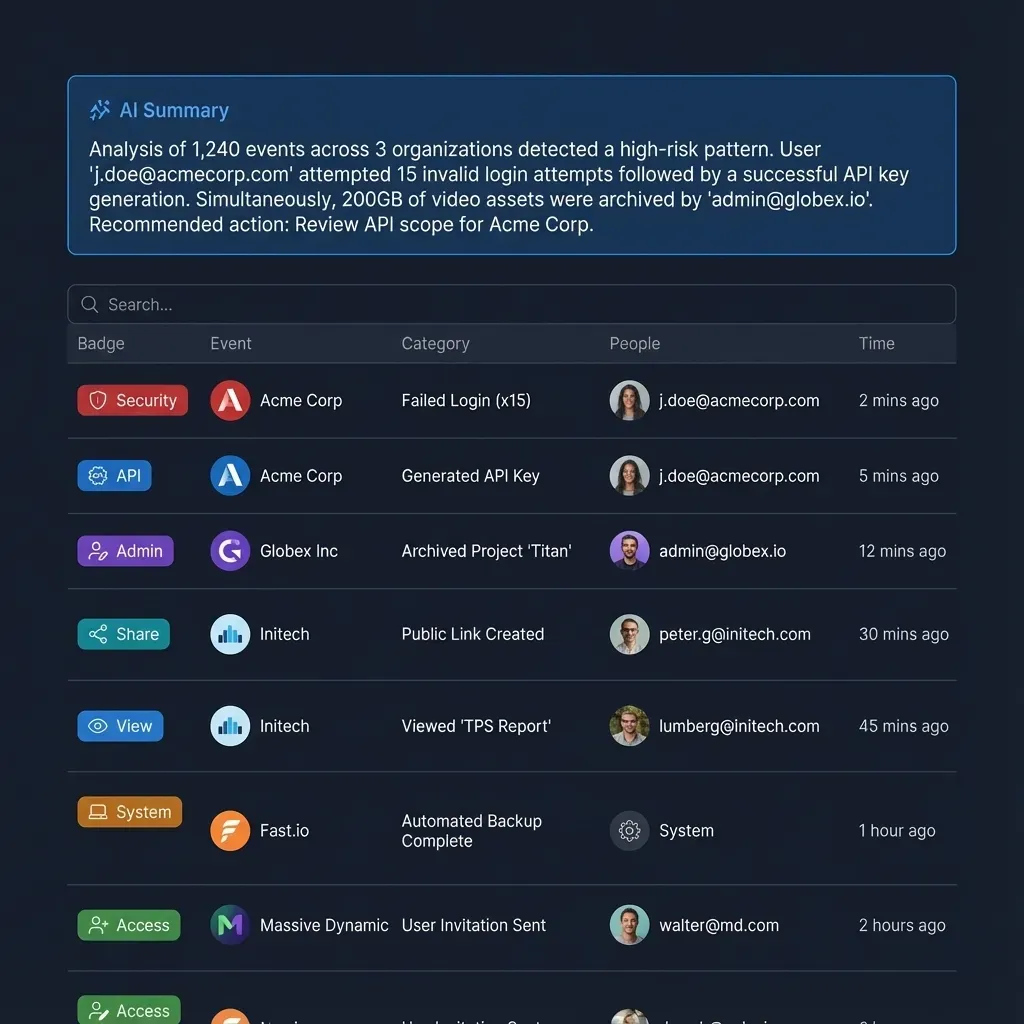
Fastio provides the persistent infrastructure agents need to be tested safely. While not a metrics calculator, it offers the sandbox environment where agents can read, write, and manipulate files during tests without affecting production systems. Its detailed audit logs also serve as a source of truth for agent actions.
Key Strengths:
- Persistent Sandboxes: Provides generous storage per workspace, allowing agents to have "memory" across test runs.
- Consolidated MCP toolset: Comes with a full Model Context Protocol server, giving agents standard interfaces for file I/O, search, and management.
- State Verification: You can poll the realtime activity feed or listen to the WebSocket events feed to trigger validation scripts whenever an agent modifies a file, closing the loop on action-level testing.
Limitations:
- Not a Metric Tool: Does not calculate precision/recall scores; it provides the environment for the tests.
- Integration Required: Works best alongside a scoring framework like DeepEval or Pytest.
Best For: Agent sandboxing, stateful file testing, and multi-agent coordination checks.
Pricing: 14-day Business Trial, card required; see /pricing/. Paid plans start with Starter at $9.99/mo.


Give Your AI Agents Persistent Storage
Fastio provides persistent storage and a secure sandbox for AI agents. Get generous storage and start testing safely today.
4. LangSmith
Built by the team behind LangChain, LangSmith is the gold standard for full-stack observability. It does a good job visualizing the complex, non-deterministic paths an agent takes. If your agent is stuck in a loop or calling the wrong tool, LangSmith's traces make it immediately obvious.
Key Strengths:
- Trace Visualization: Strong UI for inspecting every step of an agent's reasoning chain.
- Prompt Playground: Tweak prompts and re-run specific traces to see if the output improves.
- Dataset Management: Built-in tools for curating golden datasets and running bulk evaluations against them.
Limitations:
- LangChain Bias: While usable with other frameworks, the integration is tightest with LangChain.
- Cost: Usage-based pricing can scale up quickly for high-volume testing environments.
Best For: Teams using LangChain who need deep debugging and visual tracing.
Pricing: Free tier available; paid plans based on trace volume.
5. Deepchecks
Deepchecks started as a testing tool for traditional machine learning models and has expanded into LLM agents. It focuses on continuous testing and monitoring in production, helping teams catch "drift," which occurs when an agent's performance degrades over time due to new data patterns.
Key Strengths:
- Drift Detection: Good at identifying when production data deviates from your test set.
- Pre-built Checks: Comes with a large library of checks for hallucinations, toxicity, and leakage.
- Comparison Views: Makes it easy to compare the performance of two different model versions side-by-side.
Limitations:
- Enterprise Focus: The UI and feature set are geared toward larger teams; individual developers might find it overkill.
- Configuration: Setting up custom suites can require some initial configuration work.
Best For: Production monitoring and regression testing for enterprise agents.
Pricing: Tiered SaaS pricing; free community version available.
6. Promptfoo
Promptfoo is a CLI-first evaluation tool popular with developers who prefer the command line over web UIs. It is designed to be fast, local, and diff-friendly. It does well at "red teaming" and comparative testing, letting you run the same prompt across ten different models instantly.
Key Strengths:
- Developer Experience: Everything is configured via YAML and run from the terminal.
- Matrix Testing: Strong ability to test combinations of prompts, variables, and models.
- Local First: No data needs to leave your machine unless you want it to.
Limitations:
- Limited Visualization: The web view is functional but less rich than LangSmith or Arize.
- Less "Agentic": Stronger on single-turn prompt evaluation than multi-step agent flows.
Best For: Rapid iteration on prompts and model selection.
Pricing: Open Source (MIT); Cloud version available.
7. Arize Phoenix
Arize Phoenix provides open-source observability for LLMs. It focuses on the harder part of evaluation: visualizing embedding clusters and tracing execution. It works well for troubleshooting retrieval issues in RAG systems by visualizing where retrieved documents sit in vector space.
Key Strengths:
- Embedding Visualization: Unique tools for visualizing vector clusters to understand retrieval failures.
- Open Source: You can run the entire observability stack locally in a Docker container.
- Trace Analysis: Good support for OpenInference standards.
Limitations:
- Learning Curve: The interface is data-science heavy and may be intimidating for generalist developers.
- Setup: Self-hosting requires managing infrastructure.
Best For: Data science teams doing deep forensic analysis on RAG performance.
Pricing: Open Source (Apache 2.0); Arize Cloud available.
Which Tool Should You Choose?
The "best" tool depends on where you are in the development lifecycle:
- For pure development: Start with Promptfoo for prompt iteration and DeepEval for writing your first unit tests.
- For complex agents: If you have multi-step agents manipulating files, you need Fastio for the sandbox and LangSmith to trace the logic.
- For production: Once deployed, Deepchecks or Arize provide the monitoring to keep your agent reliable. Most mature teams use a combination: Fastio for the environment, DeepEval for the CI/CD pipeline, and LangSmith for debugging. Consider how this fits into your broader workflow and what matters most for your team. The right choice depends on your specific requirements: file types, team size, security needs, and how you collaborate with external partners. Testing with a free account is the fast way to know if a tool works for you.
Sources
References used to verify factual claims in this guide.
-
DeepEval offers over 30 built-in metrics including Faithfulness and Answer Relevancy
-
DeepEval, Ragas, and Arize Phoenix are open source under Apache 2.0 license
-
Fastio provides generous storage per workspace allowing agents to have memory across test runs
-
Fastio MCP server comes with a consolidated MCP toolset giving agents standard interfaces for file I/O, search, and management
-
Arize offers a paid cloud platform Arize Cloud available
-
agent error in step 1 can compound into major failure in step 5 requiring traces to debug
Frequently Asked Questions
How do you test an AI agent?
Testing an AI agent involves three layers: unit tests for individual functions, evaluation of the reasoning trace (using tools like LangSmith), and end-to-end task completion checks in a sandbox environment (like Fastio). You must test for both correct outputs and correct process.
What is Ragas in AI testing?
Ragas (Retrieval Augmented Generation Assessment) is a framework for evaluating RAG pipelines. It uses an 'LLM-as-a-judge' approach to score your agent on metrics like faithfulness (did it make things up?) and answer relevance (did it answer the user's question?).
Why is agent testing harder than software testing?
Agent testing is harder because LLMs are probabilistic, meaning the same input can produce different outputs. Also, agents take autonomous actions, meaning a small error in step 1 can compound into a major failure in step 5, requiring traces to debug.
Related Resources

Give Your AI Agents Persistent Storage
Fastio provides persistent storage and a secure sandbox for AI agents. Get generous storage and start testing safely today.