Best MCP Tools for AI Agent Development in 2026
MCP tools extend AI agent capabilities through the Model Context Protocol standard. This guide compares essential MCP tools across file storage, browser automation, API integrations, code execution, and web scraping to help you build production-ready agents.


What Are MCP Tools?
MCP tools are software components that extend AI agent capabilities through the Model Context Protocol (MCP) standard. Think of them as plugins that let your AI assistant interact with external systems, querying databases, calling APIs, browsing the web, or managing files. Each tool is uniquely identified by a name and includes metadata describing its schema. Tools in MCP are designed to be model-controlled, meaning the language model discovers and invokes them automatically based on contextual understanding and user prompts. For example, if a user asks "What's the temperature in Tokyo right now?" the model might invoke a weather API tool, retrieve current data, and integrate it into a natural response. Research on AI agent workflows shows projects typically use multiple MCP tools to accomplish tasks. Tool-using agents complete more tasks successfully than agents without external integrations. This makes choosing the right MCP tools critical for building capable agents. The Model Context Protocol defines the message format for communication between clients and servers, including tool discovery, invocation, and response handling. Pre-built MCP servers are available for popular enterprise systems like Google Drive, Slack, GitHub, Git, Postgres, and Puppeteer, dramatically reducing integration effort.
Related guides
- Best MCP Clients for 2026: Connect Your AI to Any ToolMCP clients are AI interfaces like Claude Desktop, Cursor, or specialized IDEs that implement the Model Context...
- MCP Server Examples: Practical Implementations for AI AgentsThe Model Context Protocol ecosystem has grown past 1,000 public servers, but finding the right implementation for your...
- How to Connect AI Agents to Google Docs with MCPAn MCP server for Google Docs exposes document read, write, and search capabilities to AI agents through the Model...
- How to Use MCP for Agent WorkflowsMCP (Model Context Protocol) standardizes tool calls in multi-agent systems. This guide covers how to use MCP for agent...
- How to Connect AI Agents to Azure Blob Storage via MCPAn Azure Blob Storage MCP server exposes cloud containers and object storage to AI agents using standard Model Context...
- Box MCP Server Setup and AI Agent Storage IntegrationA Box MCP server allows AI agents to interact with Box enterprise files and folders using the standardized Model...
More on this subject: MCP and Model Context Protocol (238 guides)
How We Evaluated These MCP Tools
We assessed MCP tools based on five criteria:
Integration Ease: How quickly can you integrate this tool into an existing agent? We prioritized tools with clear documentation, SDK support, and minimal configuration.
Reliability: Production-ready tools need error handling, retry logic, and transparent failure modes. Tools that return clear error codes help models decide how to proceed.
Security: Tools must validate inputs to prevent misuse, and sensitive data (API keys, credentials) should be managed securely. We strongly recommend keeping a human in the loop for operations that modify external systems.
Performance: Response time matters when agents need real-time data. We evaluated typical latency and throughput for each tool category.
Flexibility: The best tools work across multiple LLMs (Claude, GPT-4, Gemini) and support diverse use cases without vendor lock-in.
1. Fastio MCP Server - File Storage & RAG
Fastio provides a comprehensive file management MCP server with a consolidated MCP toolset. Designed specifically for AI agents, it covers file CRUD operations, workspace management, sharing, permissions, activity tracking, and built-in RAG (Retrieval-Augmented Generation).
Key strengths:
- Consolidated MCP toolset via Streamable HTTP or SSE - comprehensive tools for file operations
- Built-in Intelligence Mode - once enabled for the workspace, indexes files for semantic search and RAG with citations
- Ownership transfer - agents build workspaces and shares, then transfer to human users while keeping admin access
- Business Trial - 14-day trial, card required; see /pricing/
- Persistent storage - files don't expire, unlike ephemeral assistant APIs
- Multi-LLM support - works with Claude, GPT-4, Gemini, LLaMA, and local models
- Activity and Events - realtime activity feed and WebSocket events feed to track file changes
Limitations:
- Focused on file storage and collaboration (not a general-purpose database)
Best for: Agents that need to store outputs, share deliverables with clients, or query document knowledge bases. Ideal for document processing workflows, report generation, and human-agent collaboration scenarios.
Pricing: Starter ($9.99/mo), Business ($49.99/mo), and Enterprise ($199.99/mo) plans with usage-based credits, along with a 14-day Business Trial requiring a credit card. Documentation: fast.io/storage-for-agents
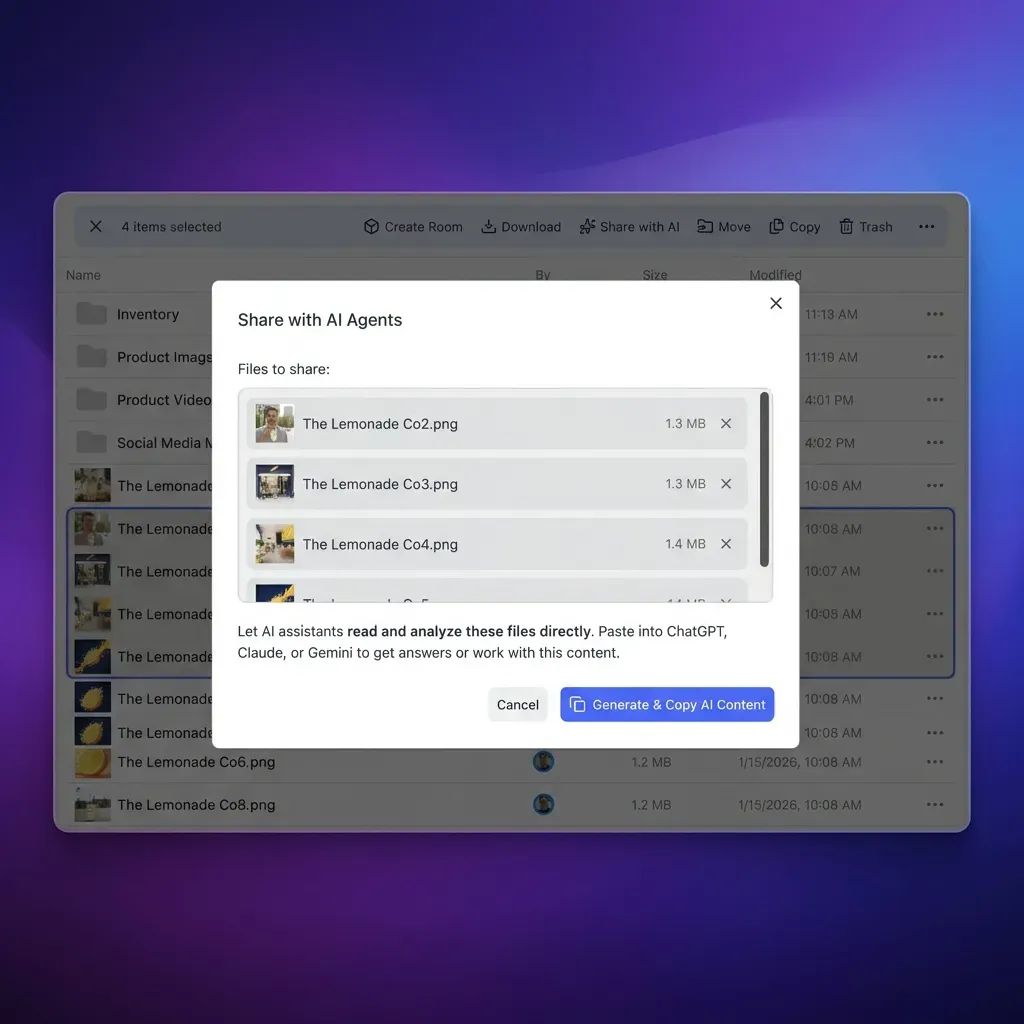


Store AI agent outputs with the most comprehensive MCP server
Fastio provides a consolidated toolset for file storage, RAG, and collaboration.
2. Playwright MCP Server – Browser Automation
The Playwright MCP Server is the most popular browser automation tool with 12,000+ GitHub stars. It enables AI agents to interact with web pages, perform scraping, and automate browser-based workflows.
Key strengths:
- Industry-leading browser automation library
- Supports Chromium, Firefox, and WebKit
- Handles JavaScript-heavy sites and dynamic content
- Built-in screenshot and PDF generation
- Network interception for testing
Limitations:
- Requires local browser installation
- Resource-intensive for high-volume scraping
- Complex for simple tasks (consider DuckDuckGo for basic searches)
Best for: Web testing, form filling, screenshot capture, single-page app interaction, and data extraction from JavaScript-rendered sites. Consider how this fits into your broader workflow and what matters most for your team. The right choice depends on your specific requirements: file types, team size, security needs, and how you collaborate with external partners. Testing with a free account is the fast way to know if a tool works for you.
3. Rube – 500+ App Integrations
Rube is a hosted MCP server that bundles integrations with popular tools like Slack, Gmail, Facebook, Notion, and many other apps. It's the fast way to connect agents to your existing toolchain.
Key strengths:
- Instantly unlock 500+ apps inside AI chat tools
- No server setup or maintenance
- OAuth flows handled for you
- Pre-built integrations with CRMs, calendars, project management, communication platforms
Limitations:
- Third-party hosted service (data passes through Rube's infrastructure)
- Pricing scales with usage
Best for: Agents that need to trigger workflows across multiple SaaS platforms (e.g., "When this document is uploaded, create a Slack thread and a Notion page").
4. PipedreamHQ – 2,500 APIs with 8,000+ Tools
PipedreamHQ connects with 2,500 APIs and provides 8,000+ prebuilt tools. It's a workflow platform that lets agents trigger multi-step automations across services.
Key strengths:
- Massive API library (Stripe, Shopify, Salesforce, HubSpot, etc.)
- Visual workflow builder
- Manages servers for your users
- Built-in event sources for triggering workflows
Limitations:
- Learning curve for complex workflows
- Execution time limits on free tier
Best for: Business automation agents that need to orchestrate actions across CRMs, payment processors, marketing platforms, and analytics tools. Consider how this fits into your broader workflow and what matters most for your team. The right choice depends on your specific requirements: file types, team size, security needs, and how you collaborate with external partners. Testing with a free account is the fast way to know if a tool works for you.
5. GitHub MCP – Code Repository Operations
GitHub's MCP implementation lets agents execute, test, and commit code changes autonomously inside repositories.
Key strengths:
- Read/write repository access
- Pull request creation and review
- Issue management
- GitHub Actions integration
- Organization and team management
Limitations:
- Requires careful permission scoping
- Always keep a human in the loop for merge operations
- Rate limits apply to API calls
Best for: Coding agents that generate pull requests, review code, run tests, or manage project issues. Consider how this fits into your broader workflow and what matters most for your team. The right choice depends on your specific requirements: file types, team size, security needs, and how you collaborate with external partners. Testing with a free account is the fast way to know if a tool works for you.
6. Run Python MCP Server – Sandboxed Code Execution
Run Python allows secure execution of arbitrary Python code in a sandbox. This is essential for agents that need to perform calculations, data transformations, or generate visualizations.
Key strengths:
- Safe sandboxed environment
- Access to popular data science libraries (pandas, numpy, matplotlib)
- Supports script execution and result capture
Limitations:
- Python-only (no JavaScript, R, or other languages)
- Timeout limits prevent infinite loops
- Limited file system access
Best for: Data analysis agents, report generation, computational tasks, and quick prototyping. Consider how this fits into your broader workflow and what matters most for your team. The right choice depends on your specific requirements: file types, team size, security needs, and how you collaborate with external partners. Testing with a free account is the fast way to know if a tool works for you.
7. GPT Researcher MCP – Research & Synthesis
GPT Researcher is engineered for agents that browse, summarize, and synthesize information independently. It automates multi-source research and generates comprehensive reports.
Key strengths:
- Multi-source browsing and scraping
- Automatic citation tracking
- Generates structured reports
- Configurable research depth
Limitations:
- Slower for simple lookups (use DuckDuckGo for single queries)
- Requires credits or API keys for web access
Best for: Agents writing research reports, competitive analysis, or literature reviews. As your file library grows, finding what you need becomes the bottleneck. Folder hierarchies help, but they break down at scale. AI-powered semantic search lets you describe what you are looking for in plain language rather than remembering exact filenames or folder paths.
8. DuckDuckGo MCP – Secure Web Search
DuckDuckGo provides a secure and straightforward way for AI agents to perform web searches and fetch content from URLs without tracking.
Key strengths:
- Privacy-focused (no tracking)
- Fast response time for simple queries
- No API key required for basic searches
- Clean text extraction from URLs
Limitations:
- Less comprehensive than Google for niche queries
- No advanced search operators
Best for: Agents that need quick fact-checking, current events, or general web lookups. As your file library grows, finding what you need becomes the bottleneck. Folder hierarchies help, but they break down at scale. AI-powered semantic search lets you describe what you are looking for in plain language rather than remembering exact filenames or folder paths.
9. FireCrawl MCP – Web Scraping & Content Extraction
FireCrawl assists with web scraping, crawling, and content extraction. It lets AI agents fetch content, dig through pages, and parse structured data.
Key strengths:
- Handles pagination and multi-page crawling
- Structured data extraction
- Respects robots.txt
- Rate limiting and politeness built-in
Limitations:
- May struggle with heavily obfuscated sites
- CAPTCHAs can block automated access
Best for: Agents building datasets from public web sources, monitoring price changes, or archiving content. Consider how this fits into your broader workflow and what matters most for your team. The right choice depends on your specific requirements: file types, team size, security needs, and how you collaborate with external partners. Testing with a free account is the fast way to know if a tool works for you.
10. n8n MCP Server – Workflow Orchestration
n8n's MCP server lets agents trigger workflows, integrate systems, and orchestrate logic flows. It's a low-code automation platform with visual workflow design.
Key strengths:
- Visual workflow editor
- 300+ integrations
- Self-hosted or cloud options
- Custom function nodes for JavaScript
Limitations:
- Requires setup and maintenance
- Complex workflows can be fragile
Best for: Agents that trigger multi-step business processes (e.g., "When invoice is uploaded, extract data, create QuickBooks entry, send Slack notification"). Your file workflow should match how your team actually works, not force you into rigid processes. Look for flexibility in how you organize, review, and deliver files. The best tools adapt to your existing workflow rather than requiring you to adapt to theirs.
11. Postgres MCP – Database Queries
Postgres MCP provides read/write access to PostgreSQL databases, enabling agents to query data, insert records, and manage schemas.
Key strengths:
- Full SQL query support
- Transaction management
- Schema introspection
- Connection pooling
Limitations:
- Requires careful permission scoping (read-only recommended for most agents)
- Always validate agent-generated SQL to prevent injection
- Database performance depends on query complexity
Best for: Analytics agents, reporting bots, or agents that need to pull structured data from databases. Consider how this fits into your broader workflow and what matters most for your team. The right choice depends on your specific requirements: file types, team size, security needs, and how you collaborate with external partners. Testing with a free account is the fast way to know if a tool works for you.
12. Slack MCP – Team Communication
Slack MCP enables agents to read channels, post messages, manage threads, and respond to mentions.
Key strengths:
- Full Slack API access
- Bot user integration
- Interactive messages and buttons
- File uploads and sharing
Limitations:
- Requires Slack workspace admin approval
- Rate limits on message posting
Best for: Notification bots, support agents that answer questions in Slack channels, or agents that summarize thread discussions. Effective team collaboration starts with shared context. When everyone works from the same organized workspace, you eliminate the confusion of scattered files and version conflicts. Real-time presence indicators and threaded comments keep discussions focused and productive.
13. Google Drive MCP – Cloud File Access
Google Drive MCP lets agents read, write, and organize files in Google Drive without manual downloads.
Key strengths:
- OAuth integration
- Folder and file management
- Sharing and permissions control
- Search across Drive contents
Limitations:
- Requires user authentication
- Google API quotas apply
Best for: Agents that need to pull reports from shared drives, organize files, or works alongside Google Workspace. Cloud storage architecture matters more than most people realize. Sync-based platforms require local copies of every file, consuming disk space and creating version conflicts. Cloud-native platforms stream files on demand, so your team accesses what they need without downloading entire folder trees.
14. Puppeteer MCP – Headless Browser Control
Puppeteer is another browser automation tool, lighter-weight than Playwright but Chromium-only.
Key strengths:
- Smaller footprint than Playwright
- Fast for simple tasks
- Good DevTools protocol access
Limitations:
- Chromium-only (no Firefox or WebKit)
- Less feature-rich than Playwright
Best for: Lightweight scraping and screenshot tasks where cross-browser support isn't needed. Consider how this fits into your broader workflow and what matters most for your team. The right choice depends on your specific requirements: file types, team size, security needs, and how you collaborate with external partners. Testing with a free account is the fast way to know if a tool works for you.
15. NCP - MCP Orchestrator
NCP orchestrates your entire MCP ecosystem through intelligent discovery, eliminating token overhead while maintaining high accuracy.
Key strengths:
- Smart tool discovery
- Reduces context window consumption
- Routes requests to appropriate MCP servers
- Performance optimization
Limitations:
- Adds abstraction layer
- Best for large multi-tool setups
Best for: Complex agents using multiple MCP tools that need efficient routing and context management. Consider how this fits into your broader workflow and what matters most for your team. The right choice depends on your specific requirements: file types, team size, security needs, and how you collaborate with external partners. Testing with a free account is the fast way to know if a tool works for you.
Comparison Table: MCP Tools at a Glance
Choosing the Right MCP Tools for Your Project
Start with your agent's core task. If your agent primarily handles documents, prioritize file storage tools like Fastio MCP Server. For web research agents, combine DuckDuckGo (quick lookups) with GPT Researcher (deep dives).
Layer tools strategically. Production agents typically need several MCP tools:
- Storage – Where does output live? (Fastio, Google Drive)
- Data retrieval – How does the agent get information? (DuckDuckGo, Postgres)
- Automation – What actions can it trigger? (n8n, Slack, GitHub)
- Computation – Does it need to run code? (Run Python)
- Browser interaction – Does it need to interact with web apps? (Playwright)
Prioritize security. Always keep a human in the loop for destructive operations. Use read-only database connections where possible. Validate all agent-generated code before execution. Set expiration dates on shared links.
Test with small scopes first. Grant minimal permissions initially. Expand access once you've validated agent behavior.
Setting Up Your First MCP Tool
Step 1: Choose an MCP client. Popular options include Claude Desktop, VS Code with Copilot, Cursor, or Devin Desktop (formerly Windsurf). Each supports MCP servers through configuration files.
Step 2: Install your MCP server. Most MCP servers are npm packages or Python modules. For example:
npm install @modelcontextprotocol/server-playwright
Step 3: Configure the client. Add the MCP server to your client's config file (usually claude_desktop_config.json or VS Code settings). Specify the transport method (stdio, HTTP, or SSE) and any required environment variables.
Step 4: Test tool discovery. Ask your agent to list available tools. You should see the MCP server's tools appear in the response.
Step 5: Invoke a tool. Try a simple operation like "Search DuckDuckGo for MCP tools" or "Create a file in Fastio."
For detailed setup guides, see the Claude MCP Integration Guide and VS Code MCP documentation.
Common MCP Tool Integration Challenges
Authentication complexity. Many MCP tools require OAuth flows or API keys. Store credentials securely using environment variables, never hardcode them.
Rate limiting. APIs have usage quotas. Implement retry logic with exponential backoff. Cache responses when possible to reduce API calls.
Error handling. Tools fail for many reasons: network issues, invalid inputs, quota exceeded. Design agents to handle errors gracefully and inform users when manual intervention is needed.
Context window consumption. Large tool responses (e.g., entire web pages) can consume significant token budget. Use streaming responses when available, or summarize results before returning to the agent.
Tool selection ambiguity. If you have 10+ tools, the model might choose the wrong one. Provide clear tool descriptions and examples to guide selection.
Future of MCP Tools
The MCP ecosystem is growing rapidly. Expect to see:
Hosted MCP services. Providers offering managed MCP servers with built-in rate limiting, caching, and observability.
Multi-modal tools. MCP tools that handle images, audio, and video natively, not just text.
Agent-to-agent communication. MCP tools that enable agents to collaborate, sharing context and delegating subtasks.
Industry-specific toolkits. Vertical MCP tool bundles for healthcare, legal, finance, and other regulated industries.
Better orchestration. Tools like NCP will become standard for managing large tool collections efficiently. Consider how this fits into your broader workflow and what matters most for your team. The right choice depends on your specific requirements: file types, team size, security needs, and how you collaborate with external partners. Testing with a free account is the fast way to know if a tool works for you.
Sources
References used to verify factual claims in this guide.
-
Fastio storage for agents provides a consolidated file management MCP server and team plans with seats included.
-
Playwright MCP Server is the most popular browser automation tool with 12,000+ GitHub stars.
-
PipedreamHQ connects with 2,500 APIs and provides 8,000+ prebuilt tools.
-
Best tools work across multiple LLMs Claude GPT-4 Gemini and support diverse use cases without vendor lock-in MCP tools LLM-agnostic Claude GPT-4 Gemini LLaMA local models.
-
Setting Up Your First MCP Tool Step 1 Choose an MCP client Step 2 Install your MCP server Step 3 Configure the client Step 4 Test tool discovery Step 5 Invoke a tool.
-
If you have 10+ tools, the model might choose the wrong one due to tool selection ambiguity.
Frequently Asked Questions
What tools work with MCP?
MCP tools include file storage (Fastio with a consolidated toolset), browser automation (Playwright, Puppeteer), web search (DuckDuckGo), API integrations (Rube app integrations, PipedreamHQ with 2,500 APIs), code execution (Run Python), research (GPT Researcher), web scraping (FireCrawl), workflow automation (n8n), database access (Postgres), team communication (Slack), and cloud storage (Google Drive). The MCP ecosystem includes hundreds of tools across these categories.
How do I add tools to Claude?
To add MCP tools to Claude Desktop, install the MCP server (usually an npm package or Python module), then add it to your claude_desktop_config.json file with the transport method (stdio, HTTP, or SSE) and any required environment variables. Claude will automatically discover available tools when the MCP server is configured correctly. For detailed setup, see the Claude MCP Integration Guide.
What MCP servers are available?
Popular MCP servers include Fastio (consolidated toolset), Playwright (browser automation), Rube (app integrations), PipedreamHQ (2,500 APIs), GitHub (code repositories), Run Python (sandboxed execution), GPT Researcher (multi-source research), DuckDuckGo (web search), FireCrawl (web scraping), n8n (workflow orchestration), Postgres (database queries), Slack (team messaging), Google Drive (cloud files), and NCP (MCP orchestration). The Awesome MCP Servers list on GitHub tracks hundreds more.
Can I use multiple MCP tools together?
Yes. AI projects typically use multiple MCP tools together. For example, an agent might use DuckDuckGo to research a topic, Run Python to analyze data, Fastio to store the output, and Slack to notify the team. MCP tools are designed to work together through the Model Context Protocol standard. Use orchestration tools like NCP to manage large multi-tool setups efficiently.
Are MCP tools secure for production use?
MCP tools can be production-ready if you follow security best practices: always keep a human in the loop for destructive operations, validate all agent-generated inputs to prevent injection attacks, use read-only permissions where possible, store API keys in environment variables (never hardcode), implement rate limiting to prevent abuse, and audit agent actions regularly. The MCP specification recommends human approval for sensitive tool invocations.
How do MCP tools compare to function calling?
MCP tools are built on the Model Context Protocol standard, which provides a unified interface for tool discovery, invocation, and response handling across different LLMs and clients. Function calling is LLM-specific (each provider has its own format). MCP tools are portable across Claude, GPT-4, Gemini, and other models, while function calling implementations vary by provider. MCP also handles session state, streaming, and complex multi-turn interactions more elegantly than basic function calling.
Do MCP tools work with local models?
Yes. MCP tools are LLM-agnostic and work with Claude, GPT-4, Gemini, LLaMA, and local models. The Model Context Protocol defines the client-server communication, not the underlying language model. Any MCP-compatible client can use MCP tools, regardless of which LLM powers it. This makes MCP tools future-proof as new models emerge.
What's the difference between MCP servers and MCP tools?
An MCP server is a service that exposes multiple MCP tools. For example, the Fastio MCP server provides a consolidated toolset for file operations (upload, download, search, share, etc.). Think of the server as the platform and tools as individual functions. One MCP server can expose dozens or even hundreds of tools.
How much do MCP tools cost?
Many MCP tools are free and open source (Playwright, Run Python, DuckDuckGo, GitHub). Some require API credits (GPT Researcher, FireCrawl) or paid plans (Rube, PipedreamHQ cloud). Fastio offers a 14-day Business Trial requiring a credit card, followed by paid plans starting at $9.99/mo. Costs vary widely based on usage and tool complexity.
Can I build custom MCP tools?
Yes. The Model Context Protocol specification is open, and you can build custom MCP servers using the Python SDK, TypeScript SDK, or other language implementations. Define your tool schema, implement the tool logic, and expose it through an MCP server. This lets you integrate proprietary systems or custom workflows into your agent.
Related Resources

Store AI agent outputs with the most comprehensive MCP server
Fastio provides a consolidated toolset for file storage, RAG, and collaboration.